Dan Rose held leadership roles at Amazon and Facebook, later chaired Coatue Ventures, and now describes himself as a senior advisor at Coatue. These lessons draw on his first-person threads and recorded interviews. — Dan Rose — Author Bio.
On Leadership and Career Growth
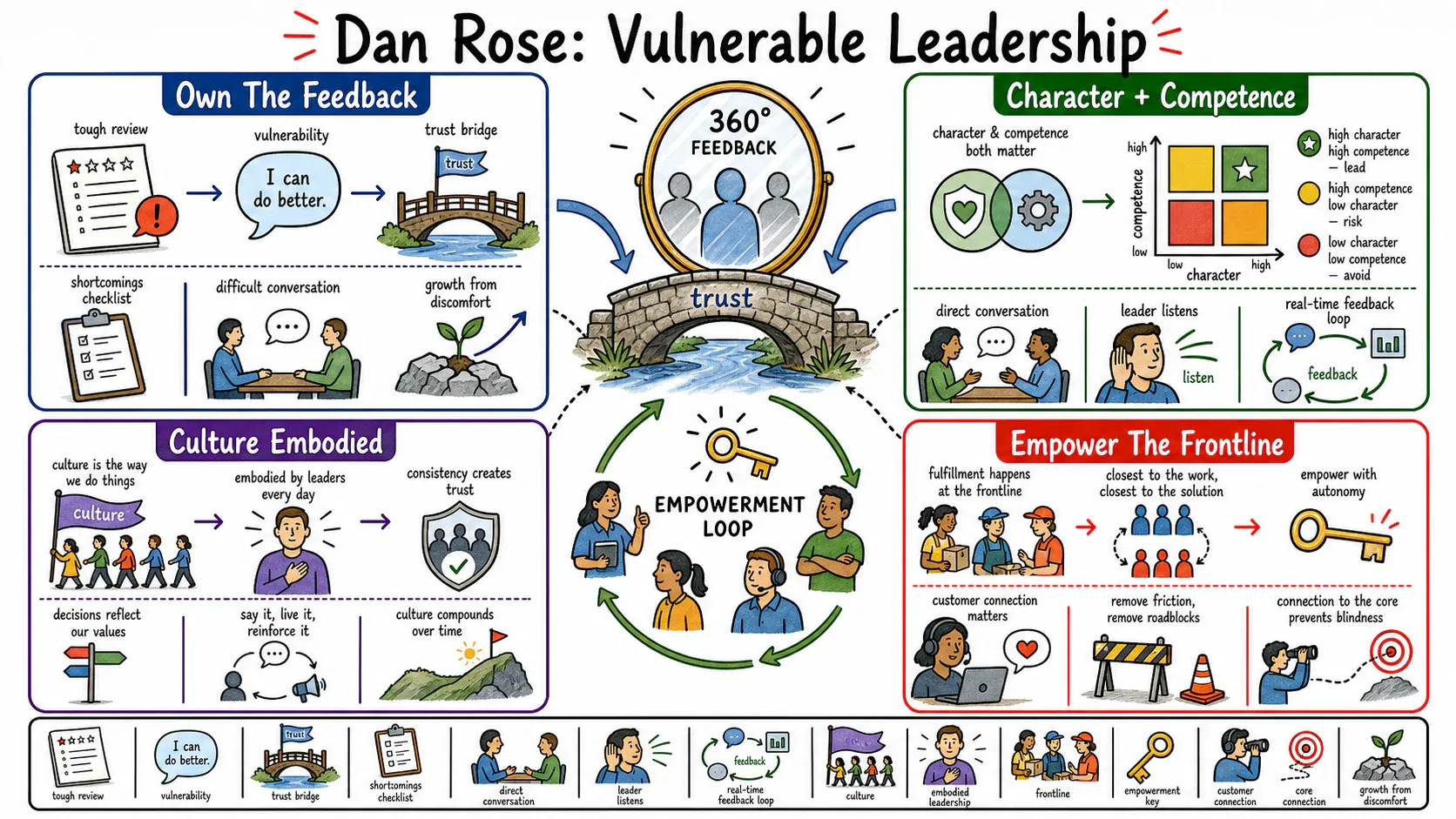
- Vulnerability can rebuild trust: After colleagues described him as political and untrustworthy in a 360 review, Rose shared the feedback and asked for help recognizing the behavior. — Dan Rose — 360 Review Thread.
- Lead difficult feedback with vulnerability: Rose says sharing his own painful review before delivering tough feedback helped the other person listen without becoming defensive. — Dan Rose — 360 Review Thread.
- Character matters alongside competence: At a Facebook management offsite, a competence/character matrix treated high competence with low character as a failing combination; Rose linked it to his own review. — Dan Rose — 360 Review Thread.
- Own a distinctive company culture: Rose contrasts Amazon's sharp-edged culture with Facebook's and argues that a company should build a culture suited to itself rather than copy another company's style. — Angel S4 E2 — Dan Rose Interview.
- Empower frontline problem-solvers: Rose says Jeff Wilke reframed Amazon fulfillment as a manufacturing problem and empowered fulfillment-center teams to improve it. — Dan Rose — Amazon Fulfillment Thread.
- Stay connected to frontline work: Rose describes Amazon's program sending corporate employees into fulfillment centers or customer support so they understood the work behind customer delivery. — Dan Rose — Amazon Fulfillment Thread.
- Ask for uncomfortable real-time feedback: Rose repeatedly asked teammates to point out untrustworthy behavior as it happened, despite the awkwardness. — Dan Rose — 360 Review Thread.
- Confront a blind spot directly: After the review, Rose met individually with teammates and peers, shared the criticism, and asked them to help him change. — Dan Rose — 360 Review Thread.
On Business Strategy and Innovation
- Cannibalize the core when needed: Rose says Bezos put Steve Kessel in charge of Kindle with a mission to challenge Amazon's successful physical-book business. — Dan Rose — Kindle Thread.
- Improve even a successful product: Rose attributes the line “Just because it ain't broke, doesn't mean you can't make it better” to Bezos in his first-person Kindle account. — Dan Rose — Kindle Thread.
- Connect distant ideas: Rose recalls Bezos comparing the early electric grid to the shared computing infrastructure that became AWS. — Angel S4 E2 — Dan Rose Interview.
- Scale can be a strategic moat: Rose says Bezos's early “get big fast” approach aimed to build Amazon's competitive position while the internet market formed. — Angel S4 E2 — Dan Rose Interview.
- Give disruptive teams room to challenge the core: Rose describes Kindle as a separate team charged with advancing digital books even though physical books were central to Amazon. — Dan Rose — Kindle Thread.
- Make advertising useful to the user: Rose contrasts irrelevant ads with relevant ones in explaining Facebook's early advertising strategy. — Angel S4 E2 — Dan Rose Interview.
- Combine network effects with a workable business model: Rose says Facebook attracted him because its social network effects could pair with a high-margin advertising model. — Angel S4 E2 — Dan Rose Interview.
- Prioritize survival during a cash crisis: Rose recounts Amazon's 2000 cash crunch and price increases as part of its effort to survive the dot-com downturn. — Dan Rose — Amazon Crisis Thread.
- Reframe the operating problem: Rose recalls Jeff Wilke treating Amazon fulfillment more like manufacturing than conventional retail, changing how the company attacked holiday delivery problems. — Dan Rose — Amazon Fulfillment Thread.
On Fundraising and Investing
- Raise capital before you need it: Rose points to Amazon's February 2000 financing as a reminder to raise money while markets remain open, rather than waiting for an emergency. — Dan Rose — Downturn Lessons.
- Cash matters more than a headline valuation: In a downturn, Rose advises founders to focus on cash and runway rather than optimizing the valuation attached to financing. — Dan Rose — Downturn Lessons.
- Survival comes before growth: Rose argues that a company facing a downturn should reduce burn and protect free cash flow before pursuing growth at any cost. — Dan Rose — Downturn Lessons.
- A down round can buy resilience: Rose says Facebook accepted a roughly 33% down round in 2009 despite remaining runway, choosing additional financing over valuation optics. — Dan Rose — Downturn Lessons.
- Look for a non-consensus founder view: Rose says compelling founders can explain a future others do not yet see and teach investors something new. — Angel S4 E2 — Dan Rose Interview.
- Choose work that fits your strengths and interests: Rose says he favored Kindle over AWS partly because books interested him and AWS seemed too technical for him; Steve Kessel led Kindle. — Invest Like the Best — Dan Rose.
- Match diligence to investment stage: Rose says early-stage assessment gives greater weight to the founder and idea because there is little financial history; later-stage valuation can use more concrete data. — Angel S4 E2 — Dan Rose Interview.
- Build a strong senior team: Rose recalls Bezos assembling a capable, long-serving leadership team at Amazon and stresses the importance of complementary senior talent. — Angel S4 E2 — Dan Rose Interview.
- Value founders who see around corners: In describing founders he backs, Rose prizes a clear, contrarian account of how a market could develop. — Angel S4 E2 — Dan Rose Interview.
On Personal Philosophy and Learnings
- Treat a failed experiment as learning: Rose recalls a Kindle keyboard design that did not work as hoped, but says the experiment was still worth trying. — Dan Rose — Kindle Thread.
- Respect the work behind operations: Rose says his time packing boxes in Amazon fulfillment centers gave him lasting respect for physically demanding frontline work. — Dan Rose — Amazon Fulfillment Thread.
- A near-death business crisis can sharpen discipline: Rose recounts Amazon's 2000 cash crisis and the operating changes it forced, without claiming every later strength arose from it. — Dan Rose — Amazon Crisis Thread.
- Accept a changed reality quickly: Rose describes a travel startup losing revenue during the pandemic and argues that leaders must first acknowledge the new reality. — Dan Rose — Downturn Lessons.
- Leaders can signal seriousness visibly: Rose recalls Zuckerberg wearing a tie to work during Facebook's 2009 downturn as one signal of changed priorities. — Dan Rose — Downturn Lessons.
- Communicate through a crisis: Rose advises calm, frequent communication when a company's revenue collapses, drawing on a travel startup he advised during the pandemic. — Dan Rose — Downturn Lessons.
- Contingency shapes company histories: Rose recalls Bezos surviving a helicopter crash and reflects on how narrowly some business histories can hinge on chance. — Dan Rose — Kindle Thread.
- Treat feedback as a gift: Rose says he told teammates that their difficult, specific feedback was helping save his career, and later saw his behavior and their trust change. — Dan Rose — 360 Review Thread.
- History can rhyme without repeating: While discussing Bezos's electric-grid analogy for AWS, Rose observes that history may rhyme even when it does not repeat. — Angel S4 E2 — Dan Rose Interview.
Learn more: