Dan Siroker helped lead analytics for Barack Obama's 2008 presidential campaign and later co-founded Optimizely and Limitless. His interviews trace lessons about experimentation, product focus, company culture, and the trade-offs of fundraising. — The Social Radars Interview.
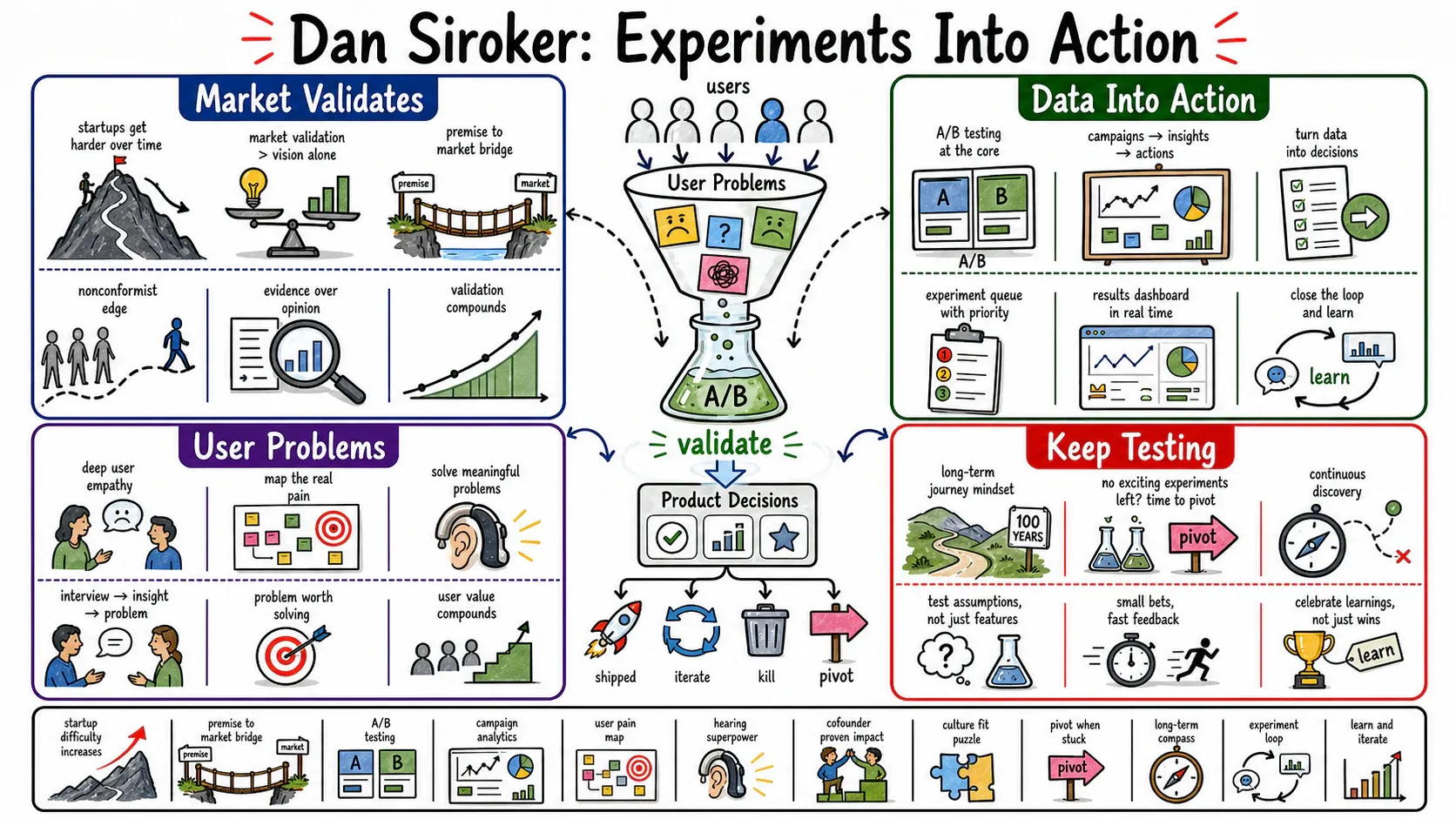
On Entrepreneurship and Startups
- Startup difficulty: Siroker describes founding as a sustained execution challenge: even a plausible idea can require years of persistence and repeated adjustments. — 20VC Interview.
- Validate the premise: A startup idea is a hypothesis; Siroker emphasizes testing it against a real user problem and changing course when the evidence warrants it. — The Social Radars Interview.
- Solve a user problem: He traces Optimizely to the A/B-testing tool he wished he had on the Obama campaign, grounding the product in a problem he had experienced. — 20VC Interview.
- Build for longevity: Siroker described Optimizely as a company intended to outlive its founder; the 2017 CEO transition was framed around a long-term, 100-year ambition. — Optimizely CEO Announcement.
- Technology as a superpower: After a hearing aid restored his hearing, Siroker began seeking technology that could similarly augment people's abilities; that experience informed Rewind and Limitless. — First Round Interview.
- Earn the co-founder role: At Limitless, he named two early employees co-founders after seeing them do co-founder-level work, rather than choosing both partners at formation. — The Social Radars Interview.
- Nonconformism in founders: Siroker sees a nonconformist streak in many founders, whether conventional jobs push them out or autonomy pulls them toward entrepreneurship. — 20VC Interview.
- Know when to pivot: He says a pivot can be appropriate when the team no longer sees promising experiments on its current path; the formulation came from Dalton Caldwell, which Siroker endorsed. — 20VC Interview.
- Learn from a first venture: Siroker contrasts his first and second companies: experience helped him focus on the few decisions that mattered and assemble a more experienced early team. — 20VC Interview.
On Focus and Decision-Making
- Keep the main thing central: At Rewind, Siroker used a team mantra about keeping the main thing the main thing, reinforcing concentration on work that serves the product's core users. — First Round Interview.
- Few decisions move the outcome: Looking back at Optimizely, he judged that only three or four actions made the decisive difference despite the many things he worked on. — 20VC Interview.
- Focus requires judgment: Hindsight reveals the few consequential decisions more clearly than the moment itself; his second-founder approach aims to distinguish those decisions earlier. — 20VC Interview.
- Hours do not replace focus: Siroker says he compensated for unfocused work at his first company by working nearly every waking hour, a pattern he wanted to avoid the second time. — 20VC Interview.
- Test the highest-paid opinion: Siroker argues for testing ideas rather than accepting decisions merely because they come from the most senior person in the room. — Siroker on Culture.
- Turn data into action: Optimizely's stated vision was to help teams turn data into action by making controlled experimentation usable in ordinary product and marketing work. — SaaStr Interview.
On A/B Testing and Experimentation
- Estimate the experiment's impact: Siroker's account of a 2008 Obama campaign website test reports a 40.6% increase in sign-ups; the often-cited $60 million is an extrapolated donation estimate, not directly measured revenue. — Optimizely Field Note.
- Build the tool you needed: Experiencing the power and friction of campaign A/B-testing tools helped Siroker identify the usability gap that became Optimizely. — SaaStr Interview.
- Randomize to learn: In Siroker's Obama campaign example, visitors were randomly shown alternative images and calls to action so the team could compare their effect on sign-ups. — Optimizely Field Note.
- Let experiments challenge intuition: Siroker favors controlled tests over executive preference when a product or marketing decision can be measured reliably. — Siroker on Culture.
- Define a test's goal: Before changing a page, define what outcome the experiment is intended to improve and how success will be measured. — A/B Testing: Chapter 2.
- Test through a redesign: For major redesigns, Siroker and coauthor Pete Koomen recommend testing during the redesign rather than waiting until the new site has launched. — A/B Testing: Chapter 3.
- Build from smaller experiments: Smaller experiments can reveal which changes deserve broader exploration, making later redesign or product decisions better informed. — A/B Testing: Chapter 10.
- Explore beyond local maxima: The coauthors warn that optimizing only tiny variations can miss larger improvements; alternate broad exploration with incremental refinement. — A/B Testing: Chapter 3.
- Use room to experiment: As an underdog, the Obama campaign could test bold variations; Siroker describes the results as evidence that assumptions about the best-performing creative can be wrong. — Optimizely Field Note.
On Leadership and Culture
- Transparency builds investor trust: Siroker says publishing Limitless's pitch deck broadened access to investors and used transparency as a way to build trust. — First Round Interview.
- Culture affects decisions: Siroker describes culture as the values and behaviors that shape how a company hires, makes decisions, and handles new ideas. — Siroker on Culture.
- Make values observable: At Optimizely, the values were expressed through expected behaviors—including ownership and transparency—rather than existing only as slogans. — First Round Interview.
- Give good ideas a hearing: He argues that culture should attract capable people, give them context, and protect promising ideas before they are broadly understood. — Siroker on Culture.
- Plan leadership succession: When Jay Larson became CEO, Siroker framed the handoff as consistent with building a company that could outlast his tenure in that role. — Optimizely CEO Announcement.
- Keep contributing after the handoff: The CEO appointment announcement said Siroker, as executive chairman, would continue working on design, engineering, and product. — Optimizely CEO Announcement.
- Hire experienced people deliberately: For Limitless, Siroker favored a small early team of exceptional, experienced people who could operate with little management overhead. — 20VC Interview.
- Act on persistent defensiveness: Reflecting on Optimizely hires, Siroker says he waited too long after repeated defensive responses to feedback became clear. — The Social Radars Interview.
- Retain founder accountability: Siroker has written that hiring great people does not mean abdication: the founder remains accountable for the company's direction and decisions. — Siroker on Hiring.
On Product and Technology
- Start with a painful problem: Optimizely emerged from Siroker's first-hand frustration with existing A/B-testing software, not from adding technical sophistication for its own sake. — SaaStr Interview.
- Let the product lead growth: Siroker describes Optimizely's early self-serve motion as product-led growth before that label became common. — Churn.fm Interview.
- Build product pull: His aim for Limitless was a product useful enough that customers would choose it without a large sales team persuading them. — Churn.fm Interview.
- Adapt when evidence changes: Siroker recounts several pivots and describes a good change of direction as moving closer to the real customer problem rather than rigidly following the original plan. — 20VC Interview.
- Personalize AI with context: Siroker argues that general-purpose models know little about a particular user; Limitless aims to differentiate through permissioned personal context. — First Round Interview.
- Set realistic hardware expectations: In describing the Limitless Pendant, Siroker stresses delivering a useful experience and being careful about what an early wearable can promise. — Peter Yang Interview.
- Make the user the customer: For a device that records personal context, Siroker favors a direct customer relationship so the wearer—not an employer—controls use of the product. — The Social Radars Interview.
- Address privacy for everyone nearby: Siroker acknowledges that a wearable recording assistant must account for the privacy expectations of both its user and other people in a conversation. — Churn.fm Interview.
On Fundraising
- Separate fundraising from operating: Siroker recommends being either in fundraising mode or not; intermittent investor conversations can refine a pitch without turning every day into a raise. — 20VC Interview.
- Recognize the valuation signal: Siroker says an investor's question about how much a company is raising can also be a way to infer the valuation the founder has in mind. — 20VC Interview.
- Use a public pitch deliberately: Siroker posted Limitless's pitch deck publicly, describing the unusual approach as a way to cast a wider investor net and build trust through transparency. — First Round Interview.
- Choose long-term investor alignment: For Limitless's Series A, Siroker says he preferred NEA's long-term orientation over higher-priced offers and checked references with other founders. — 20VC Interview.
- Do not optimize valuation alone: He says the highest valuation was not automatically the best offer; the quality and time horizon of the investor partnership also mattered. — 20VC Interview.
Sources
- The Social Radars — Dan Siroker transcript
- First Round Review — AI Hot Takes and Unusual Twitter Fundraising Strategies with Dan Siroker
- The Twenty Minute VC — Dan Siroker on Fundraising and Founding Limitless
- Churn.fm — From Optimizely to Limitless: Building Products That Wow
- Optimizely Field Notes — How Obama Raised $60 Million by Running a Simple Experiment
- SaaStr — Dan Siroker and Ajay Agarwal on How to Break Out and Scale
- A/B Testing: The Most Powerful Way to Turn Clicks Into Customers — Chapter 2
- A/B Testing: The Most Powerful Way to Turn Clicks Into Customers — Chapter 3
- A/B Testing: The Most Powerful Way to Turn Clicks Into Customers — Chapter 10
- YFS Magazine — Optimizely CEO Dan Siroker: 3 Questions to Ask Every Job Candidate
- Optimizely — Jay Larson CEO Appointment and Dan Siroker Executive Chairman Announcement
- Dan Siroker — Hire Great People and Get Out of Their Way
- Peter Yang — Dan Siroker on Building the Limitless AI Wearable
- Mixergy — Dan Siroker on Optimizely and Obama Campaign Experimentation