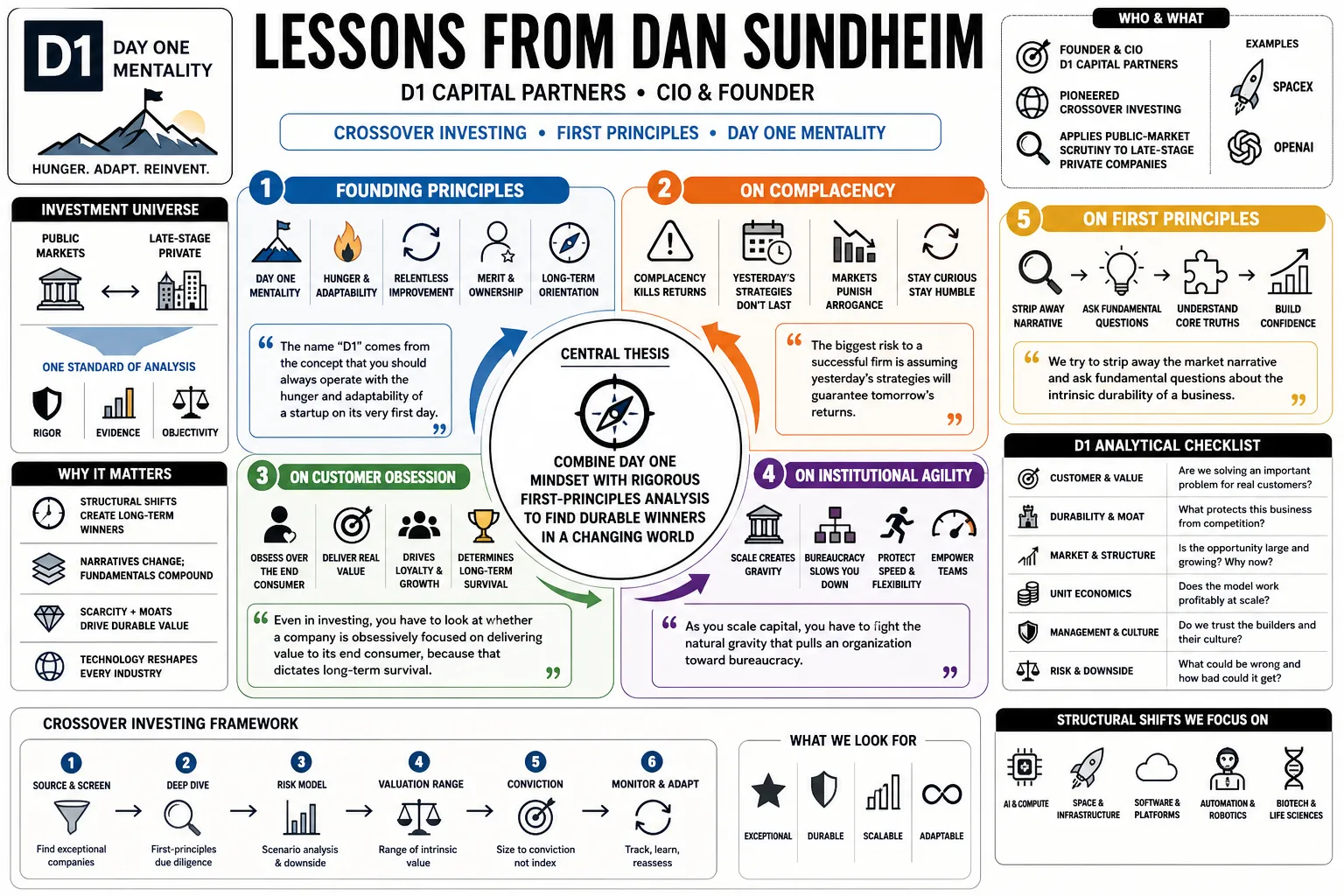
Lessons from Dan Sundheim
Dan Sundheim founded D1 Capital Partners, which researches and invests in both public and private companies. In direct interviews, he discusses a multi-year approach to business analysis, portfolio risk, private-market access and the economics of emerging technologies. — Cheeky Pint Interview.
Part 1: Investment Philosophy
- Assess the product and business: D1 studies whether a company sells a good product and can turn customer demand into an enduring business, rather than relying on market excitement alone. — Cheeky Pint Interview.
- Recognize the limits of size: Sundheim says returns in his short-selling strategy become harder to sustain as fund size grows, which is why capacity matters when scaling a firm. — Cheeky Pint Interview.
- Study the business beneath the narrative: His stated process is bottom-up research into business models, company prospects and management, without trading on short-term technical signals. — Cheeky Pint Interview.
- Invest on a multi-year horizon: D1 applies a three-to-five-year horizon to both public and private positions, even though public holdings can be sold more readily. — Cheeky Pint Interview.
- Read broadly to develop judgment: Sundheim advises aspiring investors to read stock pitches relentlessly and follow how the ideas play out; that was central to his own learning on Value Investors Club. — Cheeky Pint Interview.
- Adapt the talent model as you grow: Sundheim says D1 generally recruits analysts from private equity for their accounting and modeling skills, then invests years in teaching its stock-picking approach. — Cheeky Pint Interview.
Part 2: Crossover Investing
- Use comparable diligence in both markets: D1 says it applies the same fundamental due-diligence process to public and private companies, while recognizing private shares are much harder to exit. — Cheeky Pint Interview.
- Let private exposure inform public views: Sundheim says proximity to leading private AI companies helps D1 understand potential suppliers, beneficiaries and disrupted public businesses. — Invest Like the Best Interview.
- Seek access to exceptional private companies: He argues private investing is competitive in a different way: even when investors agree a company is excellent, its founders can choose which investors to admit. — Invest Like the Best Interview.
- Judge private valuations case by case: Sundheim says late-stage private valuations vary with the cycle and can be reasonable or expensive depending on the growth and business model actually underwritten. — Invest Like the Best Interview.
- Question the benefits of going public: Sundheim says he would hesitate to take a company like Stripe public because he regards aspects of today's public markets as problematic for management. — Cheeky Pint Interview.
- Connect private innovation to public analysis: D1's public/private overlap has increased as private AI advances affect the outlook for public suppliers, cloud providers and software companies. — Invest Like the Best Interview.
- Treat private shares as hard to sell: He calls private investing a one-way door: secondary sales can be slow, require company information rights and send an unwelcome signal to management. — Cheeky Pint Interview.
- Reassess late-stage opportunities by cycle: Sundheim sees current late-stage private opportunities in unusually large, innovative businesses, but stresses that relative attractiveness changes with market cycles. — Invest Like the Best Interview.
Part 3: Fundamental Research and Valuation
- Do the accounting work yourself: His Orthodontic Centers of America case began with hours spent reconciling filings, models and unit-level economics; he concluded the reported numbers did not add up. — Invest Like the Best Interview.
- Study cost advantage in context: Sundheim credits SpaceX's reusable rockets with materially lowering launch costs and making its launch business unusually strong; he does not claim every industry has one inevitable winner. — Cheeky Pint Interview.
- Value durable cash flows: He explains that the market multiple assigned to a company changes as investors gain confidence that its future cash flows will persist. — Cheeky Pint Interview.
- Develop pattern recognition: After more than two decades assessing companies, Sundheim says repeated exposure helps him recognize business-model and valuation patterns, while acknowledging it remains an art. — Cheeky Pint Interview.
- Assess management execution: In his Rolls-Royce example, strong technology had been undermined by poor management and contracts; a new CEO's operational changes altered the investment case. — Cheeky Pint Interview.
- Compare upside and downside: Sundheim describes position selection as a risk-reward calculation: a large potential gain is not enough if the corresponding downside would make the whole portfolio fragile. — Cheeky Pint Interview.
- Look for a reinforcing moat: He argues Netflix's large upfront content investment and global distribution created a flywheel that made its economics stronger over time. — Cheeky Pint Interview.
- Stay within your analytical edge: Sundheim says he avoids macro bets because their outcome can depend on a binary timing call; he prefers company-level positions where time can compound value. — Cheeky Pint Interview.
- Underwrite a turnaround's evidence: In Rolls-Royce, Sundheim looked for operating progress under new management rather than relying solely on a projected improvement plan. — Cheeky Pint Interview.
Part 4: Risk, Resilience, and The GameStop Squeeze
- Understand the GameStop stress test: Sundheim calls the 2021 short squeeze a harrowing period for D1; he says positions moved violently without a fundamental change and exposed a weakness in his risk framework. — Cheeky Pint Interview.
- Separate thesis risk from position risk: He says his fundamental short theses could be right while his position sizing was wrong, a distinction he drew explicitly after GameStop. — Cheeky Pint Interview.
- Size risk before a squeeze: His revised approach sizes individual shorts small enough that a sudden retail-driven spike need not force a cover at the worst moment. — Cheeky Pint Interview.
- Diversify single-name shorts: After pausing shorts, D1 resumed them with smaller, more diversified positions; Sundheim says that reduced squeeze exposure without necessarily sacrificing short alpha. — Cheeky Pint Interview.
- Protect the ability to hold a thesis: Sundheim's risk-management rule is to choose position sizes that let the fund withstand a technical surge instead of being forced out before the fundamental view can play out. — Cheeky Pint Interview.
- Recognize retail-driven short squeezes: He describes the 2021 episode as a technical shock in which heavily shorted prices rose rapidly despite little underlying business change. — Cheeky Pint Interview.
Part 5: Artificial Intelligence and Tech Investing
- Treat scaling laws as an underwriting question: Sundheim says the core investment question for frontier models is whether future capability gains will justify the rapidly rising capital spent on training and compute. — Invest Like the Best Interview.
- Price the capital burden of frontier AI: He describes frontier-model development as unusually capital intensive, with large up-front compute commitments and uncertain returns on each additional round of spending. — Invest Like the Best Interview.
- Examine where AI economics accrue: Sundheim distinguishes model providers, hyperscalers and applications; he argues model APIs have shown more differentiation and pricing power than some early investors expected. — Invest Like the Best Interview.
- Allow for multiple frontier winners: He resisted treating Anthropic as merely a second-place clone of OpenAI because it was too early to know the ranking and he saw distinct strengths in its leadership and product. — Invest Like the Best Interview.
- Expect software business models to adapt: Sundheim expects AI to pressure traditional software economics, but says strong distribution and systems of record may adapt rather than simply disappear. — Invest Like the Best Interview.
- Value SpaceX's launch economics: He argues reusable rockets lowered the cost of launch dramatically, strengthened SpaceX's core business and created options for new services in orbit. — Cheeky Pint Interview.
- Treat compute spending as a real constraint: For AI infrastructure, Sundheim focuses on the scale of GPU and power investment and the uncertainty of returns on that capital, not a guaranteed path from more compute to profit. — Invest Like the Best Interview.
- Engage founders on business-model choices: Sundheim describes discussing monetization with AI founders, including his view that OpenAI could have introduced advertising earlier. — Invest Like the Best Interview.
- Distinguish valuation from the narrative: He says a compelling technology still requires a view on growth, margins and ultimate returns on invested capital; attractive narratives do not settle the price question. — Invest Like the Best Interview.
- Look for economy-wide uses of AI: His investment interest in large language models rests partly on their potential to improve many kinds of work and consumer activity, while he stresses the capital returns are uncertain. — Invest Like the Best Interview.
Part 6: Private Markets and Venture Strategy
- Earn access by being useful to founders: Sundheim says private founders choose their investors, making access a distinct investment challenge; he also describes a founder group chat as useful to both founders and D1. — Invest Like the Best Interview.
- Let exceptional holdings compound: His SpaceX discussion illustrates how a large private holding can become increasingly consequential as the underlying business scales; that outcome was not guaranteed at entry. — Cheeky Pint Interview.
- Match deep-tech claims to capital needs: The SpaceX/Rivian comparison shows how very large engineering and manufacturing investments can produce radically different outcomes; capital intensity is part of the thesis. — Invest Like the Best Interview.
- Avoid selling the strongest holdings reflexively: Sundheim says private investments can benefit from illiquidity because a manager cannot easily sell a great company too early—the mistake he made with Netflix in public markets. — Cheeky Pint Interview.
Part 7: Lessons from Value Investors Club and Viking Global
- Learn by publishing a researched thesis: Early in his career, Sundheim posted anonymous investment cases on Value Investors Club; his Orthodontic Centers case became a calling card for hedge-fund interviews. — Invest Like the Best Interview.
- Reconcile the accounting details: In his Orthodontic Centers analysis, Sundheim says the filings and unit economics failed to reconcile; he suspected expenses were being capitalized improperly. — Invest Like the Best Interview.
- Read other investors' work: Sundheim credits the habit of reading many Value Investors Club pitches, then observing the outcomes, as a practical way to learn investing. — Cheeky Pint Interview.
- Use mentorship to broaden coverage: At Viking, he learned from Tom Purcell but moved beyond banks into healthcare, industrials and technology to grow his investment responsibilities. — Invest Like the Best Interview.
- Train for the firm's actual process: D1 often hires analytically trained private-equity professionals rather than lateral public-equity portfolio managers, because its own stock-picking habits take years to learn. — Cheeky Pint Interview.
- Do not sell a good thesis too early: Sundheim says his Netflix thesis was broadly right but he failed to hold the shares long enough to capture its compounding; he treats that as a painful public-market error. — Cheeky Pint Interview.
- Recognize organizational concentration: By 2016, Sundheim says he managed more than half of Viking's capital and understood why that concentration was not ideal for the firm or its investors. — Invest Like the Best Interview.
Part 8: The Psychology of Markets
- Notice what repeated habits reveal: Sundheim says he often wakes near the European open around 3 a.m. without an alarm after many years in the market; he does not recommend the habit as a universal edge. — Cheeky Pint Interview.
- Understand contrarian holding risk: Netflix was an unpopular pitch in 2018 because it consumed cash; Sundheim says his analysis of the content flywheel was right but he exited too soon. — Cheeky Pint Interview.
- Combine conviction with risk humility: After GameStop, Sundheim held that the shorts' fundamentals could still be sound while admitting his portfolio sizing had been wrong. — Cheeky Pint Interview.
- Read the filings beneath market noise: His Orthodontic Centers work illustrates a preference for reconciling financial statements and unit economics instead of accepting a company's surface story. — Invest Like the Best Interview.
- Notice where younger talent prefers to work: Sundheim told Bloomberg that D1 is co-headquartered in New York and Miami, and that about 75% of its younger talent preferred New York at the time of the interview. — Bloomberg Wealth Interview.
- Give compounding time to work: He prefers owning strong businesses through temporary earnings misses because, unlike many macro bets, growth in their underlying value can make time an ally. — Cheeky Pint Interview.