Dan Wang is a writer and former China technology analyst whose annual letters and book examine how technology, governance and culture shape China and the United States. His 2025 book, Breakneck, develops the “engineering state” and “lawyerly society” contrast. — Breakneck Book Announcement.
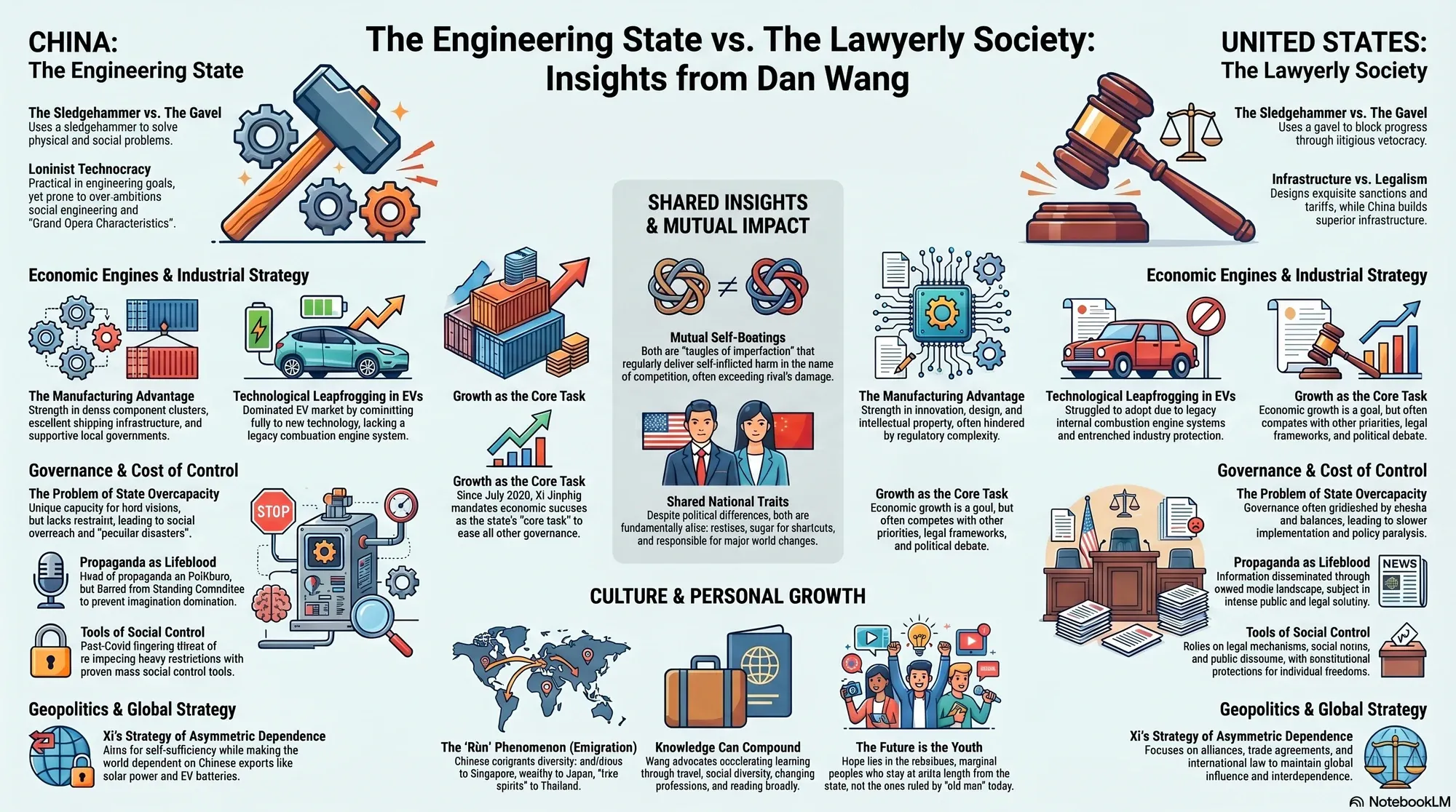
On China's "Engineering State" vs. America's "Lawyerly Society"
This contrast is central to Breakneck: China’s Quest to Engineer the Future, which Wang announced for publication in August 2025. — Breakneck Book Announcement.
- Engineering state versus lawyerly society: Wang frames China as an engineering state that attacks physical and social problems with a sledgehammer, while America’s lawyerly society can block both good and bad projects. — Breakneck Book Announcement.
- Building versus legalism: He contrasts U.S. tariffs and sanctions with China’s effort to build cars, cities and power plants. — Breakneck Book Announcement.
- Costs of a lawyer-led elite: Wang argues that the prominence of lawyers among U.S. elites has contributed to litigation and veto points that favor the well-connected. — Breakneck Book Announcement.
- Engineer-led government: Wang says China’s engineer-led political culture favors building, in contrast with a U.S. system that has become less able to build. — Stern Strategy Interview.
- The danger of social engineering: His framework is not simply praise for infrastructure: he says Beijing can go badly wrong when it treats society itself as something to engineer. — Breakneck Book Announcement.
- Infrastructure in a poorer province: After cycling from Guiyang to Chongqing, Wang judged the infrastructure in Guizhou, China’s fourth-poorest province, better than what he had seen in California or New York. — Breakneck Book Announcement.
- A practical party with theatrical extremes: Wang describes the Communist Party as a “Leninist Technocracy with Grand Opera Characteristics,” a shorthand for its combination of practical capacity and grandiose excess. — Breakneck Book Announcement.
- Seeing the lawyerly society up close: Returning to the U.S. in 2023 and writing at Yale Law School helped Wang formulate his contrast between American legal institutions and China’s engineering state. — Breakneck Book Announcement.
On China's Economy and Development
- Manufacturing clusters matter: Wang attributes China’s manufacturing strength not just to labor but to dense component-supplier clusters and strong shipping infrastructure. — Noah Smith Interview.
- Local governments support employers: He says Chinese local governments often go out of their way to assist major employers rather than merely extracting from them. — Noah Smith Interview.
- Why China pushed into EVs: Unable to overtake established gasoline-car makers, Chinese policymakers and automakers committed much more strongly to battery-powered cars. — Noah Smith Interview.
- Growth incentives for local officials: Wang cites economist Barry Naughton’s observation that China’s incentives for local officials to pursue growth are unusually blunt and powerful; this is Naughton’s wording, not Wang’s. — Dan Wang’s 2020 Letter.
- Growth is no longer the supreme priority: Wang says Xi has formally deprioritized economic growth, leaving officials without an equally clear replacement objective. — Dan Wang’s 2023 Letter.
On Governance and Social Control in China
- State overcapacity: Wang worries that China’s unusually capable state can persist with harmful interventions long after it should stop. — Noah Smith Interview.
- Knowing when to leave people alone: His criticism of excessive state capacity includes a wish that the Chinese state would learn to leave more room for individual life. — Noah Smith Interview.
- Propaganda as a governing tool: Wang cites scholar Anne-Marie Brady’s account of propaganda as central to the Party-state, and describes its use in political campaigns. — Dan Wang’s 2020 Letter.
- Constraints on the propaganda chief: Drawing on Brady, Wang describes the propaganda chief’s Politburo role as influential but generally kept below the standing committee. — Dan Wang’s 2020 Letter.
- Tools of social control may persist: After zero-Covid restrictions ended, Wang asked whether authorities might reuse travel controls and empowered neighborhood committees in future crises. — Noah Smith Interview.
- Conditions behind the 2022 protests: Wang cautions that spontaneous protests in 2022 followed unusually widespread, simultaneous lockdowns, not merely ordinary low growth. — Dan Wang’s 2023 Letter.
- Aging and the likelihood of unrest: Wang predicted that an aging population would be less prone to broad protest, while emphasizing that price shocks to essentials can be stronger triggers. — Dan Wang’s 2023 Letter.
- Inspiration and personnel control: Wang reduces two major Party functions to setting ideological direction and controlling personnel appointments. — Dan Wang’s 2020 Letter.
On US-China Relations and Geopolitics
- Self-sufficiency and dependence: Wang interprets Xi’s strategy as seeking more Chinese self-sufficiency while making other countries depend on Chinese production. — Stern Strategy Interview.
- Export dependence is not guaranteed: In that strategy, solar equipment and EV batteries are examples of goods Beijing wants the world to buy from China; Wang cautions that success is uncertain. — Stern Strategy Interview.
- Shared American and Chinese dynamism: Wang argues that Americans and Chinese share restlessness and a drive to change the world, despite their different political systems. — Breakneck Book Announcement.
- Avoid stale geopolitical labels: He advises against explaining the U.S.–China rivalry only through inherited labels such as socialist, democratic or neoliberal. — Breakneck Book Announcement.
- Recognize self-inflicted harm: Wang argues that each country sometimes damages itself in the name of competition more effectively than its rival could. — Breakneck Book Announcement.
- Xi may erode China’s strengths: Wang argues that Xi has weakened some of China’s institutional strengths, while also acknowledging serious U.S. weaknesses. — Dan Wang’s 2023 Letter.
On Technology and Society
- Crypto under state controls: Wang sees little need for digital currencies in much of the West but greater potential value for people facing state controls. — Dan Wang’s 2023 Letter.
- Space exploration inspires capability: Wang argues that even when space exploration is uneconomic, it can inspire people and pull technological capabilities forward. — Dan Wang’s 2020 Letter.
- Dynamism and repression coexist: Wang says China’s dynamism and its repressive treatment of people must both be recognized; neither cancels out the other. — The Browser Interview.
On Learning and Personal Growth
- Knowledge can compound: Wang proposes treating learning as something that compounds and deliberately seeking ways to accelerate it. — Dan Wang’s 2017 Letter.
- Vary the inputs to learning: He recommends travel, social variety, new books, career changes and relocation as ways to encounter unfamiliar ideas. — Dan Wang’s 2017 Letter.
- Manage the scale of a book project: Wang compares writing a book to climbing a mountain: progress became easier once he stopped dwelling on the entire distance ahead. — Breakneck Book Announcement.
- Study wartime logistics: In reading war books, Wang is especially interested in the production and delivery systems behind military campaigns. — Dan Wang’s 2020 Letter.
- Read acknowledgments for care: Wang treats a thoughtful acknowledgments section as one sign that an author took care with a book. — Breakneck Book Announcement.
- Notice where writers do the hard work: Wang says careful reading helps him detect when authors tackle difficult material and when they skate past topics that do not interest them. — Breakneck Book Announcement.
On the Chinese People and Culture
- Understanding rùn: Wang reports that Chinese young people repurposed rùn to describe escaping intense work and family pressures, and later emigrating after zero-Covid. — Dan Wang’s 2023 Letter.
- Different destinations for emigrants: From people he met, Wang observed different groups looking toward Singapore, Japan and Thailand for different economic and lifestyle reasons. — Dan Wang’s 2023 Letter.
- Searching for new ideas: Wang reports that slower growth and tighter censorship led some young Chinese people to question inherited expectations and seek different ways to understand the world. — Dan Wang’s 2023 Letter.
- Question an overdrawn exile analogy: Wang notes that some Chinese crypto expatriates compare their situation to Jewish exile, but he calls that analogy overdramatic. — Dan Wang’s 2023 Letter.
- Young people may reshape China: Wang argues that the China inherited by today’s young people need not resemble the country presently ruled by older leaders. — Dan Wang’s 2023 Letter.
- Choose life away from the center: In his 2022 letter, Wang uses “It’s a barbarian’s life for me” to describe turning away from Beijing’s political center; this was not literally his final annual letter. — Dan Wang’s 2022 Letter.
- Reject a Han-centric hierarchy: Wang is uncomfortable with a Han-centered view that ranks minority and outsider groups as different kinds of barbarians. — Dan Wang’s 2022 Letter.
- Value life at the margins of the state: He hopes for greater appreciation of rebellious and marginal peoples who have maintained distance from state power. — Dan Wang’s 2022 Letter.
Learn more:
- Dan Wang — 2023 Letter
- Dan Wang — Breakneck: China’s Quest to Engineer the Future (Book Announcement)
- Stern Strategy — Dan Wang Interview and Speaker Profile
- Noah Smith — Interview with Dan Wang, China Specialist
- Dan Wang — 2020 Letter
- The Browser — Interview with Dan Wang
- Dan Wang — 2022 Letter
- David Perell — Why You Should Write Less Often (Dan Wang Interview)
- Dan Wang — 2017 Letter