Lessons from Dani Rodrik
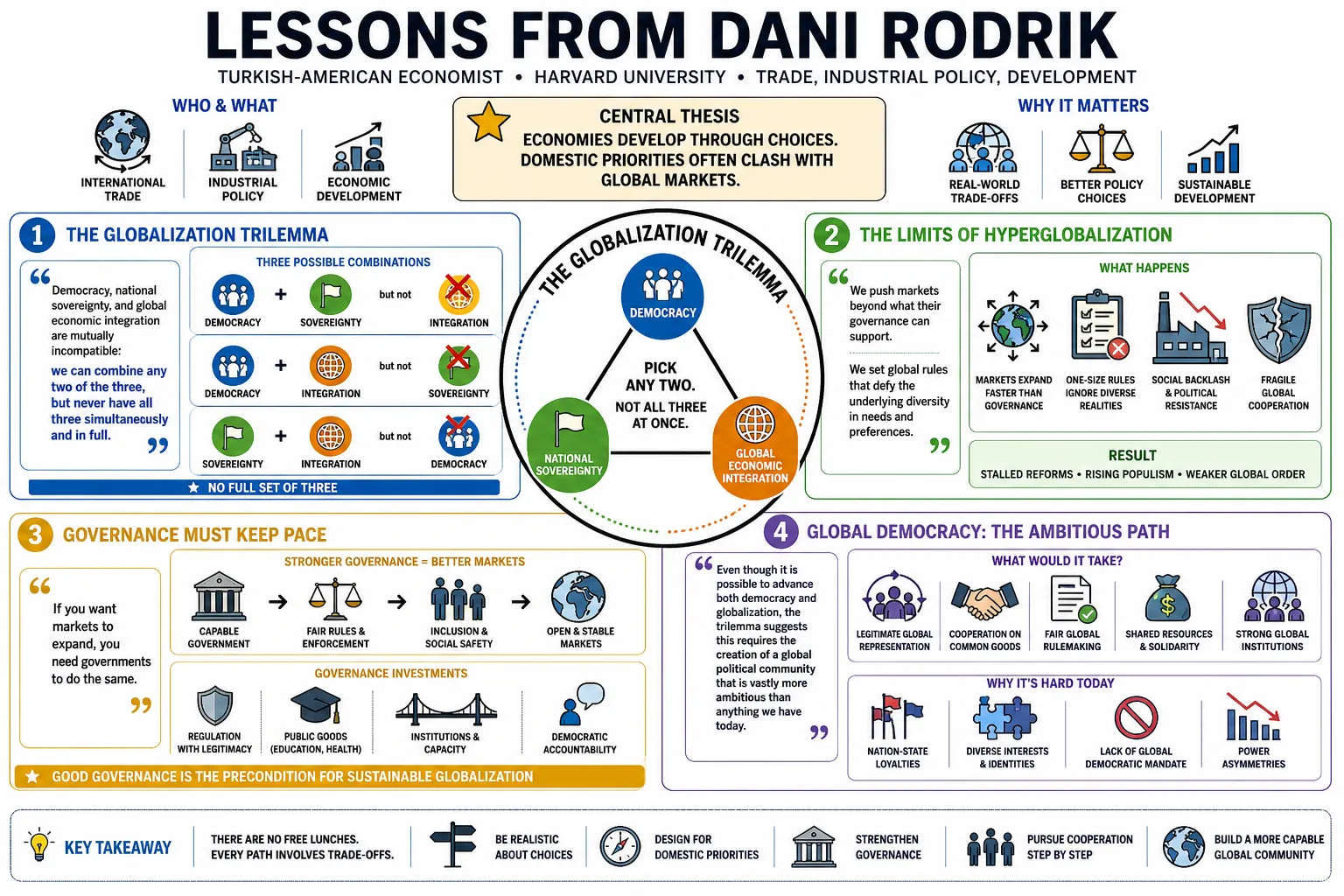
Dani Rodrik is a Harvard economist whose work examines international trade, globalization, industrial policy and economic development. His political trilemma argues that full global economic integration, national sovereignty and democratic politics cannot all be achieved at once. — Feasible Globalizations.
Part 1: The Globalization Trilemma
- The political trilemma: Full economic integration, national sovereignty and democratic politics cannot all be realized simultaneously; Rodrik argues societies can combine at most two. — Feasible Globalizations.
- The limits of hyperglobalization: Deep integration runs up against diverse national institutions that create, regulate, stabilize and legitimate markets. — Feasible Globalizations.
- Markets need public institutions: Markets depend on non-market institutions for regulation, stabilization and legitimacy; an enlarged market needs governance capable of serving those functions. — Feasible Globalizations.
- Global democracy is demanding: Maintaining democratic politics alongside full integration would require political authority to move to a global level, a far more ambitious project than current institutions. — Feasible Globalizations.
- National rules can support markets: Differences in national institutions are not merely trade barriers: regulatory and social arrangements can make markets function well at home. — Feasible Globalizations.
- The gold-standard tradeoff: Rodrik uses the gold-standard era and the interwar breakdown to illustrate how deep integration constrained domestic political choices as mass politics expanded. — Political Trilemma Paper.
- The Bretton Woods compromise: Bretton Woods left governments room for domestic economic management, social insurance and capital-flow restrictions while permitting substantial trade. — Feasible Globalizations.
- The European integration challenge: Rodrik treats European integration as an unusually ambitious attempt to align market scale and political authority, while noting its democratic-governance challenge. — Who Needs the Nation State?.
- Protect domestic policy space: A democratic globalization leaves room for countries to maintain distinct institutional arrangements and social contracts instead of enforcing a single template. — Feasible Globalizations.
Part 2: The Limits of Free Trade
- Small gains can conceal large losses: Rodrik warns that some deep trade agreements yield modest aggregate efficiency gains alongside large losses for particular workers and communities. — What Do Trade Agreements Really Do?.
- Trade gains have a distribution: Trade can increase aggregate welfare yet impose concentrated losses; evaluating it requires asking who wins, who loses and whether losers are compensated. — What Do Trade Agreements Really Do?.
- Comparative advantage is not compensation: Standard gains-from-trade reasoning concerns aggregate possibilities, not a guarantee that every household benefits from liberalization. — What Do Trade Agreements Really Do?.
- Backlash has economic roots: Rodrik links political resistance to globalization to the distributional and legitimacy problems created when cross-border integration outruns domestic support. — Feasible Globalizations.
- Trade can test social norms: Rodrik uses child-labor rules to show how imports can create tension between trade gains and domestic social arrangements that a polity values. — Tensions Between Trade and Social Arrangements.
- Compensation cannot be assumed: In assessing agreements, Rodrik asks whether those who lose will actually be compensated; a theoretical possibility is not enough to dismiss concentrated losses. — What Do Trade Agreements Really Do?.
- Modern agreements reach behind borders: Many modern trade agreements govern intellectual property, investment and domestic regulation, making their welfare effects less clear than tariff reduction. — What Do Trade Agreements Really Do?.
- Choose feasible globalization: Rodrik favors a renewed Bretton Woods-style balance that preserves national policy space while negotiating rules for attainable cross-border integration. — Feasible Globalizations.
Part 3: Industrial Policy and Development
- Let failed industrial bets end: Rodrik says effective industrial policy requires learning from mistakes and withdrawing support when initiatives fail, not a presumption that officials can identify winners in advance. — Financial Times Interview.
- Development requires structural change: Moving workers from low-productivity traditional activities into more productive modern ones is central to the growth process Rodrik describes. — Premature Deindustrialization.
- Early entrants generate information: Industrial policy can address learning and discovery spillovers that make private pioneers underinvest in new productive activities. — Industrial Policy: Don’t Ask Why, Ask How.
- Government needs business feedback: Rodrik argues for embedded public agencies that learn from firms while using accountability and conditions to limit capture. — Industrial Policy: Don’t Ask Why, Ask How.
- Manufacturing once aided catch-up: Rodrik documents convergence in labor productivity across countries within organized, formal manufacturing, a property not established for economies as a whole. — Unconditional Convergence.
- Experiment with local constraints: Growth strategies should respond to each country’s binding constraints rather than apply a universal checklist of reforms. — Growth Diagnostics.
- Balance access with accountability: Industrial-policy agencies need information from private firms but must condition support and remain accountable so collaboration does not become capture. — Industrial Policy: Don’t Ask Why, Ask How.
- Convergence is sector-specific: Rodrik finds unconditional productivity convergence in formal manufacturing industries, not in entire national economies. — Unconditional Convergence.
- Go beyond the reform checklist: Standard reforms can have different effects in different settings; diagnose binding constraints before prescribing a broad Washington Consensus package. — Growth Diagnostics.
- Build productive capabilities: Sustained development depends on accumulating productive capabilities, including skills, technologies and institutions, rather than relying on liberalization alone. — Growth Strategies.
Part 4: Premature Deindustrialization
- Industrialization now peaks earlier: Rodrik finds developing countries reaching peak manufacturing employment at lower income levels and lower employment shares than earlier industrializers. — Premature Deindustrialization.
- Fewer manufacturing jobs: Declining peak manufacturing employment narrows a historically important route to formal, higher-productivity work for developing economies. — Premature Deindustrialization.
- Technology and trade both matter: Rodrik’s evidence associates premature deindustrialization with labor-saving technology and globalization, with different mechanisms across country groups. — Premature Deindustrialization.
- Deindustrialization affects politics: Rodrik warns that losing manufacturing early may weaken organized working-class politics and make democratic bargains harder; he treats these as risks, not settled outcomes. — Premature Deindustrialization.
- Informal services are not an automatic substitute: Rodrik observes that urban workers in parts of Africa are moving into petty services rather than manufacturing, limiting the traditional productivity route. — Premature Deindustrialization.
- Regions have fared differently: Rodrik reports especially severe deindustrialization in Latin America, while Asian manufacturing exporters have been more insulated. — Premature Deindustrialization.
- The export-manufacturing path has narrowed: For many developing countries, early deindustrialization makes the old labor-intensive manufacturing route to catch-up less available. — Premature Deindustrialization.
- Tradable services face a skills constraint: Rodrik argues that high-productivity tradable services can grow but often demand skills that prevent them from absorbing large numbers of less-educated workers. — On Productivism.
- Develop service productivity locally: With manufacturing less able to absorb workers, Rodrik calls for policies that raise productivity and job quality in domestic services. — An Industrial Policy for Good Jobs.
Part 5: Institutions and Economic Growth
- Institutions underpin growth: Rodrik identifies property rights, regulation, social cooperation and conflict management as important institutional foundations, without claiming one imported template is sufficient. — Institutions for High-Quality Growth.
- Separate institutional function from form: Different institutional designs can perform the same economic function; policy should ask what a society needs its institutions to accomplish. — Institutions for High-Quality Growth.
- Avoid imported blueprints: Rodrik cautions against transplanting institutional blueprints without adapting them to local knowledge, opportunities and political conditions. — Institutions for High-Quality Growth.
- Property rights can take different forms: Secure expectations about returns matter, but Rodrik cites China’s unconventional institutional arrangements as evidence that Western legal forms are not the sole path. — Institutions for High-Quality Growth.
- Democracy can improve growth quality: Rodrik finds participatory democracies better able, on average, to deliver predictable growth, resilience to shocks and distributional outcomes. — Institutions for High-Quality Growth.
- China used institutional experimentation: China’s gradual transition illustrates the potential of context-specific institutional innovations rather than immediate adoption of a complete orthodox package. — Institutions for High-Quality Growth.
- Partial reforms interact: A policy that looks efficient in isolation can work differently amid other distortions; Rodrik cautions against assuming every orthodox reform is growth-promoting everywhere. — Growth Diagnostics.
- Find the binding constraint: Growth diagnostics directs policymakers to identify the constraint most limiting investment and entrepreneurship before choosing reforms. — Growth Diagnostics.
Part 6: The Economics Profession and Methodology
- Models are purposeful simplifications: Rodrik compares economic models to fables: simplified accounts that isolate mechanisms rather than literal descriptions of the whole economy. — What Models Do.
- Choose the model for the context: Good economic analysis requires judging which model fits the institutional setting and question, not applying one framework mechanically. — In Praise of Foxy Scholars.
- Mathematics clarifies assumptions: Rodrik defends formal models for exposing assumptions and logic, while warning against confusing mathematical neatness with real-world relevance. — What Models Do.
- Policy conclusions depend on assumptions: Rodrik and coauthors stress that economics does not predetermine one policy: conclusions depend on assumptions and circumstances. The older aphorism in their essay is explicitly attributed to Carlos Díaz-Alejandro, not Rodrik. — Economics for Inclusive Prosperity.
- Public certainty can mislead: Rodrik argues economists should communicate the conditional nature of their findings instead of presenting contested trade-policy conclusions as unconditional truths. — Economics for Inclusive Prosperity.
- Ideas shape perceived interests: Rodrik argues that policy choices reflect not only material interests but also the ideas through which actors understand their interests and the world. — When Ideas Trump Interests.
- Economists need a repertoire: Rodrik favors “foxes” who can draw on different models for different circumstances over one-size-fits-all “hedgehogs.” — In Praise of Foxy Scholars.
- Evidence requires a model of interpretation: Rodrik cautions that empirical patterns do not interpret themselves; the choice of model matters to what a finding can establish. — What Models Do.
- Economics can learn from other disciplines: Rodrik and coauthors describe economics as somewhat insular but also note recent incorporation of ideas from history, behavioral science and culture. — Economics for Inclusive Prosperity.
Part 7: Democracy and the Nation-State
- The nation-state still supplies governance: Rodrik argues national governments remain principal providers of market regulation, redistribution and political accountability. — Who Needs the Nation State?.
- Different societies choose differently: Rodrik defends policy space because national communities have distinct institutional preferences and development circumstances. — Who Needs the Nation State?.
- Legitimacy is difficult to scale: Rodrik notes persistent democratic-deficit complaints about supranational rulemaking and a weaker connection to domestic political debate. — Who Needs the Nation State?.
- National identity can aid solidarity: Rodrik treats national identity as a continuing source of solidarity that helps support collective institutions; this is a qualified argument, not a universal rule about patriotism. — Who Needs the Nation State?.
- Cooperate where spillovers are global: Rodrik distinguishes true global public goods, such as climate policy, from many economic choices best left to national deliberation. — Putting Global Governance in Its Place.
- Set modest global rules: Rodrik favors international rules where cross-border spillovers justify them while preserving legitimate variation in domestic institutions. — Putting Global Governance in Its Place.
- Capital and tax competition create spillovers: Rodrik argues tax havens can erode other countries’ tax bases and shift the burden toward labor, one case for targeted international cooperation. — Putting Global Governance in Its Place.
- Capital controls can protect domestic choices: Rodrik points to Bretton Woods restrictions on capital flows as part of a system that allowed national economic management and democratic politics. — Feasible Globalizations.
Part 8: Productivism and the Future of Work
- Productivism widens opportunity: Rodrik’s productivism seeks to spread productive opportunities across places and workers rather than assume growth in leading firms will diffuse on its own. — On Productivism.
- Good jobs mean more than wages: Rodrik defines good jobs by adequate pay, stability, safe conditions and chances to progress, because they sustain middle-class living standards. — On Productivism.
- Service jobs need productivity gains: As services employ most workers, Rodrik argues policy must improve productivity and job quality in sectors such as care and retail. — On Productivism.
- Move beyond transfers alone: Productivism complements redistribution with direct efforts to create productive employment opportunities and better jobs. — On Productivism.
- Firms have a role in good jobs: Rodrik calls for a reciprocal bargain: public support and services for firms alongside commitments to employment quantity and quality. — An Industrial Policy for Good Jobs.
- Steer innovation toward workers: Rodrik proposes employment-friendly technology policy, including an ARPA-style agency focused on tools that complement workers. — An Industrial Policy for Good Jobs.
- Coordinate skills and employer demand: Rodrik argues training should be linked to firms’ capacity to create productive jobs, with locally tailored support rather than training in isolation. — On Productivism.