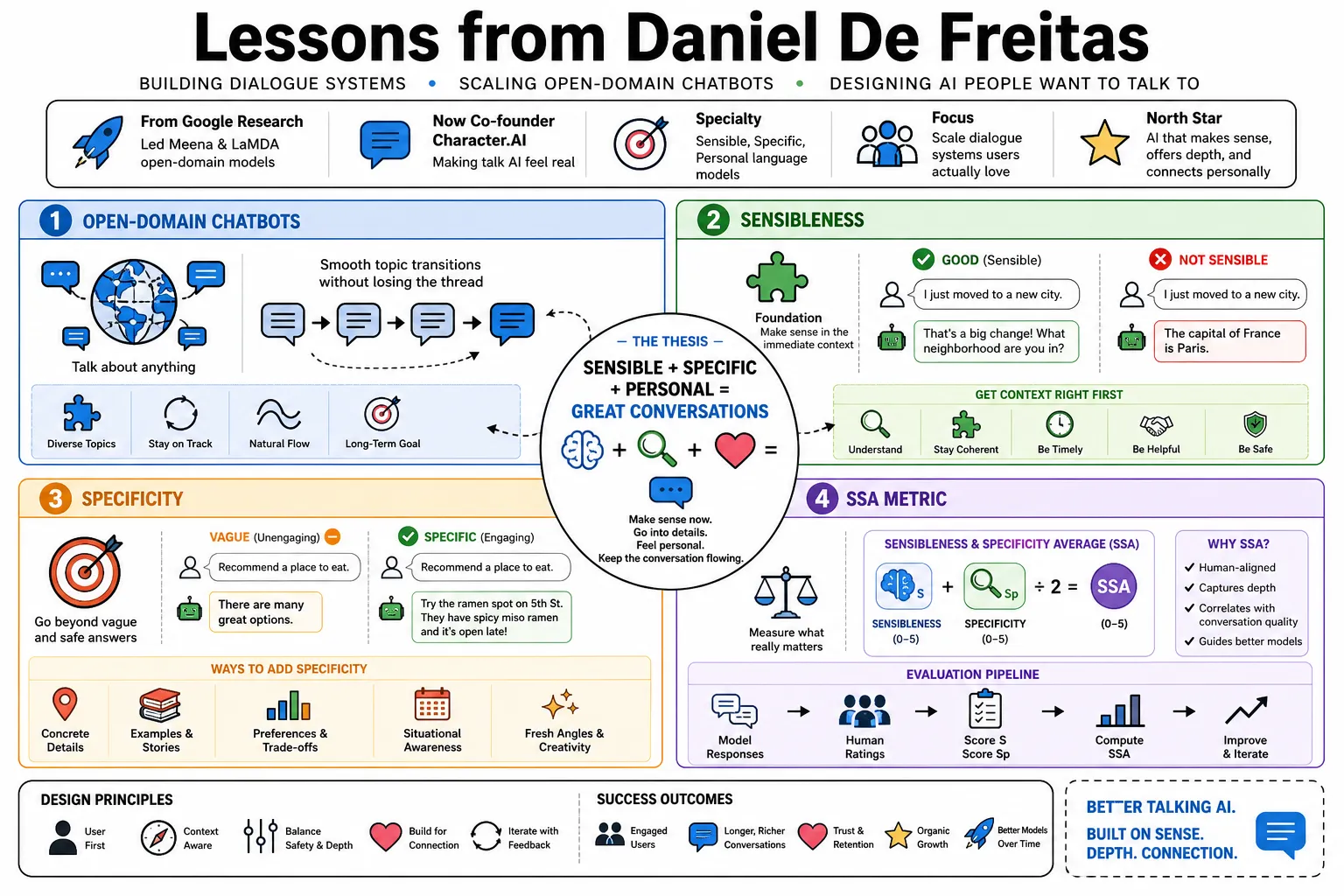
Lessons from Daniel De Freitas
Daniel De Freitas co-founded Character.AI after leading the development of Google's open-domain conversational models, Meena and LaMDA. He specializes in building language models that are sensible, specific, and personal. This profile breaks down his approach to scaling dialogue systems and designing AI that users actually want to talk to.
Part 1: Conversational AI and Dialogue
- On Open-Domain Chatbots: "The ultimate goal of a conversational agent is to be able to talk about anything, smoothly transitioning between topics without losing the thread of the interaction." — Source: Google Research Blog
- On Sensibleness: "Before a model can be helpful or interesting, it simply needs to make sense in the context of the immediate conversation." — Source: Towards a Human-like Open-Domain Chatbot
- On Specificity: "A chatbot that only gives vague, safe answers is technically sensible but entirely unengaging. The system must venture into specific details to feel human." — Source: Towards a Human-like Open-Domain Chatbot
- On the SSA Metric: "We designed Sensibleness and Specificity Average because existing automated metrics didn't capture what actually makes a conversation feel natural to a human evaluator." — Source: Google Research Blog
- On Context Windows: "Memory in conversation isn't just about storing facts; it's about maintaining the persona and tone across multiple turns." — Source: Character.AI Blog
- On End-to-End Training: "By training models end-to-end on dialogue, we remove the brittle rules of traditional chatbots and let the neural network discover the implicit rules of conversation." — Source: Towards a Human-like Open-Domain Chatbot
- On Multi-Turn Coherence: "A single impressive response is easy. Sustaining a coherent identity and logical flow over fifty turns is the true test of a dialogue model." — Source: Character.AI Blog
- On Meena's Architecture: "Scaling a sequence-to-sequence model with a massive dataset of social media conversations proved that scale alone could solve many conversational shortcomings." — Source: Google Research Blog
- On Language as Interaction: "Language modeling isn't just about predicting the next word; when applied to dialogue, it is about predicting the next social action." — Source: Character.AI Blog
- On LaMDA's Evolution: "Building on Meena, LaMDA showed that grounding models in external knowledge could resolve the tension between open-ended conversation and factual accuracy." — Source: Google Research Blog
Part 2: Personalization and Character
- On Persona Definition: "Users want to talk to a specific entity, not a generic oracle. Defining a character gives the model constraints that actually make it more creative." — Source: Character.AI Blog
- On User Connection: "People don't just want answers from AI; they want companionship, empathy, and entertainment." — Source: The Washington Post
- On Flexible Identity: "This technology, fundamentally, is great at an infinitude of user experience, allowing anyone to shape the AI into whatever character they need." — Source: The Washington Post
- On Creative Writing: "When you interact with a well-designed character, you are co-authoring a story in real-time." — Source: Character.AI Blog
- On Emotional Intelligence: "A successful conversational model must interpret the emotional subtext of the user's prompt and respond with the appropriate tone." — Source: Character.AI Blog
- On Community Creators: "The most surprising and compelling characters come from the users themselves, tweaking descriptions and examples to craft entirely new personalities." — Source: Character.AI Blog
- On Consistency: "A character must act like itself. If a historical figure suddenly uses modern slang, the illusion breaks instantly." — Source: Character.AI Blog
- On Fiction vs. Fact: "In a character-driven interaction, narrative consistency is often more important than strict factual accuracy." — Source: Character.AI Blog
- On Empathy: "We design models to be active listeners, reflecting the user's input back to them in a way that feels validating." — Source: The Washington Post
Part 3: Scaling and Model Capabilities
- On Compute and Performance: "Every time we scaled up the model size and data for Meena, the perplexity dropped and the conversational quality noticeably improved." — Source: Towards a Human-like Open-Domain Chatbot
- On the Bitter Lesson: "Our experience with dialogue systems confirmed that leveraging massive compute to learn from data consistently outperforms hand-engineered rules." — Source: Towards a Human-like Open-Domain Chatbot
- On Training Data: "The quality of a conversational model is a direct reflection of the diversity and richness of the conversational data it trains on." — Source: Towards a Human-like Open-Domain Chatbot
- On Emergent Abilities: "As models get larger, they don't just get better at grammar; they suddenly acquire the ability to maintain complex personas and follow intricate logical reasoning." — Source: Google Research Blog
- On Efficiency: "Building massive models is only half the battle; serving them efficiently to millions of users in real-time requires entirely new engineering paradigms." — Source: Character.AI Blog
- On Optimization: "We spend as much time optimizing inference speed as we do on training, because latency kills the illusion of conversation." — Source: Character.AI Blog
- On Model Architecture: "Standard Transformer architectures are powerful, but adapting them specifically for the nuances of multi-turn dialogue requires careful attention to attention mechanisms." — Source: Towards a Human-like Open-Domain Chatbot
- On Hallucinations: "While scaling reduces many errors, the tendency of language models to confabulate remains a stubborn challenge that scaling alone doesn't entirely solve." — Source: Google Research Blog
- On Evaluation: "You cannot manage what you cannot measure. Developing robust, human-correlated metrics is the prerequisite for scaling a model." — Source: Towards a Human-like Open-Domain Chatbot
Part 4: Democratizing Superintelligence
- On Accessibility: "Our goal is to give every single person access to deeply personalized, super intelligence to help them live their best lives." — Source: Character.AI Launch Blog
- On Individual Tutors: "Imagine every student having access to a tutor that perfectly understands their learning style and infinite patience." — Source: The Washington Post
- On Personal Assistants: "We envision a future where everyone has an AI assistant that anticipates their needs and manages the friction of daily life." — Source: Character.AI Blog
- On Corporate Gatekeeping: "The most powerful AI tools shouldn't be locked behind enterprise contracts; they belong in the hands of everyday consumers." — Source: Character.AI Launch Blog
- On Cost Reduction: "Driving down the cost of inference is a moral imperative if we want to truly democratize this technology." — Source: Character.AI Blog
- On Open Exploration: "Users should have the freedom to explore the capabilities of AI in their own way, shaping the tool to their specific context." — Source: The Washington Post
- On Global Reach: "Language barriers will disappear when personalized conversational models can seamlessly translate and adapt cultural nuances in real-time." — Source: Character.AI Blog
- On Empowering Creators: "By providing the raw intelligence, we empower non-technical users to build interactive experiences that used to require teams of engineers." — Source: Character.AI Blog
- On Niche Interests: "A highly capable, personalized AI can serve the deepest niche interests that mass-market products completely ignore." — Source: Character.AI Blog
- On the Transition to Startups: "Sometimes, realizing a vision for democratized access means leaving a large institution to build a company entirely focused on the consumer." — Source: The Washington Post
Part 5: User Experience in AI
- On Latency: "In a text-based chat, any delay over a few hundred milliseconds breaks the rhythm of human interaction." — Source: Character.AI Blog
- On Interface Design: "The chat interface is the most natural UI we have. It requires zero training for the user to understand." — Source: Character.AI Blog
- On Onboarding: "Users shouldn't have to read a manual to talk to an AI. The system should guide them organically through the conversation." — Source: Character.AI Blog
- On Feedback Loops: "The best interfaces allow users to seamlessly regenerate responses or steer the conversation, effectively training the AI on their preferences." — Source: Character.AI Blog
- On Tone: "A conversational AI needs to master the subtle differences between a formal query and a casual chat." — Source: Character.AI Blog
- On Anthropomorphism: "People naturally project human qualities onto responsive systems; good UX designs around this rather than fighting it." — Source: The Washington Post
- On Discovery: "Finding the right character or prompt should feel like a recommendation engine for conversation." — Source: Character.AI Blog
- On Multi-Modal Interaction: "Text is just the beginning. The future of AI interaction involves voice, vision, and seamless integration into our physical environment." — Source: Character.AI Blog
- On Breaking the Illusion: "When the AI gives a generic or out-of-character response, the UX fails. Maintaining the illusion is the core engineering challenge." — Source: Character.AI Blog
Part 6: Navigating Risk and Safety
- On Safe Deployment: "Releasing open-ended conversational models requires balancing the desire for free expression with the need to prevent harm and abuse." — Source: Google Research Blog
- On Corporate Caution: "Large institutions naturally index heavily on reputational risk, which can sometimes slow the public deployment of cutting-edge research." — Source: The Washington Post
- On Content Moderation: "Automated systems must be designed to detect and mitigate toxic outputs without lobotomizing the model's creativity." — Source: Character.AI Blog
- On User Autonomy: "We have to build systems that trust the user's intent while providing guardrails against objectively dangerous or illegal content." — Source: Character.AI Blog
- On Bias: "Language models reflect the biases of their training data; acknowledging this and actively filtering for fairness is a continuous operational requirement." — Source: Google Research Blog
- On Mental Health: "As users form emotional bonds with AI, companies bear a responsibility to ensure these interactions remain healthy and supportive." — Source: The Washington Post
- On Transparency: "It is crucial to remind users that they are speaking to an AI, even when the interaction feels incredibly human." — Source: Character.AI Blog
- On Adversarial Testing: "You cannot predict every failure mode of an open-domain model. Rigorous, adversarial red-teaming is the only way to find the edges." — Source: Google Research Blog
- On Iterative Release: "The safest way to build conversational AI is to release it incrementally, learn from real-world usage, and rapidly iterate on safety protocols." — Source: Character.AI Blog
Part 7: The Future of Human-Computer Interaction
- On the Next Computing Platform: "Conversational AI is not just a feature; it is a fundamental shift in how we interact with information and computing." — Source: Character.AI Launch Blog
- On Search vs. Chat: "Why search for links when an AI can synthesize the exact answer you need, tailored to your level of understanding?" — Source: Character.AI Blog
- On Always-On AI: "In the future, our AI companions will have persistent memory across devices and sessions, growing with us over time." — Source: Character.AI Blog
- On Companionship: "For many, the most valuable application of AI won't be writing code or drafting emails; it will be having someone to talk to at the end of the day." — Source: The Washington Post
- On Symbiosis: "We are moving toward a symbiotic relationship where the AI augments human creativity, acting as a brainstorming partner." — Source: Character.AI Blog
- On Education: "The transition from one-to-many classroom teaching to one-to-one personalized AI tutoring will be the biggest educational leap in a century." — Source: Character.AI Blog
- On Entertainment: "Interactive fiction, where you control the protagonist and the AI generates the world and characters around you, is the future of storytelling." — Source: Character.AI Blog
- On Specialization: "We will see a proliferation of hyper-specialized AI models trained for specific domains, all accessible through a single conversational interface." — Source: Character.AI Blog
- On Ambient Computing: "Eventually, the chat window will fade away, and we will converse with the computing environment around us as naturally as speaking to a person." — Source: Character.AI Blog
- On Human Connection: "Ironically, by building better artificial conversationalists, we may free up human time and energy to build deeper connections with each other." — Source: The Washington Post
Part 8: Engineering and Building Large Models
- On Data Quality over Quantity: "While scale matters, cleaning and filtering the pre-training data to remove noise and low-quality text pays massive dividends in the final model." — Source: Towards a Human-like Open-Domain Chatbot
- On Infrastructure: "The bottleneck in AI progress isn't just algorithmic; it's the sheer engineering difficulty of keeping thousands of GPUs synchronized." — Source: Character.AI Blog
- On Reinforcement Learning: "RLHF is a powerful tool for aligning a model's outputs with human preferences, but it requires carefully designed reward models to avoid hacking." — Source: Google Research Blog
- On Decoding Strategies: "The way you sample from a model's probability distribution—balancing temperature and top-k—completely changes the perceived intelligence of the response." — Source: Towards a Human-like Open-Domain Chatbot
- On Continuous Training: "A static model quickly becomes obsolete. Models must be continuously updated to reflect new cultural context and user feedback." — Source: Character.AI Blog
- On Distributed Systems: "Serving a billion-parameter model to millions of concurrent users is primarily a distributed systems challenge." — Source: Character.AI Blog
- On Hardware Constraints: "Model design is fundamentally constrained by memory bandwidth; reducing KV cache size is critical for scaling context windows." — Source: Character.AI Blog
- On Open Source: "The open-source community will always drive the base layer of innovation, but fine-tuning and specialized serving infrastructure remain significant moats." — Source: Character.AI Blog
- On The Path Forward: "The transition from LaMDA to Character.AI proved that when you optimize for user joy and accessibility, the engineering challenges sort themselves out." — Source: The Washington Post