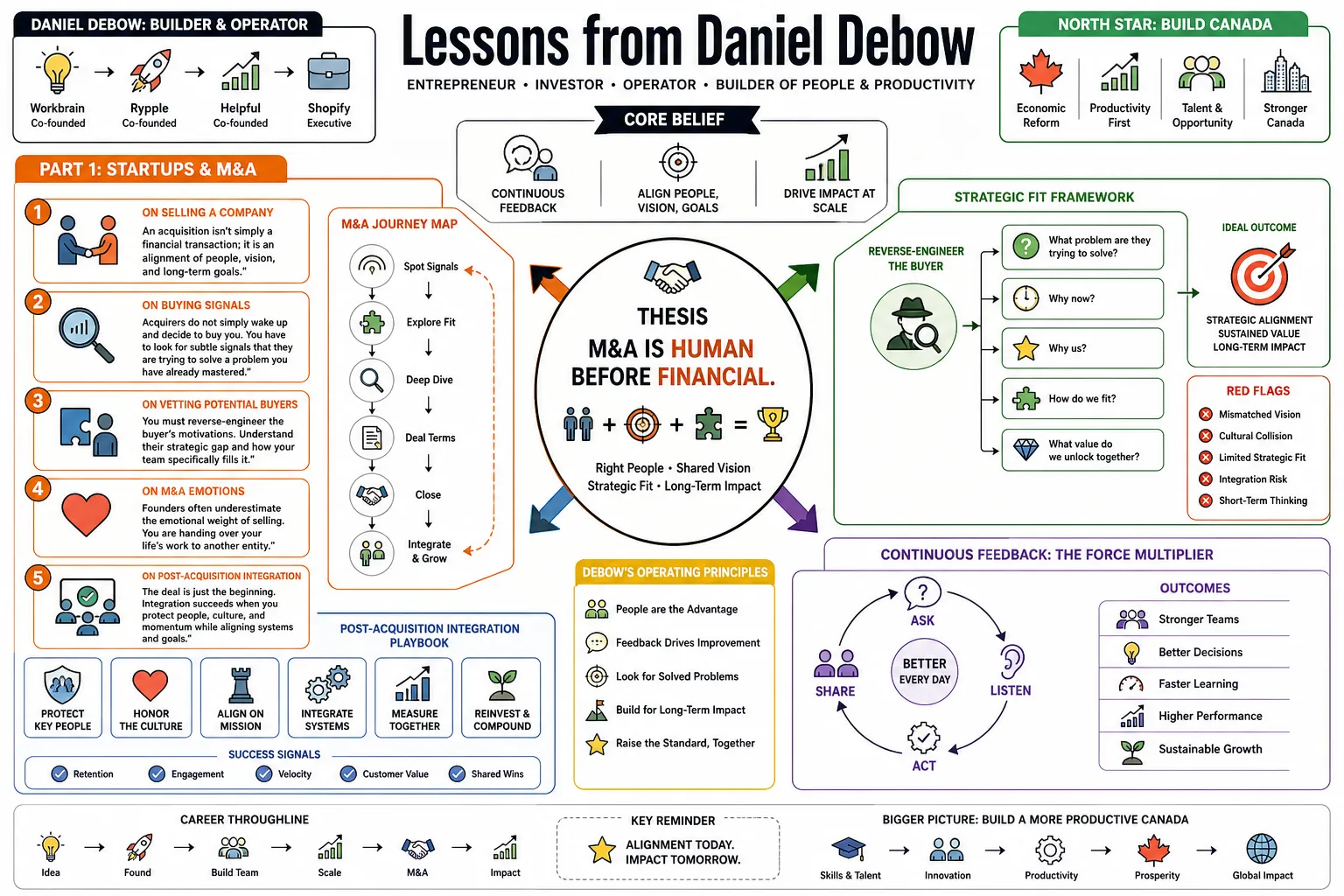
Lessons from Daniel Debow
Daniel Debow co-founded Workbrain, Rypple and Helpful, later serving as an executive at Shopify. He has written about early-stage teamwork and real-time feedback and has advocated for Canadian productivity through Build Canada. — First Round M&A Interview.
Part 1: Startups & M&A
- Sell to people, not an abstract company: Treat an acquisition as persuading specific decision-makers that your team solves a business problem for them. — First Round M&A Interview.
- Watch for real buying signals: Access to senior executives, substantive questions about value, and cap-table or revenue diligence are stronger buying signals than a generic inquiry. — First Round M&A Interview.
- Understand the buyer’s problem: Identify which executive needs the solution your startup offers and show how your product and team could fit into the buyer’s organization. — First Round M&A Interview.
- Expect an emotional process: Debow describes an acquisition as stressful for founders; honest conversations with investors and the team matter alongside price and process. — First Round M&A Interview.
- Plan the first 90 days: After a sale, learn the new company’s culture and processes before trying to change them, while retaining the ability to move decisions forward. — First Round M&A Interview.
- Build from strength: Debow advises founders to keep building while treating inbound M&A interest as a way to establish relationships and understand future options. — First Round M&A Interview.
- Build executive relationships early: Cultivate trust with executives at complementary companies before an acquisition process begins; a cold sale pitch is a weaker starting point. — First Round M&A Interview.
- Vet a founder-friendly buyer: Assess whether an acquirer has an honest M&A function, people who can support incoming founders, and a CEO who values their mindset. — First Round M&A Interview.
- Work with corporate development, but find a sponsor: Corporate-development staff can open doors, but a senior executive sponsor is usually needed to make an acquisition happen. — First Round M&A Interview.
Part 2: Hiring & Building Teams
- Hire for evidence of building: When evaluating candidates, Debow looks for what they have actually built, raw ability and adaptability—not merely a persuasive account of past work. — Financial Post Q&A.
- Give early employees real ownership: Debow describes high-potential early employees as people who can take on cross-functional problems and act without waiting for the founder to solve everything. — Be Helpful.
- Be helpful by solving the problem: His “Helpful Hierarchy” places the greatest value on identifying a problem, investigating it, solving it and then keeping the leader informed. — Be Helpful.
- Give high-potential people room: Debow advises managers to state the goal, trust capable people with substantial responsibility and let them find the route. — Managing High-Potential People.
- Invite different thinking: He asks managers to pose hard questions in meetings and to welcome ideas from employees rather than assuming their own answer is always best. — Managing High-Potential People.
- Keep learning visible: Debow argues that ambitious early employees need challenge, learning opportunities and direct feedback if they are to keep growing. — Managing High-Potential People.
Part 3: Canada's Productivity Challenge
- Treat stagnation as a policy problem: Debow argues that weak productivity growth threatens Canadian prosperity and calls for urgency in removing barriers to building and adopting new technology. — Build Canada AI Strategy Memo.
- Growth compounds the available choices: In his On The Line interview, Debow uses the gap between two-percent and four-percent growth to illustrate how much a higher growth rate could matter. — On The Line Podcast.
- Compete for mobile talent and capital: Debow’s memo argues that complex rules, misaligned incentives and an uncompetitive tax code can push founders and talent toward the United States. — Build Canada AI Strategy Memo.
- Adopt general-purpose technology: He treats AI adoption across sectors as a potential route to productivity gains and urges Canada to create conditions for firms to experiment. — Build Canada AI Strategy Memo.
- Reduce friction for builders: The signed memo calls for simpler regulations and more competitive tax treatment to make it easier to build AI companies in Canada. — Build Canada AI Strategy Memo.
- Direct capital toward commercialization: Debow calls for market-based support that prioritizes firms demonstrating commercial value, instead of a fragmented innovation-funding system. — Build Canada AI Strategy Memo.
- Link productivity to prosperity: The memo presents productivity growth as central to future prosperity and warns that continued stagnation would leave Canada behind. — Build Canada AI Strategy Memo.
Part 4: Competition & Policy
- Let competition drive adoption: Debow argues that competition encourages entrepreneurs to test and spread technology; his memo calls for removing barriers that blunt it. — Build Canada AI Strategy Memo.
- Publish actionable policy memos: Build Canada asks practitioners to turn broad complaints into specific policy proposals that can be discussed and implemented. — Lean Out Transcript.
- Make procurement usable by innovators: His AI-strategy memo proposes simplifying defence procurement and giving commanders limited purchasing authority so new tools can be tested. — Build Canada AI Strategy Memo.
- Help firms scale in Canada: Debow says Canada should reduce regulatory and tax friction so independent Canadian companies can build and grow instead of losing founders abroad. — Build Canada AI Strategy Memo.
- Reward reinvestment and risk: The memo proposes deferring capital-gains tax on reinvestment and raising exemptions for founders and early employees. — Build Canada AI Strategy Memo.
- Set outcomes for public institutions: His memo proposes measuring public executives by service outcomes and removing bureaucratic vetoes that block adoption. — Build Canada AI Strategy Memo.
- Remove interprovincial friction: Debow notes that differing provincial standards can impede internal trade even when the barriers were not intentionally designed to do so. — RBC Disruptors Transcript.
Part 5: Bold Adventurism
- Answer risk with action: Debow argues that delay in technology adoption has risks of its own; he calls for faster experimentation rather than waiting to eliminate every uncertainty. — Build Canada AI Strategy Memo.
- Encourage ambitious Canadian builders: In a direct interview, Debow urges Canadians to build businesses and sees even failed attempts as useful learning. — RBC Disruptors Transcript.
- Choose ambitious policy experiments: The AI-strategy memo proposes consequential tax, public-sector incentive and procurement changes rather than only a statement of ambition. — Build Canada AI Strategy Memo.
- Turn complaints into proposals: Debow says Build Canada was formed so people with practical experience could submit specific policy changes rather than simply complain. — Lean Out Transcript.
- Test policy ideas in public: Debow says Build Canada publishes varied policy proposals without requiring unanimity; he argues that Canadians should lower the threshold for trying new approaches. — Maclean’s Debow Interview.
- Celebrate Canadian builders: Debow is listed as a supporter of a Build Canada memo urging Canada to celebrate achievement and encourage risk-taking and entrepreneurship; the proposal is not solely his authorship. — Build Canada National Pride Memo.
- Account for the risk of delay: His signed memo says waiting to remove every risk from AI adoption can itself allow other countries to move ahead. — Build Canada AI Strategy Memo.
Part 6: Rethinking Performance & Feedback
- Replace the annual batch review: Debow criticizes annual reviews for storing up feedback until it is too late to help people improve in the moment. — Lean Interview Transcript.
- Make feedback continuous: Rypple was designed to let people ask for feedback at any time and use it during short learning cycles rather than once a year. — Lean Interview Transcript.
- Coach in short cycles: Debow describes weekly coaching tied to visible work data and goals rather than one large retrospective assessment. — Lean Interview Transcript.
- Make recognition visible: Rypple made peer recognition more public and timely; Debow describes recognition as part of motivation alongside goals and feedback. — Lean Interview Transcript.
- Manage as a coach: Debow frames performance tools as a way to help people learn and improve continuously, with goals and coaching tied to work. — Lean Interview Transcript.
- Share context with trusted employees: In his management essay, Debow urges leaders to share concerns and business context with high-potential employees so they can solve problems. — Managing High-Potential People.
- Accept negative feedback constructively: Debow advises founders to learn from criticism without panic, while also studying what customers already value. — Financial Post Q&A.
- Use software to reduce feedback delay: Rypple was designed to make feedback, recognition and goals more timely and connected to daily work, not to substitute for a healthy culture. — Lean Interview Transcript.
Part 7: Entrepreneurial Mental Models
- Start from the business problem: Debow advises managers to explain the real business problem and desired outcome, then let capable employees reason from first principles about the route. — Managing High-Potential People.
- Test with customers early: To assess a startup idea, he recommends talking with potential customers, putting a light prototype in their hands and watching the response. — Financial Post Q&A.
- Work through uncertainty by testing: In his startup Q&A, Debow describes idea development as repeated testing, learning and refinement rather than a single fixed launch plan. — Financial Post Q&A.
- Upgrade through feedback: Debow says early employees should keep learning and founders should accept and incorporate feedback instead of treating criticism as a threat. — Financial Post Q&A.
Part 8: The Reality of Founding
- Acknowledge founder stress: Debow describes the existential stress of building a startup and the added difficulty of navigating an acquisition. — First Round M&A Interview.
- Show the combined future: Before Rypple’s sale, Debow mocked up how it could look inside Salesforce so the buyer could see the integration and customer value. — First Round M&A Interview.
- Bring in complementary expertise: Debow says a nontechnical founder can build a web company if strong technical teammates join early and their expertise is respected. — Financial Post Q&A.
- Show culture in daily behavior: His management essay advises leaders to be direct, trust employees, own mistakes and give them room to learn—concrete behaviors rather than slogans. — Managing High-Potential People.
- Expect operational work after the vision: Debow advises founders to prepare a small internal deal team, a data room and a clear process rather than improvising after acquisition interest appears. — First Round M&A Interview.
- Know what you do not know: In his management essay, Debow asks leaders to welcome employees’ ideas and avoid assuming they must always have the best answer. — Managing High-Potential People.
- Take risks and learn: Asked about his entrepreneurial success, Debow says he is willing to take risks and fail repeatedly. — Toronto Life Q&A.
- Build for a real customer problem: Debow’s startup advice starts with making something good, testing it with customers and showing concrete results rather than leading with a pitch. — Financial Post Q&A.