Daniela Amodei is Anthropic’s president and co-founder. Earlier, she led risk operations at Stripe and held people, engineering and safety-policy roles at OpenAI. Her interviews discuss Anthropic’s governance, its approach to AI safety, company culture and the possible effects of AI on work. — WIRED Interview. — Stripe Interview.
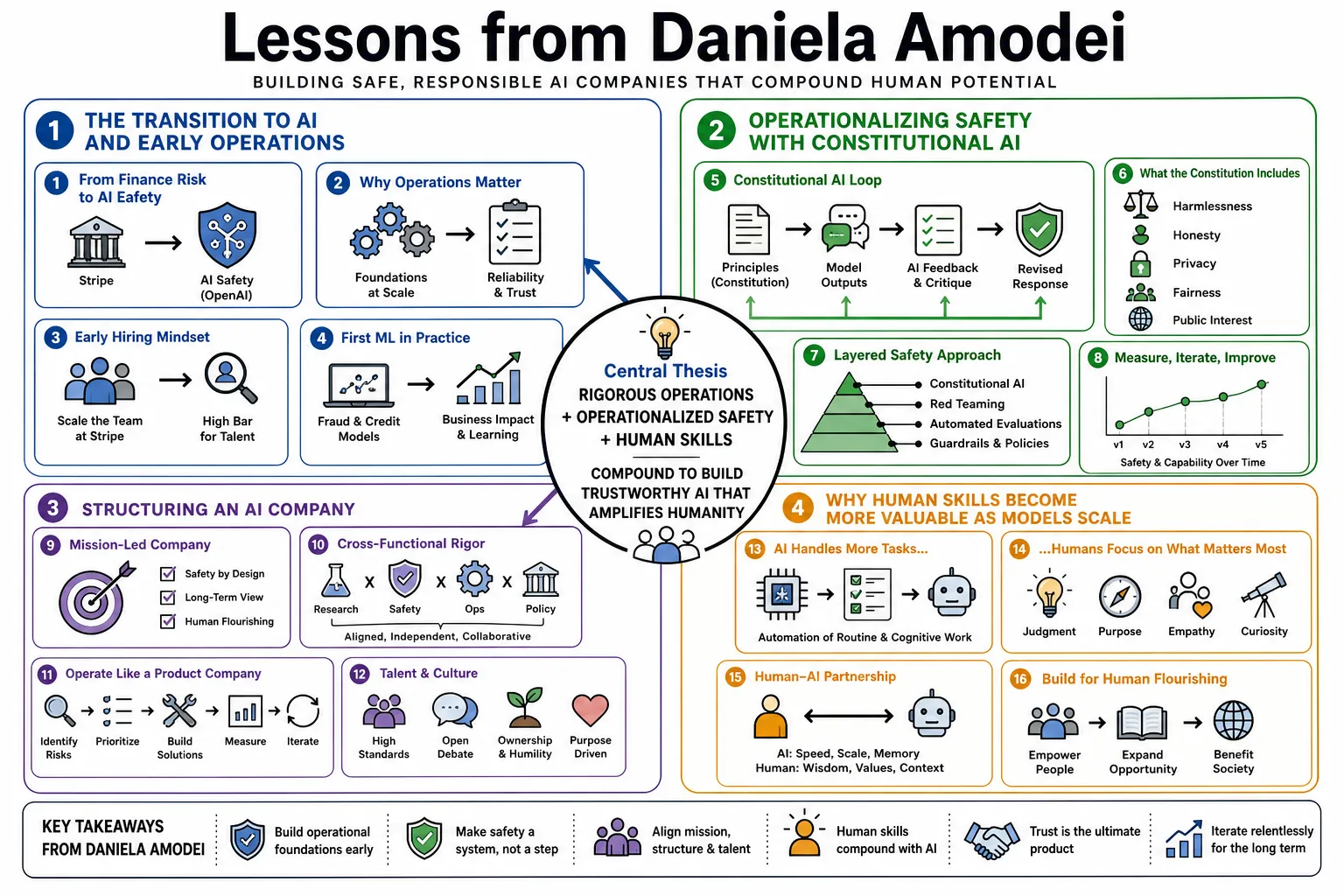
Part 1: The Transition to AI and Early Operations
- On Operating Foundations: Amodei’s early roles included recruiting and risk operations at Stripe; she later brought people and operational experience to AI research organizations. — WIRED Interview.
- On Moving Into AI: Her career moved from payments risk at Stripe to people, engineering and safety-policy responsibilities at OpenAI before co-founding Anthropic. — WIRED Interview.
- On Early Recruiting: Amodei’s experience recruiting at Stripe and OpenAI informed the attention she later gave Anthropic’s hiring culture. — Bain Capital Ventures Interview.
- On Safety Leadership: At OpenAI she became vice president of safety and policy after working with engineering and people teams. — WIRED Interview.
- On the People Side: Amodei held people-management responsibilities at OpenAI before her safety-and-policy leadership role. — WIRED Interview.
- On Choosing a New Direction: Amodei says the founders wanted to create an organization that put safety and responsibility at the forefront; she describes moving toward that vision rather than only away from OpenAI. — Stripe Interview.
Part 2: The Sibling Dynamic and Co-Founding Anthropic
- On a Long Shared History: Amodei describes co-founding with Dario as a chance to build with someone she has known her entire life and whose skills complement hers. — Vanta Founder Interview.
- On Complementary Strengths: Amodei says she and Dario bring complementary approaches to problems, which she calls a strength of their working relationship. — Vanta Founder Interview.
- On Shared Founding Values: She says Anthropic’s founders wanted an organization that could pursue commercially useful AI while putting safety and public benefit at its center. — Stripe Interview.
- On Prior Collaboration: Daniela and Dario worked together at OpenAI before building Anthropic; she says they had wanted to work on a project together for years. — Vanta Founder Interview.
- On Building With Colleagues: In Amodei’s 2023 account, the founding group had to rebuild a language model and company from scratch while continuing safety research. — Stripe Interview.
Part 3: The Public Benefit Corporation Structure
- On Choosing the PBC Form: Amodei says the founders spent time choosing a public benefit corporation structure to balance commercial needs with public-purpose commitments. — Vanta Founder Interview.
- On Legal Latitude: Anthropic says its Delaware PBC form permits directors to weigh public benefit and affected stakeholders alongside stockholder financial interests; it is not absolute protection from litigation. — Anthropic Benefit Trust.
- On Balancing Commercial and Public Aims: Amodei describes the PBC as a pragmatic way to pursue a commercial AI business while preserving a public-benefit purpose. — Vanta Founder Interview.
- On the Benefit Trust: Anthropic’s Long-Term Benefit Trust consists of financially disinterested trustees empowered to select and remove a growing share of its board. — Anthropic Benefit Trust.
- On Business and Public Good: Amodei argues that building a commercial product and pursuing safer AI can often reinforce one another, while acknowledging possible conflicts. — Stripe Interview.
- On Safety as Customer Value: In her 2023 Stripe interview, Amodei said customers wanted models that avoided harmful, dishonest and unhelpful outputs; this was her market judgment, not a measured universal preference. — Stripe Interview.
- On Owning AI’s Risks: Amodei says Anthropic must acknowledge both AI’s potential benefits and harms and take responsibility for how it develops the technology. — WIRED Interview.
- On Mission as a Decision Guide: Anthropic’s published values say its mission supplies a common purpose and guides decisions; this is company-authored language rather than a verified Daniela quotation. — Anthropic Company Values.
Part 4: Constitutional AI and the HHH Framework
- On Helpful, Honest and Harmless: Anthropic describes helpfulness, honesty and harmlessness as design goals for Claude, not as a claim that any released model is completely safe. — Claude’s Constitution.
- On Tradeoffs Between Goals: The Stanford talk frames helpfulness, honesty and harmlessness as priorities that can require different balances depending on an application. — Stanford eCorner Talk.
- On Constitutional AI: Amodei explains Constitutional AI as using a set of ethical principles during model training; she explicitly credits Anthropic’s research team with developing the idea. — WIRED Interview.
- On Guiding Behavior: Anthropic’s constitution supplies principles for judging and revising responses, aiming for outputs that are helpful, honest and harmless. — Claude’s Constitution.
- On AI Feedback: Anthropic describes training phases in which models critique or compare outputs using constitutional principles, reducing some reliance on direct human feedback; this is a method, not guaranteed self-policing. — Claude’s Constitution.
- On Borrowed Principles: Amodei says the original constitution drew on existing documents such as the Universal Declaration of Human Rights rather than relying solely on the company’s own ethical preferences. — WIRED Interview.
- On Early Safety Design: Amodei argues that safety principles should be incorporated during training rather than appended only after a model is built. — WIRED Interview.
- On a Safety Example: Amodei says Anthropic wants its safety work to set a useful example for other AI companies, while recognizing that one company cannot settle governance alone. — WIRED Interview.
- On Empirical Simplicity: Anthropic’s published value “do the simple thing that works” describes an empirical preference for effective methods over sophistication for its own sake. — Anthropic Company Values.
Part 5: Responsible Scaling and Managing Risk
- On Anthropic’s Founding Aim: Amodei describes making AI systems safer from the start as a central reason the team founded Anthropic. — Stripe Interview.
- On Policy and Regulation: Anthropic says responsible scaling policies can inform regulation rather than replace it. — Anthropic Targeted Regulation.
- On Capability-Linked Safeguards: Anthropic’s 2023 Responsible Scaling Policy links stronger model capabilities with stronger evaluation and security requirements. — Anthropic Scaling Policy.
- On Threshold Commitments: The original policy describes capability thresholds that trigger specified safeguards before further model development or deployment; it should be read as the 2023 policy, not an immutable current rule. — Anthropic Scaling Policy.
- On Providers and Policymakers: Anthropic argues that developers should disclose risk evaluations and provide useful evidence to policymakers rather than asking the public simply to trust voluntary promises. — Anthropic Targeted Regulation.
- On Military-Use Boundaries: In February 2026 Anthropic said talks with the U.S. defense department reached an impasse over two restrictions: mass domestic surveillance and fully autonomous weapons. This is the company’s dated account, not a blanket rejection of military use. — Anthropic February 2026 Statement.
- On Light and Shade: Amodei uses “hold light and shade” to describe acknowledging AI’s benefits and risks at the same time. — WIRED Interview.
- On Benefits Conditional on Risk Work: Amodei argues that potential benefits such as medical advances require serious attention to misuse, reliability and public oversight; she is describing a responsibility, not proven outcomes. — WIRED Interview.
- On an Iterative Policy: Anthropic says it has revised its Responsible Scaling Policy as model capabilities and risk evidence changed; the policy is an evolving framework. — Current Scaling Policy.
Part 6: Building Culture and the Culture Fit
- On Culture as Currency: Amodei calls culture a small, fast-growing company’s most valuable currency and links it to its lived values. — Vanta Founder Interview.
- On Holding Tensions: Anthropic’s published “hold light and shade” value asks employees to see AI’s promise and risks together. — Anthropic Company Values.
- On Making Values Concrete: Amodei says values should be written down and backed by ready examples, so employees can recognize how they guide real decisions. — Vanta Founder Interview.
- On a Culture Interview: Anthropic added a culture interview alongside technical interviews to explore value alignment while allowing disagreement and evolution. — Bain Capital Ventures Interview.
- On Deliberate Culture Screening: Amodei explains the culture interview as a way to understand candidates’ reasoning and give them a realistic view of the company, not to demand a particular belief system. — Vanta Founder Interview.
- On Explicit Mission Fit: She recommends being clear about an organization’s mission early so interested candidates opt in and others can decide it is not for them. — Vanta Founder Interview.
- On Repeating Values: Amodei says Anthropic tries to mention a company value at each all-hands meeting without forcing it into the discussion. — Vanta Founder Interview.
- On Employee Vocabulary: She wants values to feel natural and usable to employees; she notes that wording people reject will not stick. — Vanta Founder Interview.
Part 7: Hiring for the Human Edge
- On Human Strengths: In discussing advanced AI, Amodei argues for preserving human judgment and flourishing rather than treating model capability as the sole measure of progress. — WIRED Interview.
- On Respectful Communication: Amodei says she looks for people who can discuss difficult or controversial subjects respectfully and remain open-minded. — Vanta Founder Interview.
- On Unusual Beliefs: Her culture interview asks candidates about unusual beliefs they have defended or revised, to learn how they reason under disagreement. — Vanta Founder Interview.
- On Disagreement: For Amodei, respectful disagreement is a skill Anthropic deliberately probes in its culture interview. — Vanta Founder Interview.
- On Cross-Functional Teams: Amodei says collaboration between research and product teams helps new model capabilities become useful products, with customer use informing later model work. — Vanta Founder Interview.
Part 8: The Humanities and the Future of Work
- On the Humanities: In her 2026 ABC News interview, Amodei argued that studying the humanities could become more valuable as AI improves at technical tasks; this is her forecast, not a measured labor-market outcome. — ABC News Daniela Interview.
- On Understanding People: Amodei points to understanding ourselves, history and one another as enduring reasons to study literature and the humanities. — ABC News Daniela Interview.
- On AI as a Collaborator: In her Stripe interview, Amodei says she hopes people use Claude as a partner or collaborator that helps them pursue their own aims. — Stripe Interview.
- On Work in Transition: Amodei says AI’s effects on work deserve public discussion; in a 2025 interview she described Anthropic’s observed use as a mix of automation and augmentation, then mostly complementary. — WIRED Interview.
- On Expanding What People Can Do: Amodei says AI may help people accomplish tasks they could not before, but she also calls for careful choices about deployment and labor effects. — WIRED Interview.
- On Critical Thinking: Amodei’s humanities argument emphasizes critical thinking and the ability to relate to other people; it does not establish that AI fails at all ambiguous work. — ABC News Daniela Interview.
- On Choices Around AI: Amodei argues that the outcome of more capable AI depends partly on how its developers and society handle benefits, risks and the future of work. — WIRED Interview.