Danielle Morrill was Twilio’s first marketing hire and later co-founded and led Mattermark. Her work and writing span developer marketing, startup metrics, product development and the personal aftermath of building a company. — Danielle Morrill Resume.
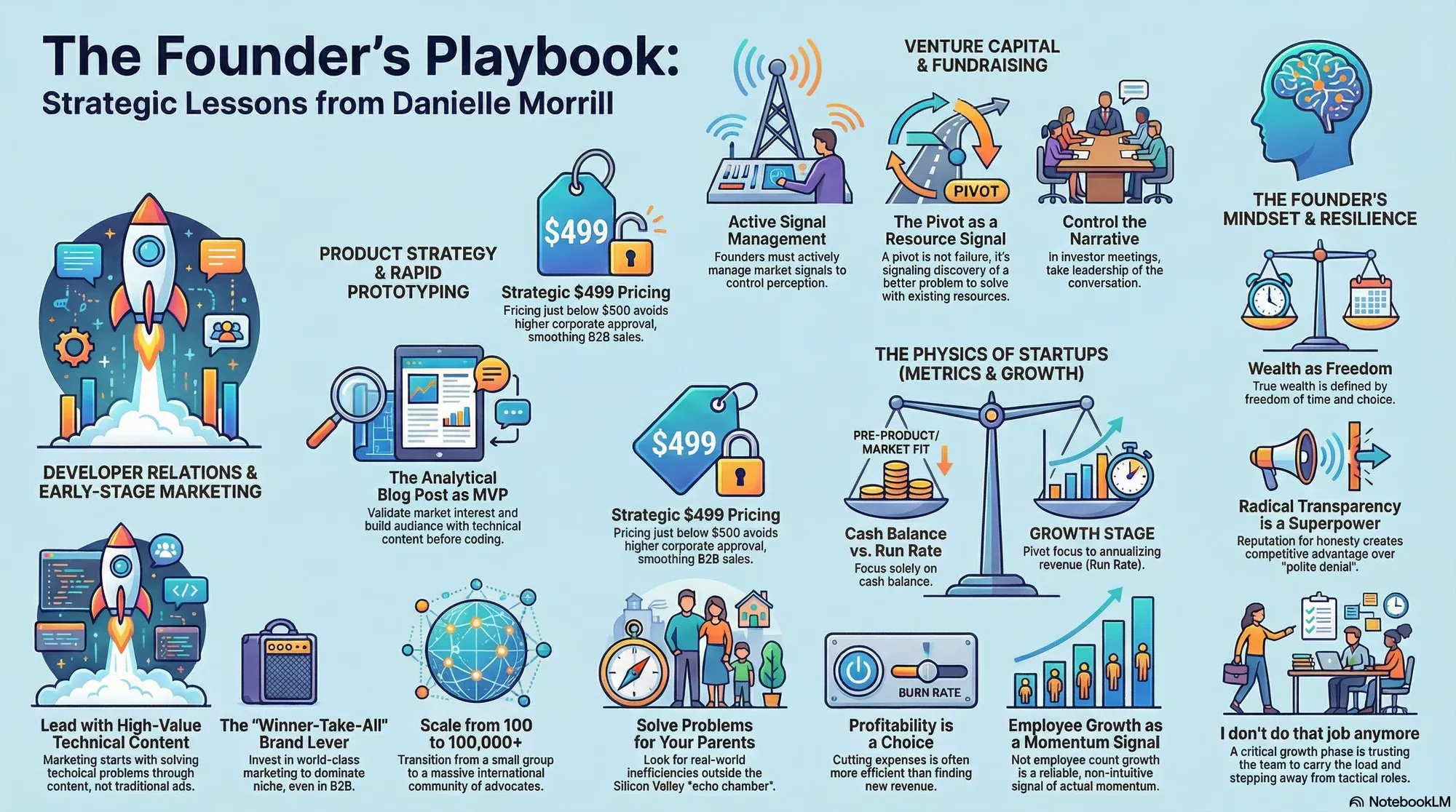
Part 1: Developer Relations and Early-Stage Marketing
- On the First Marketing Mandate: Heavybit says Morrill joined Twilio to acquire early customers and build its developer community. — Heavybit Twilio Launch Masters.
- On Developer Community Growth: Heavybit reports that the Twilio community grew from a few hundred to more than 100,000 developers while its advocates became a distributed international team. — Heavybit Twilio Launch Masters.
- On Developer Content: Morrill treated useful content as a core way to earn developer attention, adapting the pipeline as the audience grew. — Heavybit Developer Marketing Talk.
- On Respecting Developers: Her account of Twilio emphasizes documentation, working demos and useful material that developers can try, not a generic “developers, developers, developers” quotation. — Danielle Morrill Resume.
- On Scaling a Marketing Team: Morrill says she built Twilio’s marketing organization from zero to eighteen people over roughly three years. — Danielle Morrill Resume.
- On B2B Awareness: Morrill argued that B2B products still need brand awareness: prospects must know a product exists before they can buy it. — Judge and Prepare to Be Judged.
- On Original Content: In her developer-marketing talk, Morrill resisted a fixed content template and urged teams to make material distinctive enough to earn attention. — Heavybit Developer Marketing Talk.
- On Leaving Well: Morrill says she left Twilio while still engaged so she could help onboard successors rather than slowly taper off. — YC Career Interview.
- On Direct Communication: In a Mattermark interview, Morrill described valuing direct questions and candid discussion while learning from customers. — Mixergy Mattermark Interview.
- On Leading a YC Interview: Morrill recalls bringing her product to a YC interview and steering the brief conversation toward what she had built. — Mixergy Mattermark Interview.
Part 2: The Physics of Startups—Metrics and Growth
- On Pre-Fit Cash: Morrill’s 2015 framework treats cash balance and runway as the most useful high-level indicators before product–market fit. — 3 Phases of Financial Indicators.
- On Growth-Stage Run Rate: Once revenue was growing, she used run rate while warning that annualized revenue and annual recurring revenue mean different things. — 3 Phases of Financial Indicators.
- On Revenue Recognition: For later-stage reporting, she distinguishes annual revenue recognized under accrual accounting from cash collected and end-of-year run rate. — 3 Phases of Financial Indicators.
- On Burn and Profitability: Morrill says spending and profitability are partly management choices; controlling expenses can be easier than creating new revenue. — 3 Phases of Financial Indicators.
- On Net Burn: She describes monitoring the monthly change in Mattermark’s bank balance against a burn target and investigating deviations. — 3 Phases of Financial Indicators.
- On Delayed Recognition: Morrill warned that founders should not use misleading growth signals to postpone acknowledging an unhealthy business. — Judge and Prepare to Be Judged.
- On Public Momentum Signals: Her early startup research looked beyond revenue to changes in public signals that might reveal emerging companies. — Revenue vs. Value.
- On Premature Expansion: Her incrementality essay urges founders to keep winning an initial market after product–market fit instead of chasing adjacent products for fundraising appeal. — Incrementality Mentality.
- On Growth Pressure: Morrill describes how the transition from starting to building a company demands specialists and makes earlier growth rates harder to sustain. — Incrementality Mentality.
- On Metric Definitions: She shows that several revenue metrics can be numerically true yet communicate different realities, so founders must define which one they mean. — 3 Phases of Financial Indicators.
Part 3: Product Strategy and Requests for Startups
- On Content Before Product: After Referly, Morrill began blogging about startup data while simultaneously exploring a prototype; the writing helped reveal demand. — YC Founder Interview.
- On Fast Prototyping: Mattermark’s first paid prototype was a simple web page assembled within weeks of ending Referly, before a polished user system existed. — Mixergy Mattermark Interview.
- On the $499 Price: Morrill says Mattermark’s initial $499 monthly price was partly arbitrary but attractive because it fell below some companies’ $500 expense-review threshold. — Mixergy Mattermark Interview.
- On Spreadsheet-to-API Tools: In a 2014 request for startup, she proposed turning uploaded spreadsheet data into a simple documented API. — Spreadsheet-to-API Request.
- On Problems Outside the Bubble: Morrill urges founders to talk with people outside their own demographic circle, including older adults, to find different unmet needs. — Solve the Problems Your Parents Have.
- On Incremental Wins: She argues that after the excitement of fundraising, much of building a company is a series of subtle, incremental wins in the chosen market. — Incrementality Mentality.
- On Zombie Startups: Morrill used Referly’s stalled original idea to warn against staying nominally alive without meaningful progress; she says to acknowledge reality and decide a next step. — Zombie Startups.
- On Expanding Beyond VCs: Mattermark’s ambitions grew from tools for venture investors toward a wider group of deal professionals, including corporate development and sales. — Mattermark Deal Intelligence.
- On Starting With Spreadsheets: Her manual startup-data spreadsheets exposed a problem worth automating; customers later asked to pay for access to the data. — Mixergy Mattermark Interview.
Part 4: Venture Capital and the Fundraising Ecosystem
- On Visible Startup Signals: Morrill observed that investors, employees and others infer a startup’s momentum from public actions and data, even when the picture is incomplete. — Judge and Prepare to Be Judged.
- On Pursuing a Skeptical Idea: When some investors doubted a startup-data blog could become a business, Morrill kept testing it through writing and a prototype. — YC Founder Interview.
- On Valuation Windows: In 2015 Morrill warned that a favorable late-stage private valuation window might close and emphasized businesses with sound economics. — The Unicorn Window Is Closing.
- On Backing Female Founders: Morrill has been an XFactor Ventures partner; the fund backs companies founded by women and mixed-gender teams. — XFactor Ventures.
- On Downturn Preparation: Asked how Mattermark would respond to a bear market, Morrill proposed data-rich reporting, longer contracts, a more resilient customer mix and cost cuts. — 3 Phases of Financial Indicators.
- On Communicating Vision: In a public investor update, Morrill acknowledged she needed to share Mattermark’s vision more consistently while hiring and managing cash. — Mattermark Investor Update.
- On Starting Over: Morrill says Mattermark was not a simple pivot: after ending Referly, she began again with writing, spreadsheets and a new product. — Mattermark Wasn’t a Pivot.
Part 5: The Founder's Mindset and Mental Resilience
- On Identity After a Startup: After Mattermark’s sale, Morrill says it took time to separate her identity from the CEO role and explain herself outside work. — Post-Startup Life Reflection.
- On Meaning and Distress: During her post-startup sabbatical, Morrill describes difficulty making meaning each day and recognized those thoughts as warning signs for herself. — Post-Startup Life Reflection.
- On Nonlinear Recovery: Morrill says her adjustment after burnout was uneven, with periods of progress and mornings when she felt in a funk again. — Post-Startup Life Reflection.
- On Economic Freedom: For Morrill, money matters chiefly because it can provide the freedom to choose how to live and work. — Post-Startup Life Reflection.
- On Rebuilding Routine: Morrill describes using activities such as exercise, cooking and reading, plus sharing daily accomplishments with her husband, as part of her own post-startup adjustment. — Post-Startup Life Reflection.
- On Time and Focus: Morrill writes that small daily choices compound and that founders should reassess what they work on when effort no longer advances the goal. — Don’t Waste a Single Moment.
- On Letting Go of Roles: As she moved from Twilio into founding, Morrill deliberately set aside professional identities that had once defined her so she could do different work. — I Don’t Do That Job Anymore.
- On Saying No: During Referly’s YC summer, she temporarily declined unrelated requests to focus on the metrics she had chosen for the company. — Saying No.
- On Public Candor: Morrill publicly described Mattermark’s difficult sale and the uneven period that followed rather than presenting an unbroken success story. — Post-Startup Life Reflection.