Dara Khosrowshahi took over Uber in 2017 after leading Expedia. His account of Uber’s turnaround emphasizes cultural change, marketplace execution and a shift from owning every new technology to partnering where appropriate. — Stratechery Interview.
On Leadership and Management
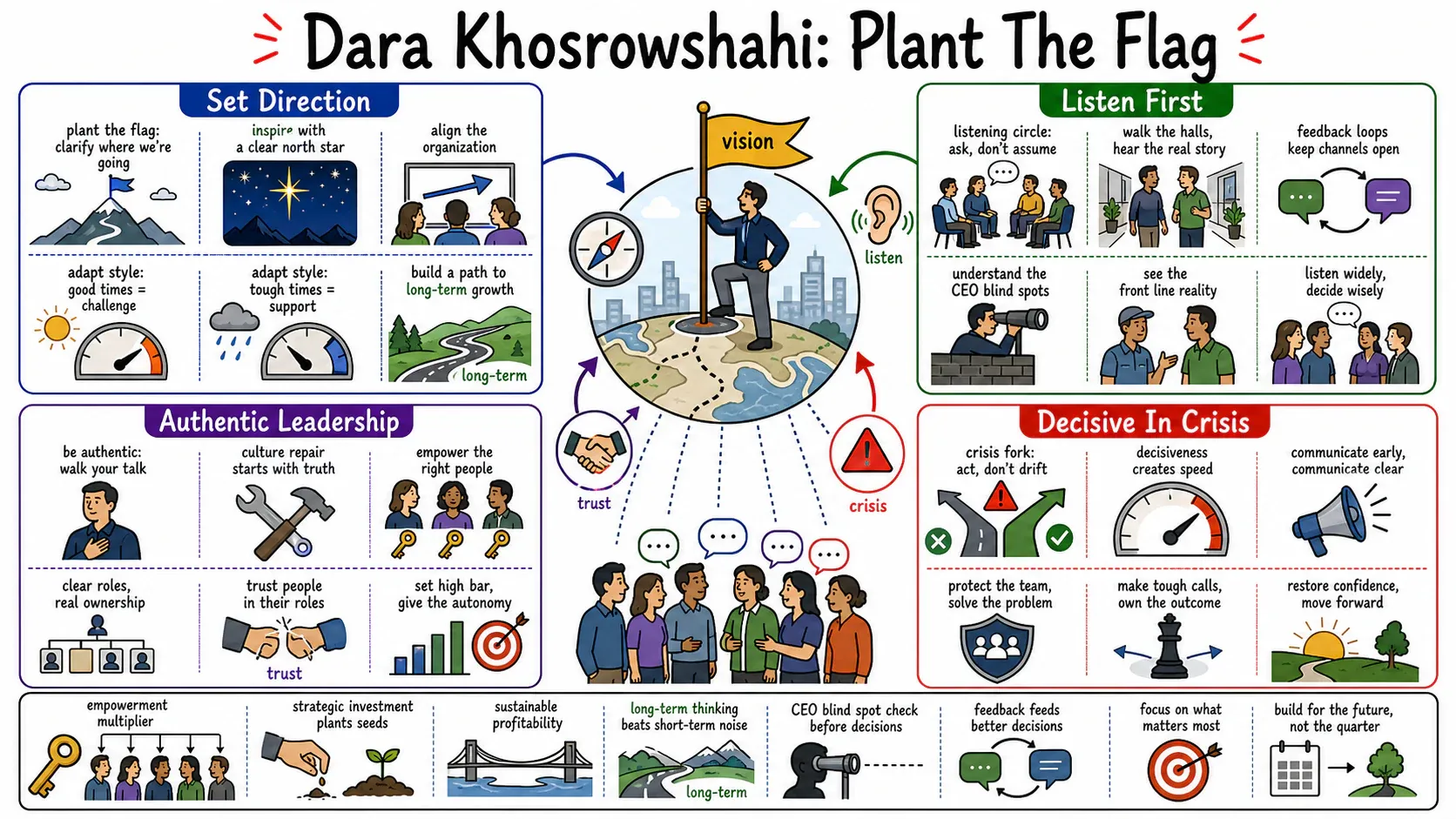
- The Core Role of a Leader: An Expedia product manager told Khosrowshahi to describe where the company was going instead of prescribing each task. He says this changed how he led: set direction, then trust people to find the route. — Masters of Scale Interview.
- Leading Through Tough Times: Khosrowshahi says leaders should counter the prevailing mood: offer reassurance and focus during bad times, while pressing for discipline when success makes a team complacent. — GeekWire Interview.
- Decision-Making in Crisis: In a crisis, Khosrowshahi says a leader must process bad signals quickly and make decisive, action-oriented calls; his more consultative peacetime style may be too slow. — Greylock Decision-Making Talk.
- Authenticity: Khosrowshahi learned that borrowing another executive’s mannerisms felt awkward; a leader has to choose practices that fit his own personality. — Masters of Scale Interview.
- Empowering Employees: At Expedia, he placed capable people in autonomous units and trusted them to act rather than requiring permission for routine decisions. — GeekWire Interview.
- Listening: After arriving at Uber, Khosrowshahi listened to employees and drivers; he describes dialogue with driver-partners as a basis for changes such as tipping and paid wait time. — Masters of Scale Interview.
- The CEO's Blind Spot: Senior leaders can receive filtered information. Khosrowshahi recounts Barry Diller seeking facts from the person closest to the work, a habit worth preserving as organizations grow. — Masters of Scale Interview.
- Long-Term Vision: Khosrowshahi argues that a durable mobility marketplace needs supply, demand and reliable operations to compound together, rather than optimizing for a short-term headline. — Stratechery Interview.
- Leading with Empathy: Khosrowshahi says his father treated factory employees as people rather than confusing managerial authority with personal status; he carried that model into his own approach. — Masters of Scale Interview.
On Company Culture
- Cultural Transformation: When Uber revised its 2017 cultural norms, Khosrowshahi explicitly made doing the right thing and responsible growth central to the reset. Those were stated commitments, not proof that the culture was already repaired. — Uber Cultural Norms.
- Evolving Company Values: Khosrowshahi called Uber’s 2017 rules cultural norms rather than timeless values because he expected them to evolve as the company changed. — Uber Cultural Norms.
- Avoiding Weaponized Values: He wrote that Uber’s old “toe-stepping” norm was intended to encourage candid ideas but had too often been used to excuse abusive behavior. — Uber Cultural Norms.
- Crowdsourcing Culture: Uber solicited more than 1,200 employee submissions and held focus groups before selecting the 2017 norms; Khosrowshahi wanted the culture shaped from the bottom up. — Uber Cultural Norms.
- Diversity and Inclusion: One of the 2017 norms was to celebrate differences and make room for people with varied backgrounds and opinions. This describes Uber’s stated cultural aim, not a measured inclusion outcome. — Uber Cultural Norms.
- The Importance of a Safe Workplace for Women: In a 2018 CBS interview, Khosrowshahi said Uber would fail if it could not make women and all employees feel safe at work. — CBS News Interview.
- Repairing a Toxic Culture: After Uber’s harassment allegations, Khosrowshahi said the company’s cultural change had to continue from the bottom up; this was a repair effort, not an accomplished cure. — CBS News Interview.
- Continuous Cultural Work: Khosrowshahi described repairing Uber’s culture as continuing work rather than a one-time announcement. — Masters of Scale Interview.
On Strategy and Innovation
- Desperation and Innovation: Uber’s pandemic crisis forced Khosrowshahi to simplify and make painful changes quickly; the lesson is that pressure can catalyze adaptation, not that desperation reliably produces innovation. — Masters of Scale Interview.
- Speed and Failure: Uber’s 2017 norms encouraged big bets and learning from failures; Khosrowshahi treated speed and experimentation as disciplines bounded by accountability. — Uber Cultural Norms.
- Combating Bureaucracy: To fight the slowdown that accompanies scale, Expedia kept brands and operating units relatively independent so teams could act without asking the CEO for every decision. — GeekWire Interview.
- Customer-Centricity: Khosrowshahi’s stated customer-obsession norm calls for solving rider and driver problems and sometimes accepting short-term sacrifices for lasting loyalty. — Uber Cultural Norms.
- Product and Technology: In ride-hailing, he focuses on reliability, wait time and price as customer-facing results of matching supply and demand well, rather than assuming technology alone solves the business. — Stratechery Interview.
- The Future of Transportation: Uber’s 2018 air-taxi idea later became a partnership: Joby acquired Uber Elevate in 2021, and Uber’s 2026 plan is to let riders book Joby aircraft through its app, subject to launch and certification. — Uber–Joby Announcement.
- Autonomous Vehicles: Uber sold its in-house autonomous-driving unit and now aims to aggregate partners’ self-driving vehicles into a high-utilization marketplace; safety and regulation remain adoption constraints. — Stratechery Interview.
- Competition: In a 2025 India interview, Khosrowshahi called Rapido a tougher local competitor than Ola, while advising challengers to build liquidity in a niche or city before scaling. This is a dated competitive assessment. — People by WTF Interview.
- Focus: In his India interview, he argued that competitors’ distracting initiatives create room for Uber to concentrate on mobility and sustainability in that market. — Economic Times Interview.
- Supply-Led Growth: Khosrowshahi says Uber is more supply-led than he initially expected: adding relevant drivers or restaurants can improve selection, conversion and demand. — Stratechery Interview.
On Life and Career
- His Immigrant Experience: His family fled Iran and rebuilt in the United States; Khosrowshahi says that experience taught him that losing a business need not be final. — Masters of Scale Interview.
- Gratitude for His Parents' Sacrifices: Khosrowshahi credits his parents’ resilience and hard work after emigrating from Iran with shaping his own response to setbacks. — Brown University Conversation.
- The American Dream: He describes his family’s opportunity to rebuild in the United States with gratitude, using his immigration story as a personal example rather than a universal claim. — Brown University Conversation.
- Curiosity: Khosrowshahi advises curiosity about people and subjects outside one’s immediate field; he says openness helped him notice unexpected career opportunities. — Brown University Conversation.
- Overplanning: In his signed career essay, he warns that a rigid five- or ten-year plan can make people miss unexpected opportunities; stay flexible while choosing the next useful step. — Why You Should Dump Your 5-Year Career Plan.
- Facing Messy Situations: He initially rejected the Uber CEO role as too messy, but came to see it as a chance for impact; he does not present the difficulty as a reason by itself to take a job. — Stratechery Interview.
- Travel's Resilience: During the 2008–09 downturn, Khosrowshahi told Expedia staff that people would continue to travel and focused the team on pushing through, while acknowledging the recession. — GeekWire Interview.
- His Personal Life: In a Bloomberg first-person profile, Khosrowshahi recalled marrying his wife in Las Vegas on 12/12/12 and her wearing a Slayer T-shirt; it is a personal anecdote, not a management lesson. — Bloomberg How Did I Get Here.
Additional Learnings and Insights
- Regain Trust Through Transparency: The 2017 Uber norms asked employees to admit mistakes, act like owners and place integrity at the center of decisions; transparency was an intended practice for rebuilding trust. — Uber Cultural Norms.
- Data-Driven Decision Making: Khosrowshahi recounts Barry Diller bypassing polished summaries to ask the analyst doing the work for underlying numbers; he learned to seek unfiltered evidence. — Masters of Scale Interview.
- Engage with Stakeholders: As Uber grew beyond its upstart phase, Khosrowshahi says it needed a more responsible dialogue with regulators and cities instead of relying on confrontation. — Stratechery Interview.
- Work for Great People: His signed career advice is to work hard for a leader from whom you can learn, even if the move is lateral; the original “50% more” prescription is not needed to make that supported point. — Why You Should Dump Your 5-Year Career Plan.
- The Importance of a Stable Policy Framework: For long-term investment in India, he asks for regulatory stability so Uber can forecast several years ahead; local variation still requires dialogue city by city. — Economic Times Interview.
Learn more:
- Uber: Uber’s New Cultural Norms
- Greylock: Uber CEO Dara Khosrowshahi on Decision-Making
- GeekWire: New Uber CEO on Leadership, Innovation and Crisis
- Masters of Scale: Bringing a Culture Back from the Brink
- Brown University: Dara Khosrowshahi on Leadership and Career Advice
- Dara Khosrowshahi: Why You Should Dump Your 5-Year Career Plan
- CBS News: Dara Khosrowshahi on Flying Taxis and Uber’s Culture
- Bloomberg: How Did I Get Here? Dara Khosrowshahi
- Uber: Get Ready for Takeoff with Uber and Joby
- Aurora: Acquiring Uber’s Self-Driving Unit
- People by WTF: Dara Khosrowshahi Interview
- Stratechery: Interview on Aggregation and Autonomy
- Economic Times: Dara Khosrowshahi on India Mobility
- Acquired: Uber CEO Dara Khosrowshahi