Daron Acemoglu studies how institutions and political power shape long-run economic outcomes. His work with collaborators also examines how choices about technology affect workers, inequality and democracy. — Institutions and Long-Run Growth.
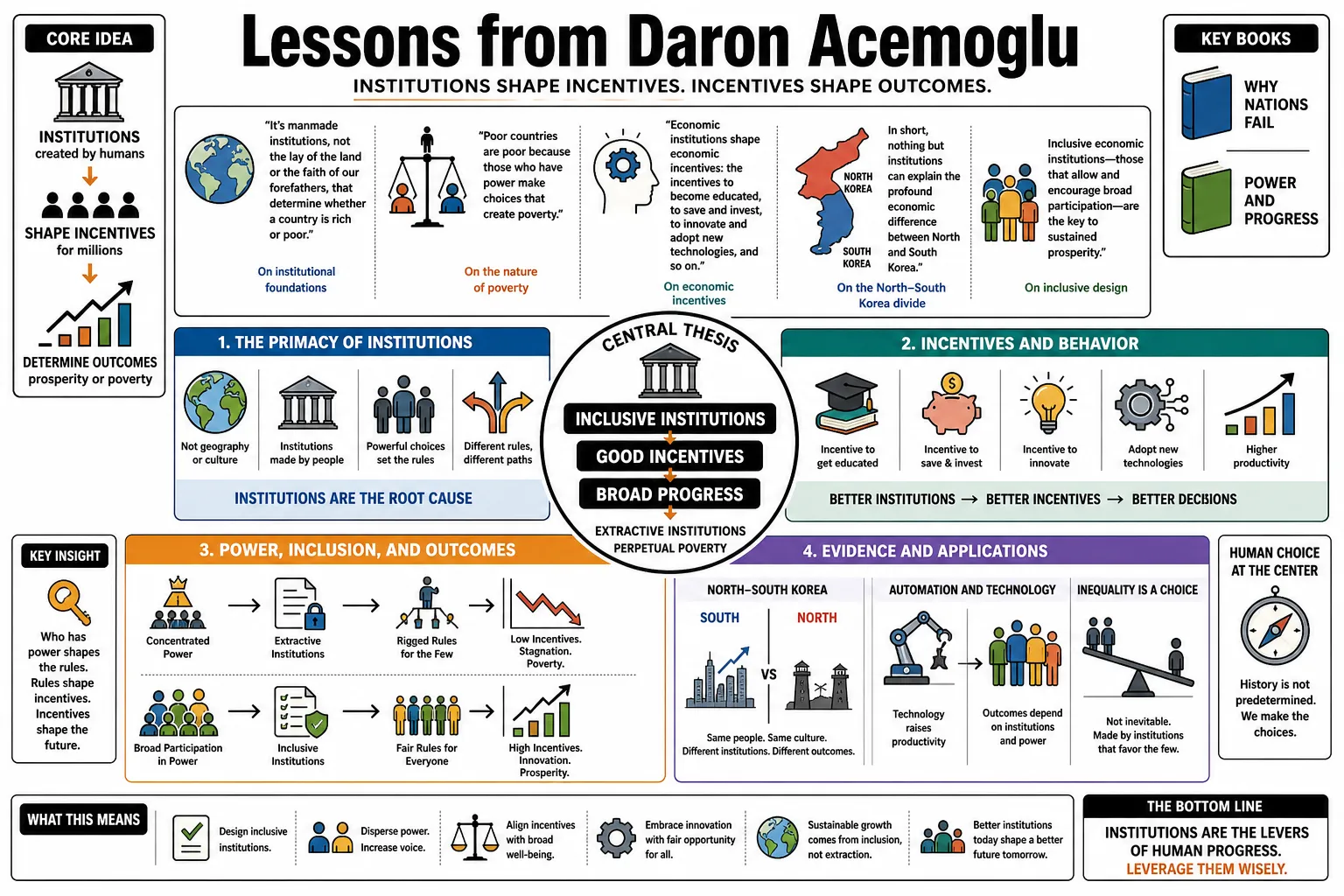
Part 1: The Primacy of Institutions
- Institutional Foundations: Acemoglu argues that political and economic institutions are central to long-run prosperity; geography and culture alone do not explain the observed divergence. — Why Nations Fail Lecture.
- Why Some Countries Stay Poor: Economic institutions are social choices, and groups holding political power can preserve arrangements that benefit them even when those arrangements inhibit development. — Institutions and Long-Run Growth.
- Economic Incentives: Economic institutions shape incentives to invest, acquire skills, adopt technology and organize production. — Institutions and Long-Run Growth.
- The Two Koreas: The division of Korea provides a comparison of similar geography and culture under sharply different institutional arrangements and economic outcomes. — Institutions and Long-Run Growth.
- Broad Participation: Inclusive economic institutions combine secure rights, market access, education and opportunity for a broad share of citizens. — Why Nations Fail Lecture.
- Enforceable Rights: Secure property rights and contracts depend in part on a state capable of providing law, order and public services. — Why Nations Fail Lecture.
- Political Centralization: Inclusive political institutions require pluralism and checks on rulers, alongside enough state centralization to enforce rules. — Why Nations Fail Lecture.
- Path Dependence: Small institutional differences can accumulate through drift and produce divergent outcomes when a critical juncture arrives. — Why Nations Fail Lecture.
- Prosperity Is Political: The move toward broadly shared prosperity depends on political arrangements that support inclusive economic institutions. — Why Nations Fail Lecture.
Part 2: The Trap of Extractive Systems
- Extractive Institutions: Extractive rules concentrate power and restrict entry, rights and opportunity, making sustained broad-based growth less likely. — Why Nations Fail Lecture.
- Political and Economic Extraction: Acemoglu distinguishes extractive economic rules from political institutions that concentrate power without effective constraints; the two can reinforce one another. — Why Nations Fail Lecture.
- Who Holds Political Power: Political institutions allocate formal power, while control of resources can also give groups effective power outside formal rules. — Institutions and Long-Run Growth.
- Elite Replacement Is Not Reform: Replacing a ruler does not automatically replace the extractive institutions that allow a narrow elite to dominate. — Why Nations Fail Lecture.
- Fear of Creative Destruction: Incumbent elites may resist innovation and inclusive reform because new firms and technologies threaten their economic rents or political position. — Why Nations Fail Lecture.
- The Limits of Extractive Growth: Growth can occur under extractive political institutions, but without creative destruction and broad entry it is less likely to be sustained. — Why Nations Fail Lecture.
- The Political Logic of Bad Policy: Rulers can protect their hold on power by blocking changes that would improve economic performance but create political rivals. — Why Nations Fail Lecture.
- Aid Cannot Substitute for Reform: Acemoglu and Robinson argue that aid can ease hardship but money alone is unlikely to change a country’s development path when institutions restrict opportunity. — Why Foreign Aid Fails.
Part 3: The Mechanics of Political Power
- Politics Shapes Economic Rules: The authors’ framework makes political power central: it helps determine which economic institutions are chosen and maintained. — Institutions and Long-Run Growth.
- Dispersed Political Power: Inclusive politics combines broad participation, limits on rulers and the rule of law. — Why Nations Fail Lecture.
- Critical Junctures: Large historical shocks can open opportunities for institutional change, but the outcome depends on pre-existing institutions and political conflict. — Why Nations Fail Lecture.
- The Vicious Circle: Extractive political and economic institutions can reinforce each other as those who gain resources use them to preserve power. — Why Nations Fail Lecture.
- The Virtuous Circle: Broad participation and constraints on elites can help inclusive institutions survive and support further economic openness. — Why Nations Fail Lecture.
- Institutional Drift: Gradual institutional changes can make societies respond differently to the same major historical shock. — Why Nations Fail Lecture.
- Pluralism: Acemoglu treats widely distributed political power and checks on rulers as key features of inclusive political institutions. — Why Nations Fail Lecture.
- Free Media and Inclusion: In their discussion of development, Acemoglu and Robinson identify a free media and a public voice in government among the institutional changes that matter. — Why Foreign Aid Fails.
- Coalitions for Reform: In Acemoglu’s account of England, a broad coalition used a critical juncture to constrain absolutist power and open political institutions. — Why Nations Fail Lecture.
Part 4: The Narrow Corridor of Liberty
- A Strong State and a Strong Society: Liberty depends on state capacity to provide security and on an organized society capable of checking how that power is used. — Narrow Corridor Lecture.
- The Balance Is Dynamic: The corridor of liberty is an ongoing political relationship between state and society, not a fixed institutional blueprint. — Narrow Corridor Lecture.
- The Red Queen: Acemoglu and Robinson call the continuing competition and cooperation between state and society the Red Queen dynamic. — Narrow Corridor Lecture.
- Despotic Leviathan: When state power overwhelms society’s ability to constrain it, state capacity can become a tool of domination. — Narrow Corridor Lecture.
- Absent Leviathan: A state too weak to maintain order leaves people vulnerable to violence or domination by others. — Narrow Corridor Lecture.
- The Shackled State: A capable state can protect liberty when citizens and their organizations can hold it to account. — Narrow Corridor Lecture.
- Capacity Is Double-Edged: State capacity can provide public order and services, but that same capacity requires effective social constraints. — Narrow Corridor Lecture.
- Staying in the Corridor: Maintaining liberty requires continual adjustment as the relative powers of state and society change. — Narrow Corridor Lecture.
Part 5: Technology, Automation, and Work
- Technology Has More Than One Path: Acemoglu and Johnson argue that technological development is shaped by choices, and automation is not its only possible direction. — Rebalancing AI.
- Excessive Automation: Automation can raise efficiency, but firms may invest in more of it than is socially desirable when they do not account for costs imposed on workers. — Harms of AI.
- Create New Tasks: Technologies that create new tasks for people can raise workers’ marginal productivity rather than merely reduce labor costs. — Rebalancing AI.
- The Productivity Bandwagon Is Not Automatic: Higher output per worker does not guarantee higher wages; the effect depends on whether technology increases workers’ contribution and bargaining power. — Rebalancing AI.
- Displacement Versus New Work: Automation displaces people from tasks; without offsetting new work or stronger worker productivity, gains need not be broadly shared. — Rebalancing AI.
- An Automation Bias: Acemoglu and Johnson say the digital era has emphasized automation more than creating new tasks, alongside declining worker power. — Power and Progress Lecture.
- Worker Voice: The postwar auto industry illustrates their argument that strong labor organizations helped workers share in productivity gains. — Power and Progress Lecture.
- Human-Complementary AI: Acemoglu advocates tools that give workers useful information and support more complex decisions and tasks. — Senate AI Testimony.
- Policy Can Redirect Investment: Their policy menu includes changing tax incentives and supporting worker-friendly technologies, rather than simply accepting the present direction of innovation. — Power and Progress Lecture.
Part 6: Artificial Intelligence and Human Agency
- A Pro-Citizen Direction: Acemoglu contrasts AI that informs public deliberation with tools used for surveillance, manipulation or manufactured outrage. — Senate AI Testimony.
- AI Can Empower Workers: AI could help people perform more complex tasks and make better decisions if it is designed as a complement to human work. — Senate AI Testimony.
- Data, Monitoring and Privacy: Acemoglu warns that AI-enabled data collection can erode privacy and enhance companies’ and governments’ capacity to monitor people. — Harms of AI.
- Keep Human Judgment: He cautions that handing decisions to AI can weaken human decision-making capabilities rather than necessarily freeing people for higher-value judgment. — Harms of AI.
- Whose Interests Shape AI?: Acemoglu argues that current AI development may amplify corporate and governmental power against workers and citizens. — Harms of AI.
- So-So Automation: Their self-checkout example illustrates technology that shifts work away from employees without a corresponding productivity gain. — Power and Progress Lecture.
- Machine Usefulness Over Imitation: He argues that making AI useful to workers and decision-makers deserves more emphasis than pursuing systems that mimic general human intelligence. — Senate AI Testimony.
- Democratic Oversight of AI: His Senate testimony calls for regulation and a pro-citizen direction that supports informed democratic participation. — Senate AI Testimony.
Part 7: Inequality and Shared Prosperity
- Inequality Is Shaped by Choices: Acemoglu and Johnson connect recent inequality to the direction of technological change and the erosion of worker power, rather than treating it as an inevitable effect of innovation. — Power and Progress Lecture.
- Education Is Only Part of Inclusion: Acemoglu includes access to education among inclusive institutions, but also emphasizes property rights, open entry and political constraints on power. — Why Nations Fail Lecture.
- The Loss of Good Jobs: Their account links the digital era’s wage divergence to a technology path concentrated on automation and weakened worker voice. — Power and Progress Lecture.
- Minimum Wages and Job Quality: In Acemoglu’s model, a moderate minimum wage can shift job creation toward higher-wage, more productive positions; the result is conditional, not universal. — Good Jobs versus Bad Jobs.
- Welfare and Civic Power: Acemoglu and Robinson use the social-democratic state to show how expanded welfare can coexist with liberty when organized groups help constrain the stronger state. — Narrow Corridor Lecture.
- Wealth Can Become Political Power: Their institutional framework allows concentrated resources to translate into effective political power and influence future rules; it does not make that outcome inevitable in every case. — Institutions and Long-Run Growth.
- Colonial Institutional Legacies: Their research traces part of today’s cross-country income divergence to different institutions established during European colonization. — Institutions and Long-Run Growth.
- Market Power and Democracy: Acemoglu warns that data advantages can weaken competition and that AI-mediated communication can also damage democratic discourse. — Harms of AI.
Part 8: Reclaiming the Democratic Future
- Society as a Counterweight: Organized citizens can constrain the state and help maintain a capable but shackled government. — Narrow Corridor Lecture.
- Institutional Change Needs Coalitions: Acemoglu’s examples of reform emphasize political conflict and coalition-building, not policy design alone. — Why Nations Fail Lecture.
- Steer Technology Policy: They propose regulation, tax reform and support for worker-friendly technologies to change the direction of innovation. — Power and Progress Lecture.
- Do Not Outsource Civic Judgment: His pro-citizen AI proposal would give people better information for deliberation rather than use algorithms to manipulate their choices. — Senate AI Testimony.
- Organize Civil Society: Their account treats bottom-up mobilization and its institutionalization as essential to checking elite and state power. — Narrow Corridor Lecture.
- Learn from Institutional History: Comparing episodes such as the Glorious Revolution and colonial divergence helps identify how institutional change and critical junctures interact. — Why Nations Fail Lecture.
- Reform Is Possible: Acemoglu’s historical account includes transitions toward more inclusive political and economic institutions, even though they are contested and reversible. — Why Nations Fail Lecture.
- Liberty Beyond Income: In their framework, a successful state protects people from violence and domination as well as supporting economic opportunity. — Narrow Corridor Lecture.