Lessons from Dave Baszucki
Dave Baszucki is the co-founder and CEO of Roblox, the platform that turned video games into user-generated social spaces. He started with educational physics simulators before building a multi-billion dollar economy where teenagers create and monetize their own digital worlds. This collection tracks his perspective on digital identity and the infrastructure required for shared 3D experiences.
Part 1: The Origins and Knowledge Revolution
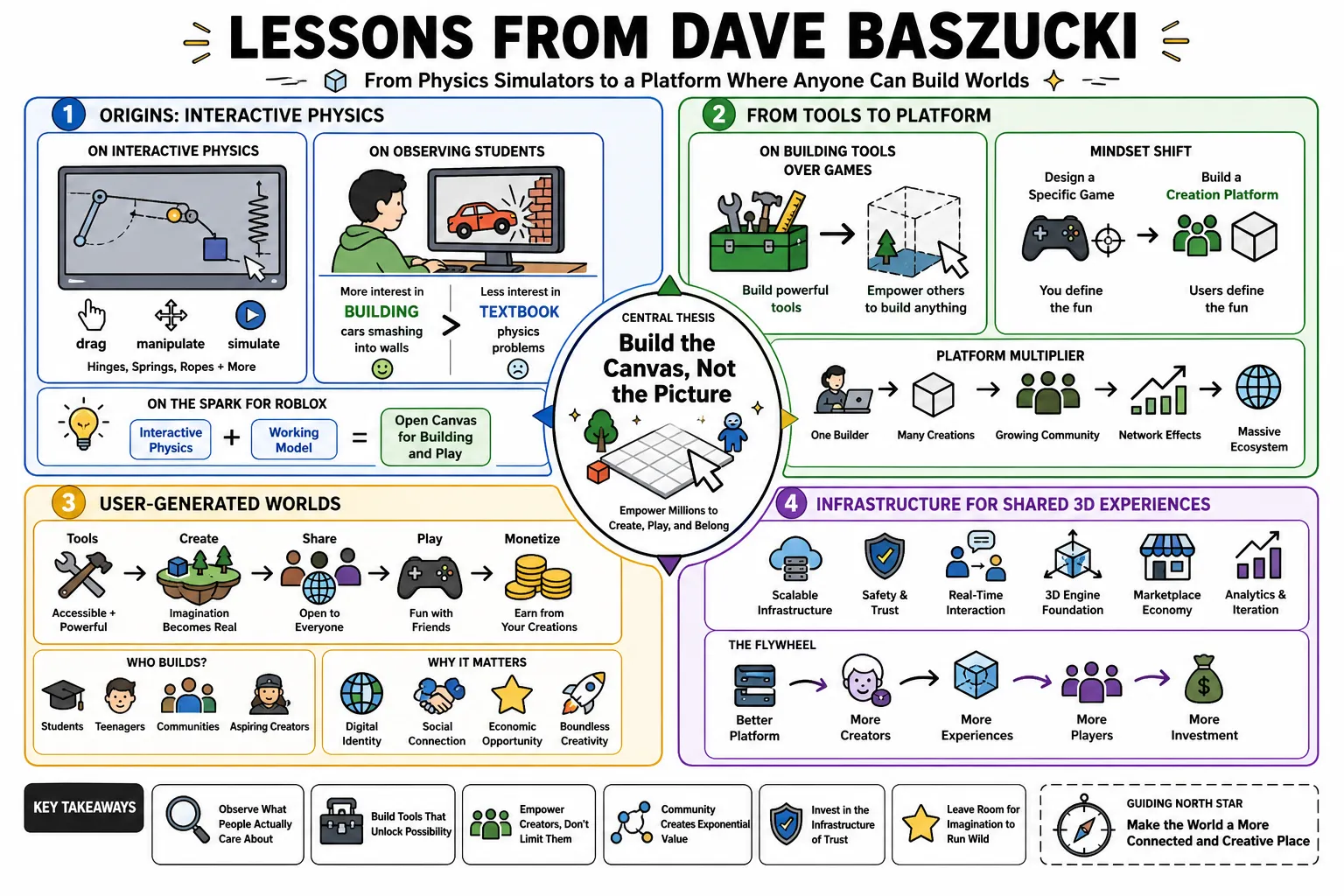
- On Interactive Physics: "The program allowed students to conduct physics experiments on-screen by dragging and manipulating parts like hinges, springs, and ropes." — Source: Time Graphics
- On observing students: He noticed that students using Interactive Physics were more interested in building cars smashing into walls than solving textbook physics problems. — Source: Game Developer
- On the spark for Roblox: The success of Interactive Physics and Working Model served as the primary inspiration for a platform that functioned as an open canvas for building and play. — Source: Game Developer
- On building tools over games: Rather than designing a specific game, his early career taught him the value of building simulation tools that let the user dictate the outcome. — Source: Pop Culture Hall
- On early partnerships: After selling Knowledge Revolution for $20 million, he reunited with his former engineer Erik Cassel to begin developing the prototype that would become Roblox. — Source: Reddit
- On physics engines as a foundation: He believed that rigid body dynamics and accurate physics simulations were the necessary underlying fabric for a believable virtual world. — Source: Roblox YouTube
- On the two-year sabbatical: Before starting Roblox, he took a two-year break to reflect on how software could enable people to build their own social environments. — Source: Conversations with Tyler
- On early company building: Before Roblox, Baszucki, Erik Cassel, and his brother Greg founded Knowledge Revolution in the late 1980s and built Interactive Physics as a leading educational physics software package. — Reference: Baszucki Group bio on Knowledge Revolution and Interactive Physics
- On transitioning from 2D to 3D: The leap from 2D physics modeling to a fully networked 3D environment was the core technical bet behind the initial Roblox prototype. — Source: Roblox YouTube
Part 2: The Philosophy of Co-Experience
- On defining the metaverse: He views the metaverse not as a fixed destination, but as an evolving space for social connection, communication, and shared experiences. — Source: All Women's Talk
- On human co-experience: The fundamental goal is to provide the ability for people to come together in immersive 3D spaces to play, learn, work, and socialize just as they do in physical life. — Source: Startup Hub
- On digital life events: People use the platform for events that mirror real life, such as throwing birthday parties or hosting graduations when they cannot meet in person. — Source: GamesBeat
- On the "Shepherd" philosophy: Roblox does not build the metaverse itself; instead, the company acts as a shepherd to provide the tools and infrastructure for the community to construct it. — Source: GamesBeat
- On utility beyond gaming: The platform is an extension of the history of entertainment, moving from books to film to interactive 3D environments that serve a broader purpose than just playing a game. — Source: Hardcore Gamer
- On connection over consumption: "The reason I feel they're beautiful is... I tried to imagine the 12-year-old or the 18-year-old or the 30-year-old struggling to build something wonderful and the human connection to those games." — Source: Conversations with Tyler
- On spatial interaction: True co-experience requires spatial audio and physics so that standing next to a friend in a digital room feels socially equivalent to standing next to them physically. — Source: Roblox YouTube
- On asynchronous vs. synchronous: While social media relies on asynchronous feeds, the future of the internet is shifting toward synchronous, real-time shared activities. — Source: Stratechery
- On emergent gameplay: Providing a physics engine and a multiplayer environment allows social norms and complex gameplay loops to emerge organically from the players rather than the developers. — Source: GamesBeat
Part 3: The Creator Economy and User-Generated Content
- On the creator flywheel: Better tools lead to higher-quality user-generated content, which attracts more players, which in turn draws more creators to the platform. — Source: Koder.ai
- On teen entrepreneurs: He emphasizes that the platform's content is the authentic effort of real people pouring their hearts out to make something that other people love to play. — Source: Conversations with Tyler
- On the Developer Exchange (DevEx): Baszucki describes Roblox as a virtual economy where creators can earn Robux inside experiences, cash those Robux out for real money, and grow from hobbyists into studios making a living. — Reference: Conversations with Tyler transcript on Roblox creators and the virtual economy
- On lowering the barrier to entry: Providing a robust development environment like Roblox Studio is essential for removing technical friction so anyone with an idea can build it. — Source: GamingBolt
- On economic scale: The platform has matured into a multi-billion dollar economy, paying out over a billion dollars to developers and enabling top creators to earn millions annually. — Source: Sourcery.vc
- On distributed creation: The vast majority of the content, games, and social experiences are created by the community and not the company itself. — Source: Hardcore Gamer
- On learning through building: Modding and building simple games serves as an on-ramp for computer science education and digital literacy for a younger generation. — Source: Tech Blog Writer
- On aligning incentives: The virtual economy is designed so that the platform only succeeds if the creators are also economically successful and motivated to keep updating their worlds. — Source: Wikipedia
- On open marketplaces: Allowing creators to sell digital items, clothing, and assets to one another creates a secondary economy that fuels independent digital fashion and design. — Source: Stratechery
- On long-term developer retention: The goal is to provide enough server infrastructure and monetization tools so that developers never feel the need to graduate off the platform to build standalone apps. — Source: GamesBeat
Part 4: Identity, Avatars, and Representation
- On the necessity of virtual identity: "You have to have an avatar with a virtual identity. You can be everything from a rock star to a fashion model, and that's one big draw of the metaverse." — Source: GamesBeat
- On self-expression: The platform aims to provide a wide range of skin tones, body sizes, hair colors, textures, and styles to enable authentic digital self-expression. — Source: GamesBeat
- On the combinatorial explosion: He advocates for a system that allows for a combinatorial explosion in a user’s ability to customize their look and be exactly who they want to be. — Source: Reddit
- On persistent identity: Avatars serve as a persistent, single identity that travels with a user across completely different experiences on the platform to reinforce social presence. — Source: Substack
- On conveying emotion: The evolution of avatars through integrating facial animation, body language, and voice is crucial for conveying emotion and authentic connection between users. — Source: GamesBeat
- On physical interaction in 3D: Baszucki argues that 3D simulation communication adds body language, spatial audio, walking around, and the feeling of being together in the same place. — Reference: The Verge Decoder interview on 3D simulation communication
- On updating the aesthetic: While the traditional blocky character is iconic, supporting high-fidelity, proportional avatars is necessary to attract older audiences and fashion brands. — Source: The Motley Fool
- On digital fashion economies: Users care deeply about how they present themselves digitally, making avatar clothing and accessories a massive driver of the platform's internal economy. — Source: Ampere Analysis
- On identity as a foundational pillar: Along with friends, immersion, and a functioning economy, identity is one of his strictly defined eight tenets of the metaverse. — Source: USM
Part 5: The Architecture of the Metaverse
- On execution speed over competition: He maintains that the company's primary competition is its own execution speed in scaling infrastructure. — Source: Marginal Revolution
- On the Everything App: He has explored the evolution of platforms into everything apps, where social communication, storytelling, commerce, and immersive gameplay naturally converge. — Source: Fenado AI
- On seamless teleportation: A core technical requirement of a metaverse is the ability to instantly teleport from one experience or digital world to another without friction. — Source: Stratechery
- On device agnosticism: The platform must be accessible on phones, tablets, consoles, PCs, and VR headsets simultaneously to allow cross-play regardless of the hardware. — Source: Roblox YouTube
- On global infrastructure: Supporting millions of concurrent users requires building a proprietary edge cloud network to minimize latency and ensure fair physics simulations globally. — Source: GamesBeat
- On organic growth: The architecture of the platform relies on network effects, where users invite their real-life friends to join them in an experience, driving organic user acquisition. — Source: The Tim Ferriss Show
- On scaling to older demographics: The architectural roadmap has deliberately shifted from focusing solely on children to accommodating the visual fidelity and complexity demanded by older teens and adults. — Source: Bloomberg Technology
- On avoiding a walled garden: While keeping users within the platform is the goal, the architecture relies heavily on interoperability between the millions of internal user-created places. — Source: Stratechery
- On the eight tenets: His vision is strictly guided by eight characteristics: identity, friends, immersion, low friction, variety, anywhere access, economy, and civility. — Source: USM
Part 6: Artificial Intelligence and Democratizing Creation
- On the magical nature of AI: He envisions a platform where anyone can simply speak or use natural language prompts for items to appear or games to be built. — Source: Stanford University
- On 4D generation: The focus is moving toward 4D generation, which creates immersive, functional 3D objects with embedded code, such as a car that can immediately be driven. — Source: Roblox Corporate
- On the ultimate creation goal: The goal is allowing a user to sketch a few characters, describe the gameplay mechanics, and have an AI produce a complete, playable 3D experience. — Source: Big Technology
- On the data advantage: The platform's massive repository of high-fidelity 3D objects, scenes, and interactions provides a proprietary dataset for training native foundational models. — Source: Swift VC
- On lowering the skill floor: Generative AI is a democratizing force that allows users with zero coding experience to become creators. — Source: Stratechery
- On real-time translation: AI is being utilized to seamlessly translate text and voice chat in real-time, allowing users from different countries to play and communicate without language barriers. — Source: Roblox YouTube
- On dynamic NPCs: Baszucki says AI-generated experiences will need NPCs powered by AI, distinct personalities, and worlds that can come to life from prompts inside Roblox. — Reference: Big Technology interview on Roblox AI game generation
- On material generation: Users will be able to instantly generate complex textures and materials for their 3D models just by describing the desired physical properties. — Source: Roblox Corporate
- On transitioning phases: The industry is moving past the behind-the-scenes phase of AI optimization into a visible, generative phase that directly alters user behavior. — Source: Stratechery
- On AI-assisted moderation: Machine learning and AI are critical for analyzing millions of 3D assets and chat messages daily to maintain community standards at scale. — Source: New York Times
Part 7: Safety, Civility, and Governance
- On safety as an opportunity: In navigating the challenges of moderation, he has stated, "We think of it not necessarily just as a problem, but an opportunity as well" to build the future of safe communication. — Source: Hard Fork Podcast
- On foundational protection: Safety and civility, especially for creating a protected space for children, are fundamental requirements for the platform's long-term existence and success. — Source: Axios
- On parental involvement: He has emphasized the responsibility of parents in managing online activity, noting that if parents are uncomfortable, they should restrict their children's access. — Source: New York Times
- On Trusted Connections: The platform is evolving from a simple friends list to a model of Connections and Trusted Connections to give users better control over who they interact with. — Source: Roblox YouTube
- On behavioral nudging: Rather than relying solely on bans, the system attempts to nudge users who may be acting uncivilly to guide them toward better conduct in digital spaces. — Source: Roblox YouTube
- On facial age estimation: Implementing AI-assisted facial age estimation allows the platform to verify age groups and restrict mature content without requiring traditional identification documents. — Source: Roblox YouTube
- On civic infrastructure: Managing a virtual world with millions of daily users requires building governance systems that resemble civic infrastructure more than traditional game moderation. — Source: GamesBeat
- On freedom vs. safety: The constant tension in building a metaverse is balancing the freedom of expression and open creation with the strict safety guardrails required for younger audiences. — Source: Roblox YouTube
- On opening safety tech: In response to external pressure, the company has taken steps toward transparency, offering to share some of its proprietary safety technology with the broader industry. — Source: Hard Fork Podcast
Part 8: Health, Family, and Business Strategy
- On metabolic psychiatry: Along with his wife, he has become a major funder of metabolic psychiatry research to advocate for alternative treatments for mental health conditions. — Source: The Tim Ferriss Show
- On family struggles: The Baszucki family has publicly described Matthew's recovery from bipolar disorder with a therapeutic ketogenic diet, a family experience that helped motivate their metabolic psychiatry work. — Reference: Metabolic Mind story on the Baszucki family and ketogenic therapy
- On routine and resilience: He attributes his ability to manage the stress of leading a publicly traded company to strict daily routines and a focus on physical and mental health. — Source: The Tim Ferriss Show
- On the transition to CEO: As Roblox scaled, Baszucki framed delegation as an operating discipline: give groups autonomy, use leaders as shepherds across connected work, and reduce CEO tiebreaking wherever possible. — Reference: The Verge Decoder interview on Roblox delegation and decision-making
- On long-term thinking: The decision to remain focused on the core platform rather than building first-party games was a deliberate strategy to align the company's success entirely with its community. — Source: Stratechery
- On taking the company public: Moving to the public markets via a direct listing was approached as a way to build a sustainable, multi-generational institution rather than a quick exit. — Source: CNBC
- On advertising in the metaverse: He views brand partnerships and immersive 3D advertising as a natural, non-intrusive way to monetize the platform without compromising the user experience. — Source: CNBC
- On internal culture: He fosters an engineering-driven culture that prioritizes solving hard computer science problems over short-term engagement metrics. — Source: Conversations with Tyler
- On continuous learning: He frequently references reading broadly across economics, history, and science to inform his approach to building digital economies. — Source: Conversations with Tyler
- On the ultimate vision: The overarching goal remains unchanged from the early days, which is to build the definitive platform that connects billions of people with optimism and civility. — Source: GamesBeat