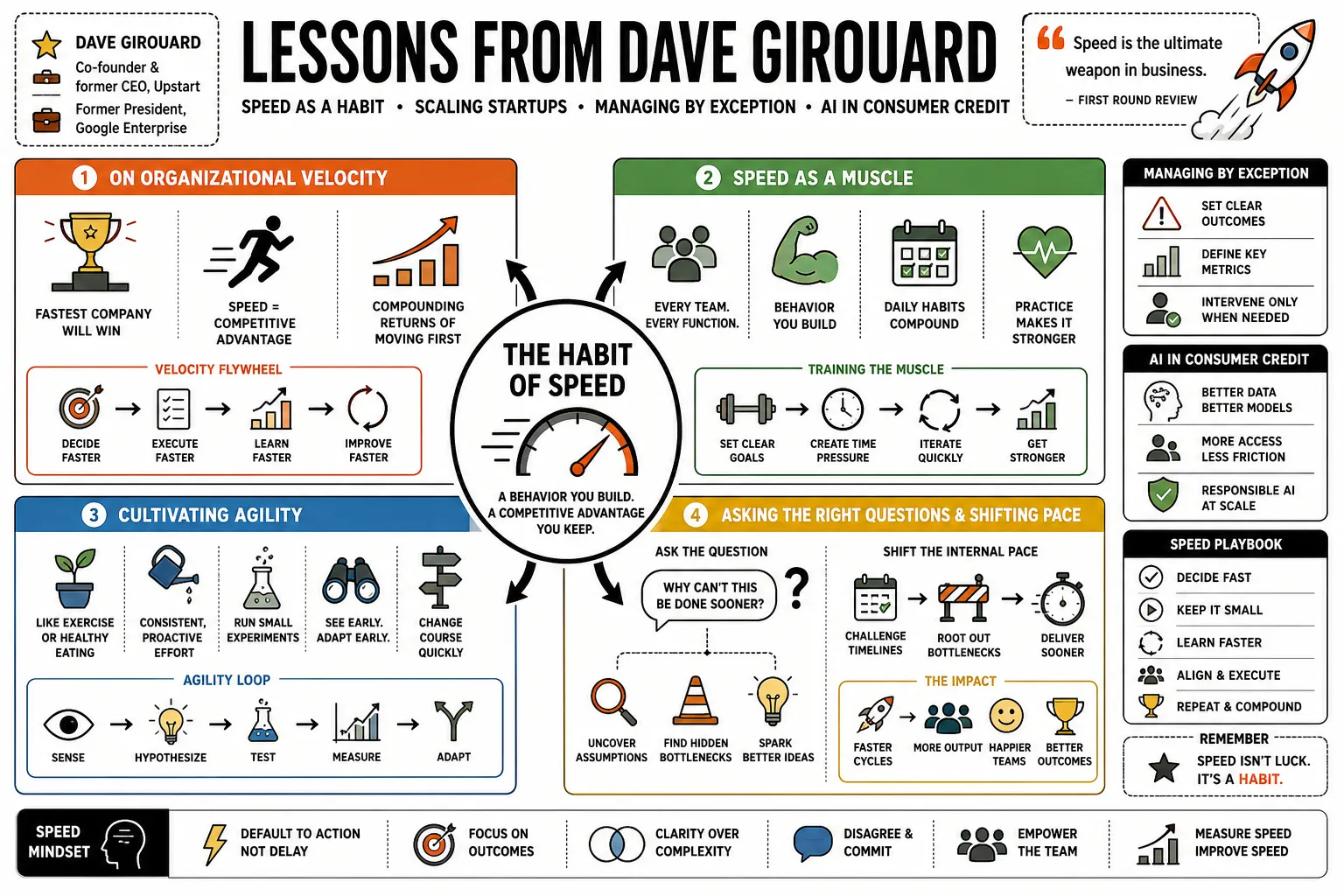
Lessons from Dave Girouard
Dave Girouard co-founded Upstart after leading Google Enterprise. He served as Upstart CEO until 2026, when he became executive chairman. His essays and interviews discuss organizational speed, startup leadership, and AI-assisted lending. — Upstart Leadership Announcement.
Part 1: The Habit of Speed
- Speed as a competitive habit: Girouard argues that, other things equal, faster companies can gain an advantage when they make and execute decisions well. — Speed as a Habit.
- Speed beyond product: He says organizational speed must extend beyond product development into other functions. — Speed as a Habit.
- Challenge the due date: For critical-path work, Girouard recommends habitually asking why a task cannot be finished sooner. — Speed as a Habit.
- Expose dependencies: Challenge default deadlines and identify dependencies that can be removed or handled in parallel. — Speed as a Habit.
- Reward timely action: Speed becomes an organizational habit when individuals practice it and leaders reinforce the behavior. — Speed as a Habit.
- Reduce execution friction: He recommends removing needless dependencies and cognitive overhead, not simply asking people to work longer. — Speed as a Habit.
- Decide, then execute: Girouard frames business activity as making decisions and carrying them out, both with appropriate urgency. — Speed as a Habit.
Part 2: Making and Executing Decisions
- Define the decision process: Before deciding, set how much time it merits, whose input is needed, and when the answer is due. — Speed as a Habit.
- Match pace to reversibility: Spend more time on consequential or hard-to-reverse choices; many ordinary decisions can be revisited. — Speed as a Habit.
- Get input without a veto: Hear team perspectives, then make a clear decision instead of allowing consensus to become a blocker. — Speed as a Habit.
- Own the final call: When debate has run its course, the leader can explain the choice and accept responsibility for it. — Speed as a Habit.
- Give consequential choices time: Girouard explicitly allows extra analysis or a pause for important decisions; speed is not a vote for rashness. — Speed as a Habit.
- Pair conviction with humility: Girouard describes holding a core product thesis while remaining flexible about particular answers. — First Round — Girouard Podcast.
- Avoid decision paralysis: He argues that no decision can be worse than a timely, revisable decision. — Speed as a Habit.
Part 3: Management by Exception & Delegation
- Manage by exception: Girouard wants to focus on work only the CEO can do while building a company that outlasts him. — First Round — Girouard Interview.
- Push decisions down: He prefers decisions to be made as far down the organization as the responsible team can handle. — First Round — Girouard Interview.
- Observe before intervening: The CEO should watch how the operating system works and step in where something is off course. — First Round — Girouard Interview.
- Ask why the CEO is needed: If a matter reaches his desk that another leader could decide, Girouard examines why it was escalated. — First Round — Girouard Interview.
- Trace the escalation path: When a problem reaches him, he asks how it arose, why it came to him, and whether it should have. — First Round — Girouard Interview.
- Build a self-improving operating system: His management-by-exception model depends on a coordinated executive team and regular attention to weak spots. — First Round — Girouard Interview.
- Stretch future leaders: He wants executives to grow until many could take his role without the company missing a beat. — First Round — Girouard Interview.
- Avoid unnecessary micromanagement: Delegation frees the CEO to spot cross-company issues while remaining willing to help or break ties. — First Round — Girouard Interview.
Part 4: Hiring and Building the Executive Team
- Hire for delegated leadership: His model needs executives who execute well, coordinate, and can take responsibility without constant direction. — First Round — Girouard Interview.
- Treat references as substantive evidence: Girouard learns more about executive candidates from close professional references than from interviews alone. — First Round — Girouard Interview.
- Acknowledge executive-hiring difficulty: He says assembling a strong executive team is a CEO's most important and difficult responsibility. — First Round — Girouard Interview.
- Evaluate leaders multidimensionally: His written framework combines execution, future growth, initiative, judgment, urgency and representation; it does not reject quantified reviews. — How Does Your Leadership Team Rate?.
- Balance autonomy and coordination: He says an executive team needs capable people, clear direction, and coordination as the company matures. — First Round — Girouard Interview.
- Expect leaders to raise the bar: Girouard values executives who challenge their department's current baseline and plan for future growth. — How Does Your Leadership Team Rate?.
Part 5: Leadership Philosophies
- Write to lead: Girouard argues that strong writing improves both a founder's effectiveness and the organization's execution. — A Founder's Guide to Writing Well.
- Make intent legible: He says careful writing can prevent misread intent, buried logic and needless misunderstanding. — A Founder's Guide to Writing Well.
- Question inherited assumptions: At Google, Girouard learned to challenge established product and industry conventions rather than adopt them unchanged. — First Round — Girouard Interview.
- Think in career chapters: His landscape-mode metaphor helped him recognize when it was time to end the Google chapter and found Upstart. — First Round — Girouard Interview.
- Use a mental reset: When problems pile up, Girouard uses a reset-button exercise to address them one at a time. — First Round — Girouard Interview.
- Adapt with company scale: He says fast-growing companies must revisit onboarding, communication and leadership practices as headcount changes. — Ladders — Girouard Interview.
- Make urgency repeatable: Speed can become part of company culture when people practice and reinforce it in ordinary decisions and execution. — Speed as a Habit.
Part 6: Navigating Risk and Uncertainty
- Finance early ambition: Upstart's original 2012 model aimed to give graduates capital to pursue ventures rather than default to unwanted safe jobs. — TechCrunch — Upstart Launch Interview.
- Pair capital with mentoring: Girouard's original Upstart concept paired financial backing with mentors who could help graduates pursue ventures. — TechCrunch — Upstart Launch Interview.
- Stay resourceful at small scale: He says the first Upstart team had to choose next steps, decide and improvise much as he had at Google. — First Round — Girouard Interview.
- Start from zero: Leaving Google meant losing a large built-in team; founding Upstart tested whether he could build without that infrastructure. — First Round — Girouard Interview.
- Pivot when demand signals disagree: Girouard describes abandoning Upstart's original income-share model when the team could not make it scale. — First Round — Girouard Interview.
- Respond to credit cycles: In a 2024 interview he described adjusting model calibration and committed-capital partnerships after a difficult credit cycle. — American Banker — Girouard Interview.
- Check intuition against users: Girouard admitted that Upstart's predictions of consumer behavior were often wrong and that founders need real data. — BusinessNewsDaily — Girouard Q&A.
- Redesign as headcount changes: He says a company that doubles must revisit plans, onboarding and communication as the organization scales. — Ladders — Girouard Interview.
Part 7: Lessons from Google to Startup
- Bring first-principles thinking: Girouard says Google's founders taught him not to accept inherited constraints as fixed. — Ladders — Girouard Interview.
- Test yourself without the brand: He wanted to learn whether he could create a company without Google's built-in momentum and resources. — First Round — Girouard Interview.
- Lead by setting direction: Across large and small organizations, he describes the job as forming a plan with the team and reinforcing culture. — Ladders — Girouard Interview.
- Create the early operating system: He says company growth changes how new hires onboard, communicate and understand what to do next. — Ladders — Girouard Interview.
- Question the default: Girouard credits Google with teaching him to revisit assumptions about products, customers and ways of working. — First Round — Girouard Interview.
- Become the decision owner: After leaving Google, he had to stop deferring to its founders and form his own views as Upstart's founder. — First Round — Girouard Interview.
Part 8: The Vision for AI and Credit
- Make credit less painful: Girouard's stated vision was affordable borrowing on reasonable terms without a long, painful process. — Upstart — Girouard Fireside Chat.
- Explain the historical bank choice: At its 2020 IPO, Upstart chose to supply AI lending technology to banks rather than seek to become one. — Upstart IPO Letter.
- Challenge FICO-only decisions: In his 2020 letter, Girouard argued that older credit scores miss creditworthy borrowers and cited Upstart's own retrospective analyses. — Upstart IPO Letter.
- Use richer risk models: Girouard argued AI could combine more data with adaptive models to price lending risk more precisely. — Upstart IPO Letter.
- Update the bank-partnership strategy: In July 2026 Upstart received conditional approval for a bank charter intended to complement, not replace, bank and credit-union partnerships. — Upstart Bank Charter Announcement.
- Look beyond credit scores: Girouard's testimony says Upstart considered employment and education information alongside conventional credit measures. — Girouard — Congressional Testimony.
- Test for bias: Girouard acknowledged that algorithmic lending can reproduce or amplify bias and argued for ongoing fair-lending tests. — Girouard — Congressional Testimony.
- See why AI fits lending: Girouard's IPO letter identifies high-volume decisions, broad available data and model learning as reasons credit suited AI. — Upstart IPO Letter.