Dave Morin is a technology founder and investor who helped develop Facebook Platform, founded Path, and co-founded Slow Ventures and Offline Ventures. His work has focused on social connection, product design, patient company building and technology that supports human well-being. — Esalen — Dave Morin.
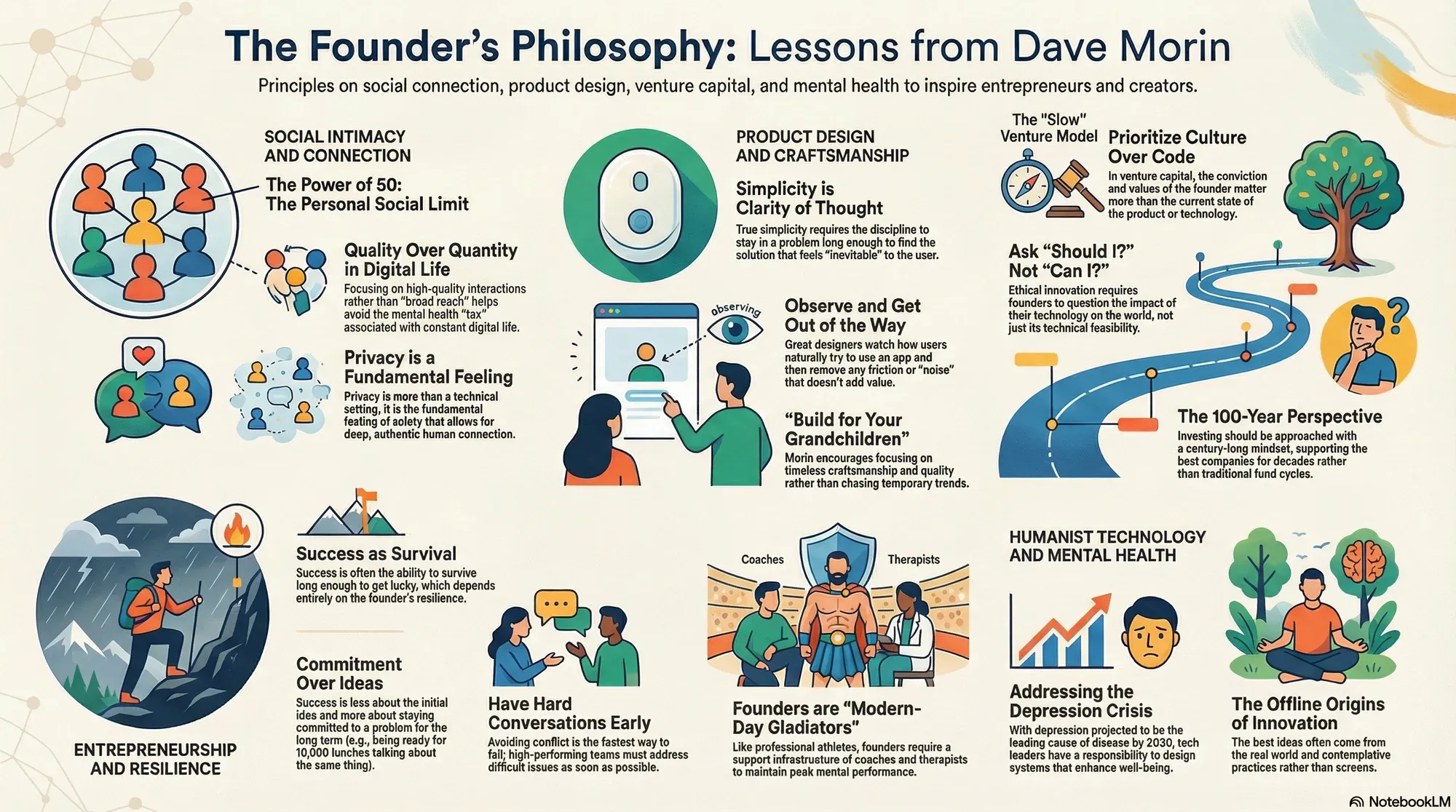
Part 1: The Philosophy of Connection and Social Intimacy
- Distinguish Path’s Two Social-Circle Limits: Path began with a 50-person friend cap for intimate sharing and later expanded to 150, a separate product choice associated with Dunbar’s proposed social-circle size. Treat those numbers as Morin’s design rationale, not a proven universal limit. — Foundation — Dave Morin.
- Favor Depth Over Reach: Morin argues that a smaller set of repeated, trusted interactions can build stronger relationships than superficial engagement across many online groups. — Thin Cultures.
- Make Space for Ordinary Vulnerability: Morin designed Path so close friends could share everyday difficulties and emotions without the self-consciousness of a large public network. — CNN — Path Interview.
- Let Close Friends Share More Than Highlights: Morin observed that Path users wanted to share notes, music, health activity and other ordinary moments once the network felt private enough. — Get Out Of The Way.
- Use Limits to Shape the Experience: Path experimented with social-graph size before settling on a 150-person cap; Morin described testing different sizes while trying to preserve an intimate experience. — PandoMonthly — Dave Morin.
- Think of Path as a Private Home: Morin described Path as a personal network built for the kinds of everyday updates people share with family and close friends. — TechCrunch — Path Interview.
- Follow How People Actually Express Themselves: Path’s redesign followed user behavior that went well beyond photos; Morin urged product teams to notice those unexpected uses and give them room. — Get Out Of The Way.
- Match Sharing to Relationship Context: Morin noticed that people wanted different social graphs for different kinds of information, from location sharing to family communication. — Foundation — Dave Morin.
- Treat Privacy as User Control: After Path was criticized for uploading contacts without adequate notice, Morin apologized, deleted the stored data, and said users should control their personal information. His stated principle needs to be read alongside that failure. — WIRED — Path Privacy Interview.
- Design for Deeper Communities: Morin argues that ad-driven feeds encourage thin engagement; he favors platforms and habits that support fewer, deeper communities. — Thin Cultures.
Part 2: Design and the Pursuit of Product Excellence
- Simplicity Starts With Clarity: Morin says a simple interface follows sustained, clear thinking about the underlying idea, not merely removing a button. — Fast Company — On Simplicity.
- Focus Means Making Difficult Product Choices: Morin recalls learning at Apple to concentrate a launch on a clear product rather than dispersing attention across many variants. — Foundation — Dave Morin.
- Build on Familiar User Concepts: Morin advises starting with interaction patterns users already understand, then improving them, instead of requiring people to learn unfamiliar concepts. — Super Normal.
- Study User Workarounds: Morin’s Path team learned from the music, notes and health screenshots users posted; those workarounds informed a broader journaling product. — Get Out Of The Way.
- Make the Familiar Better: Morin’s “Super Normal” design approach starts with a familiar product and solves a concrete friction point rather than inventing a category for its own sake. — Super Normal.
- Preserve Quality as You Grow: Morin said Path sought to grow in a way consistent with its design quality, trust and users’ ability to be themselves, not growth at any cost. — Foundation — Dave Morin.
- Let Research Guide Iteration: Path broadened beyond photos after observing how people used it; Morin reports that the redesigned product grew sharply, an account of that specific iteration rather than a universal growth formula. — Get Out Of The Way.
- Remove Friction Around Familiar Actions: Morin argues that useful innovation can come from removing friction in an interaction people already know how to perform. — Super Normal.
Part 3: Venture Capital and the "Slow" Approach
- Give Good Ideas Time: Slow Ventures’ jointly signed founding letters say ambitious companies need time to develop and that short-term growth pressure can distort decisions. — The Next Evolution of Slow Ventures.
- Reserve Capital for Follow-On Support: Slow Ventures III reserved more than half its fund for follow-on investments as portfolio companies grew; this is a concrete long-term support mechanism, not an evergreen or decades-long guarantee. — The Next Evolution of Slow Ventures.
- Design the Founder Team, Not Only the Product: Morin says the relationships around a venture are part of what it builds, recalling Jony Ive’s advice that team design deserves attention alongside product design. — Solo Founders — Dave Morin.
- Ask What a Technology Is For: Offline Ventures’ jointly signed launch essay frames investing around companies that improve human well-being, not technical possibility alone. — Introducing Offline Ventures.
- Look Beyond a Single Sector: Slow’s jointly signed 2016 letter says the firm was willing to explore unconventional ideas across sectors when it saw signs of innovation. — The Next Evolution of Slow Ventures.
- Serve Founders With Relationships and Expertise: Slow described founder support as a team effort drawing on its partners’ varied skills and an active network of operators and investors. — The Next Evolution of Slow Ventures.
- Help Shape Companies From the Beginning: Slow said it sometimes worked with founders to ideate and co-develop a company’s initial launch, not only to finance an already formed business. — The Next Evolution of Slow Ventures.
- State the Long-Term Thesis as a Belief: Slow’s jointly signed 2016 letter says the partners believed patient support could produce better outcomes; it does not establish that outcome as an independently proven result. — The Next Evolution of Slow Ventures.
- Bound Early Experiments: Morin says Offline’s studio tests ideas in phases with explicit timelines and budgets before it recruits a full-time team. — World of DaaS — Dave Morin.
Part 4: Entrepreneurship and Building for the Long Term
- Choose Work You Can Stay With: Morin advises founders to build around an idea they care deeply about, because they may spend years explaining and improving it. — Solo Founders — Dave Morin.
- Expect a Long Company Journey: Morin tells founders to be ready to discuss the same company for years; he uses ten years and ten thousand meals as a vivid estimate, not a literal requirement. — Angel Podcast — Dave Morin, Part 1.
- Start Before the Plan Is Perfect: Morin argues that starting is often the hardest step for a new founder and that tools and collaborators make experimentation more accessible. — Solo Founders — Dave Morin.
- Pair Optimism With People-First Investing: Slow’s original jointly signed letter expresses optimism about technology’s future while placing the quality of people at the center of its investment approach. — Announcing Slow Ventures 2.
- Explore Unreasonable Possibilities as a Firm: Offline Ventures’ jointly signed founding essay describes a shared willingness to pursue ideas at the edge of the unreasonable; the matching quotation in the launch release is spoken by Brit Morin, not Dave individually. — Introducing Offline Ventures.
- Solve a Familiar Problem in a New Way: Morin’s “Super Normal” approach looks for a specific problem in an established use case, then changes the product just enough to remove that friction. — Super Normal.
Part 5: Technology Platforms and the Future
- Bring Social Context Into Applications: Facebook Platform opened the social graph to third-party applications; Morin later described the web as fundamentally about the people behind its interfaces. — WIRED — Facebook and the Web.
- Make Online Identity Portable Across Services: Facebook Connect let people carry their Facebook login and social relationships into participating websites and applications. — WIRED — Facebook and the Web.
- Make Sharing Control Understandable: Path’s contact-upload controversy showed that intended product simplicity does not replace explicit permission and transparency about personal data; Morin acknowledged the mistake and promised greater clarity. — WIRED — Path Privacy Interview.
- Lower the Barrier to Building Software: Morin describes AI-assisted building tools that let non-engineer creators prototype and ship useful products faster than before; the scale of adoption remains uncertain. — More or Less Podcast #156.
- Build Across Disciplines: Offline Ventures’ jointly signed essay says the firm seeks breakthroughs where science, engineering, art, design and culture meet. — Introducing Offline Ventures.
- Stay Open About the Future of AR: Morin sees promise in hands-free glasses but says it is unclear which AI and augmented-reality device form will work; he treats the shift away from phone screens as an experiment, not an inevitability. — World of DaaS — Dave Morin.
Part 6: Humanist Technology and Mental Health
- Create Offline Space for Founders: Offline Ventures’ jointly signed launch essay says founders need space away from always-on digital work for creative thinking while building consequential companies. — Introducing Offline Ventures.
- Aim Technology at Human Well-Being: Offline Ventures framed its investment and incubation mission around technology that supports healthier, happier lives rather than attention for its own sake. — Introducing Offline Ventures.
- Connect Mental-Health Science and Practice: Morin co-founded Sunrise Foundation to reduce suffering and improve mental health by translating research into better support. — Esalen — Dave Morin.
- Test Ideas Before Building Full Teams: Morin says Offline’s studio uses phased viability and product tests before hiring full-time teams for incubated companies. — World of DaaS — Dave Morin.
- Start Digital Balance With Builders: Offline Ventures’ jointly signed essay says founders need explicit well-being support because the demands of building technology can erode their own health. — Introducing Offline Ventures.
- Use Contemplative Practice to Regain Focus: Morin says meditation and related practices can help people notice reactive behavior and make more intentional choices about technology use. — Dandelion Effect — Dave Morin.
- Protect Space for Human Exploration: Morin described Esalen visitors’ desire for respite from connectivity while discussing the institute’s role in exploring human potential. — Dandelion Effect — Dave Morin.
- Back Companies That Matter to People: Offline Ventures’ jointly signed essay commits the firm to companies it believes can improve lives and to the well-being of the founders creating them. — Introducing Offline Ventures.
Part 7: The Founder's Journey and Well-being
- Treat Founders Like High-Performance Athletes: Morin argues that founders, like elite athletes, need a support system for both sustained performance and personal well-being. — Angel Podcast — Dave Morin, Part 1.
- Use Coaching Before Crisis: Morin recommends that founders establish a coach or therapist early as preventive support, before a difficult period becomes acute. — Angel Podcast — Dave Morin, Part 1.
- Protect Founder Health: Morin calls a founder’s health a first-order priority amid the pressure of leading a company. — Angel Podcast — Dave Morin, Part 1.
- Look for a Founder’s Sense of Inevitability: Morin describes a founder quality he calls a sense of inevitability: the founder seems committed to making the venture happen with or without a particular investor. — Angel Podcast — Dave Morin, Part 2.
- Make Room for Honest Founder Conversations: Morin says founders benefit from board members or investors they can call and speak honestly with when circumstances become hard. — Angel Podcast — Dave Morin, Part 1.
- Notice the Mental Cost of Reactive Feeds: Morin worries that social-media systems encourage rapid emotional reactions and calls for more intentional design and personal use. — Dandelion Effect — Dave Morin.
- Seek Diverse Perspectives as a Firm: Offline Ventures’ jointly signed essay says its investment approach values diversity of expression, experience and perspective; the matching individual quotation in the press release belongs to Brit Morin. — Introducing Offline Ventures.
Part 8: Wisdom, Identity, and Long-Term Thinking
- Design Balance Into Daily Life: Morin advises people building companies to schedule relationships, exercise and other healthy commitments first rather than letting digital work consume all available time. — Dandelion Effect — Dave Morin.