David Allen, the creator of the renowned "Getting Things Done" (GTD) methodology, has revolutionized personal productivity with his insightful principles and practical advice. His teachings offer a pathway to achieving a state of relaxed control, enabling individuals to manage their commitments effectively and reduce stress.
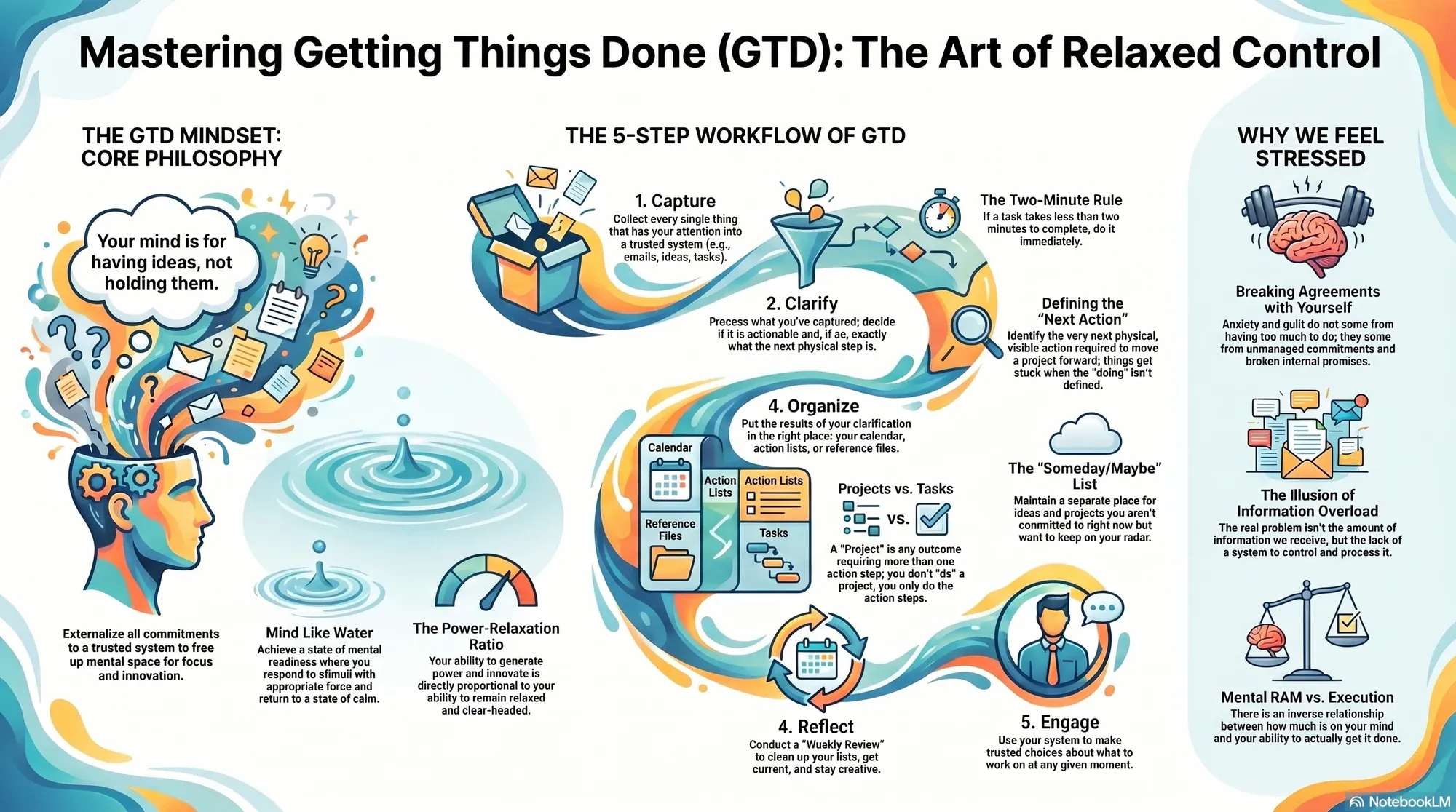
Core Philosophy and Mindset
The foundation of David Allen's methodology rests on a fundamental shift in how we approach our thoughts and commitments.
- "Your mind is for having ideas, not holding them." [1][2] This central tenet of GTD underscores the importance of externalizing thoughts to free up mental space for creativity and focus.
- Source: Getting Things Done: The Art of Stress-Free Productivity by David Allen, Crucial Learning, Medium, Goodreads, Getting Things Done® Forums.
- Link: https://gettingthingsdone.com/, https://www.goodreads.com/work/quotes/5759-getting-things-done-how-to-achieve-stress-free-productivity, https://cruciallearning.com/blog/author/david-allen/
- "Your ability to generate power is directly proportional to your ability to relax." [1][3] A calm and clear mind is the wellspring of productivity and innovation.
- Source: Getting Things Done: The Art of Stress-Free Productivity by David Allen, Medium, Goodreads.
- Link: https://medium.com/the-mission/the-most-popular-productivity-pieces-of-wisdom-from-david-allen-72ffe70ac7b9, https://www.goodreads.com/work/quotes/5759-getting-things-done-how-to-achieve-stress-free-productivity
- "If you don't pay appropriate attention to what has your attention, it will take more of your attention than it deserves." [1][3] Uncaptured and unclarified tasks create persistent mental noise.
- Source: Getting Things Done: The Art of Stress-Free Productivity by David Allen, Medium, Goodreads.
- Link: https://medium.com/the-mission/the-most-popular-productivity-pieces-of-wisdom-from-david-allen-72ffe70ac7b9, https://www.goodreads.com/work/quotes/5759-getting-things-done-how-to-achieve-stress-free-productivity
- "Getting things done is not about getting things done." [1][4] The ultimate goal is to be appropriately engaged with your life and work, feeling present and in control. [4]
- Source: Interview with Zapier, Medium.
- Link: https://zapier.com/blog/interview-with-david-allen/, https://medium.com/the-mission/the-most-popular-productivity-pieces-of-wisdom-from-david-allen-72ffe70ac7b9
- "You can do anything, but not everything." [5][6] This highlights the necessity of making conscious choices about where to direct your energy.
- "Mind like water." [7][8] This martial arts metaphor describes a state of mental readiness where one responds to stimuli with appropriate force and then returns to a state of calm.
- Source: Getting Things Done: The Art of Stress-Free Productivity by David Allen, Wikipedia, Times Now.
- Link: https://en.wikipedia.org/wiki/Getting_Things_Done, https://www.timesnownews.com/lifestyle/books/features/10-lessons-to-learn-from-the-book-getting-things-done-article-117337773
- "There is an inverse relationship between what is on your mind and getting it done." [1][9] The more mental RAM you dedicate to remembering, the less capacity you have for execution.
- Source: Getting Things Done: The Art of Stress-Free Productivity by David Allen, Medium, Wikipedia.
- Link: https://medium.com/the-mission/the-most-popular-productivity-pieces-of-wisdom-from-david-allen-72ffe70ac7b9, https://en.wikipedia.org/wiki/Getting_Things_Done
- "You can't fool your own mind." [1] Your subconscious knows all your commitments and will remind you of them, often at inconvenient times.
- "Use your mind to think about things, rather than think of them." [3] Transition from a state of being constantly reminded to one of strategic thinking.
- "The great secret about goals and visions is not the future they describe but the change in the present they engender." [5] A clear vision of the future informs and motivates your present actions.
- Source: Goodreads.
- Link: https://www.goodreads.com/author/quotes/1058.David_Allen
- On Perspective: "perspective is an ephemeral asset, and not to be taken for granted." — What's the slipperiest commodity you have?
- On Intuition: "Simple: pay attention to the still, small voice inside. Your intuition." — David Allen's Substack: Who has your best advice?
- On Relying on Intuition: The most valuable advice you can follow comes from your own inner voice, which understands your unique path better than any external consultant or self-help book. — David Allen's Substack: Who has your best advice?
The Five Steps of GTD
The GTD methodology is built around a five-step process for managing workflow and gaining control.
- Capture: Collect everything that has your attention into a trusted system. [7][10]
- Clarify: Process what you've captured, determining if it's actionable. [7][10]
- Organize: Put everything in its right place—on your calendar, on action lists, or filed away. [7][10]
- Reflect: Regularly review your system to maintain clarity and focus. [7][10]
- Engage: Make trusted choices about what to do in any given moment. [7][10]
Key Concepts and Rules
Several core concepts and rules are central to the practical application of GTD.
- The Two-Minute Rule: If a task takes less than two minutes to complete, do it immediately. [2][8]
- Next Action: Identify the next physical, visible action required to move a project forward. [10][11]
- Projects vs. Tasks: A "project" is any desired outcome that requires more than one action step. [11]
- The Weekly Review: A crucial habit of reviewing all your open loops to get clear, current, and creative. [2][8]
- "Someday/Maybe" List: A designated place for ideas and projects you don't want to commit to right now. [8][12]
- "Open Loops": These are the unfulfilled commitments that occupy your mental space and create stress. [7][13]
- Define what "done" looks like: Gaining clarity on the successful outcome of a project is a prerequisite for effective planning. [2][11]
- "You don't actually do a project; you can only do action steps related to it." [1][3] This emphasizes the importance of focusing on the immediate next step.
- "Things rarely get stuck because of lack of time. They get stuck because the doing of them has not been defined." [5][11] Procrastination is often a symptom of unclear next actions.
- "The secret of getting ahead is getting started. The secret of getting started is breaking your complex overwhelming tasks into small, manageable tasks." [3][5] This classic advice aligns perfectly with the "Next Action" principle.
On Productivity and Stress
David Allen's teachings provide profound insights into the relationship between productivity and stress.
- "Anxiety and guilt don't come from having too much to do; it comes from breaking agreements with yourself." [2] The stress is a result of unmanaged commitments.
- "Sometimes the biggest gain in productive energy will come from cleaning the cobwebs, dealing with old business, and clearing the desks." [1][5] A mental and physical reset can be incredibly powerful.
- "Most people feel best about their work the week before their vacation... I just suggest that you do this weekly instead of yearly." [1][3] The clarity and focus of a pre-vacation mindset can be replicated regularly.
- "Anything that causes you to overreact or underreact can control you, and often does." [1][3] Emotional regulation is a key component of personal productivity.
- "Everything you've told yourself you ought to do, your mind thinks you should do right now." [1][3] This creates a constant feeling of being overwhelmed.
- "The real problem is not the amount of information, but the lack of control over it." [6] GTD provides a framework for managing the influx of information.
- "There is never enough time to do everything, but there is always enough time to do the most important thing." [6] This underscores the importance of prioritization.
- "Your best thoughts about work won't happen while you're at work." [2] Creating unstructured time is essential for creativity and insight.
- "If your daily life is out of control, it's almost impossible to think strategically or plan effectively." [11] GTD offers a bottom-up approach to regaining control.
- "You must use your mind to get things off your mind." [5] The initial effort to set up a system leads to long-term mental freedom.
- On Inspiration: "Inspiration is like health--when you have it, you don’t ever think you won’t. And when you don’t have it, it can seem like there is no path to get there from where you are." — What's the slipperiest commodity you have?
- On Productivity During Low-Energy Periods: When you lack the inspiration or energy for major creative work, tackling minor, mundane tasks like cleaning your inbox or paying bills is still highly productive because those tasks must be completed eventually. — David Allen's Substack: What's the slipperiest commodity you have?
Deeper Insights and Advanced Concepts
Beyond the basics, Allen's work offers deeper wisdom for those looking to master his methodology.
- "Small things done consistently in strategic places create major impact." [14] The power of consistent habits cannot be overstated.
- "When they jump you in a dark alley, it's too late to train." [14] Prepare your system before you are in a state of crisis.
- "GTD is a lifelong practice and you'll get better at it over time." [15] It is a journey of continuous improvement.
- The Threefold Model for Evaluating Daily Work: This model categorizes work into pre-defined tasks, unexpected tasks, and the work of defining your work. [13]
- "Your system needs to be as simple as it can, but no simpler." [14] Find the right balance between simplicity and effectiveness.
- "The beginning is half of every action." [5] Overcoming the initial resistance is often the most challenging part.
- "You are the captain of your own ship; the more you act from that perspective, the better things will go for you." [5] Take ownership of your commitments.
- "There is a light at the end of the tunnel, but the way out is through." [5] You must engage with your tasks to achieve clarity.
- "When we truly need to do is often what we most feel like avoiding." [5] Acknowledge and address the psychological barriers to important tasks.
- "Chaos is in the world. Not in your head." [1] A well-organized system allows for internal calm amidst external chaos.
- "At any point in time, knowing what has to get done, and when, creates a terrain for maneuvering." [1] This knowledge provides the flexibility to make informed decisions.
- "The people most interested in GTD are the people who need it the least." [4] Those who are already productive are often the most eager to improve.
- "GTD is not about time; it's about space. More room in your head." [4] The primary goal is mental clarity.
- "You need no new skills to increase your productivity and reduce your stress—just an enhanced set of systematic behaviors with which to apply them." [16] GTD is about adopting new habits, not acquiring new skills.
- "Suffice it to say that something automatic and extraordinary happens in your mind when you create and focus on a clear picture of what you want." [5] The power of a clear vision cannot be underestimated.
- On External Advice vs. Internal Wisdom: "The good coaches will eventually hand you back to yourself, the bad ones make you dependent on them." — Who has your best advice?
- On Shifting Focus: "What we’re really after is learning to see how we see. Like reaching over to re-tune the receiver to a clearer station. That is the whole game of shifting focus." — What's the slipperiest commodity you have?
- On Reflective Practices: "Reflective practices are my ultimate first aid, because they strengthen my ability to detach my focus from the material stuff anyway, and keep my priorities straighter." — What's the slipperiest commodity you have?
- On Making Room for Inspiration: You cannot force inspiration to arrive; rather, you must remain open to it and create the right conditions by letting go of your conditioned perspective. — What's the slipperiest commodity you have?
Learn more:
- The Most Popular Productivity Pieces of Wisdom from David Allen | by Mission - Medium
- Book Summary: Getting Things Done by David Allen | Sam Thomas Davies
- Getting Things Done Quotes by David Allen - Goodreads
- David Allen of Getting Things Done on Quality Over Quantity - Zapier
- Quotes by David Allen (Author of Getting Things Done) - Goodreads
- some quotes from “Getting Things Done” by David Allen: - book Quotes by litTalks - Medium
- Book Summary: Getting Things Done by David Allen - To Summarise
- 10 Lessons to Learn from the Book 'Getting Things Done' | Features - Times Now
- Getting Things Done - Wikipedia
- My Takeaways From "Getting Things Done" By David Allen - Lisa Tselebidis
- Getting Things Done by David Allen : Book Summary - Dean Bokhari
- 8 Key Productivity Lessons from Getting Things Done - College Info Geek
- David Allen: Getting Things Done - MindTools
- David Allen Quotes ! | Getting Things Done® Forums
- Book Summary for Getting Things Done by David Allen : r/BettermentBookClub - Reddit
- Lessons from Getting Things Done (GTD) by David Allen - Peter Kang