Lessons from David Chalmers
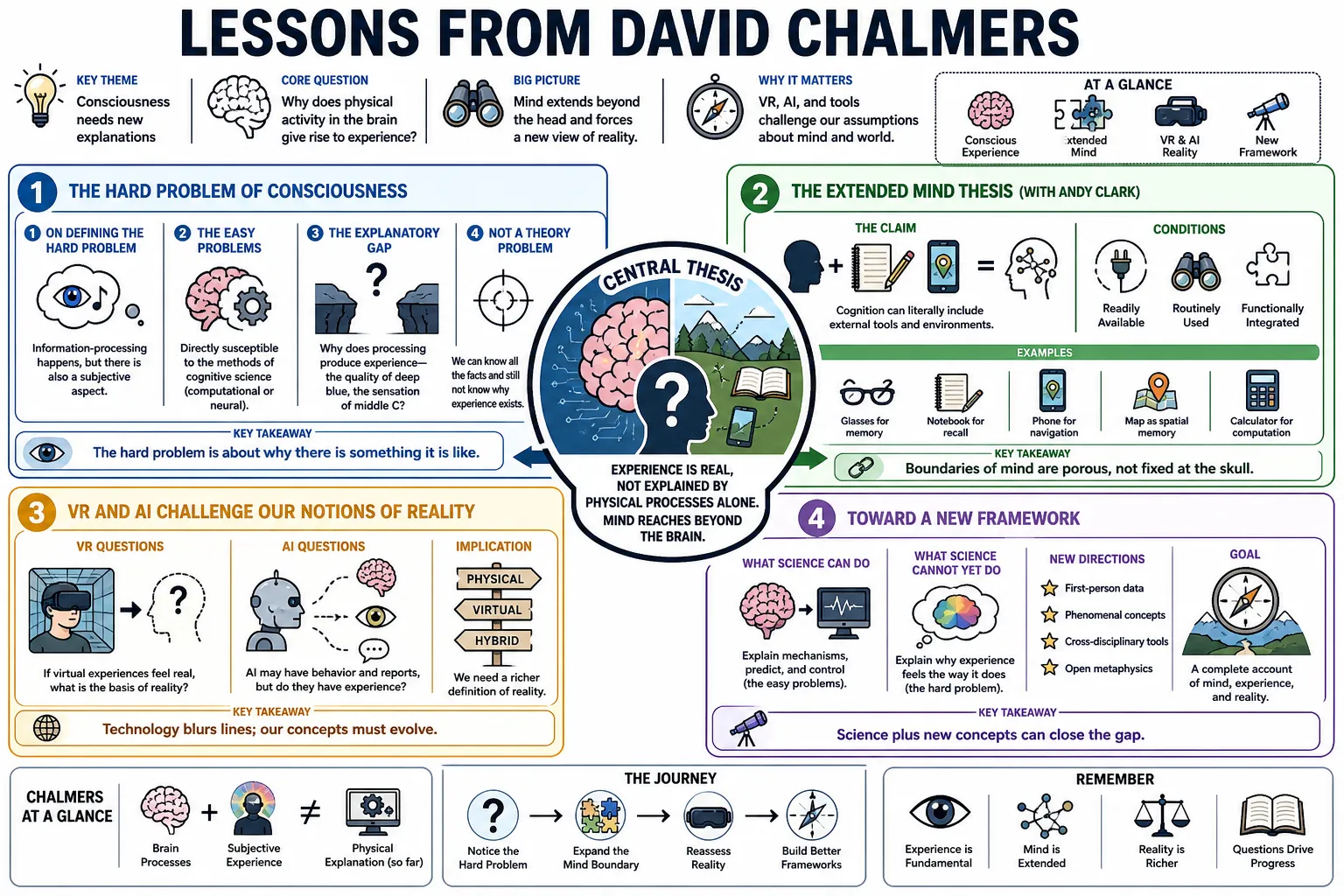
David Chalmers defined the "hard problem" of consciousness, asking why physical brain activity generates subjective experience. He and Andy Clark also formulated the extended mind thesis, arguing that human cognition literally incorporates external tools and environments. This collection details his case against standard scientific explanations of the mind, alongside his arguments for how VR and AI demand a new definition of reality.
Part 1: The Hard Problem of Consciousness
- On defining the hard problem: "The really hard problem of consciousness is the problem of experience. When we think and perceive, there is a whir of information-processing, but there is also a subjective aspect." — Source: [Facing Up to the Problem of Consciousness]
- On the easy problems: "The easy problems of consciousness are those that seem directly susceptible to the standard methods of cognitive science, whereby a phenomenon is explained in terms of computational or neural mechanisms." — Source: [Facing Up to the Problem of Consciousness]
- On the explanatory gap: "Why is it that when our cognitive systems engage in visual and auditory information-processing, we have visual or auditory experience: the quality of deep blue, the sensation of middle C?" — Source: [Facing Up to the Problem of Consciousness]
- On theoretical limits: "We won't have a theory of everything without a theory of consciousness." — Source: [The Conscious Mind]
- On the illusion of biological reduction: "No matter how precisely we map the neural correlates of a mental state, the question of why that physical state feels like anything at all remains completely unanswered by neuroscience." — Source: [TED Talk: How Do You Explain Consciousness?]
- On physicalism's blind spot: "Standard physical theories describe structure and dynamics, but subjective experience is not a structural or dynamical property, meaning physicalism is fundamentally incomplete." — Source: [The Conscious Mind]
- On taking experience seriously: "We must accept consciousness as a fundamental feature of the universe, irreducible to anything more basic, just as physicists accept mass or space-time." — Source: [Facing Up to the Problem of Consciousness]
- On inner life: "There is nothing that we know more intimately than conscious experience, but there is nothing that is harder to explain." — Source: [The Conscious Mind]
- On cognitive mechanisms: "Even after we have explained the performance of all cognitive and behavioral functions associated with perception, the problem of consciousness persists untouched." — Source: [Facing Up to the Problem of Consciousness]
- On psychophysical laws: "A complete theory of the universe will require new foundational laws that connect physical processes directly to conscious experience." — Source: [The Conscious Mind]
Part 2: Philosophical Zombies & Materialism
- On the zombie thought experiment: "A philosophical zombie is a being physically identical to a normal human being, behaving exactly the same way, but completely lacking any conscious experience or inner life." — Source: [The Conscious Mind]
- On conceivability: "Because we can logically conceive of a universe physically identical to ours but devoid of consciousness, consciousness cannot be logically entailed by physical facts alone." — Source: [The Conscious Mind]
- On naturalistic dualism: "The mind is perfectly natural and governed by natural laws, but it involves properties over and above physical properties, requiring a dualism of properties rather than a dualism of substances." — Source: [The Conscious Mind]
- On supervenience: "Conscious experience does not logically supervene on the physical. God could have created a universe physically identical to ours without creating consciousness." — Source: [The Conscious Mind]
- On epiphenomenalism: "The possibility that mental states do not cause physical events is a counterintuitive but logical consequence of property dualism that cannot be easily dismissed." — Source: [The Conscious Mind]
- On Mary the color scientist: "If a scientist learns all physical facts about color vision in a black and white room, she still learns something new upon seeing red for the first time, proving physical facts do not exhaust all facts." — Source: [The Conscious Mind]
- On functionalism's failure: "Defining a mental state purely by its causal role in a system ignores the core phenomena: what it actually feels like to inhabit that state." — Source: [The Conscious Mind]
- On logical possibility: "The logical possibility of zombies is all it takes to establish that consciousness is not identical to any physical property." — Source: [The Conscious Mind]
- On the failure of materialism: "Materialism is a beautiful and compelling view of the world, but to account for consciousness, we have to go beyond the resources it provides." — Source: [The Conscious Mind]
- On explanatory methods: "Trying to explain consciousness with the tools of physics is like trying to explain the rules of chess by studying the wood of the chess pieces." — Source: [Lex Fridman Podcast]
Part 3: The Extended Mind
- On boundaries: "Where does the mind stop and the rest of the world begin?" — Source: [The Extended Mind]
- On language and cognition: "Language is not a mirror of our inner states but a complement to them. It serves as a tool whose role is to extend cognition." — Source: [The Extended Mind]
- On active externalism: "The human organism is linked with external entities in a two-way interaction, creating a coupled system that can be seen as a cognitive system in its own right." — Source: [The Extended Mind]
- On Otto's notebook: "If a man with Alzheimer's uses a notebook to recall directions to a museum, the notebook plays the exact same cognitive role as biological memory plays for someone else." — Source: [The Extended Mind]
- On the parity principle: "If a process in the world works in a way that we would immediately recognize as cognitive if it happened in the head, then that process is part of our cognitive system." — Source: [The Extended Mind]
- On biological bias: "Limiting the mind to the boundaries of the skin and skull is an arbitrary prejudice without functional justification." — Source: [The Extended Mind]
- On smartphones: "A modern smartphone acts as a direct extension of our memory and spatial navigation systems. Relying on it is functionally identical to relying on our biological brain." — Source: [Closer To Truth]
- On cognitive damage: "Stealing a smartphone is an act of cognitive interference. It removes a piece of active cognitive hardware and causes the equivalent of temporary brain damage." — Source: [Philosophy Bites]
- On coupling: "Remove the external component and the system's behavioral competence will drop, just as it would if we removed part of its brain." — Source: [The Extended Mind]
Part 4: Virtual Reality and Technophilosophy
- On virtual worlds: "Simulations are not illusions. Virtual worlds are real. Virtual objects really exist." — Source: [Reality+]
- On meaning in VR: "A sufficiently immersive digital world becomes a genuine reality where humans can form authentic relationships, build communities, and lead completely meaningful lives." — Source: [Reality+]
- On structural reality: "Even if we are currently living inside a computer simulation, the world around us is perfectly real because it is grounded in stable structural relationships." — Source: [The Matrix as Metaphysics]
- On It-from-bit: "A simulated universe is functionally an it-from-bit world where the physical objects we touch are composed of underlying digital processes instead of quarks or strings." — Source: [Reality+]
- On technophilosophy: "We can use philosophical frameworks to make sense of new technologies, and simultaneously use those technologies to solve ancient philosophical problems." — Source: [Reality+]
- On physical versus digital substrates: "Virtual reality is not a second-class version of physical reality. It is a different substrate that can support the exact same density of experience." — Source: [Clearer Thinking Podcast]
- On the experience machine: "Unlike Nozick's completely pre-programmed experience machine, a multiplayer virtual reality allows for genuine autonomy, unpredictable interactions, and real consequences." — Source: [Reality+]
- On value: "Reality is not exclusively physical. You do not have to be made of atoms to matter." — Source: [Reality+]
- On illusionism: "Treating virtual reality as an illusion is a philosophical mistake based on the assumption that only biological and physical substrates are capable of grounding truth." — Source: [Reality+]
Part 5: Panpsychism & Fundamental Properties
- On panpsychism: "It may be that the relationship between physical processes and experience is the same simple relationship everywhere, even in a thermostat or an electron." — Source: [Panpsychism and Panprotopsychism]
- On simplicity: "If we assume that very simple systems have very simple phenomenology, it makes it less unintelligible to accept consciousness as a unified property of the universe." — Source: [Panpsychism and Panprotopsychism]
- On Russellian monism: "Physics only tells us what physical properties do, not what they intrinsically are. Panpsychism suggests that the intrinsic nature of fundamental physical entities is consciousness itself." — Source: [Panpsychism and Panprotopsychism]
- On proto-phenomenal properties: "Fundamental particles might not have full experiences, but rather proto-phenomenal properties that act as the building blocks for human consciousness." — Source: [Panpsychism and Panprotopsychism]
- On the combination problem: "The biggest hurdle for panpsychism is explaining how billions of micro-conscious particles combine to form a single unified human perspective." — Source: [Panpsychism and Panprotopsychism]
- On avoiding magic: "If consciousness is not fundamental, its sudden emergence in biological evolution looks like magic. Treating it as a basic property avoids this discontinuity." — Source: [80,000 Hours Podcast]
- On intrinsic nature: "Science maps the relational structure of the world, detailing how things push and pull each other, but remains entirely silent on the intrinsic nature of the stuff doing the pushing and pulling." — Source: [Sean Carroll's Mindscape]
- On terminology: "The reason why I am not referring to my thesis as panpsychism is that it misleadingly suggests that proto-phenomenal experiences are basic and complex experiences are composed of them, which I do not believe." — Source: [Panpsychism and Panprotopsychism]
- On expanding physics: "Admitting consciousness as a fundamental property does not destroy physics. It merely expands our inventory of the universe's basic ingredients." — Source: [TED Talk: How Do You Explain Consciousness?]
Part 6: Artificial Intelligence & the Singularity
- On machine consciousness: "There is no principled reason why a machine made of silicon cannot be conscious. Substrate independence suggests consciousness depends on the pattern of organization, not the material." — Source: [The Singularity: A Philosophical Analysis]
- On the intelligence explosion: "If we create artificial intelligence capable of improving its own software, it could lead to an intelligence explosion, rapidly surpassing all human cognitive capabilities." — Source: [The Singularity: A Philosophical Analysis]
- On gradual uploading: "If we replace the human brain with silicon chips one neuron at a time, preserving exact functional behavior at each step, conscious experience would likely be preserved throughout the transition." — Source: [The Conscious Mind]
- On fading qualia: "The idea that a partially silicon brain would have fading consciousness while perfectly replicating human behavior is logically coherent but highly implausible." — Source: [The Conscious Mind]
- On moral status: "Once an artificial intelligence achieves subjective experience, it crosses a moral threshold. Shutting it down would no longer be unplugging a machine, it would be ending a life." — Source: [Lex Fridman Podcast]
- On structural replacement: "Replicating the exact causal structure of the human brain in software is the most plausible route to producing artificial general intelligence with a conscious inner life." — Source: [The Singularity: A Philosophical Analysis]
- On predicting the singularity: "The arrival of superintelligent AI is arguably the most important event in the history of our planet, yet philosophy and cognitive science remain largely unprepared for its metaphysical consequences." — Source: [The Singularity: A Philosophical Analysis]
- On philosophical constraints: "The limits of artificial intelligence are not strictly engineering problems. They are philosophical problems regarding the nature of mind and the definition of intelligence." — Source: [The Singularity: A Philosophical Analysis]
- On surviving upload: "A perfect digital copy of your brain might be conscious, but determining whether that copy is actually you requires solving the philosophical problem of personal identity." — Source: [The Singularity: A Philosophical Analysis]
Part 7: The Matrix & Simulation Theory
- On the simulation argument: "If you accept that a simulated universe is possible, you must accept that there are vastly more simulated universes than base realities, making it highly probable we are in one." — Source: [Reality+]
- On the creator: "The creator of a simulation acts as a localized god. They are omnipotent and omniscient relative to the simulated world, even if they are just a teenager in the base reality." — Source: [The Matrix as Metaphysics]
- On discovering the truth: "If we discovered we were living in a computer simulation, it would not mean our lives are a lie. It would simply mean we have discovered the underlying physics of our universe." — Source: [The Matrix as Metaphysics]
- On the Matrix as creation myth: "The Matrix hypothesis is not a skeptical hypothesis that undermines all knowledge. It is a metaphysical hypothesis about the nature of the reality we inhabit." — Source: [The Matrix as Metaphysics]
- On Cartesian demons: "Unlike Descartes' evil demon who deceives us with illusions, a simulation creator builds a real computational environment that we genuinely interact with." — Source: [The Matrix as Metaphysics]
- On code as physics: "If atoms are actually made of code running on a higher level computer, the atoms are still real. We have just updated our understanding of what an atom is made of." — Source: [Reality+]
- On spatial reality: "Space in a simulation is real space to the inhabitants of the simulation, even if it corresponds to no physical distance on the hard drive running it." — Source: [The Matrix as Metaphysics]
- On epistemological limits: "We can never conclusively prove we are not in a perfect simulation, because any evidence we gather would itself be part of the simulation." — Source: [Reality+]
- On base reality: "The search for a base reality might be infinite. It is entirely possible that simulations are nested within other simulations, with no discernible bottom." — Source: [Sean Carroll's Mindscape]
Part 8: The Future of Philosophy & Metaphilosophy
- On philosophical progress: "While science converges on consensus, philosophy maps the space of possible answers. Progress in philosophy is not measured by agreement, but by the refinement of arguments." — Source: [Why Isn't There More Progress in Philosophy?]
- On the meta-problem: "The meta-problem of consciousness is the challenge of explaining why we think there is a hard problem in the first place, and why human brains universally report feeling a mysterious inner life." — Source: [The Meta-Problem of Consciousness]
- On verbal disputes: "Many intractable philosophical debates could be resolved if participants realized they were simply using different definitions for the same words, arguing over semantics rather than reality." — Source: [Verbal Disputes]
- On thought experiments: "Thought experiments like zombies or Mary the color scientist are not meant to predict empirical science, but to isolate our conceptual commitments and test their logical coherence." — Source: [The Conscious Mind]
- On interdisciplinary philosophy: "Philosophy is most productive when it operates at the frontiers of science, helping to clarify the conceptual foundations of new fields like cognitive science and artificial intelligence." — Source: [80,000 Hours Podcast]
- On mapping minds: "A primary goal of future philosophy and science must be mapping the vast space of possible minds, from animals to artificial intelligence to aliens, and determining which ones possess conscious experience." — Source: [Lex Fridman Podcast]
- On the limits of knowledge: "We may never completely solve the mystery of consciousness, but the act of rigorous inquiry forces us to abandon our deepest prejudices about the nature of the universe." — Source: [The Conscious Mind]
- On intuition: "Intuitions are the starting point of philosophy, not the end. When a theory contradicts strong human intuition, it assumes a massive burden of proof." — Source: [Why Isn't There More Progress in Philosophy?]
- On the search for a theory of everything: "A true final theory of the universe cannot be formulated purely in the language of mathematics and physics. It must include irreducible laws governing subjective experience." — Source: [Facing Up to the Problem of Consciousness]
- On the ultimate goal: "The ultimate objective of philosophy is not to tear down our understanding of reality, but to build a framework large enough to contain both the mathematical universe and the mind that perceives it." — Source: [The Conscious Mind]