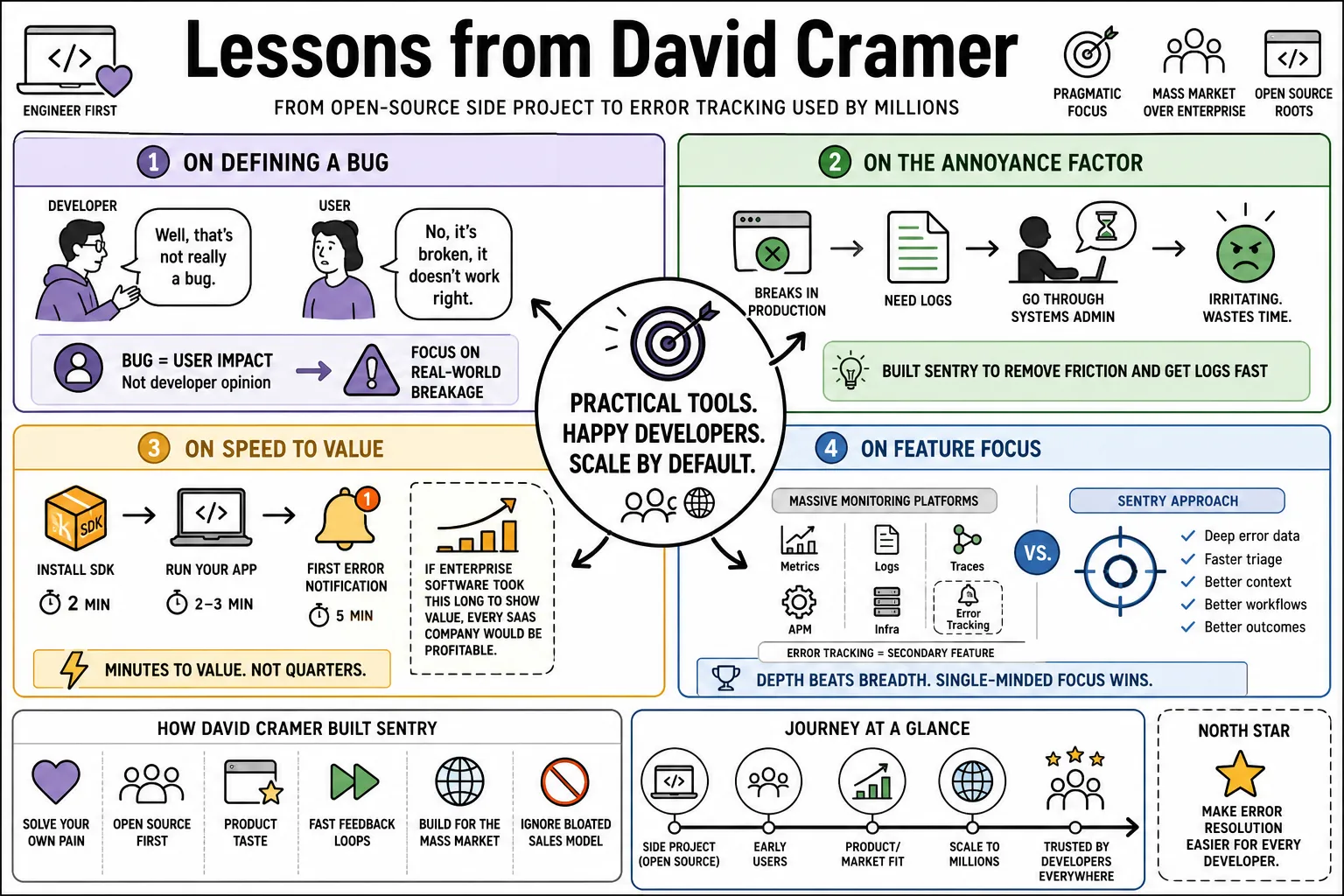
David Cramer turned an open-source side project into Sentry, an error-tracking tool now used by millions of developers. He built the company on pragmatism, ignoring bloated enterprise sales models to focus on mass-market products. This profile covers his takes on open source, product taste, and how engineering teams actually operate.
Part 1: Product & Developer Experience
- On defining a bug: "What do we think of as a bug? Users, not developers. Because you talk to a developer about what's a bug and they're like, 'Well, that's not really a bug.' And you're like, 'No, it's broken, it doesn't work right.'" — Source: [Dev Propulsion Labs]
- On the annoyance factor: He built Sentry because he found it irritating to go through a systems administrator just to get access to logs when he broke something in production. — Source: [Sentry Blog]
- On speed to value: "Our SDK takes 2 minutes to install. Your first error notification arrives 5 minutes later. If enterprise software took this long to show value, every SaaS company would be profitable." — Source: [Netfigo]
- On feature focus: While massive monitoring companies continually add error tracking as a secondary feature, depth and single-minded focus on error resolution will always win out over a platform's fifteenth add-on. — Source: [Netfigo]
- On the silent user: "By the time a user complains, 1,000 other users already hit the same error and left silently." — Source: [Netfigo]
- On solving your own problem: An engineer's primary job is simply to make their own job easier; creating a tool to simplify your own immediate problem is the best starting point for a product. — Source: [Orb Podcast]
- On product ubiquity: Sentry's singular goal was to dominate the industry by being ever-present, achieving that scale by making the right product decisions rather than tricking customers. — Source: [Evil Martians]
- On tolerable breakage: It is generally better to have a tolerable amount of breakage that you can catch and fix immediately than to endure an endlessly slow, overly-perfected QA phase. — Source: [CIO.com]
- On developer expectations: Tools should just work out of the box without requiring engineers to negotiate with enterprise sales reps or configure endless boilerplate. — Source: [Orb Podcast]
- On testing versus shipping: You should prioritize a tight feedback loop with real users in production over trying to predict every possible failure state in staging. — Source: [CIO.com]
Part 2: Open Source & Licensing
- On the purpose of open source: "Open source is not a business model; it is a distribution strategy." — Source: [TechSpot]
- On ideology versus pragmatism: "We changed our license from BSD to BSL and the open-source purists lost their minds. But the alternative was watching AWS offer Sentry as a service and collect the revenue. Pragmatism beats ideology." — Source: [Netfigo]
- On rejecting Open Core: The cloud service and the self-hosted version of a product should maintain feature parity; blocking fundamental features behind an "enterprise" tier breaks developer trust. — Source: [Sentry Blog]
- On eventual open source: The Functional Source License (FSL) ensures code is source-available for two years to prevent parasitic competition, after which it automatically converts to a permissive Apache 2.0 license. — Source: [Sentry Blog]
- On early motivations: Releasing early code as open source was largely about attention seeking, driven by a desire to have peers use the code, validate it, and offer feedback. — Source: [Accel Podcast]
- On open source career capital: "For anybody that says open source doesn't give you anything, it gives you quite a lot. Every real job I've gotten has been like, 'Oh, they knew who I was because they used my code already.'" — Source: [First Round Review]
- On the sustainability crisis: Many founders and companies acknowledge the challenges of open-source funding, but rarely do more than talk about the problem. — Source: [Developer Tech]
- On preventing cloud monopolies: You cannot expect to build a sustainable independent open-source company if a major cloud provider can legally repackage your exact code and sell it to their captive audience. — Source: [TechSpot]
- On self-hosting: Providing developers the ability to run the full software stack on their own infrastructure for free is necessary for bottom-up adoption. — Source: [Sentry Blog]
- On treating code as public: Building in the open forces a higher standard of code quality and architectural simplicity because you know your peers are watching. — Source: [Accel Podcast]
Part 3: Building for the Fortune 500,000
- On target audiences: Instead of chasing complex contracts with the Fortune 500, companies should aim to build for the "Fortune 500,000"—the massive long tail of developers and small teams. — Source: [Evil Martians]
- On mass-market pricing: Keeping the entry-level price incredibly low ensures your tool is accessible to anyone who wants to try it. — Source: [Sentry Blog]
- On rejecting enterprise friction: Turning down complex requirements like FedRAMP or exhaustive banking RFPs is often necessary if they threaten to compromise the product's simplicity for the broader market. — Source: [Evil Martians]
- On inbound enterprise growth: Large enterprises usually end up adopting a tool not because of outbound sales, but because their engineers already rely on it for their side projects or smaller internal apps. — Source: [YouTube]
- On the Atlassian model: The ideal software business builds a product so inherently useful and frictionless to purchase that it functions without needing a traditional outbound sales team. — Source: [Evil Martians]
- On avoiding bespoke builds: Modifying your core product to close a single massive enterprise deal almost always damages the experience for your core developer base. — Source: [YouTube]
- On the value of volume: High-volume, lower-price customers provide a much faster and more honest feedback loop than a handful of high-paying enterprise clients. — Source: [Orb Podcast]
- On marketing to engineers: Developers are inherently skeptical; the only way to market to them is to provide a transparent, immediately useful tool and let the utility speak for itself. — Source: [Postman Breaking Changes]
- On scale as a moat: When you serve hundreds of thousands of companies, your aggregate data on edge cases and error patterns creates a structural advantage no competitor can replicate. — Source: [Orb Podcast]
Part 4: Leadership, Decisiveness, and "Taste"
- On engineering taste: "I expect my developers to have taste." — Source: [Simon Willison's Weblog]
- On A/B testing: Relying solely on A/B tests often leads to local maxima and a soulless product; strong teams should have the intuition to know what is good without a spreadsheet. — Source: [Sentry Blog]
- On the weakness of leaders: "I think a lot of leaders are too weak. They don't want to make decisions. They don't want to deal with conflict." — Source: [Netfigo]
- On taking action: "The best thing you can do as a leader: make a decision, don't care about the consequence. Take conflict head-on because if you don't make the decision decisively, literally what is the point of your job?" — Source: [Netfigo]
- On informed opinions: "If you can't come to me with an informed opinion, at least a hypothesis, what are you testing? Don't care about the test results; come with a reasonable opinion that we all agree with and just ship that." — Source: [Netfigo]
- On the illusion of control: "As soon as you forget about the illusion of control—because control actually is not that important most of the time—life gets a lot easier." — Source: [Netfigo]
- On the limit of AI coding: While AI can generate raw code, it fundamentally lacks the taste to know what to delete, how to simplify a system, or why a specific detail matters to a human user. — Source: [Substack]
- On choosing a path: "The strength of making a decision is making it. You can always make a new one later. Choose the obvious path forward, and if you don't see one, find someone who does." — Source: [Simon Willison's Weblog]
- On senior talent: True senior engineers act as tastemakers who possess the subjective judgment required to maintain quality and simplicity. — Source: [Sentry Blog]
- On maintaining influence: You can delegate formal roles like CEO or CTO, but maintaining cultural influence requires consistently demonstrating good judgment and enforcing high standards. — Source: [Evil Martians]
Part 5: The Founding & Evolution of Sentry
- On the origins: Sentry began in 2008 simply as django-db-log, a basic open-source dashboard he created to track errors in his own Django projects. — Source: [Django Chat]
- On early adoption: The tool gained initial traction not through marketing, but because he built it while working at Dropbox and Disqus, where the scale of errors demanded a better solution. — Source: [Orb Podcast]
- On transitioning to a business: Moving from a beloved side project to a formal business requires recognizing that the primary goal shifts from writing cool code to actually sustaining an operation. — Source: [Accel Podcast]
- On the power of middleware: Building early versions using Django's middleware allowed Sentry to drop seamlessly into existing projects without requiring developers to rewrite their applications. — Source: [Django Chat]
- On avoiding reinventing the wheel: A key to early velocity was utilizing the Python ecosystem rather than trying to build bespoke underlying infrastructure from scratch. — Source: [Django Chat]
- On early customer support: In the beginning, the founders handled support directly, which provided an unfiltered, painful look at exactly where the product was failing users. — Source: [First Round Review]
- On scaling architecture: As Sentry grew, the engineering team had to systematically rip out early monolithic decisions to support the massive volume of incoming event data. — Source: [Sentry Blog]
- On managing growth: The transition from a small engineering tool to a massive company required intentionally focusing on the non-technical aspects of organizational scaling. — Source: [Accel Podcast]
- On founder mistakes: The honest truth of founding a company is that you will make massive structural mistakes early on, and your success depends on how quickly you rewrite them later. — Source: [Postman Breaking Changes]
Part 6: Company Building vs. Technology
- On the purpose of VC: "So many founders are too busy building technology. You raise money to build a business first and foremost. It's not charity... venture capital builds a business." — Source: [YouTube]
- On career timing: 20-year-olds should stop starting companies and instead go work for established organizations to learn from other people's mistakes on their dime. — Source: [Evil Martians]
- On hiring criteria: "You gotta have the right capabilities, and then you just gotta try really, really hard. The combination of the two, I feel like, is most things." — Source: [Netfigo]
- On workplace culture: A startup is fundamentally a commercial enterprise, not a venue for unrelated activism; the focus must remain on the business objectives. — Source: [Whiskey FM]
- On avoiding distractions: Early-stage companies often kill themselves by adopting enterprise requirements that pull engineering resources away from making the core product actually good. — Source: [Evil Martians]
- On business complexity: Rejecting markets with high regulatory overhead early on is a strategic necessity to protect your engineering velocity. — Source: [Evil Martians]
- On engineering as a means: Engineers often forget that the code they write is purely a vehicle for delivering commercial value; elegant code that nobody buys is useless. — Source: [YouTube]
- On product iteration: Your earliest version doesn't need to be perfect, it just needs to solve one painful problem well enough that people are willing to pay you. — Source: [First Round Review]
- On delegation: As a technical founder, letting go of the codebase to focus on product strategy and business growth is the hardest but most necessary transition. — Source: [Evil Martians]
Part 7: Engineering "Hot Takes" & Pragmatism
- On software difficulty: "Software is not that hard most days. Most of what we build is really low complexity code—like a registration form. It's not like I'm building rockets or Google's page rank algorithm." — Source: [First Round Review]
- On GraphQL: For almost every company except Facebook, GraphQL introduces unnecessary complexity, resulting in performance issues and dependency hell. — Source: [Whiskey FM]
- On hype-driven development: "We adopt technology because it seems cool, but it bears no fruit on what I'm trying to solve. It's overly complicated and a lot of that's hype-driven, not needs-driven." — Source: [Netfigo]
- On Tailwind CSS: Despite the aesthetic complaints from purists, Tailwind CSS is highly effective because it simply works and prevents the infinite complexity of traditional CSS-in-JS. — Source: [Whiskey FM]
- On Vibe Coding: After experimenting with autonomous AI agents, he found they produce unmaintainable code for non-trivial tasks; developers should ignore the hype about AI completely replacing engineering thought. — Source: [Substack]
- On simplicity as a mandate: The primary enemy of any engineering team is complexity; if a new pattern or tool requires too much context switching, it should be ruthlessly ejected. — Source: [Peerlist]
- On framework tribalism: Being dogmatic about a specific web framework is counterproductive; tools are just tools, and if something gets the job done faster, you use it. — Source: [Whiskey FM]
- On markdown over HTML: For content negotiation with AI agents, serving clean, semantic Markdown is vastly superior and more legible than trying to parse complex HTML structures. — Source: [Sentry Blog]
- On the reality of scaling: Most companies engineer for a scale they will literally never reach, wasting months of development time on microservices when a simple monolith would suffice. — Source: [First Round Review]
Part 8: Funding, Bootstrapping & The Open Source Pledge
- On funding open source: "We do believe giving cash money to maintainers is an appropriate way to show your thanks, to recognize their hard work, [and] the value they create for you." — Source: [Developer Tech]
- On the baseline contribution: The Open Source Pledge asks companies to commit $2,000 per year per employed developer to support the maintainers whose code their business relies upon. — Source: [Gazetteer]
- On competitive advantage: "You buy products from brands that you connect with, and if your customers care about Open Source, you're giving them one more reason to care about you over your competition." — Source: [Sentry Blog]
- On fairness to maintainers: It is fundamentally unfair that open-source maintainers go unpaid while generating commercial value for the corporations using their software. — Source: [Gazetteer]
- On industry norms: The ultimate goal of the pledge is not charity, but establishing a new social norm where paying for your dependencies is a standard line item in every tech budget. — Source: [YouTube]
- On moving beyond talk: While the tech industry loves to host panels about the open-source sustainability crisis, direct financial contribution is the only metric of support that actually matters. — Source: [Developer Tech]
- On early bootstrapping: Building Sentry organically without massive initial funding forced the team to ensure the product was actually useful enough that developers would willingly pay out of pocket. — Source: [Accel Podcast]
- On taking venture capital: The decision to take VC money should only be made when you are explicitly ready to aggressively build a commercial enterprise, not just to fund a research project. — Source: [YouTube]
- On developer goodwill: Cultivating goodwill with the open-source community is a highly effective, long-term strategic asset for acquiring talent and customers. — Source: [Substack]