Lessons from David Friedberg
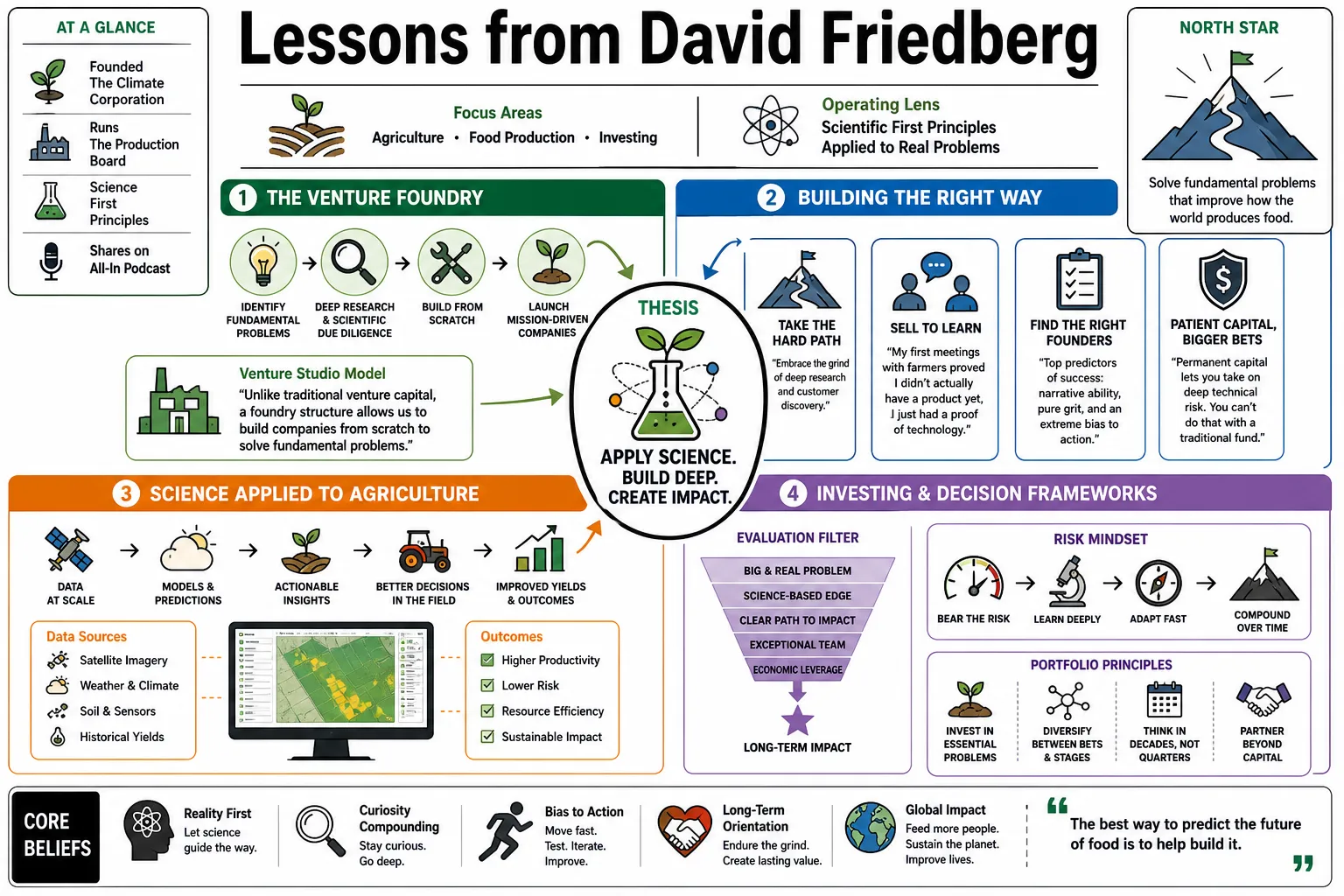
David Friedberg founded The Climate Corporation and currently runs The Production Board. He grounds his approach to agriculture, food production, and investing in scientific first principles, a perspective he regularly shares on the All-In Podcast. This collection organizes his specific frameworks for evaluating risk, building technical companies, and applying science to concrete problems.
Part 1: The Venture Foundry and Building
- On the venture studio model: "Unlike traditional venture capital, a foundry structure allows us to build companies from scratch to solve fundamental problems." — Source: [The Production Board]
- On taking the hard path: "If you want to solve an important problem, you have to embrace the grind of deep research and customer discovery." — Source: [Stanford eCorner]
- On early product validation: "My first meetings with farmers proved I didn't actually have a product yet, I just had a proof of technology. You have to sell to learn." — Source: [20VC]
- On finding founders: "When building companies, the top predictors of success are narrative ability, pure grit, and an extreme bias to action." — Source: [Opto Sessions]
- On capital structures: "Permanent capital lets you take on deep technical risk. You cannot force a decade-long science project into a typical ten-year venture fund cycle." — Source: [The Production Board]
- On solving real problems: "The greatest opportunities in our lifetime lie in reimagining systems of production to solve actual human needs." — Source: [Lessie]
- On moonshots: "Smart people often stay comfortable, avoiding failure by choosing safe projects. If you don't take the moonshot, you cap your potential impact." — Source: [Podcast Notes]
- On incentives: "To build a successful business, everyone involved must feel like a founder with real ownership and aligned incentives." — Source: [Accelerate Shares]
- On long-term cycles: "Hardware and science businesses require patience, but the moat you build through technical advantage makes it worthwhile." — Source: [TPB]
- On adapting assumptions: "Expect sudden gusts of wind that will force you to adapt. Your initial thesis is rarely the one that scales without alteration." — Source: [Farm Progress]
Part 2: Science as a Solution
- On human survival: "Science and technological innovation remain the best and most reliable hopes to save humanity from its greatest challenges." — Source: [Substack]
- On objective truth: "We live in a world driven by innuendo and anecdotal evidence, which makes a commitment to hard science and factual truth a competitive advantage." — Source: [Berkeley News]
- On scientific reasoning: "Independent thought and understanding through reason should be the foundation for navigating complex global crises." — Source: [YouTube]
- On bio-manufacturing: "Programming biology will allow us to manufacture food, medicine, and materials more efficiently than relying on traditional extraction." — Source: [TPB]
- On intellectual honesty: "There is immense value in simply saying 'I don't know' when you lack the data to form a scientific conclusion." — Source: [Reddit]
- On gain-of-function research: "The decentralization of science requires new frameworks for safety, particularly when dealing with biological research that has systemic risk." — Source: [Into the Impossible]
- On the microbiome: "Understanding and engineering the microbiome will unlock an entirely new paradigm for human health and agricultural yield." — Source: [Brian Keating]
- On funding science: "We need structures that fund deep science based on technical milestones, rather than pure software metrics." — Source: [The Production Board]
- On technology commercialization: "A scientific breakthrough is only half the battle; building the economic model that brings it to market is equally complex." — Source: [20VC]
- On energy: "Energy abundance, driven by advancements in nuclear and renewables, is the prerequisite for scaling advanced scientific solutions." — Source: [All-In Podcast]
Part 3: Investment Philosophy and Risk
- On contrarianism: "If you invest with the market, you will get market-matching returns. To generate alpha, you must invest where the market isn't." — Source: [Opto]
- On risk and return: "Without risk, there is no alpha. The goal isn't to avoid risk, but to identify technical advantages that reduce it systematically over time." — Source: [Opto Sessions]
- On assessing founders: "I look for a bias to action over pure intellect. You need founders who will run through walls to figure out the business model." — Source: [Apple Podcasts]
- On market timing: "You are either before the market or you disagree with the market. Both require conviction when everyone else says you are wrong." — Source: [Podcast Notes]
- On capital efficiency: "In hardware and bio, capital efficiency means de-risking the core technical thesis before scaling the commercial operations." — Source: [The Production Board]
- On narrative: "A founder's ability to craft a compelling narrative is a survival skill for raising capital and recruiting talent in hard tech." — Source: [Opto]
- On the VC asset class: "Traditional venture capital is often structurally misaligned for funding the deep, systemic changes needed in food and agriculture." — Source: [Startup Intros]
- On asset valuation: "The uncomfortable truth of the economy is that the ultra-wealthy do not live on income, they live by borrowing against appreciating assets." — Source: [India Times]
- On long-term holds: "Compounding returns in deep tech require a permanent capital base that won't force an early exit just to return a fund." — Source: [TPB]
Part 4: Human Progress and Extreme Optimism
- On capitalism: "Capitalism and entrepreneurship are the most effective engines we have for improving human productivity, sustainability, and quality of life." — Source: [TPB]
- On abundance: "Our goal should be to use technology to meet human desires while reducing environmental impact, allowing consumers to consume more for less." — Source: [YouTube]
- On identifying as an optimist: "I am an extreme optimist. I believe there won't be a shortage of problem-solving opportunities in our lifetime." — Source: [Buildd]
- On meaning: "Solving fundamental problems through entrepreneurship gives life profound meaning and purpose." — Source: [Stanford eCorner]
- On historical progress: "While short-term political cycles can be chaotic, the fundamental trajectory of human well-being is permanently tied to our capacity to innovate." — Source: [YouTube]
- On productivity: "True economic growth comes from step-function gains in productivity, which are only delivered by foundational technologies." — Source: [All-In Podcast]
- On the future of consumption: "We don't need to force people to consume less to save the planet; we need to invent ways to make consumption fundamentally sustainable." — Source: [Modern Wisdom]
- On longevity: "Advancements in biotechnology are not just about treating disease, but about fundamentally extending the human healthspan." — Source: [Chris Williamson]
- On global wealth: "Lifting billions out of poverty requires technological scaling, not just policy adjustments. Technology is the great democratizer." — Source: [All-In Podcast]
Part 5: Lessons from The Climate Corporation
- On the origin story: "WeatherBill started as a weather insurance product, but we realized the real value was in building a data science company for agriculture." — Source: [The Twenty Minute VC]
- On data in agriculture: "Farmers were making multi-million dollar decisions based on intuition. We brought hyper-local, data-driven modeling to the field." — Source: [Farm Progress]
- On pivoting: "The evolution of a business model is necessary. You have to follow the data to see where the actual customer value lies." — Source: All-In Podcast
- On customer discovery: "Cold calling farmers taught me more about building a product than any spreadsheet ever could." — Source: The Production Board
- On market education: "When you introduce a completely new paradigm, half your job is educating the market on why their old way is broken." — Source: [20VC]
- On software in farming: "Agriculture is the largest and most important industry on Earth, yet it was one of the last to be digitized. That was our wedge." — Source: [Substack]
- On acquisitions: "Joining Monsanto allowed our technology to scale globally faster than we could have done as a standalone entity at that time." — Source: [Berkeley News]
- On continuous iteration: "A product is never finished. In agriculture, every season gives you new data to refine your models." — Source: [Lessie]
- On building trust: "Farmers operate on thin margins. You cannot sell them software unless you can mathematically prove it increases their yield or reduces their risk." — Source: [Stanford eCorner]
Part 6: Problem Solving and Strategic Reason
- On strategy: "The most effective way to reach an objective is to win through intelligence and strategy, avoiding destructive conflict whenever possible." — Source: [Podcast Notes]
- On conflict: "Engaging in emotional arguments rarely changes minds. Presenting an undeniable technological alternative changes behavior immediately." — Source: [All-In Podcast]
- On first principles: "Break down the cost of production to its atomic parts. If the physics work, the economics will eventually follow." — Source: [Grokipedia]
- On systemic thinking: "You cannot isolate one part of the supply chain. You have to understand the entire system to find the real bottlenecks." — Source: [The Production Board]
- On cognitive bias: "We have to actively fight our own biases. Relying on reason and data over narrative is difficult but essential for accuracy." — Source: [Reddit]
- On AI: "Artificial intelligence is a tool for accelerating scientific discovery, turning biological engineering from a craft into an exact science." — Source: [Modern Wisdom]
- On thinking bigger: "Larry Page pushed me to think grander. The mental effort required to solve a massive problem is often the same as solving a small one." — Source: [Podcast Notes]
- On debate: "A healthy debate requires both sides to agree on a baseline of facts. Without that, you are just shouting into the void." — Source: All-In Podcast
- On patience: "Real innovation takes time. If you expect a foundational shift to occur in three years, you are setting yourself up for disappointment." — Source: [TPB]
- On execution: "An idea is a multiplier of execution. A brilliant idea with zero execution is worth nothing." — Source: [Stanford eCorner]
Part 7: The Global Economy and Policy
- On government spending: "You cannot simply tax the wealthy to solve structural government shortfalls. We have to address the root causes of inefficiency." — Source: [India Times]
- On the network state: "The decentralization of technology will naturally lead to a rethinking of state borders and the role of private networks." — Source: The Network State Podcast
- On California policy: "California's regulatory environment has created friction for builders. We need policies that incentivize production, not just redistribution." — Source: [Modern Wisdom]
- On inflation: "Inflation is fundamentally a supply chain problem. If you want to fix it long-term, you must invest in technologies that increase output per unit of energy." — Source: [All-In Podcast]
- On energy policy: "Shutting down nuclear power without a baseload alternative is a math error that sets environmental progress backward." — Source: [YouTube]
- On trade: "Global supply chains are fragile. The next decade will be about onshoring and automating production to guarantee sovereign resilience." — Source: All-In Podcast
- On national debt: "Our debt trajectory requires a massive leap in GDP growth to remain manageable, and only extreme technological breakthroughs can provide that." — Source: [All-In Podcast]
- On regulation: "Regulation often protects incumbents. Startups must navigate these moats by being so overwhelmingly better that consumers force the regulatory change." — Source: [Stanford eCorner]
- On economic models: "We are transitioning from a resource-extraction economy to an information and biology-based economy." — Source: [TPB]
Part 8: Agriculture and Systems of Production
- On food security: "We have to figure out how to feed billions more people using less land and less water. That is a pure engineering challenge." — Source: [TPB]
- On molecular printing: "In the future, we will synthesize beverages and foods at the point of consumption, eliminating the need to ship heavy water around the world." — Source: [Podcast Notes]
- On alternative proteins: "Precision fermentation will allow us to produce identical proteins without the massive carbon footprint of traditional animal agriculture." — Source: The Production Board
- On soil health: "The microbiome of the soil is as important to crop yield as the microbiome of the gut is to human health." — Source: [Brian Keating]
- On water management: "Water is going to be the most critical resource constraint of the next century. Our agricultural systems must adapt to hyper-efficiency." — Source: [Lessie]
- On farming margins: "Farmers are incredible business people who operate with massive weather and commodity risk. Technology's job is to stabilize that variance." — Source: [20VC]
- On the carbon cycle: "Agriculture can shift from being a carbon emitter to a massive carbon sink if we align the economic incentives with biological realities." — Source: [Substack]
- On synthetic biology: "We are moving from discovering things in nature to compiling them from code. Biology is the next great programming language." — Source: [TPB]
- On the ultimate goal: "The end state of production is a system where high-quality goods are abundant, localized, and environmentally restorative." — Source: [All-In Podcast]