David George is a general partner at Andreessen Horowitz, where he leads the firm’s Growth investing team. This collection gathers his own words from essays he wrote for a16z. — The Year to Be Great (David George, a16z).
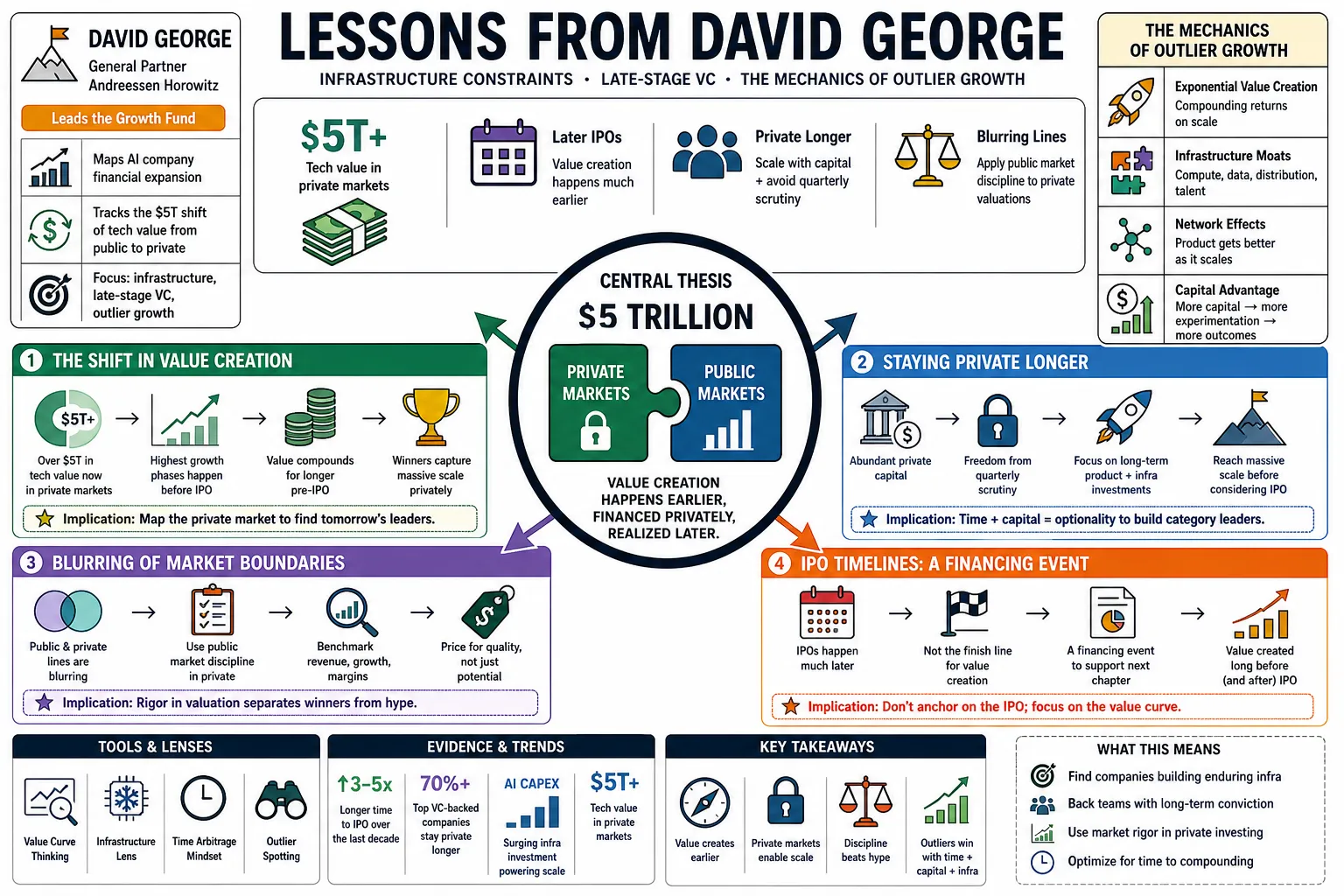
Part 1: The Fusion of Private and Public Markets
- On the inversion of software growth and profit: David George: "Back in ‘22, the market was full of high-growth, mostly unprofitable software businesses, but by 2026, the story has inverted: ~75% are profitable, but only ~30% are growing 20%+." — State of Markets II (David George, a16z).
- On going public versus being public: David George: "Going public is not the same as being a public company." — Are You Ready to Be a Public Company? (David George, a16z).
- On the real-time scoreboard: David George: "When you go public, your company’s performance suddenly has a real-time scoreboard: your stock price." — Are You Ready to Be a Public Company? (David George, a16z).
- On a credible path to grow: David George: "As a public company, your stock value depends on your ability to show investors that you have a credible path to grow—especially if you’re not cash flow positive yet." — Are You Ready to Be a Public Company? (David George, a16z).
- On skeptics of loss-making tech companies: David George: "Hindsight is 20/20, but the investors who remained skeptical that loss-making techcos would ever grow into high-margin machines, missed out on the theme of the previous decade." — State of Markets II (David George, a16z).
- On this cycle being different: David George: "In general, the technology is improving at an exponential pace, and while no one can predict the future, given the rate and pace of change, we’re pretty confident that this cycle isn’t going to be like any previous cycle." — State of Markets II (David George, a16z).
- On repricing: David George: "Fast-growing companies are still trading at multiples in line with historical averages (albeit not ZIRP peaks), but there are simply fewer of those now, so the sector as a whole was broadly repriced." — State of Markets II (David George, a16z).
Part 2: The Arrival of "Model Busters"
- On what a Great company can become: David George: "A Great company has the potential to be a $5B+ public company." — The Year to Be Great (David George, a16z).
- On refocusing on growth: David George: "And the best way to become Great is to refocus on generating fast growth." — The Year to Be Great (David George, a16z).
- On efficiency as table stakes: David George: "Efficiency alone doesn’t build a generation-defining company—it’s table stakes." — The Year to Be Great (David George, a16z).
- On growth being hard to grok: David George: "This isn’t rocket science, but sometimes high growth over many years can be hard to grok." — The Year to Be Great (David George, a16z).
- On the math of 30% versus 20% growth: David George: "If you’re growing 30% over the next 5 years instead of 20%, you’re going to be 1.5x bigger on a forward gross profit basis, and you’ll be trading at 15x forward gross profit vs 10x." — The Year to Be Great (David George, a16z).
- On the number of Great companies ahead: David George: "AI is going to turbocharge this expansion, and I expect there will be 200–300+ of these companies over the next 5–10 years." — The Year to Be Great (David George, a16z).
- On recommitting to why you started: David George: "Consider 2024 an opportunity to recommit to why you got into this game in the first place—to build amazing new products, outrun the competition, and reach users across the globe." — The Year to Be Great (David George, a16z).
- On using a tough market: David George: "A Great company uses a tough market as an opportunity to break away from the pack and outrun its competitors." — The Year to Be Great (David George, a16z).
- On evolving products to meet demand: David George: "A Great company brings the most innovative products to the market and continuously evolves them to meet changing demand." — The Year to Be Great (David George, a16z).
Part 3: AI Application Scaling and Economics
- On the value of older chips and models: David George: "Better, cheaper, intelligence is accruing value to the entire ecosystem, with both older chips and models retaining substantial value well past the expiration dates assigned by the bears." — State of Markets II (David George, a16z).
- On cheaper intelligence and compute demand: David George: "As intelligence gets cheaper, demand for compute is only rising, causing GPU pricing to climb upwards for the latest chips (and stay pretty for the older ones)." — State of Markets II (David George, a16z).
- On GPUs running hot: David George: "The point is that GPUs are already running hot, even while the data indicates that it’s still so early when it comes to mature AI adoption and utilization." — State of Markets II (David George, a16z).
- On agent adoption: David George: "The same goes for agentic use-cases, where a tiny share of the overall userbase is meaningfully deploying agents with any scale." — State of Markets II (David George, a16z).
- On what will make OpenAI win: David George: "We think that OpenAI will win because they are so good at creating new kinds of customers, and because they have the most durable distribution strategy." — OpenAI Understands Something Important and Rare (David George, a16z).
- On distribution first: David George: "We think that, in the future, OpenAI will have the best models, chips and products because they have the best distribution, not the other way around." — OpenAI Understands Something Important and Rare (David George, a16z).
- On building a true platform: David George: "Doing it as a true platform is long-term preferable: the revenue comes a bit slower, but it’s much more durable and valuable when you get it." — OpenAI Understands Something Important and Rare (David George, a16z).
- On powering a product customers do not see: David George: "Furthermore, your customers may not be aware you are even powering it, so you don’t earn any trust or goodwill from them." — OpenAI Understands Something Important and Rare (David George, a16z).
Part 4: Infrastructure and the AI Buildout
- On infrastructure needs: David George: "Global infrastructure needs are measured in trillions, defense spending is rising, grids are grappling with the electrification of everything, manufacturing is being reshored, and robots and robotaxis are inbound." — State of Markets II (David George, a16z).
- On operating leverage in tech: David George: "Perhaps more importantly, tech offered massive embedded operating leverage, given substantially untapped TAM, and software’s near-zero marginal cost." — State of Markets II (David George, a16z).
- On a skeptic of the buildout: David George: "At least one prominent bear of the buildout expressed some skepticism whether all this money invested in GPUs could possibly be worth it, given that they’d become obsolete in 3-4 years’ time." — State of Markets II (David George, a16z).
Part 5: Growth Investing Mechanics
- On decisions that go well: David George: "The alpha is in every decision the founder makes that goes well, and the opportunity set perpetually refreshes itself as technology improves." — Late Stage Venture Is About Late Stage Founders (David George, a16z).
- On founders and investors being at odds: David George: "The conventional wisdom was that founders and investors were fundamentally at odds with one another; you weren’t supposed to throw your lots in together." — Late Stage Venture Is About Late Stage Founders (David George, a16z).
- On missing big as a new public company: David George: "Missing big within the first few quarters can be devastating—not because your business is broken if you miss, but because your stock price will suffer as public investors question your forecasts." — Are You Ready to Be a Public Company? (David George, a16z).
- On forecasting being hard: David George: "Consistently and accurately forecasting your business is hard, and most companies need to be pretty large before they can consistently predict revenue, future growth, and operating margins." — Are You Ready to Be a Public Company? (David George, a16z).
- On setting guidance you can beat: David George: "We counsel our companies to set guidance that you can beat by 4–6% and then build in a buffer on top, since missing can really damage investor confidence and, consequently, your stock price." — Are You Ready to Be a Public Company? (David George, a16z).
- On the six-year growth test: David George: "Investors build models over 5–10 years, so as a general rule of thumb, you want your financial model to show that you can sustain 20%+ growth in year 6 if you’re currently burning cash." — Are You Ready to Be a Public Company? (David George, a16z).
- On growth and free cash flow margins: David George: "Higher topline growth rates combined with higher free cash flow margins at maturity lead to materially different cash flow profiles and, consequently, stock prices." — Are You Ready to Be a Public Company? (David George, a16z).
- On powerful growth stories: David George: "The most powerful growth stories prompt investors to dream about what would happen if your company figures out the next product, and the next product after that, and then becomes an industry platform with stickiness and staying power." — Are You Ready to Be a Public Company? (David George, a16z).
Part 6: Evaluating Founders and Teams
- On the founder's alpha: David George: "The alpha in a company is in the founder’s ability to spot non-obvious potential from their vantage point, apply it early and aggressively, and course-correct with new information." — Late Stage Venture Is About Late Stage Founders (David George, a16z).
- On rare founders: David George: "Founders are the rare individuals who can keep up with the rapidly changing opportunity set, apply the full force of their leverage to their vantage point, and put dollars to work forever." — Late Stage Venture Is About Late Stage Founders (David George, a16z).
- On deciding when to zig: David George: "Founders carry the burden of deciding when to surf the wave of tech best practices (which is most of the time!) versus when to zig when others zag, and make brave decisions against the consensus." — Late Stage Venture Is About Late Stage Founders (David George, a16z).
- On pressure to do the consensus thing: David George: "What founders don’t like is the pressure to do the consensus thing, that pervades analyst calls and shareholder feedback, rather than make the bets that would result in that continued 100% growth." — Late Stage Venture Is About Late Stage Founders (David George, a16z).
- On when founders need help: David George: "Founders at this point are expanding internationally, going multi-product, and they only need help if it’s at the pace they expect, at the scale they’re after." — Late Stage Venture Is About Late Stage Founders (David George, a16z).
- On the VC's job: David George: "The VC’s job, frankly, is to find those rare founders who can consistently do this, and give them the freedom to operate, a long-term mandate, and resources that actually help." — Late Stage Venture Is About Late Stage Founders (David George, a16z).
- On the premise of venture capital: David George: "Venture Capital exists on the premise that great founders have an unfair advantage at these capital allocation activities, compared to anywhere else." — Late Stage Venture Is About Late Stage Founders (David George, a16z).
- On staying in the car: David George: "We built our business to make sure we can keep serving founders, and remain in the car, for as long a time horizon as the founder could ever want." — Late Stage Venture Is About Late Stage Founders (David George, a16z).
- On founders making it so: David George: "If there’s one thing we’ve learned, working closely with these success stories, is that this is true because founders make it so." — Late Stage Venture Is About Late Stage Founders (David George, a16z).
Part 7: Power Laws and Venture Capital Realities
- On the limits of technology: David George: "Technology on its own, even if applied optimally and enthusiastically to solving business problems, eventually reaches its limits like anything else." — Late Stage Venture Is About Late Stage Founders (David George, a16z).
- On failing to imagine how well things could go: David George: "The error was in a failure to imagine how well things could go, if the founder simply got to remain in founder mode." — Late Stage Venture Is About Late Stage Founders (David George, a16z).