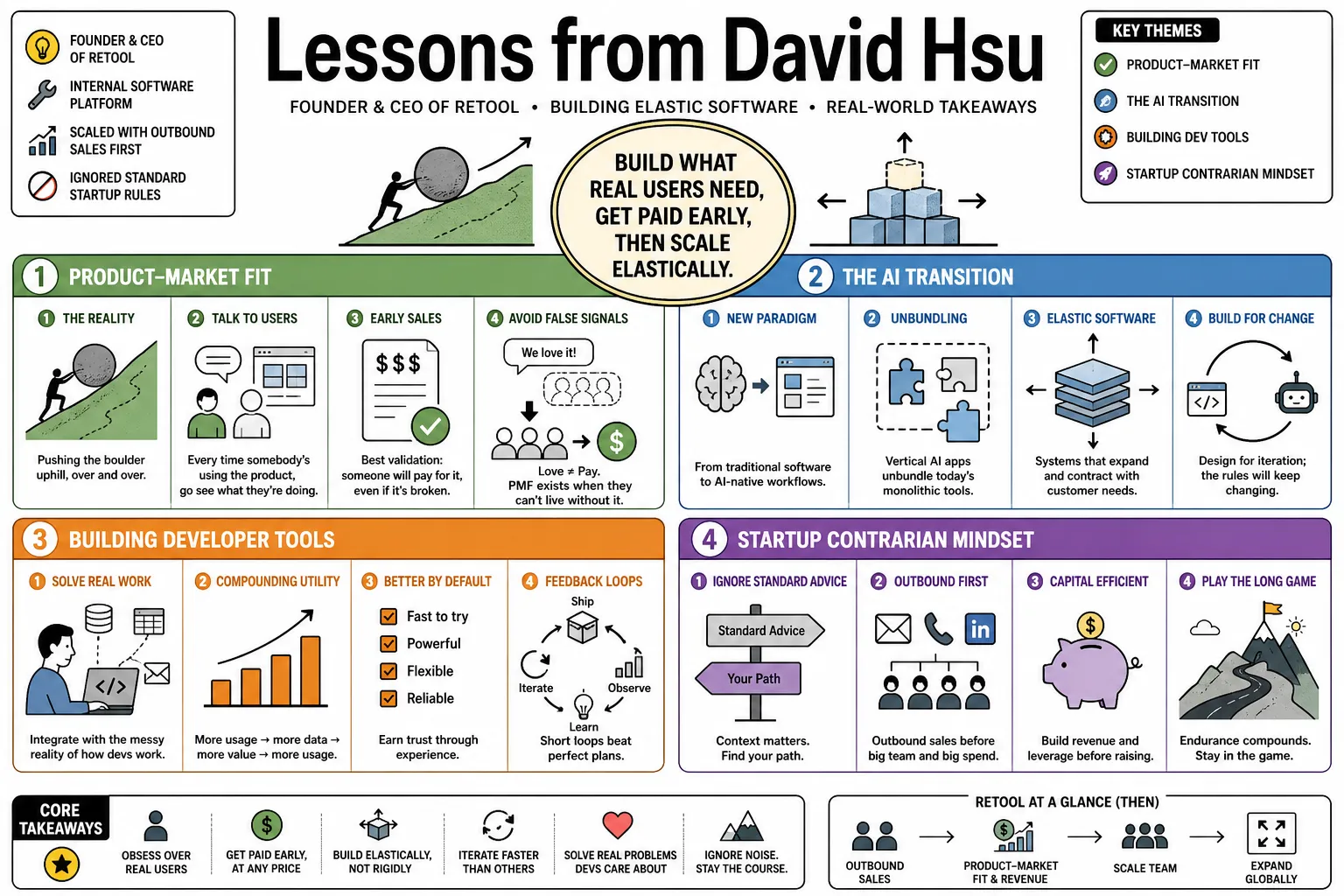
Lessons from David Hsu
David Hsu is the founder and CEO of Retool, a platform for building custom internal software. He scaled the company through aggressive outbound sales before hiring a large team, ignoring standard startup advice on venture capital and pushing the concept of "elastic software." This profile collects his takes on product-market fit, the AI transition, and the reality of building developer tools.
Part 1: Product-Market Fit
- On the reality of product-market fit: "Finding product-market fit rarely feels like a sudden aha moment. Instead, it really was kind of just pushing the boulder at a pretty steep trajectory uphill, over and over." — Source: Lenny's Newsletter
- On talking to early users: "At the beginning of any startup, no one knows about your product, nor does anyone use it... every time somebody's using the product, we should go see what they're doing." — Source: Lenny's Newsletter
- On early sales as validation: The best way to validate if a tool is useful is to see if someone will pay for it immediately, even if it is broken. — Source: Acquired
- On false signals: Lots of people will tell you they love your product, but true product-market fit only exists when they are actively utilizing it to solve a painful, expensive problem. — Source: Indie Hackers
- On hyper-specific initial use cases: Don't build for every developer. Build a tool that solves one specific, hated task so well that users are forced to adopt it. — Source: First Round Review
- On Y Combinator's utility: Y Combinator is highly effective pre-product-market fit because it forces you to maintain momentum, but its utility changes once you need to focus on scaling operations. — Source: The Twenty Minute VC
- On continuous fear: "Even when we were at 100 million in revenue, there was always this fear that we were suddenly going to crash into a wall and everything would stop." — Source: Lenny's Newsletter
- On measuring early success: Track how fast a user can complete their core workflow. If it isn't drastically faster than their previous method, you haven't found fit yet. — Source: Scaling DevTools
- On pivoting: You shouldn't blindly trust market analysis over your own conviction in a problem you genuinely want to solve. — Source: Indie Hackers
- On solving boilerplate: Hsu argues that teams should stop rebuilding the same internal systems from scratch: Retool exists to give developers reusable building blocks for admin panels, support dashboards, customer portals, and other common workflows. — Reference: Sequoia profile where Hsu says teams should not keep writing boilerplate internal-software code and describes Retool as reusable building blocks for common internal systems
Part 2: Fundraising and Venture Capital
- On the role of venture capitalists: Venture capitalists are generally not helpful before you find product-market fit, but they become highly valuable afterward when you need to scale. — Source: The Twenty Minute VC
- On bootstrapping vs. raising: You should be completely honest with yourself about whether you are building a lifestyle business or aiming for a massive, venture-backed outcome. — Source: Indie Hackers
- On maintaining a lean team: Retool reached nearly $1 million in revenue without outside hires, proving that throwing headcount at a problem isn't always necessary for early revenue growth. — Source: Indie Hackers
- On the cost of hiring: "Building a great product is the hardest part of starting a startup, not 'not hiring'." Keep headcount proportional to actual ARR. — Source: Retool Blog
- On capital as an accelerant: Don't raise money to figure out what your product is. Raise money to accelerate the distribution of a product that already works. — Source: The Twenty Minute VC
- On default alive: Staying "default alive" by keeping the team small allows you to focus purely on customer problems rather than internal management. — Source: Indie Hackers
- On startup failure rates: The fear of running out of money should drive extreme responsiveness to the few customers who actually care about what you're building. — Source: Lenny's Newsletter
- On valuation traps: High valuations can create a false sense of security; operational efficiency and actual user engagement are the only real metrics of survival. — Source: Acquired
- On taking advice: Discard generic advice from investors who haven't built products in your specific technical domain. — Source: First Round Review
Part 3: Growth and Sales Strategy
- On outbound sales: Outbound sales is one of the most effective ways to force early product-market fit because it demands immediate rejection or acceptance from cold prospects. — Source: Retool Blog
- On filtering prospects: Create strict filters for who you target in early sales deals so you don't waste time on users who lack the technical capability to deploy your software. — Source: Retool Blog
- On the transition to inbound: You can successfully transition from outbound hustling to an inbound machine, but only after you have established clear use cases in the wild. — Source: Retool Blog
- On Forward-Deployed Engineering (FDE): Using engineers in sales contexts is powerful, but only if you use their learnings to generalize patterns for the core platform. — Source: Acquired
- On avoiding the consultancy trap: Whenever dealing with a custom customer request, you must ask: "How does this feed back into the product?" Otherwise, you are just running an unscalable service business. — Source: The Twenty Minute VC
- On prioritizing developer pain: Focus your growth strategy on eliminating the tasks developers hate doing, such as building admin dashboards. — Source: Scaling DevTools
- On early pricing: Charge money early. It is the clearest signal that your tool is providing actual business value and not just intellectual curiosity. — Source: Indie Hackers
- On customer support as sales: Extreme responsiveness to bugs and feature requests is the best sales tactic for early-stage developer tools. — Source: Lenny's Newsletter
- On scaling on-premise software: Building an on-premise first SaaS company involves unique deployment challenges, but it unlocks massive enterprise contracts much earlier in a company's lifecycle. — Source: Retool Blog
- On developer marketing: Developers hate marketing. The best way to sell to them is to show them a technical solution that immediately reduces their workload. — Source: Scaling DevTools
Part 4: Product Philosophy and Design
- On being opinionated: Products fail when they try to be too broad. You have to become highly opinionated about exactly how the user should accomplish a workflow. — Source: Acquired
- On rough edges: A product with "rough edges" or minor bugs often signals to users that the tool is powerful, rapidly evolving, and built for complex tasks rather than being overly sanitized. — Source: Indie Hackers
- On the limits of self-serve: Early on, self-serve flows can actually hurt adoption if the product is complex; sometimes users need guided onboarding to understand the paradigm. — Source: Acquired
- On customizability: Developers will only adopt a platform if they believe they can drop down into code when the visual abstractions fail them. — Source: First Round Review
- On internal tools: Retool started from Hsu's observation that the internal systems Cashew had built were powerful but repetitive to create; the opportunity was to turn those recurring admin panels, support dashboards, and customer portals into reusable developer building blocks. — Reference: Sequoia profile describing how Cashew's repetitive internal systems became the provenance of Retool
- On abstraction layers: Good abstractions hide complexity without restricting power; bad abstractions force users into dead ends. — Source: First Round Review
- On speed of iteration: The faster you can push code to fix a customer's specific edge-case, the more loyalty you build. — Source: Scaling DevTools
- On dogfooding: If you aren't using your own product to run your own company, you will miss the friction points that cause churn. — Source: Retool Blog
- On product constraints: Forcing constraints on how a user builds an interface actually speeds up their development time by removing decision fatigue. — Source: Indie Hackers
Part 5: Vibe Coding and the AI Era
- On the definition of vibe coding: "Vibe coding" allows non-engineers to generate functional software prototypes rapidly using natural language prompts. — Source: The Neuron
- On the prototype gap: While AI has dropped the bar to prototype to zero, "the bar to ship hasn't moved." — Source: Retool Blog
- On AI's weakness: "What generative AI is bad at, Retool is really good at." AI struggles with connecting to production data securely, which is where governed platforms step in. — Source: Retool Blog
- On democratizing development: AI models are fundamentally changing who gets to be a developer, enabling operational teams to build their own software. — Source: Latent Space
- On prompt engineering: Natural language programming will become the default interface for the next generation of enterprise applications. — Source: Stack Overflow Blog
- On the risk of shadow AI: If employees generate apps via AI without oversight, businesses will face severe governance, security, and maintenance nightmares. — Source: Retool Blog
- On AI replacing boilerplate: Generative AI is finally fulfilling the promise of eliminating repetitive, boilerplate coding tasks. — Source: The Neuron
- On the future of coding: Writing syntax will become a niche skill, while system design and prompt structuring will become the primary focus of software engineering. — Source: Latent Space
- On governed runtimes: The future of AI-generated code relies on secure, governed platforms that handle permissions and audit logs automatically. — Source: Retool Blog
Part 6: Elastic Software and Shadow IT
- On elastic software: Just as the cloud made compute elastic, AI and modern platforms are making software itself "elastic" (able to be spun up on-demand to meet a transient business need). — Source: Retool Blog
- On code being free: Because AI makes writing code effectively free, the bottleneck shifts from writing software to managing, securing, and deploying it. — Source: Retool Blog
- On temporary applications: In the future, companies will build applications designed to last only a few weeks to solve an immediate problem, then dissolve them. — Source: Retool Blog
- On the shift away from SaaS: "SaaS products force you to work their way." As custom app generation becomes easier, companies will abandon rigid SaaS tools in favor of custom-built workflows. — Source: Retool Blog
- On competitive advantages: Businesses that use AI to custom-build their internal operations will outpace competitors relying on standard, off-the-shelf software. — Source: Stack Overflow Blog
- On standardizing shadow IT: Instead of banning shadow IT, IT departments should provide a safe sandbox where business users can build their own tools securely. — Source: Retool Blog
- On software crystallization: Elastic software can start as a quick, AI-generated reflex and later "crystallize" into a permanent, hardened application if it proves broadly valuable. — Source: Retool Blog
- On the decline of monolithic apps: The era of buying a single massive software suite to run a business is ending; the future is hyper-fragmented, custom micro-apps. — Source: Latent Space
- On the true cost of software: The cost of software is no longer in its creation, but in its maintenance, security, and integration with existing data models. — Source: Retool Blog
Part 7: Developer Culture and Tooling
- On the disdain for internal tools: Hsu frames internal systems as necessary but non-differentiating work: companies should give engineers building blocks for those workflows so they can spend more time on the custom product work that actually sets the business apart. — Reference: Sequoia profile where Hsu explains that internal-system building blocks free engineers to focus on core product work
- On respecting developers: If you build a tool for engineers, it must respect their existing workflows, version control, and testing environments. — Source: First Round Review
- On visual programming: Traditional low-code failed because it trapped developers. Modern tooling succeeds by allowing visual interfaces to co-exist with actual code. — Source: Acquired
- On the evolution of IDEs: Development environments are moving away from local machines and into browser-based, collaborative platforms. — Source: Scaling DevTools
- On trusting users: Give developers the ability to break things. If you lock down the platform too much, they will abandon it for raw code. — Source: First Round Review
- On technical debt: Adopting a developer platform is a trade-off: you accept platform lock-in in exchange for never having to maintain basic UI technical debt again. — Source: Stack Overflow Blog
- On the build vs. buy debate: The debate is shifting; you no longer have to choose between buying rigid software or spending months building it. You can generate custom software in hours. — Source: Retool Blog
- On community growth: The best developer communities are built around shared technical challenges, not forced marketing initiatives. — Source: Indie Hackers
- On open-source alternatives: Competing against open-source requires delivering an enterprise experience that is undeniably faster and more secure out of the box. — Source: Acquired
Part 8: Founder Psychology and Resilience
- On recovering from failure: After Cashew failed, Hsu treated the loss as recoverable learning: he looked back at what the team had built, asked what could be applied next, and used the repetitive internal systems from Cashew as the starting point for Retool. — Reference: Sequoia profile quoting Hsu on recovering from Cashew and applying those lessons to what became Retool
- On the burden of leadership: As a company scales, the founder's job shifts from writing code to constantly absorbing and managing the anxiety of the entire organization. — Source: The Twenty Minute VC
- On founder conviction: There is a fine line between visionary conviction and sheer stubbornness; you must be willing to pivot when the market actively rejects your thesis. — Source: Indie Hackers
- On impostor syndrome: Even successful founders frequently feel like they are on the verge of total collapse, regardless of their revenue milestones. — Source: Lenny's Newsletter
- On ignoring competitors: Obsessing over what competitors are doing is a distraction; your focus should remain entirely on the unarticulated needs of your users. — Source: Acquired
- On the emotional toll of early sales: Sending hundreds of cold outbound emails and receiving mostly rejections requires a thick skin and an irrational belief in your product. — Source: Retool Blog
- On hiring mistakes: The most expensive mistakes founders make are hiring too early and failing to fire quickly when someone isn't a fit for the company's pace. — Source: The Twenty Minute VC
- On continuous learning: The skills required to take a company from zero to one million are entirely different from those needed to take it from ten million to one hundred million. — Source: Indie Hackers
- On avoiding burnout: The best way to avoid burnout is to maintain a direct connection with the users whose lives you are actively improving. — Source: Scaling DevTools
- On defining success: Hsu was drawn to startups because they test whether a worldview is accurate and, when they work, can put a real dent in the universe; Retool applies that ambition to changing how companies build common internal software. — Reference: Sequoia profile where Hsu connects startups to testing a worldview, creating a dent in the universe, and rebuilding internal software around Retool