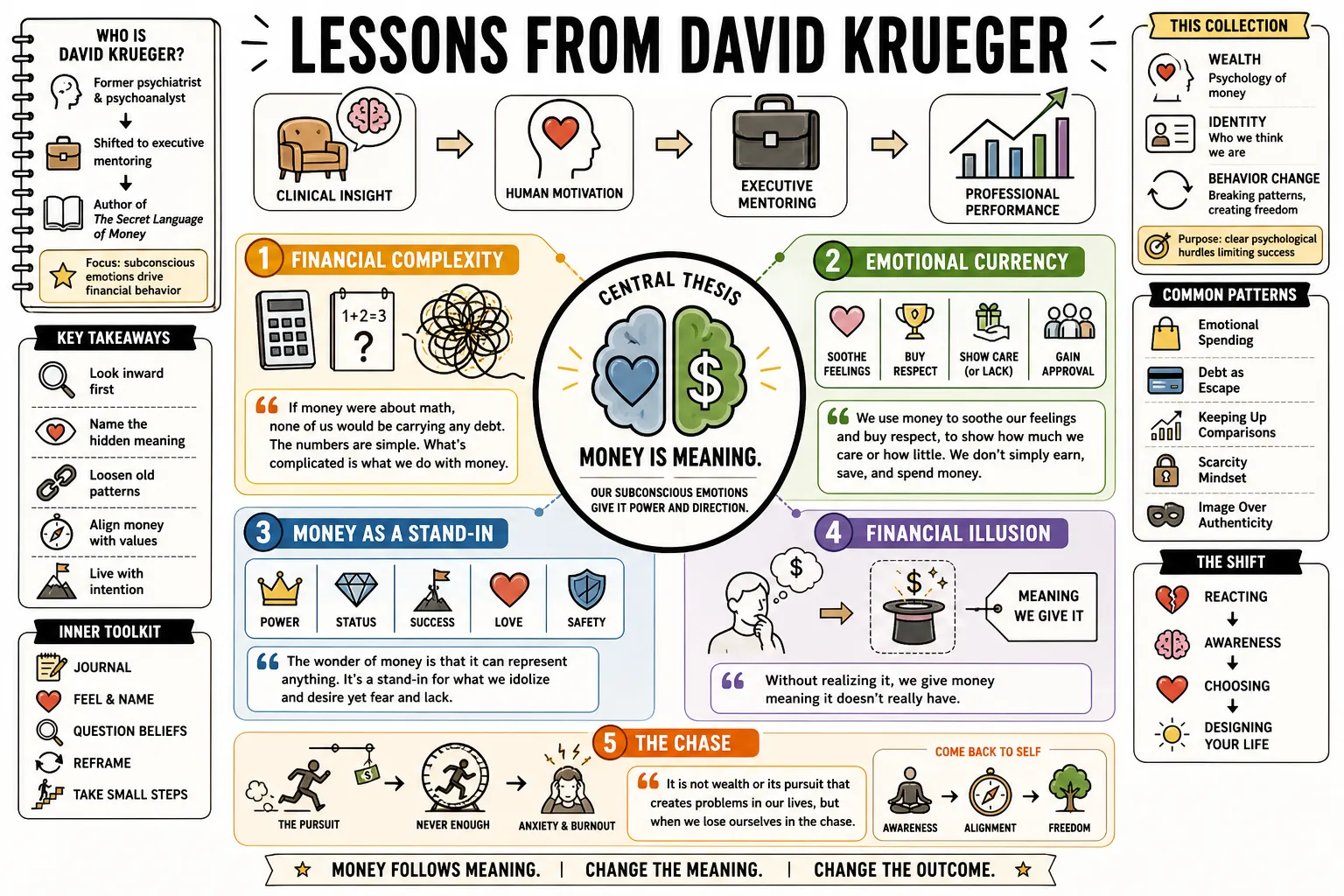
Lessons from David Krueger
This collection gathers David Krueger's own writing from his MentorPath articles and a TIME.com Q&A. — Meet Dave (MentorPath).
Part 1: The Psychology and Meaning of Money
- On the strange things we do with money: David Krueger: "Intelligent people spend money they don’t have." — Q&A with David Krueger, Author of The Secret Language of Money (TIME.com, 2009; his answers).
- On soothing emotional pain with money: David Krueger: "We use money to try to soothe emotional pains, buy the respect of others, and ourselves." — Q&A with David Krueger, Author of The Secret Language of Money (TIME.com, 2009; his answers).
- On money as a stand-in: David Krueger: "The wonder of money is that it can represent anything. It’s a stand-in for what we idealize and desire yet fear and lack, for what we covet, crave, spurn, chase or follow." — Q&A with David Krueger, Author of The Secret Language of Money (TIME.com, 2009; his answers).
- On giving money meaning: David Krueger: "The more we give money meaning, the more we lose what it really means." — Q&A with David Krueger, Author of The Secret Language of Money (TIME.com, 2009; his answers).
- On money as a social resource: David Krueger: "It gets pressed into service because it’s a commonly accepted social and personal resource—it makes people feel self-sufficient." — Q&A with David Krueger, Author of The Secret Language of Money (TIME.com, 2009; his answers).
- On credit cards: David Krueger: "Credit cards decouple buying and paying: the pleasure of the purchase is segmented from the pain of future payment." — Q&A with David Krueger, Author of The Secret Language of Money (TIME.com, 2009; his answers).
- On making money bigger than it is: David Krueger: "We give money meaning: we attribute emotional value, build a relationship with it and make it bigger than it is." — Q&A with David Krueger, Author of The Secret Language of Money (TIME.com, 2009; his answers).
- On using money to regulate moods: David Krueger: "We use money to regulate moods, increase self-esteem, and even control others." — Q&A with David Krueger, Author of The Secret Language of Money (TIME.com, 2009; his answers).
- On what we will not say about money: David Krueger: "We can debate financial markets and economics but not personal income or debt." — Q&A with David Krueger, Author of The Secret Language of Money (TIME.com, 2009; his answers).
- On questioning the meaning of money: David Krueger: "To recognize these meanings we have to monitor choices, question our ideas, and probe our reasoning." — Q&A with David Krueger, Author of The Secret Language of Money (TIME.com, 2009; his answers).
Part 2: Money Stories and Financial Narratives
- On what a money story is: David Krueger: "Your money story is not your income, expenses, assets, debt, or your net worth." — Q&A with David Krueger, Author of The Secret Language of Money (TIME.com, 2009; his answers).
- On the running dialogue about worth: David Krueger: "It’s a running dialogue about how much you deserve, how much you think you’re worth, how much you’re capable of." — Q&A with David Krueger, Author of The Secret Language of Money (TIME.com, 2009; his answers).
- On the unconscious tale about money: David Krueger: "It’s the unconscious tale you continually tell yourself about what you say with money, what money means to you, what money says about you." — Q&A with David Krueger, Author of The Secret Language of Money (TIME.com, 2009; his answers).
- On what money determines: David Krueger: "Whatever meanings and significance we attribute to money, the one reality it determines across all classes and cultures: choices." — Q&A with David Krueger, Author of The Secret Language of Money (TIME.com, 2009; his answers).
- On internal dialogues before spending: David Krueger: "We have internal dialogues in our minds before making a decision to exchange our money – our time and energy – for something else." — Q&A with David Krueger, Author of The Secret Language of Money (TIME.com, 2009; his answers).
- On the unspoken language of money: David Krueger: "Part of what keeps money language a secret is that it remains largely unspoken." — Q&A with David Krueger, Author of The Secret Language of Money (TIME.com, 2009; his answers).
- On what money stands in for: David Krueger: "It’s a stand-in for what we idealize and desire yet fear and lack, for what we covet, crave, spurn, chase or follow." — Q&A with David Krueger, Author of The Secret Language of Money (TIME.com, 2009; his answers).
- On where money management happens: David Krueger: "The vast majority of our money management occurs not through our hands, our broker’s hands, but inside our minds, in a complex interplay of thoughts, emotions, and neurological wiring." — Q&A with David Krueger, Author of The Secret Language of Money (TIME.com, 2009; his answers).
Part 3: The Neuroscience of Change and Habits
- On total absorption and mastery: David Krueger: "Those who achieve mastery immerse themselves in total absorption in a field over a period of time to acquire information and expertise to inform intuitive expression." — performance-science-meets-intuition (David Krueger, MentorPath).
- On a focus on problems: David Krueger: "A focus on problems retraces the same pathways already existing in the brain and further etches problem pathways, even when pursuing solutions." — how-can-you-help-someone-change-their-mind (David Krueger, MentorPath).
- On brain performance patterns: David Krueger: "These new brain performance patterns referred to by neuroscientists as “chunks” ultimately become long-term memory." — exceptional-performance-innate-talent-dedicated-practice-or-superhuman-effort (David Krueger, MentorPath).
- On physics and chemistry in change: David Krueger: "But if we switch from physics to chemistry, change can happen faster by adding a catalyst." — how-can-you-help-someone-change-their-mind (David Krueger, MentorPath).
- On what neuroscience teaches about change: David Krueger: "Neuroscience and quantum physics—and strategic coaching—have a lot to teach us about change." — Q&A with David Krueger, Author of The Secret Language of Money (TIME.com, 2009; his answers).
- On the brain opposing new information: David Krueger: "However, the brain opposes new information in its effort to preserve the default mode." — how-can-you-help-someone-change-their-mind (David Krueger, MentorPath).
- On what a catalyst does: David Krueger: "A catalyst simply facilitates alternatives and removes barriers." — how-can-you-help-someone-change-their-mind (David Krueger, MentorPath).
- On methods that fight the mind: David Krueger: "Many of the methods to facilitate change are contrary to how the mind and brain work." — Q&A with David Krueger, Author of The Secret Language of Money (TIME.com, 2009; his answers).
Part 4: The Fear of Success and Self-Sabotage
- On being unready for transformative challenges: David Krueger: "We are often ill-equipped and unready to prepare for our most transformative challenges." — the-vampire-problem (David Krueger, MentorPath).
- On giving up what might have been: David Krueger: "To give up what might have been is the most difficult thing to mourn, as we have to say goodbye to what never was, as well as the hope of getting what we wanted in the way that we wanted it." — your-unlived-life (David Krueger, MentorPath).
- On the road not taken: David Krueger: "The road not taken may hold the myth of our potential, the shadow inevitably bumping up against the recognition of what might have been." — your-unlived-life (David Krueger, MentorPath).
- On fantasies and longings: David Krueger: "These fantasies and longings may be for the people, experiences, or things that are absent, what we feel we are missing out on, what we could or should be doing, but for some reason are not." — your-unlived-life (David Krueger, MentorPath).
- On an unlived aspect of life: David Krueger: "Most of those accomplished people, paragons of success in the world’s eyes, were astonished to recognize an unlived aspect of their lives previously unacknowledged, or at most, only in their peripheral awareness." — your-unlived-life (David Krueger, MentorPath).
- On writing the first response: David Krueger: "The notion of immediately writing something prompts an emotional response, before being processed by the left, logical, reasoning brain." — your-unlived-life (David Krueger, MentorPath).
- On decisions that cannot be ceded to logic: David Krueger: "These experiences, including extreme success, require decisions that cannot be ceded to logic, scientific inquiry, or previous experience." — the-vampire-problem (David Krueger, MentorPath).
- On intuition and existing models: David Krueger: "But intuition uses existing models and mental representations based on known experiences to inform instantaneous unconscious simulation." — the-vampire-problem (David Krueger, MentorPath).
- On imagining another experience: David Krueger: "The act of imagining is simply not enough to inform what it might really be like to be blind, a slave, a Canadian goose, or a Vampire." — the-vampire-problem (David Krueger, MentorPath).
Part 5: Leadership, Mentorship, and Professional Growth
- On the goodbye that accompanies each step: David Krueger: "This goodbye may be the shadow story with each step ahead in the present moment, along with the accompanying uncertainty and trepidation of being in new territory." — your-unlived-life (David Krueger, MentorPath).
- On the default mode of operation: David Krueger: "This mode of default operation saves energy and sustains the familiar, but can result in stuckness and limit new possibilities." — how-can-you-help-someone-change-their-mind (David Krueger, MentorPath).
- On asking a question: David Krueger: "Asking a question shifts the listener’s perspective to one of participant, to look for answers rather than to oppose or accept." — how-can-you-help-someone-change-their-mind (David Krueger, MentorPath).
- On asking a question: David Krueger: "The antithesis of information and suggestions is to ask a question." — how-can-you-help-someone-change-their-mind (David Krueger, MentorPath).
- On the limits of more information: David Krueger: "If we attempt to introduce change by more information, reminding the benefits of seeing or doing things in a particular way (naturally ours), or even pushing, opposition results." — how-can-you-help-someone-change-their-mind (David Krueger, MentorPath).
- On intelligence and refuting: David Krueger: "And the more intelligent someone is, the more reasons they will find to refute the new information or suggestions (the Boomerang Effect)." — how-can-you-help-someone-change-their-mind (David Krueger, MentorPath).
- On listening to an unfolding story: David Krueger: "To listen together to their unfolding story and collaboratively examine the 90-95% of their operating system that is unconscious and often contains biases, blind spots, and assumptions that don’t work." — how-can-you-help-someone-change-their-mind (David Krueger, MentorPath).
- On pushing harder: David Krueger: "When this approach utilizing physics doesn’t work, we may simply nudge a bit harder, often resulting in increased resistance." — how-can-you-help-someone-change-their-mind (David Krueger, MentorPath).
- On beginning collaboratively: David Krueger: "The beginning of this collaborative framework activates oxytocin, the neurochemical system of bonding and connection to frame the remainder of the conversation." — how-can-you-help-someone-change-their-mind (David Krueger, MentorPath).
Part 6: Identity, Self, and Meaning
- On knowing our strengths: David Krueger: "A key component is to know our mental and psychological strengths, and to dedicate deliberate practice to capitalize on them." — performance-science-meets-intuition (David Krueger, MentorPath).
- On experience becoming mindfulness: David Krueger: "Time, intuitive feel, and experience become metabolized into mindfulness, catalyst to mastery, part of our own story told in our own voice." — performance-science-meets-intuition (David Krueger, MentorPath).
- On parallel lives: David Krueger: "These parallel lives include the conscious life that we live and the unlived life that we might yet have, or feel that we could or should have." — your-unlived-life (David Krueger, MentorPath).
- On intuitive awareness: David Krueger: "Intuitive awareness helps us process complex layers of emotional and cognitive information not accessible to the conscious, logical mind in order to gain an understanding of the whole." — performance-science-meets-intuition (David Krueger, MentorPath).
- On intuition and rationality: David Krueger: "Intuition and rationality paradoxically combine to shape new creative experiences and applications." — performance-science-meets-intuition (David Krueger, MentorPath).
- On learning a complex skill: David Krueger: "In any endeavor, when we learn a complex skill for it to become automatic, we free our minds to focus on the next higher level." — performance-science-meets-intuition (David Krueger, MentorPath).
- On his first job: David Krueger: "At age 8, I earned 10 cents a row chopping cotton for my Dad on hot summer days on the farm." — Q&A with David Krueger, Author of The Secret Language of Money (TIME.com, 2009; his answers).
- On internalizing fundamentals: David Krueger: "Once fundamental skills and knowledge are learned and assimilated, this internalization becomes part of our neural system, the default mode." — performance-science-meets-intuition (David Krueger, MentorPath).
- On recognizing meaningful patterns: David Krueger: "The growing ability to recognize and incorporate meaningful patterns in deliberate practice develops skills that increasingly become automatic, and a part of performance flow." — exceptional-performance-innate-talent-dedicated-practice-or-superhuman-effort (David Krueger, MentorPath).
Part 7: Overcoming Assumptions and Uncertainty
- On deciding without having experienced: David Krueger: "The difficulty is that you can’t possibly make an informed choice." — the-vampire-problem (David Krueger, MentorPath).
- On starting with what we know: David Krueger: "We often begin decision analysis with what we know, then make adjustments and conclusions from these anticipated facts." — the-vampire-problem (David Krueger, MentorPath).
- On emotional valuation: David Krueger: "At times, emotional valuation can overwrite brain valuation." — Q&A with David Krueger, Author of The Secret Language of Money (TIME.com, 2009; his answers).
- On what money stories reveal: David Krueger: "Our money stories tell us less about money and more about the human mind and its operations." — Q&A with David Krueger, Author of The Secret Language of Money (TIME.com, 2009; his answers).
- On confirmation bias: David Krueger: "We then seek data to validate what we already believe (confirmation bias), stick with what we know (the endowment effect), and repeat the same behavior (status quo bias)." — how-can-you-help-someone-change-their-mind (David Krueger, MentorPath).
- On mental representations: David Krueger: "These mental representations allow a chess master, quarterback, executive, or farmer to glance at a situation and immediately recognize patterns to inform perception, processing, and action without having to think consciously." — exceptional-performance-innate-talent-dedicated-practice-or-superhuman-effort (David Krueger, MentorPath).
- On brief questions: David Krueger: "And we know from neuroscience that we attend to and retain up to 10-12 words at a time, so the best questions are brief." — how-can-you-help-someone-change-their-mind (David Krueger, MentorPath).
- On the science of elite performance: David Krueger: "The mind, brain, and performance sciences can now inform the systematic mindset, practice, and execution of elite performance and achievement." — exceptional-performance-innate-talent-dedicated-practice-or-superhuman-effort (David Krueger, MentorPath).
Part 8: Strategy, Systems, and Sustainable Performance
- On imagining a purchase: David Krueger: "Neuroscientists in London have shown that imagining a future purchase has the same effect in the brain as getting it." — Q&A with David Krueger, Author of The Secret Language of Money (TIME.com, 2009; his answers).
- On a remark about money: David Krueger: "Someone once told me, “I’ve never seen a problem that money has made worse.” With the exception of drug or alcohol addiction, he has a point." — Q&A with David Krueger, Author of The Secret Language of Money (TIME.com, 2009; his answers).
- On two questions for every choice: David Krueger: "There are two simple questions to ask with each important choice we make: Whatever meanings and significance we attribute to money, the one reality it determines across all classes and cultures: choices." — Q&A with David Krueger, Author of The Secret Language of Money (TIME.com, 2009; his answers).
- On outsmarting our brains: David Krueger: "So we have to outsmart our brains." — Q&A with David Krueger, Author of The Secret Language of Money (TIME.com, 2009; his answers).
- On deciding once to save: David Krueger: "Automatically deduct retirement savings each month. This commitment device is a decision you only have to make once." — Q&A with David Krueger, Author of The Secret Language of Money (TIME.com, 2009; his answers).
- On the pleasure of buying: David Krueger: "It’s hard to resist the immediate pleasure of buying—it activates the same pleasure center in the brain that dopamine does." — Q&A with David Krueger, Author of The Secret Language of Money (TIME.com, 2009; his answers).
- On saving for something specific: David Krueger: "Saving is easier when it is for something specific that we can envision." — Q&A with David Krueger, Author of The Secret Language of Money (TIME.com, 2009; his answers).