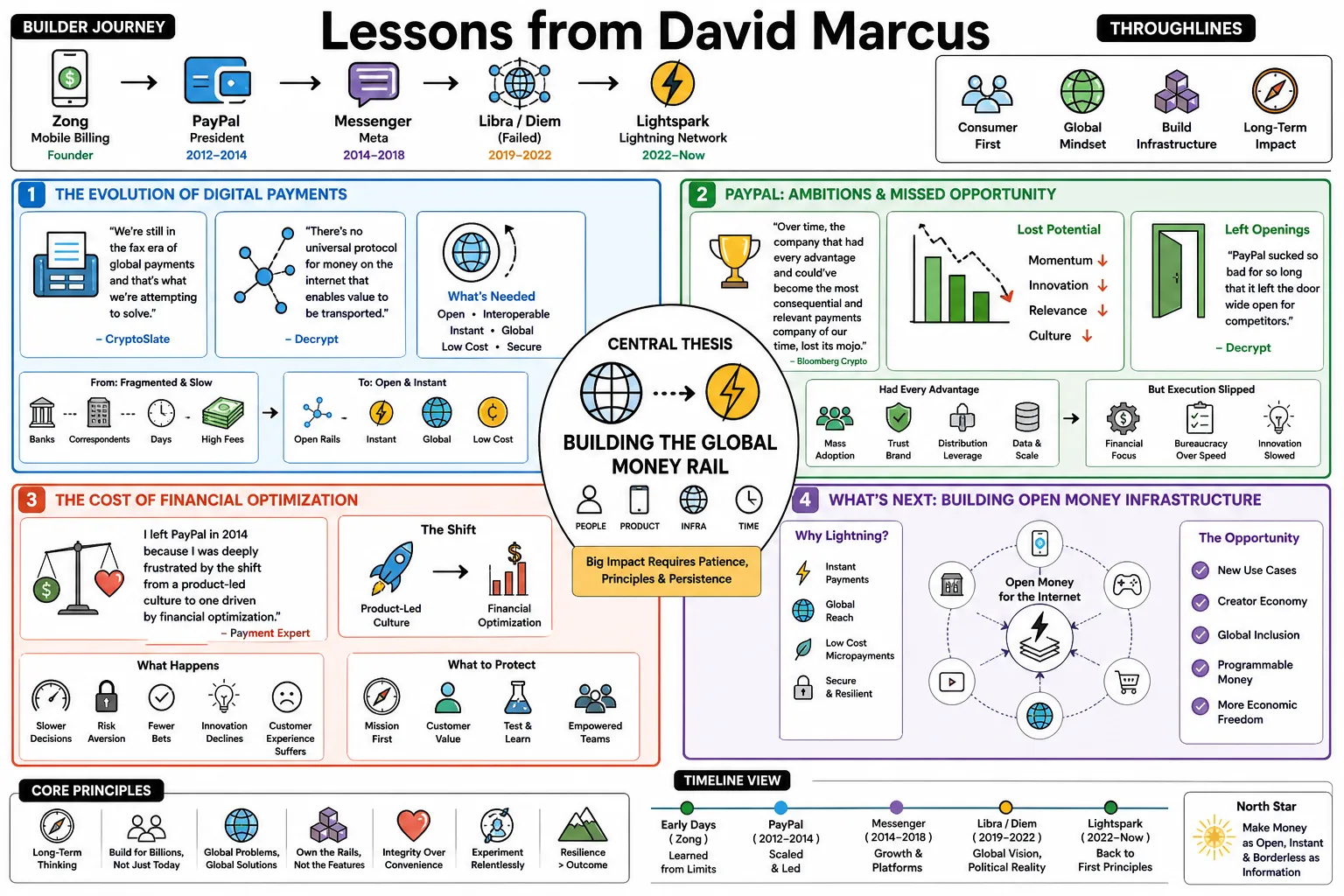
Lessons from David Marcus
David Marcus founded mobile billing startup Zong before serving as president of PayPal and leading Meta's Messenger division. He later co-created the failed Libra digital currency project and now runs Lightspark to scale Bitcoin's Lightning Network. This collection gathers his advice on building consumer products at scale while navigating corporate bureaucracy and global financial politics.
Part 1: The Evolution of Digital Payments
- On the State of Global Money: "We're still in the fax era of global payments and that's what we're attempting to solve." — Source: CryptoSlate
- On the Absence of a Standard: "There’s no universal protocol for money on the internet that enables value to be transported." — Source: Decrypt
- On PayPal's Lost Potential: "Over time, the company that had every advantage and could've become the most consequential and relevant payments company of our time, lost its mojo." — Source: Bloomberg Crypto
- On Financial Optimization: "I left PayPal in 2014 because I was deeply frustrated by the shift from a product-led culture to one driven by financial optimization." — Source: Payment Expert
- On Leaving Openings for Competitors: "PayPal sucked so badly at certain things that it created openings for competitors like Stripe and Square." — Source: The Next Web
- On Friction in Cross-Border Transactions: The current correspondent banking system is built on legacy infrastructure that requires too many intermediaries, resulting in high fees and slow settlement times. — Source: a16z Podcast
- On the Goal of UMA: "Our goal was to make transferring funds as easy as sending an email." — Source: Binance News
- On Interoperability: Future payment networks must allow users on completely different platforms and banks to transact with each other seamlessly, much like email providers do today. — Source: Lightspark Blog
- On Regulatory Necessity for Growth: "If we truly want Bitcoin and Lightning to become the winning global settlement network for value on the internet, it must enable regulated entities to participate with the network and meet their compliance obligations." — Source: Bitcoin.com
- On the Internet of Value: Money should move as natively on the internet as a text message or a photo, without being restricted by closed, proprietary walled gardens. — Source: CoinShares Interview
Part 2: Bitcoin as the Global Settlement Layer
- On Bitcoin's True Utility: "Our view is actually that Bitcoin is not the currency that people will use to buy things … the actual net settlement layer that is used is basically Bitcoin Lightning." — Source: CryptoSlate
- On Market Realization: "When the market realises that Bitcoin is the best neutral settlement asset, it will change Bitcoin forever." — Source: CoinShares Interview
- On Decentralization as a Requirement: If you intend to fundamentally change how money moves, it must be built on a truly decentralized, neutral foundation. Bitcoin is the only asset that fits this bill. — Source: a16z Podcast
- On Neutrality: Marcus argues that global payments need a neutral open settlement asset: Bitcoin provides the base layer, while open second-layer networks can add utility without leaving users dependent on one corporate rail. — Reference: CoinShares interview where Marcus describes Bitcoin as the best neutral open settlement asset and discusses open, permissionless payment infrastructure
- On Cash Finality: The power of Bitcoin over Lightning is that it settles in real time, cash final, and at a very low cost, unlike traditional credit rails that take days to clear. — Source: Decrypt
- On Centralized Crypto Limits: Centralized crypto projects are inherently limited by regulatory and political pressures, making a decentralized base layer essential for survival. — Source: a16z Crypto Startup School
- On Moving Away from Fiat: While fiat currencies will remain the primary unit of account for consumers, Bitcoin will serve as the underlying rails that connect different fiat economies. — Source: Aleph Podcast
- On the Store of Value Debate: Bitcoin has proven itself as a store of value, but its next phase of evolution requires proving its utility as a high-velocity settlement network. — Source: Lightspark Announcements
- On the Absence of a CEO: Bitcoin's greatest strength in facing regulatory scrutiny is that it has no CEO, no marketing department, and no single point of failure to be pressured. — Source: David Marcus on X
- On Professionalizing the Network: By enabling banks and exchanges to safely utilize Bitcoin, we can move the infrastructure into the mainstream financial system without compromising its core properties. — Source: Retail Banker International
Part 3: The Lightning Network and Lightspark
- On the Internet Analogy: "Bitcoin and its Layer-2 network, Lightning, are to money what IP and TCP are to the Internet." — Source: CoinShares Interview
- On Packet Analogy: "A fragment of a Bitcoin on top of lightning is like a small packet data packet on the internet only for value." — Source: Decrypt
- On the Invisible Plumbing: Just as most internet users are unaware they are using TCP/IP protocols to transmit data, users of a global money network should be able to send value without needing to understand Lightning. — Source: CoinShares Interview
- On Building Lightspark: The mission of Lightspark is to build the enterprise-grade infrastructure that makes Lightning reliable, scalable, and accessible for large financial institutions. — Source: Lightspark Blog
- On UMA and Compliance: Universal Money Addresses allow wallets to communicate compliance and exchange data before the Lightning transaction is executed, solving a major institutional hurdle. — Source: Binance News
- On Network Liquidity: One of the hardest engineering challenges with Lightning is managing channel liquidity and routing, which is the exact problem Lightspark was built to abstract away for businesses. — Source: a16z Podcast
- On Pushing Back on Purists: The integration of compliance features like Travel Rule support into Lightning interfaces is necessary for global adoption, despite pushback from absolute purists. — Source: Bitcoin.com
- On Low-Cost Remittances: Lightning fundamentally changes the economics of cross-border remittances, allowing fractions of a cent to be sent across the globe almost instantly. — Source: SoFi Blog
- On Open Protocols: Open-sourcing the UMA protocol ensures that any developer can build on top of this standard without being locked into a proprietary system. — Source: Blockworks
- On Real-Time Settlement: Marcus says Lightspark uses real-time invisible Bitcoin settlement to move currencies cross-border, 24/7, at very low cost, with Lightning still used for institutional connectivity into Bitcoin settlement. — Reference: CoinShares interview where Marcus discusses real-time invisible Bitcoin settlement, Lightning connectivity, and low-cost 24/7 cross-border money movement
Part 4: The Demise of Libra/Diem and Political Realities
- On the Project's End: The shutdown of the Libra/Diem project was "100% a political kill" orchestrated by regulators despite the team meeting all compliance requirements. — Source: Business Insider
- On the Turning Point: His 2019 congressional testimony marked "the starting point of two years of nonstop work and changes to appease lawmakers and regulators." — Source: Altcoin Buzz
- On Political Suicide: "The story, as I heard it, is that Jay Powell was told by Treasury Secretary Janet Yellen... that allowing this project to move forward was 'political suicide'." — Source: Business Insider
- On Exhausting Requirements: By the spring of 2021, Meta "had addressed every last possible regulatory concern" before political forces ultimately shut it down anyway. — Source: Business Insider
- On Being Too Idealistic: Looking back, the team was "too idealistic" with their original idea, and the goal of making "everyone happy" could not "mesh with political realities." — Source: Business Insider
- On Central Control: "It has been very clear to us from the very beginning that a payment network such as the Libra network shouldn't be controlled by one company." — Source: Khmer Times
- On the Threat to the Dollar: Policymakers fundamentally misunderstood Libra, viewing it as a threat to sovereign currency when it was actually designed to extend the reach of the US dollar digitally. — Source: David Marcus on X
- On the Power of the State: The Libra experience proved that sovereign nations will exercise immense pressure to maintain control over money issuance and distribution mechanisms. — Source: a16z Podcast
- On Leaving Meta: "My entrepreneurial DNA has been nudging me for too many mornings in a row to continue ignoring it." — Source: The Block
Part 5: Leadership and Driving Cultural Change
- On Facing Reality: "If we suck at something, we now face it, and we do something about it... You have my commitment to make this company GREAT again." — Source: Y Combinator Hacker News
- On Professional Purpose: "A life devoid of purpose, and passion in what you do every day is a waste of the precious time you have on this earth to make it better." — Source: Sword and the Script
- On Breaking Bureaucracy: Driving change in a large organization like PayPal required blowing apart existing systems and cutting away layers of middle management that slowed decision-making. — Source: Forbes
- On Rebuilding Talent: A cultural turnaround is impossible without aggressively recruiting top-tier technical talent and signaling to the market that the engineering culture has fundamentally shifted. — Source: 20VC Podcast
- On Direct Communication: Leadership requires speaking plainly to employees and customers alike, acknowledging failures directly rather than hiding behind corporate communications. — Source: Engadget
- On Founder Autonomy: Transitioning from founder to corporate executive is difficult because it requires trading absolute autonomy for the leverage of scale. — Source: Aleph Podcast
- On Managing Crises: True leadership is tested not when a product launches, but during the grueling years of regulatory hearings and internal doubt when morale must be actively maintained. — Source: David Marcus on X
- On Taking Responsibility: When a product fails to meet the mark, the leader must take the blame publicly while protecting the team internally. — Source: Wired Business Conference
- On Knowing When to Leave: You must recognize when a company's structural incentives no longer align with product-led innovation, and have the courage to walk away. — Source: Bloomberg Crypto
Part 6: Building Products and Consumer Experience
- On Customer Emotion: "It's not enough about getting your customers to like you, they need to love you." — Source: The Next Web
- On Short-Term Hype: "Did it matter for the web or did it matter for apps? And it was the exact same thing, overhyped in the short term, underhyped over the long run." — Source: Business Insider
- On Early Iterations: "The first websites were really, really bad, the first apps were really, really bad. If you load one of the first, circa-2008 apps on your phone right now, it's shocking." — Source: Business Insider
- On Product Focus: A great product cannot be designed through financial engineering; it must be built by solving a painful, specific problem for the end user. — Source: Payment Expert
- On Utility Over Novelty: Technology for technology's sake fails. The underlying protocol should be entirely invisible to the consumer, who only cares about speed and cost. — Source: CoinShares Interview
- On Iterative Development: You have to ship early versions that might be heavily criticized in order to gather the real-world usage data needed to refine the platform. — Source: Wired Business Conference
- On Reducing Friction: The ultimate goal in consumer payments is reducing the number of taps required to complete an action down to zero. — Source: ABC 10 News
- On Abstracting Complexity: Users do not want to manage private keys or worry about channel liquidity; the consumer experience must mirror the simplicity of modern banking apps. — Source: Lightspark Blog
- On Building for Scale: Designing a product for 10,000 users requires a completely different architecture and mindset than designing one that must reliably serve over a billion users daily. — Source: 20VC Podcast
Part 7: The Messenger Era and Platform Shifts
- On Conversational Commerce: The initial vision for bots on Messenger was to eliminate the need for users to download individual, single-purpose apps for every business they interact with. — Source: ABC 10 News
- On the Long Game: While early chatbots faced friction, integrating business communication directly into messaging threads remained a critical, long-term strategic shift. — Source: MarTech
- On Decoupling Messenger: Separating Messenger from the core Facebook app was a controversial but necessary move to allow it to evolve as a dedicated, high-speed communication utility. — Source: Entrepreneur
- On Ignoring the Noise: "I'm not too stressed about it. I think that we're actually starting to see some really good experiences coming on the platform." — Source: Business Insider
- On Mobile Prioritization: Joining Facebook to run Messenger was driven by the realization that messaging would become the dominant interface layer of the mobile era. — Source: Entrepreneur
- On Platform Monopolies: The transition from web to mobile concentrated power in the hands of app store operators, making alternative distribution channels like Messenger vital. — Source: Wired Business Conference
- On Global Communication: Building a product that connects over a billion people fundamentally changes your perspective on how technology impacts distinct cultures and economies. — Source: 20VC Podcast
- On Customer Support: Moving customer service away from 1-800 numbers and into asynchronous messaging threads is a permanent upgrade to the consumer experience. — Source: ABC 10 News
- On the Transition to Payments: The logical conclusion of connecting billions of people via text is giving them the ability to instantly send value to one another within the same interface. — Source: David Marcus on X
Part 8: Entrepreneurship and Building Companies
- On the Zong Acquisition: The acquisition of Zong by PayPal was a validation of the mobile carrier billing model, but transitioning the startup's speed into a large corporation proved incredibly difficult. — Source: Forbes
- On Career Risks: Leaving a secure, high-ranking executive position at PayPal to run a messaging app at Facebook was a calculated bet on the future of mobile interfaces. — Source: Entrepreneur
- On the Startup Mindset: Even inside massive corporations, you must maintain an entrepreneurial DNA to push through resistance and launch zero-to-one products. — Source: The Block
- On Silicon Valley: Relocating to Silicon Valley was necessary for Zong to scale, as the ecosystem provides unparalleled access to talent, capital, and ambition. — Source: Medium
- On Learning from Mistakes: The biggest mistakes made as an early founder provide the grit and pattern recognition required to manage much larger crises later in life. — Source: 20VC Podcast
- On Shipping Cadence: Startups win by maintaining a relentless cadence of shipping code, a rhythm that large companies inevitably lose as they optimize for risk mitigation. — Source: a16z Podcast
- On Returning to Roots: Founding Lightspark was a return to the foundational joy of building a company from scratch, free from the inertia of legacy corporate structures. — Source: David Marcus on X
- On Taking Big Swings: If you are going to dedicate years of your life to a project, it must have the potential to structurally change an entire industry, rather than just delivering incremental improvements. — Source: Aleph Podcast
- On Resilience: The journey from Zong to PayPal, Meta, and Lightspark demonstrates that long-term relevance in tech requires an absolute willingness to repeatedly reinvent yourself. — Source: 20VC Podcast