David Ossip is Chair and CEO of Dayforce, a provider of HR software and services formerly known as Ceridian HCM. The company rebranded as Dayforce in 2024 and was taken private by Thoma Bravo in February 2026.
In 2012, Ceridian acquired Dayforce, a time and attendance cloud company founded by David. He then led Ceridian’s transformation around the Dayforce HCM offering.
In 2013, David became the CEO of the company. David also founded Workbrain, a workforce management software company, where he served as CEO and President until it was sold to Infor for $227M in 2007.
Leadership, Delegation, and Personal Growth
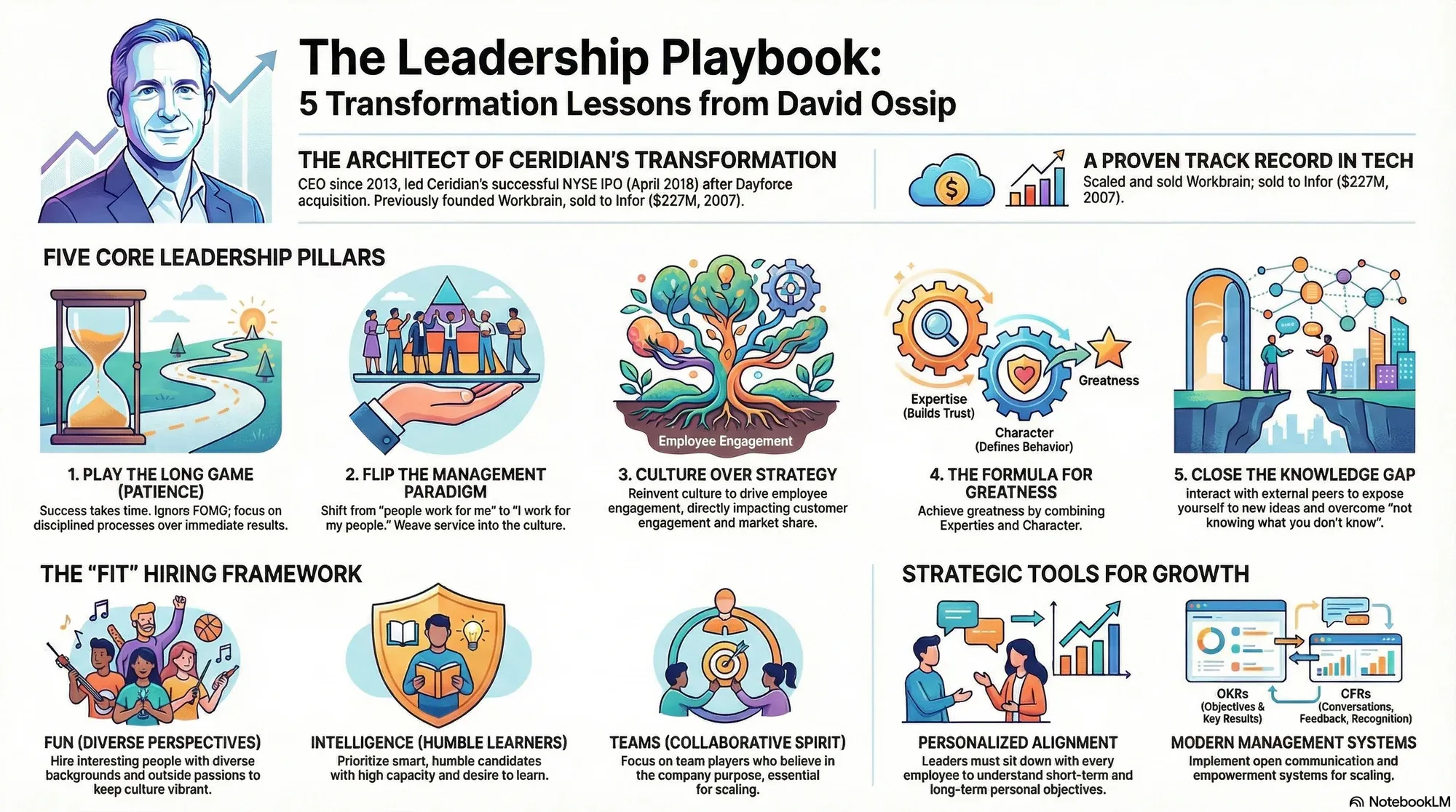
- On Patience in Business: “When you start a business, you need to remain calm. Usually it takes a lot longer to get going, and so you’re anxious to see something happen. You can get discouraged during that phase.”For millennials like me who are used to get everything quickly, it is probably the most important and toughest learning. I’m still working on it, but in the last year or so, I have increasingly become more patient regarding results and focused much more on the processes to get there. More is something you can always wish for, but it usually takes way more time and way harder than you expect. Accepting that the discipline of sticking to your core values and trusting the infrastructure you built around yourself helped me get the FOMO away and focus on playing the long game.
- On Broadening Perspective: “Interact with external leaders, because people don’t know what they don’t know. Being exposed to different role models and ideas helps close that gap.”One of the thing people can do to upscale themselves is to get other kind of perspective. People should be wary of prescriptions and the plethora of advice out there, but they can still learn a lot by having other people challenge them on their views or just by having other people reframe the problems they might have. I like these quotes from Kanye West: “I use the world as my therapist. Everyone I talk to is my therapist. People around you know more about you than a therapist” and “I am not a fan of books. I would never want a book’s autograph. I am a proud non-reader of books. I like to get information from doing stuff like actually talking to people and living real life.” — Kanye West interview
- On Leading with Accessibility: Being highly accessible and responsive to employees and customers creates a culture where people know they will be heard and helped. — Thoma Bravo: Beyond the Deal
- On Delegating to Experts: True delegation means hiring leaders who are better than you in their domains and trusting their decisions. — Thoma Bravo: Beyond the Deal
- On Hiring for the Next Stage: Companies often plateau because the current team lacks the capability for the next level, so leaders must recruit people who have already succeeded at the scale they are trying to reach. — Waterstone Human Capital
- On Supporting Employee Evolution: Employees’ interests change as they learn and gain experience, so managers must keep discovering how and why each person wants to grow. — BrainStation
- On Entrepreneurship as a Profession: "Entrepreneurship is a profession. It’s not a one-pony race." — BrainStation
Culture and Scalable Teams
- On Scaling Through Service: “In the early days, I didn’t understand that to successfully scale a company, it wasn’t about me, it was about everyone else. I had this mistaken notion that people work for me rather than seeing that taking care of my people was my job. That has been the biggest learning for me over several decades in business.”Working in mid-market management consulting taught me that the biggest challenge of executives are themselves. We see company that stops growing or have the potential for high growth, but they can’t because executives are not able to let go, try to control everything and do everything themselves. I like this quote from David where he flips the paradigm toward employees: “their primary responsibility is to their employees. You have to weave that sense of service into the fabric of your culture to be successful.” David also recommends executives sit down with every person to figure what their short- and long-term personal objectives are.
- On Cultural Reinvention: “My take home after a hard look at Ceridian was that the organization had to reinvent its culture in order to drive proper employee engagement, in turn improving our customer engagement scores and market share. If you have an organization that can’t change, you will become extinct."A famous quote in management circles is that “Culture eats strategy for breakfast”. Building a great culture is one of the most important ways to build an organization to the next level. One of the first things to do when reinventing the culture is to define a clear and common purpose that is created with the participation of employees. This exercise can be used as a stepping stone to change the management support systems and move towards OKRs/CFRs and other systems that allow open communication, alignment and empowerment of employees.
- On Expertise and Character: “To be great, you need two components. You need expertise so that your customers trust you. And you need character, so that we can clearly articulate to everyone what type of people we want inside the organization, how we want people to behave, how we want our clients to be treated. When we get those two components right, the company does become great.”One of the way Ceridian make sure they have expertise and character is to hire for what they call “FIT” short for Fun, Intelligence and Teams. These are people who believe in the purpose of Ceridian, fun in the sense that they are interesting people with a diverse background and other passion than work, intelligent people who are humble and have the ability to learn, and finally people that are team players and like to collaborate with others, because you need collaboration to scale the organization.
- On Evolving the Culture: As a company scales, its culture must move from an all-in startup dynamic, through founder-led decision making, toward equality, autonomy, and clear responsibilities. — Waterstone Human Capital
- On the Limits of Founder-Led Culture: Founder-led organizations can burn out the core team and create resentment through favoritism, making equality essential for scale. — Waterstone Human Capital
- On Defining Good Culture: "Good culture to me is where people aren’t working 50 to 60 hours a week, but instead when they are working they are completely invested and focused on the outcome of what they do." — BrainStation
- On Clarity of Purpose: Keeping the company anchored to a clear purpose makes communication easier and gives specialist leaders a shared frame for independent decisions. — Thoma Bravo: Beyond the Deal
- On Neutral Values for Cultural Integration: When combining a startup with an incumbent, shared values should avoid privileging either legacy identity and instead unite both cultures around a common promise. — Thoma Bravo: The Dayforce Deal
Product Strategy, Customer Value, and Investment
- On Simplicity Over Complexity: Large companies are often built by finding a broad, uniform opportunity and solving it elegantly rather than chasing the hardest possible problem. — BrainStation
- On Learning from Better Product Judgment: Strong leaders bring in people whose product instincts exceed their own and remain willing to have work they considered finished challenged and improved. — Thoma Bravo: Beyond the Deal
- On Compounding Product Details: Small design choices can collectively create a meaningful difference in the overall customer experience. — Thoma Bravo: Beyond the Deal
- On Transforming Delivery: Bringing in an experienced delivery leader can replace inherited habits with a disciplined operating model that improves on-time, on-budget implementation and customer outcomes. — Thoma Bravo: Beyond the Deal
- On Building Differentiated Growth: Sustainable growth comes from differentiating the culture, product, and customer experience together rather than relying on one advantage. — Thoma Bravo: Beyond the Deal
- On Sequencing Products by Customer Longevity: Decide which modules to build first by researching how long customers remain with each module, then use the most durable products as the foundation for adjacent expansion. — Thoma Bravo: The Dayforce Deal
- On Turning Legacy Assets into Platform Leverage: A startup can use an incumbent's cash flow to fund product development, its customers to lower acquisition costs, and its compliance expertise to strengthen a new platform. — Thoma Bravo: The Dayforce Deal
- On Requiring Quantifiable Product Value: Every feature should map to a customer KPI and show how improving it translates into cash savings. — Thoma Bravo: The Dayforce Deal
- On Choosing Ownership for the Investment Horizon: Private ownership can create room for investments whose revenue and profitability benefits take longer to materialize than quarterly public-market expectations allow. — Thoma Bravo: The Dayforce Deal
- On Pricing Subscriptions for Future Economics: Subscription agreements should anticipate the next three to five years because large corrective price increases later may be impractical for customers. — Thoma Bravo: The Dayforce Deal
Crisis Leadership and Operating Discipline
- On Crisis Communication: During uncertainty, communication should be transparent, authentic, frequent, and two-way rather than a periodic broadcast from leadership. — Dayforce: Leading through COVID-19
- On Listening Before Broadcasting: In a crisis, leaders learn more by listening to customers, governments, investors, and employees than by treating every interaction as a broadcast. — Dayforce: Leading through COVID-19
- On Culture as a Moat: Products can be copied, but a strong culture is harder to replicate and can become a durable competitive advantage. — Dayforce: Leading through COVID-19
- On Delegated Crisis Authority: Give a dedicated response team the experience and authority to make fast decisions so the rest of senior leadership can keep the business moving. — Dayforce: Leading through COVID-19
- On Preparing Before Disruption: Robust continuity planning lets an organization stay focused on its strengths instead of scrambling and playing catch-up when disruption arrives. — Dayforce: Leading through COVID-19
Workforce Architecture and AI
- On Designing Around Employee Liquidity: Product innovation can reduce financial stress by letting workers access net earnings as they are earned rather than waiting for a fixed pay cycle. — Dayforce: Leading through COVID-19
- On Replacing Batch Architecture: A single database and rules engine can remove the artificial separation between HCM modules and make payroll calculations and business data continuously available. — Dayforce: A vision for Intelligence at work
- On Matching Skills to Work: The future of work depends on matching people’s skills to projects more intelligently rather than organizing every opportunity around fixed jobs. — Dayforce: A vision for Intelligence at work
- On Infrastructure for an Elastic Workforce: Workforce platforms should carry identity, skills, experience, verification, and pay so people can move fluidly between projects without repeated onboarding and offboarding. — Dayforce: A vision for Intelligence at work
- On Giving AI Business Objectives: AI initiatives should be judged by whether they accelerate revenue, increase profitability, or preferably accomplish both. — Thoma Bravo: The Dayforce Deal
- On Using AI to Raise Test Coverage: Use AI to expand automated test coverage so deployments create fewer regressions, improve customer experience, and increase the opportunity to grow existing accounts. — Thoma Bravo: The Dayforce Deal
- On Encoding AI Permissions in the Data Model: Enterprise AI should answer only from data each user is allowed to see while respecting privacy, regulation, and data-residency constraints. — Thoma Bravo: The Dayforce Deal