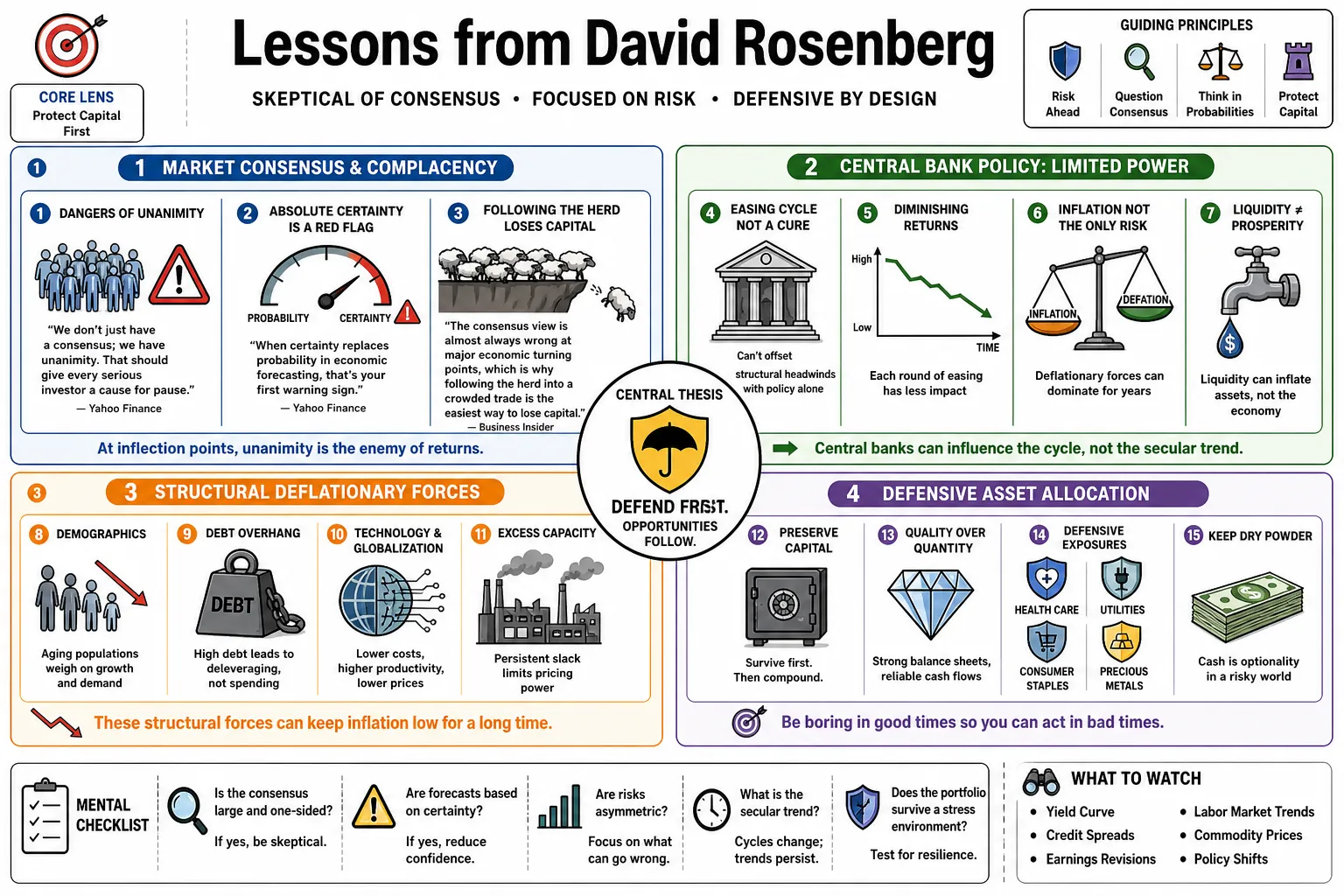
Lessons from David Rosenberg
David Rosenberg is the founder and president of Rosenberg Research. This collection gathers his own words from podcast interviews. — Full Transcript: David Rosenberg on Bubbles, Cycles, and Risk (Excess Returns).
Part 1: Market Consensus & Complacency
- On economists as a marketing tool: David Rosenberg: "Now, you know, the data points I picked up over those decades was that the Wall Street or Bay Street economists and strategists are really nothing more than a marketing tool for the institutions they work for." — Full Transcript: David Rosenberg on Bubbles, Cycles, and Risk (David Rosenberg's turns).
- On telling people where you differ: David Rosenberg: "Well, I think that’s very kind, because really what somebody in my role should be doing is telling people when it is that you differ from the consensus and why, and what the trade is on that, identifying, you know, where exactly we are in the business cycle and the market cycle." — Full Transcript: David Rosenberg on Bubbles, Cycles, and Risk (David Rosenberg's turns).
- On reading everybody else: David Rosenberg: "But in that period, when I was a buy-side economist, I had the luxury of reading everybody else, weather it was on Wall Street or Bay Street or Montgomery Street or Wilson Street, and I just fouond that it all sounded the same to me." — Transcript: David Rosenberg (David Rosenberg's turns).
- On Bob Farrell and the market: David Rosenberg: "You know, when I grew up in the market back in the 1980s, Bob Farrell, the legend, would always say, the markets make the news, the news does not make the markets." — David Rosenberg: Navigating Choppy Waters (David Rosenberg's turns).
- On sentiment and animal spirits: David Rosenberg: "But the stock market is a beast that is often influenced by expectations and by sentiment and that’s what animal spirits are all about." — Transcript: David Rosenberg (David Rosenberg's turns).
- On equities as a safe asset: David Rosenberg: "The market’s telling you, if you believe it, that equities have become a completely safe asset class." — Full Transcript: David Rosenberg on Bubbles, Cycles, and Risk (David Rosenberg's turns).
- On cycles: David Rosenberg: "Everything in our personal life and in our professional life they move in cycles." — David Rosenberg: Will The 2025’s K become 2026’s (David Rosenberg's turns).
Part 2: The Federal Reserve & Monetary Policy
- On the Powell pivot: David Rosenberg: "And that had to do with the Powell pivot and that had to do with the re-expansion the Fed balance sheet starting in the fourth quarter." — Transcript: David Rosenberg (David Rosenberg's turns).
- On rate cuts and recession: David Rosenberg: "Historically, after the Fed cuts rates, if we go into recession, the rate cuts will generate an economic recovery, but that's usually roughly 18 months after the first rate cut." — Sprott Debates #2 (David Rosenberg's turns).
- On an economy driven by credit: David Rosenberg: "But suffice it to say that an economy that is driven by credit, and now we not only have the cost of credit, having gone up substantially in the past year, this is the most aggressive tightening cycle since the Volcker years of the early 80s." — David Rosenberg: The Bear Market Bottom is Not In (David Rosenberg's turns).
- On the real interest rate shock: David Rosenberg: "But real economic growth is not accelerating, it’s decelerating, and you’ve had this real interest rate shock." — Full Transcript: David Rosenberg on Bonds, Gold, and Tail Risk (David Rosenberg's turns).
- On the damage already done: David Rosenberg: "It'd be very unusual after this interest rate shock that we've endured and continue to endure; what the Fed did at the last meeting was a speck of dust relative to the damage it has done from 2022 to 2023." — Sprott Debates #2 (David Rosenberg's turns).
- On labor market cooling: David Rosenberg: "But even in the payroll survey, things are cooling off in the labor market side, which is principally why the Fed is going to continue to cut interest rates." — David Rosenberg: Lament of a Bear (David Rosenberg's turns).
- On excess capacity in labor: David Rosenberg: "You see what's happening here, John, is that we are building up excess capacity, excess supply in the U.S. labor market, as the trend and unemployment rate tell you." — Sprott Debates #2 (David Rosenberg's turns).
Part 3: Inflation, Deflation & Japanification
- On price shocks and real incomes: David Rosenberg: "So when you get this sort of price shock into a decelerating wage environment, you get a contraction in real incomes that gets translated with a lag into a decline in real consumer spending, which I think will be the primary theme going into the end of this year and into 2027." — Full Transcript: David Rosenberg on Bonds, Gold, and Tail Risk (David Rosenberg's turns).
- On rental inflation: David Rosenberg: "So a lot of the rental inflation, which is stubbornly high is still reflecting leases that were being signed, you know, two or three years ago, when there was no supply and rental rates were going up, but that will come out of the data." — David Rosenberg: The Bear Market Bottom is Not In (David Rosenberg's turns).
- On immigration and the labor supply: David Rosenberg: "But I think that the view that he's going to constrict the economy and restrict the labor supply, people talked about that when he got elected in 2016 and he did tighten up immigration, and the unemployment rate did get down to 3.5%, but we never did get the big wage and price inflation out of that." — David Rosenberg: Lament of a Bear (David Rosenberg's turns).
- On cycles: David Rosenberg: "But the cycle is the cycle, the rate cycle, the market cycle, the economic cycle, they are these pivotal forces, the sine waves that intersect over time." — David Rosenberg: The Bear Market Bottom is Not In (David Rosenberg's turns).
- On tariffs and inflation: David Rosenberg: "Then we have the situation with tariffs if he goes ahead with them, but that's not a sustained source of inflation." — Sprott Debates #2 (David Rosenberg's turns).
- On structural inflation: David Rosenberg: "I think that that story on secular or structural inflation is way overdone." — David Rosenberg: The Bear Market Bottom is Not In (David Rosenberg's turns).
- On a huge shock, not sustained inflation: David Rosenberg: "It's going to be a huge shock, that's for sure, but it's not a primary sustained source of inflation." — Sprott Debates #2 (David Rosenberg's turns).
- On supply shocks and the business cycle: David Rosenberg: "And it comes down to where you are in the business cycle, like, for example, when we had all those supply shocks happening around COVID, those supply shocks fed into wages, because the labor market was heating up dramatically." — David Rosenberg: Navigating Choppy Waters (David Rosenberg's turns).
- On what the Fed is really after: David Rosenberg: "It’s funny ‘cause everybody talks about inflation, and that’s the Fed’s ultimate goal." — Full Transcript: David Rosenberg on Bonds, Gold, and Tail Risk (David Rosenberg's turns).
Part 4: The Consumer & The Wealth Effect
- On credit cards as desperation: David Rosenberg: "So the credit card data have been strong, but it’s not a source of strength, it’s a source of desperation, but it counts as spending." — Full Transcript: David Rosenberg on Bonds, Gold, and Tail Risk (David Rosenberg's turns).
- On the longer investor time horizon: David Rosenberg: "So, I think that the reason why the stock market, through thick and thin and through good news and bad news in the past couple of years, has continued to march higher is that the stock market has taken on a much longer time horizon than has normally been the case." — David Rosenberg: Lament of a Bear (David Rosenberg's turns).
- On excess savings: David Rosenberg: "Now, in that period in 2021, 2022 and 2023, don't forget that the household sector was flush with $2 trillion of excess pandemic savings from the deep pockets of Uncle Sam." — David Rosenberg: Navigating Choppy Waters (David Rosenberg's turns).
- On the high end carrying spending: David Rosenberg: "The high end is carrying the ball and the high end's carrying the ball because their spending is less sensitive to the labor market and more sensitive to the equity wealth effect on spending." — David Rosenberg: Will The 2025’s K become 2026’s (David Rosenberg's turns).
- On the gap between income and spending: David Rosenberg: "But you have this epic gap between underlying employment and income growth and then consumer spending." — Full Transcript: David Rosenberg on Bonds, Gold, and Tail Risk (David Rosenberg's turns).
- On a bifurcated economy: David Rosenberg: "So it's a bifurcated CapEx picture, a bifurcated consumer spending picture.It's astounding that people talk about the vibrancy in the economy because if you're taking a look at the economy from an income standpoint, now of course, equity investors pay for profits." — David Rosenberg: Will The 2025’s K become 2026’s (David Rosenberg's turns).
- On the savings rate: David Rosenberg: "But its movement is very powerful because, just think about the fact that, you know, if it wasn’t for the savings rate going down, it would mean that people were spending within their means and consumption growth — which is 70% of the economy — would only be growing at 1%." — Full Transcript: David Rosenberg on Bubbles, Cycles, and Risk (David Rosenberg's turns).
- On inflation getting snuffed out: David Rosenberg: "And so what happens is that in so far as we have any inflation, it's just gonna get snuffed out in the labor market, which means that real wages contract, real wages contracting, leads to a decline in real consumer spending, which is 70% of the economy." — David Rosenberg: Will The 2025’s K become 2026’s (David Rosenberg's turns).
Part 5: The Labor Market & "No-Hire, No-Fire"
- On rationalizing labor: David Rosenberg: "They're shifting people from full-time to part-time and cutting hours, so they're rationalizing labor by not firing people because of the miserable experience of doing that in 2020 and 2021." — Sprott Debates #2 (David Rosenberg's turns).
- On the first month of declining payrolls: David Rosenberg: "Once nonfarm payrolls decline, and I think when they decline in the first month, people will say, 'Oh, it's just one month." — Sprott Debates #2 (David Rosenberg's turns).
- On lagging indicators: David Rosenberg: "The Fed has trained the markets to focus on coincident and lagging indicators." — Sprott Debates #2 (David Rosenberg's turns).
- On broad labor market contours: David Rosenberg: "But you see, when I'm looking at the broad contours of the labor market, which goes beyond focusing on monthly headline non-farm payrolls, or even the unemployment rate, these are limited statistics." — David Rosenberg: Navigating Choppy Waters (David Rosenberg's turns).
- On why unemployment stays low: David Rosenberg: "The reason why the unemployment rate has stayed so low is because the labor force participation rate, for a variety of reasons which we know, and a lot of that is the outmigration, early retirement, that’s been going on for some time ‘cause of the aging baby boomers." — Full Transcript: David Rosenberg on Bonds, Gold, and Tail Risk (David Rosenberg's turns).
- On the workweek: David Rosenberg: "The workweek is a classic leading indicator of employment because companies tend to cut hours before they cut their staff." — David Rosenberg: The Bear Market Bottom is Not In (David Rosenberg's turns).
- On pricing power and margins: David Rosenberg: "And lower pricing power means that we have compressed margins." — Transcript: David Rosenberg (David Rosenberg's turns).
- On participation: David Rosenberg: "Here, the prime working-age adult participation rate is at a two-decade high." — Sprott Debates #2 (David Rosenberg's turns).
- On the quit rate: David Rosenberg: "You see, then the quit rate, the voluntary quit rate, I call it the take this job and shove it index, the job-hopping index." — David Rosenberg: Navigating Choppy Waters (David Rosenberg's turns).
Part 6: Recession Probabilities & Indicators
- On what the market is betting: David Rosenberg: "And we went back a century's worth of data that the market has laid down a bet that we're going to be seeing in the next half decade, corporate profits of roughly 17% growth per year, which I don't think anybody can say is impossible, but it would be double the norm." — David Rosenberg: Lament of a Bear (David Rosenberg's turns).
- On changing conviction not the base case: David Rosenberg: "And I never once changed my base case forecast — I just changed my conviction and I flipped around what I think are the most likely scenarios that the base case is wrong." — Full Transcript: David Rosenberg on Bubbles, Cycles, and Risk (David Rosenberg's turns).
- On 2000 and 2001: David Rosenberg: "Don’t forget, I mean, the recession started in March of 2001, but the problems in the stock market, especially tech, started in March of 2000, a year earlier." — Full Transcript: David Rosenberg on Bonds, Gold, and Tail Risk (David Rosenberg's turns).
- On the yield curve: David Rosenberg: "I believe interest rates matter." — David Rosenberg: The Bear Market Bottom is Not In (David Rosenberg's turns).
- On the work week in leading indicators: David Rosenberg: "That gets very little play in the work week, by the way, is one of the components of the Conference Board's index of leading economic indicators." — David Rosenberg: The Bear Market Bottom is Not In (David Rosenberg's turns).
- On debt issuance and buybacks: David Rosenberg: "When I went to school, you’ll learn to both how companies would issue debt to finance capital expenditure but the record debt issuance in the business sector went for stock buybacks." — Transcript: David Rosenberg (David Rosenberg's turns).
- On the soft landing in 2008: David Rosenberg: "And if you go back the last time we were up 50,000, from the cycle low before the pandemic was heading into January 2008, when the recession was just starting, and yet the consensus back then was that we were in a soft landing so much like the sentiment that we're seeing right now." — David Rosenberg: The Bear Market Bottom is Not In (David Rosenberg's turns).
- On the Goldilocks view: David Rosenberg: "If you see the chart of the hiring rate alone, you'd wonder where this rosy-posy Goldilocks soft landing view is coming from." — Sprott Debates #2 (David Rosenberg's turns).
- On conviction in the recession call: David Rosenberg: "The tea leaves are right in front of me, and in fact, I have more conviction in the recession call now than I did three years ago." — David Rosenberg: Navigating Choppy Waters (David Rosenberg's turns).
Part 7: Historical Parallels & Bubbles
- On reality setting in: David Rosenberg: "So I think when reality sets in, when Wily Coyote looks down, the market is going to go down to new lows, we're going to break, we're not just going to test the October lows of last year, we're gonna go through them." — David Rosenberg: The Bear Market Bottom is Not In (David Rosenberg's turns).
- On the shift into value: David Rosenberg: "If that value trade doesn't hold, and remember that we had another shift into value after the tech wreck started in 2000, there was that shift into value with the same mindset ok we're gonna shift to value." — David Rosenberg: Will The 2025’s K become 2026’s (David Rosenberg's turns).
- On the promoters and hucksters: David Rosenberg: "And then you have the promoters, and you have the hucksters, and you have all the industry officials telling you to stay in the game like Chuck Prince did in the summer of ‘07, to keep on dancing till the music stops." — Full Transcript: David Rosenberg on Bonds, Gold, and Tail Risk (David Rosenberg's turns).
- On where the bubble is: David Rosenberg: "The bubble is in investor behavior." — Full Transcript: David Rosenberg on Bubbles, Cycles, and Risk (David Rosenberg's turns).
- On the internet stocks: David Rosenberg: "Nobody believed that the internet stocks would roll over, and a lot of these companies like Cisco and Dell and Intel and IBM and Microsoft, these other stocks go down 60 to 80%, and they weren’t Pets.com or some, you know, obscure tech company." — Full Transcript: David Rosenberg on Bonds, Gold, and Tail Risk (David Rosenberg's turns).
- On generative AI and bubbles: David Rosenberg: "Generative AI is not in a bubble." — Full Transcript: David Rosenberg on Bubbles, Cycles, and Risk (David Rosenberg's turns).
- On how long recognition takes: David Rosenberg: "So I think that when the recession becomes a reality in investors minds, and look how long it took, it took a long time in 1990 for the markets to recognize recession." — David Rosenberg: The Bear Market Bottom is Not In (David Rosenberg's turns).
- On the start of the internet mania: David Rosenberg: "And of course, you date the start of the internet mania in 1995 when Netscape went public, and it went from a bull market to a raging bull market to a mania, and then to a bubble that inevitably burst, as all bubbles do." — David Rosenberg: Lament of a Bear (David Rosenberg's turns).
Part 8: Asset Allocation: Bonds, Gold, & Defensive Investing
- On gold as a hedge: David Rosenberg: "I think that, look, gold is a very good hedge against the instability that the extremes of deflation and inflation bring." — Transcript: David Rosenberg (David Rosenberg's turns).
- On China and gold: David Rosenberg: "The Chinese central bank is so ridiculously under-golded compared to all its peers." — Sprott Debates #2 (David Rosenberg's turns).
- On treasuries at cocktail parties: David Rosenberg: "If you go to the cocktail party and you talk to anybody about your exposure to treasuries, they'll run away from you like you're a skunk who wants to talk about the bond market." — David Rosenberg: Navigating Choppy Waters (David Rosenberg's turns).
- On gold as a hedge: David Rosenberg: "Gold has just got some other very great hedges, and like bonds, is a source of stability and a diversifier and a balance in the portfolio." — David Rosenberg: Navigating Choppy Waters (David Rosenberg's turns).
- On gold at $6,000: David Rosenberg: "You know, we've done a lot of work on gold and really mapping out more how this bull market ranks against other bull markets, the pattern of behavior, and we think it could get to $6,000 an ounce at the peak." — David Rosenberg: Navigating Choppy Waters (David Rosenberg's turns).
- On diversification in a concentrated market: David Rosenberg: "And diversification in such an acute concentrated market, diversification is not a dirty 15-letter word." — Full Transcript: David Rosenberg on Bonds, Gold, and Tail Risk (David Rosenberg's turns).
- On the perma-bear label: David Rosenberg: "I think a lot of what you talked about, the reputation of being the perma bear, you know, it’s a label, and it’s actually one that’s helped my career." — Full Transcript: David Rosenberg on Bubbles, Cycles, and Risk (David Rosenberg's turns).
- On managing tail risk: David Rosenberg: "This is the year coming up thematically, where you want to engage in much more diligent risk management than you've done any other time this cycle." — David Rosenberg: Will The 2025’s K become 2026’s (David Rosenberg's turns).
- On capital preservation: David Rosenberg: "And of course, 4.5% T bills and 5.5% mortgage bonds sound pretty boring, but right now I'm still in capital preservation mode." — David Rosenberg: Lament of a Bear (David Rosenberg's turns).