David Samra is a managing director of Artisan Partners and founding partner of its International Value Team. This collection gathers his own words from interviews. — Episode #216: David Samra, Artisan Partners (Meb Faber).
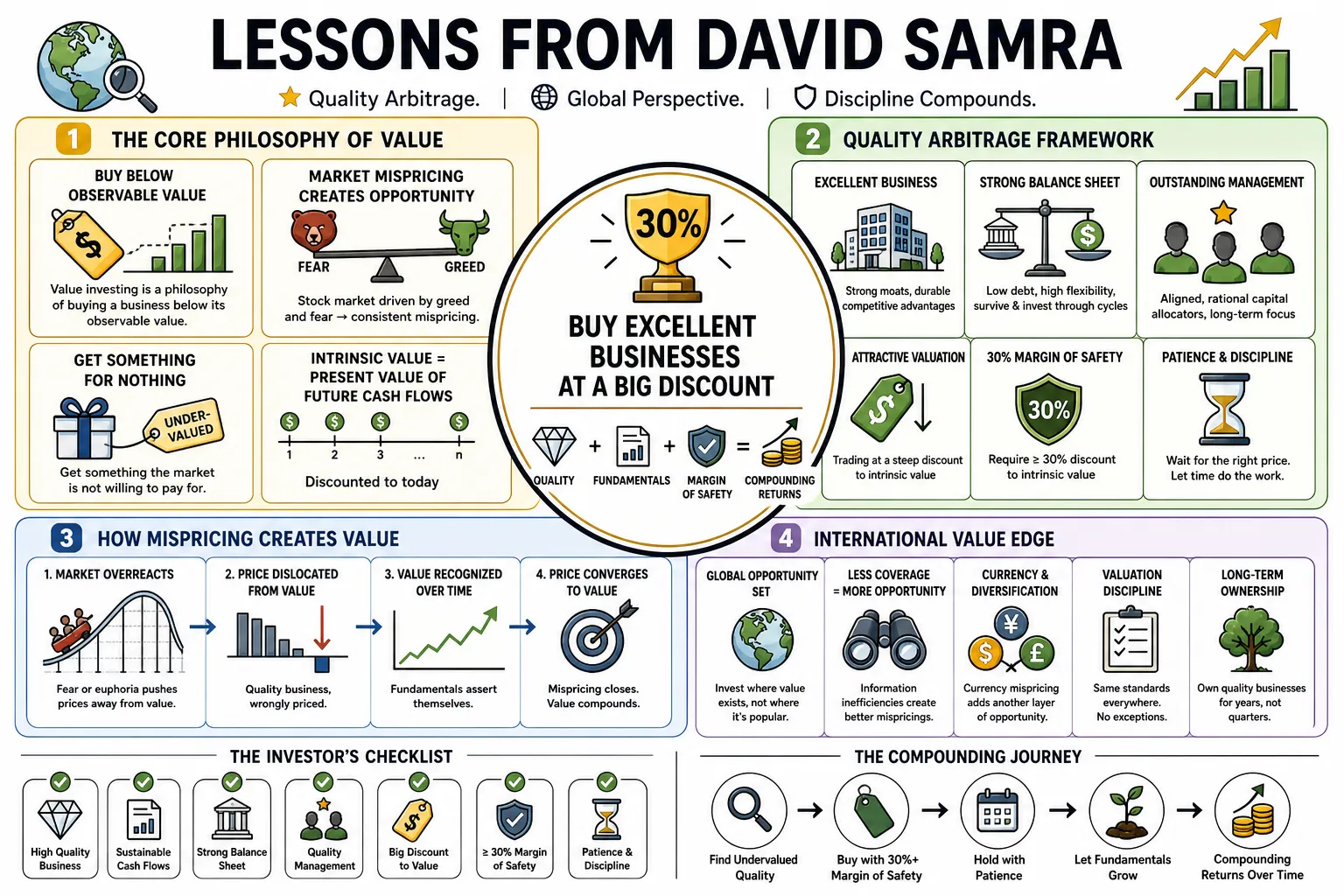
Part 1: The Core Philosophy of Value
- On the primary driver: David Samra: "We’re value investors, so the primary driver of our behaviour is finding a company that trades at a discount to intrinsic value." — The Meb Faber Show, Episode 216 (Samra's turns).
- On greed and fear: David Samra: "We’ve all read the empirical studies, we all have read about the psychological aspects of greed and fear in such a big liquid market like the stock market and how that tends to amplify things on the upside and amplify things on the downside." — The Meb Faber Show, Episode 216 (Samra's turns).
- On getting something for nothing: David Samra: "When I approach an equity, I’m trying to get something for nothing, something that the market is not willing to pay for." — The Meb Faber Show, Episode 216 (Samra's turns).
- On intrinsic value: David Samra: "The value of the business is the present value of its future cash flows." — The Meb Faber Show, Episode 216 (Samra's turns).
- On a concentrated portfolio of valuable things: David Samra: "We try to keep it relatively concentrated in things that we think are particularly valuable, because we’re able to buy good businesses at undervalued prices." — VALUE: After Hours S08E23: Inside Artisan International Value Fund (David Samra's turns).
- On neglected businesses after the tech bubble: David Samra: "When those sectors blew up, we as value investors benefitted because we could own a lot of other great businesses that had been undervalued and neglected that came through the bursting of the tech bubble with flying colors." — Value Investor Insight: At the Helm, March 2020 (Samra's answers).
- On four variables together: David Samra: "And we think that’s a powerful combination of those four key variables, cheap stock, good business, strong balance sheet, good management team." — The Meb Faber Show, Episode 216 (Samra's turns).
- On Columbia Business School: David Samra: "Columbia Business School, as you know, is the center value investing in this country." — The Meb Faber Show, Episode 216 (Samra's turns).
- On the fundamental work on intrinsic value: David Samra: "And so we spend our time doing the fundamental work to try to make an assessment on what we think that estimate of intrinsic value might be." — VALUE: After Hours S08E23: Inside Artisan International Value Fund (David Samra's turns).
- On Buffett and Munger: David Samra: "And so, this is akin to, on a much smaller scale, obviously, Warren Buffet meeting Charlie Munger, where Charlie is preaching the differences between buying a cigar butt and buying a great business, and how that compounding of wealth over time is much more meaningful than having to constantly buy and sell securities." — The Meb Faber Show, Episode 216 (Samra's turns).
Part 2: Defining Quality in a Business
- On competitive advantages: David Samra: "We believe that our companies have, generally speaking, competitive advantages in terms of the business that they’re in, their market position, their products, their investments behind those products." — The Meb Faber Show, Episode 216 (Samra's turns).
- On screening: David Samra: "We engage in screening, we look for things value investors normally look for, low PE, low price to book, high dividend yields." — The Meb Faber Show, Episode 216 (Samra's turns).
- On growth that avoids value traps: David Samra: "Well, that growth, that underlying growth is really important to avoid value traps, right?" — VALUE: After Hours S08E23: Inside Artisan International Value Fund (David Samra's turns).
- On four key characteristics: David Samra: "We look for four key characteristics in the companies in which we invest: a cheap price, a high-return business, a strong balance sheet and a management team with a record of building shareholder value." — Value Investor Insight: At the Helm, March 2020 (Samra's answers).
- On drilling down to free cash flow: David Samra: "But we, we drill everything down to free cash flow to try to minimise any, any differences and, and look at what the cash flow is coming out of the business." — VALUE: After Hours S08E23: Inside Artisan International Value Fund (David Samra's turns).
- On brands and Richemont: David Samra: "There’s also a secular trend in jewelry from unbranded items to branded ones, which obviously benefits a company with such well-recognized and well-regarded brands like Richemont." — Value Investor Insight: At the Helm, March 2020 (Samra's answers).
- On a strong balance sheet in a decline: David Samra: "So, for example, as the market is declining for most companies, especially those that have balance sheet issues, the fact that Samsung Electronics has a very strong, secure excess capital balance sheet, has all of a sudden become very valuable." — The Meb Faber Show, Episode 216 (Samra's turns).
- On a needle in a haystack: David Samra: "If I’m looking for a needle in a haystack, the smaller amount of capital that I have, the wider my opportunity set, the more effectively I can deploy that capital." — The Meb Faber Show, Episode 216 (Samra's turns).
- On excess production: David Samra: "The whole industry was being taken down by ETFs because there’s a lot of excess production in China and there’s not a number of competitive companies in Europe that could compete with dumping excess production." — VALUE: After Hours S08E23: Inside Artisan International Value Fund (David Samra's turns).
Part 3: The Importance of the Balance Sheet
- On financial strength deserving a premium: David Samra: "I’d argue that companies with that kind of financial strength should trade at a premium, yet in Samsung's case the market wasn’t giving it any credit for that at all." — Value Investor Insight: At the Helm, March 2020 (Samra's answers).
- On margin of safety: David Samra: "The expected returns, and therefore the margin of safety, weren’t high enough to make us enthusiastic about the opportunity set." — Value Investor Insight: At the Helm, March 2020 (Samra's answers).
- On what strong balance sheets allow: David Samra: "They can either take market share by investing back in the business, they can buy out a weaker competitor, or, in the absence of those things, they can buy their own stock back at a very, very cheap price during downturns like this." — The Meb Faber Show, Episode 216 (Samra's turns).
- On leverage in the system: David Samra: "You’ve seen a tremendous amount of leverage built up in the corporate system – big companies and small companies alike – who have been saying, “Gee, look how cheap debt is." — Value Investor Insight: At the Helm, March 2020 (Samra's answers).
- On using balance sheets to grow value: David Samra: "And companies that have strong balance sheets, when they’re going through a crisis like this, can use that money to grow value." — The Meb Faber Show, Episode 216 (Samra's turns).
- On who owns the debt: David Samra: "Important here is not only the amount and type of debt you have, but also who owns it." — Value Investor Insight: At the Helm, March 2020 (Samra's answers).
- On low interest rates: David Samra: "I’d like also to say something about the corrosive nature of very low interest rates." — Value Investor Insight: At the Helm, March 2020 (Samra's answers).
- On a more efficient balance sheet: David Samra: "I can make my balance sheet more ‘efficient’ by taking on additional debt.” In my experience that’s the wrong way to come at it." — Value Investor Insight: At the Helm, March 2020 (Samra's answers).
- On balance sheets that can withstand a downturn: David Samra: "We bought a few of them that we thought were better positioned in their industries and had balance sheets that could withstand a difficult economy." — Value Investor Insight: At the Helm, March 2020 (Samra's answers).
Part 4: Assessing and Engaging with Management
- On the current CEO: David Samra: "One key element of our investment case is the current CEO, Vasant Narasimhan, who took over in 2018." — Value Investor Insight: At the Helm, March 2020 (Samra's answers).
- On portfolios of undervalued good companies: David Samra: "And if we do our job correctly, at the end of this process, we have a portfolio of undervalued securities of good companies generating cash and management’s making good capital allocation decisions on a day in and day out basis." — The Meb Faber Show, Episode 216 (Samra's turns).
- On a great management team: David Samra: "And the third one is having a great management team." — The Meb Faber Show, Episode 216 (Samra's turns).
- On a CEO who focused the company: David Samra: "The company put in a new CEO, Joe Jimenez, who did a very good job of selling or spinning off a number of assets to focus on the remaining divisions today in core pharmaceuticals and generics." — Value Investor Insight: At the Helm, March 2020 (Samra's answers).
- On expected buybacks: David Samra: "With expected stock buybacks, that would translate into annual bottom-line growth closer to the mid- to high-single digits annually over the intermediate term." — Value Investor Insight: At the Helm, March 2020 (Samra's answers).
- On visiting businesses: David Samra: "And part of that process is getting out there and visiting businesses, which we do regularly." — The Meb Faber Show, Episode 216 (Samra's turns).
- On portfolio turnover: David Samra: "We’ve had very benign portfolio turnover for the last ten years – our next numbers will be substantially higher." — Value Investor Insight: At the Helm, March 2020 (Samra's answers).
- On gathering information: David Samra: "One of the key competitive advantages that you have as a value investor is your ability to gather information and, hopefully, information that others aren’t spending the time and effort to gather." — The Meb Faber Show, Episode 216 (Samra's turns).
Part 5: Navigating International Markets
- On information advantage: David Samra: "And again, it can come down to information advantage because there was no internet, there were very few English language reports that were out, and there was sparse reporting." — The Meb Faber Show, Episode 216 (Samra's turns).
- On narrowing the universe: David Samra: "So within this giant world of non-U.S. equities, we first narrow down the universe by only looking at very good companies, companies that have strong market position, good profit profile, or, like the great management team, something that differentiates it and allows it to have the ability to value over time." — The Meb Faber Show, Episode 216 (Samra's turns).
- On Samsung and memory: David Samra: "And Samsung is a Korean company, obviously, and it’s known best for its handsets, but they make almost all of their money selling memory semiconductors." — The Meb Faber Show, Episode 216 (Samra's turns).
- On indiscriminate selling: David Samra: "In areas like these the selling can be quite indiscriminate, so we’re looking mainly at the market leaders with the best cost structures and best balance sheets." — Value Investor Insight: At the Helm, March 2020 (Samra's answers).
- On the Korean discount: David Samra: "And so arguably, just given the scale and the size of these two companies, Samsung Electronics and Hynix, that you can no longer call it the Korean discount." — VALUE: After Hours S08E23: Inside Artisan International Value Fund (David Samra's turns).
- On no cheaper geography: David Samra: "We don’t see a geography that really sticks out to get to the core of your question in terms of are there cheaper stocks in one place versus another." — The Meb Faber Show, Episode 216 (Samra's turns).
- On traveling and visiting countries: David Samra: "So as I indicated earlier, we travel a lot and we visit countries." — The Meb Faber Show, Episode 216 (Samra's turns).
- On generalists with country responsibilities: David Samra: "The way that we’re structured here is we’re all generalists with country responsibilities." — The Meb Faber Show, Episode 216 (Samra's turns).
- On being generalists and investors: David Samra: "It’s a little odd, and most of the universe is organized by industry, but we’re generalists, we’re investors." — The Meb Faber Show, Episode 216 (Samra's turns).
Part 6: Understanding and Avoiding Value Traps
- On low returns on capital: David Samra: "We don’t like businesses that have low returns on capital, they don’t really grow over time because, as a value investor, you’re usually getting…you don’t get a good price for something unless something is wrong with it." — The Meb Faber Show, Episode 216 (Samra's turns).
- On multiples and earnings: David Samra: "Stock markets were up significantly and earnings hadn’t grown, so the multiples were up." — The Meb Faber Show, Episode 216 (Samra's turns).
- On inflation eroding purchasing power: David Samra: "Inflation is ever-present, and it erodes away your purchasing power, so you want the underlying value of the business to keep growing as you own the stock, and that helps you retain your purchasing power, and the fourth thing that we look for is a good management team, and, you know, if everybody had a choice, they would prefer to have a management team that’s going to add value rather than one that doesn’t, right?" — VALUE: After Hours S08E23: Inside Artisan International Value Fund (David Samra's turns).
- On screening out bad balance sheets: David Samra: "And we screen out the bad balance sheets, and that narrows down the universe pretty significantly." — The Meb Faber Show, Episode 216 (Samra's turns).
- On liquidation or sale: David Samra: "Unless you’re buying a company based on theory that it’s going to be liquidated or it’s going to be sold, which are all very hard to find these days, where to handicap, most of the time we spend looking at businesses and trying to understand their market position, their growth profile, and the type of cash flow that we can get out of these businesses for the next few years, discounting that back to today, and looking for a big gap between the price that it’s being offered to us in the market and the value that our research is telling us that the business is worth." — The Meb Faber Show, Episode 216 (Samra's turns).
- On watching the balance sheet: David Samra: "Watching the balance sheet is always key to what we do, but that’s obviously even more important when there’s the prospect your business might essentially stop for a couple of quarters." — Value Investor Insight: At the Helm, March 2020 (Samra's answers).
- On compromising quality: David Samra: "To put money to work in cheap stocks, the natural inclination is maybe to compromise on business quality, balance sheet and/or management." — Value Investor Insight: At the Helm, March 2020 (Samra's answers).
- On a third of the market cap in cash: David Samra: "And the one thing that the market for many, many years hasn’t paid us for is the fact that a third of the market cap is in cash and securities." — The Meb Faber Show, Episode 216 (Samra's turns).
- On emotions and the liquid market: David Samra: "The stock market hit because of emotions and because of the liquid nature of what it is, is driven by, oftentimes, especially in times like this short-term sentiment and people are unwilling to look past." — The Meb Faber Show, Episode 216 (Samra's turns).
Part 7: Portfolio Management and Capital Allocation
- On the discount to intrinsic value: David Samra: "We track the aggregate discount to intrinsic value in the portfolio and that had narrowed to the mid-teens, when 25% or more is when we think things start to look more attractive." — Value Investor Insight: At the Helm, March 2020 (Samra's answers).
- On forty stocks and a five percent cap: David Samra: "We generally hold around 40 stocks, are pretty agnostic about benchmarks, and don’t take position sizes at cost above 5%." — Value Investor Insight: At the Helm, March 2020 (Samra's answers).
- On building cash: David Samra: "We had built cash to our maximum of a 15% position and told clients and shareholders that while we were perfectly comfortable with the businesses we owned, we were concerned about valuations." — Value Investor Insight: At the Helm, March 2020 (Samra's answers).
- On forty to fifty percent in the top ten: David Samra: "Forty to 50% of the cap total is invested in the top 10 securities, and that’s because it’s very hard to find those factors in combination." — The Meb Faber Show, Episode 216 (Samra's turns).
- On managing risk: David Samra: "However, there are several characteristics of value investing, the historical approach to value investing that we don’t like, and we use the removal of these characteristics as a way to manage risk in the portfolio." — The Meb Faber Show, Episode 216 (Samra's turns).
- On position size and volatility: David Samra: "At the same time, the incredible market volatility can make the right position size one day after a stock is up 15% the wrong position size the next day when it’s down 15%." — Value Investor Insight: At the Helm, March 2020 (Samra's answers).
- On absolute not relative: David Samra: "So we’re not looking to make relative decisions, we’re looking to find securities that are absolutely attractive to us." — The Meb Faber Show, Episode 216 (Samra's turns).
- On absolute returns: David Samra: "We’re trying to find companies that will generate a good absolute return for us and generate wealth for our clients over time, improve their purchasing power." — The Meb Faber Show, Episode 216 (Samra's turns).
Part 8: Patience, Discipline, and the Investor's Mindset
- On a long-term philosophy: David Samra: "And, of course, our value investing philosophy is very long-term in nature, so that gets me long-term assets." — The Meb Faber Show, Episode 216 (Samra's turns).
- On a shock to nobody: David Samra: "That shouldn’t be a shock to anybody, yet the share price goes down the day it reports." — The Meb Faber Show, Episode 216 (Samra's turns).
- On the rest of infinity: David Samra: "So if you own a company and you truly believe that this epidemiological issue will be out of the system within two years, right, then you have the rest of infinity in which to discount those cash flows back." — The Meb Faber Show, Episode 216 (Samra's turns).
- On the financial crisis: David Samra: "That’s not wildly dissimilar to the financial crisis, when we generally found our estimates of intrinsic value came down 10% to 15% while stock prices were down far more than that." — Value Investor Insight: At the Helm, March 2020 (Samra's answers).
- On job one: David Samra: "I’d say job one is reassessing the financial health of every company we hold in the portfolio." — Value Investor Insight: At the Helm, March 2020 (Samra's answers).
- On crises and long-term value: David Samra: "A value investor really hasn’t had the ability to take advantage of securities crisis that are grossly out of whack with long-term value." — The Meb Faber Show, Episode 216 (Samra's turns).
- On bargains in difficult times: David Samra: "Value investors during difficult times like these often express something akin to glee at the bargains they can produce." — Value Investor Insight: At the Helm, March 2020 (Samra's answers).