David Thomson is a film critic and historian, best known for his Biographical Dictionary of Film. This collection gathers his own words from interviews. — Interview with David Thomson (The White Review).
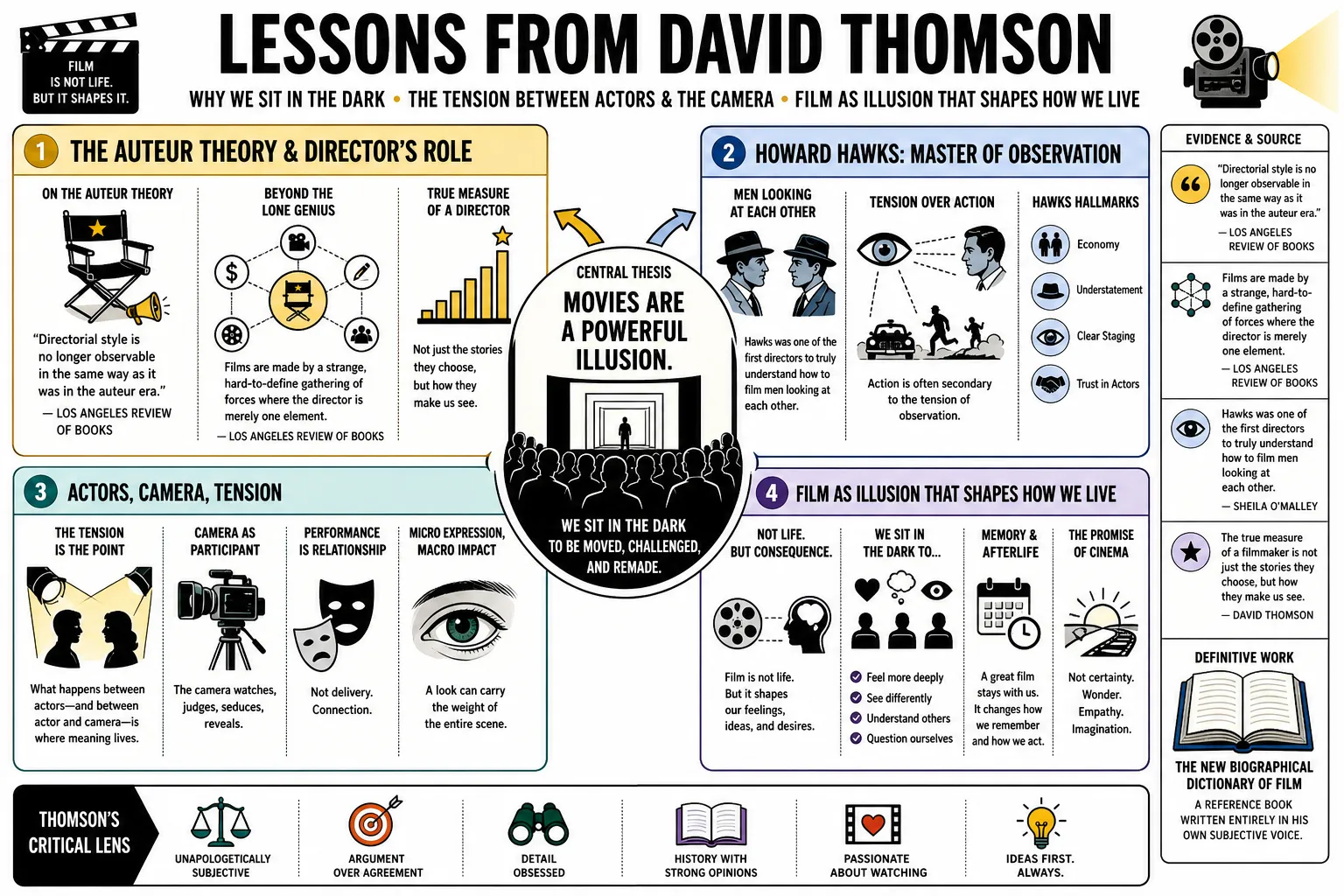
Part 1: The Auteur Theory and the Director's Role
- On the auteur theory and teaching: David Thomson: "I went through a stage, particularly when I was teaching, of saying, 'Well, these are the great filmmakers, let us explore them as if they were Charles Dickens or Van Gogh or someone like that.' The auteur theory." — theartsdesk Q&A: Film Critic David Thomson (his answers).
- On the director fading away: David Thomson: "The director is fading away - you don't think to ask who directs television, and yet television in America is at a very good stage So I knew I had to talk about Battleship Potemkin, Eisenstein, I thought Sunrise was important because it's still so esteemed, and it's right at that cusp of silence and sound." — theartsdesk Q&A: Film Critic David Thomson (his answers).
- On choices in filming: David Thomson: "You can use a Hitchcock film to open up a student’s mind to the whole range of choices that there are — where do you put the camera and why do you put it where you put it?" — The White Review: Interview with David Thomson (his answers).
- On Hawks: David Thomson: "Hawkes, for instances, is very good because Hawkes did what Hollywood wanted, and yet he expressed himself at the same time." — theartsdesk Q&A: Film Critic David Thomson (his answers).
- On technology shaping the format: David Thomson: "So I've become increasingly interested in the technology, and what that has done to shape the format." — theartsdesk Q&A: Film Critic David Thomson (his answers).
- On where the camera goes: David Thomson: "Renoir will put the camera in a more neutral point of view, a place in which the naturalism of the scene plays out more fully, and we are asked to search the screen for possibilities and meanings." — The White Review: Interview with David Thomson (his answers).
- On a tradition of not meeting the filmmakers: David Thomson: "I was born and raised in a tradition which said that “you look at a film, you think what you think, you write it.” But you certainly don’t want to get involved with the people who did it." — Conversation between Jonathan Kirshner and David Thomson, 2020 (his answers).
- On the power of money: David Thomson: "The money is so powerful, I think there is literally a way in which even the great artists we might like to name in American film do it for the money." — Fresh Air interview with David Thomson, 2002 (his answers).
- On business and art: David Thomson: "But what it has done is leave me with a great desire and interest to write about the way business affects the art in American film, because I think still to this day that is not fully understood." — Fresh Air interview with David Thomson, 2002 (his answers).
Part 2: The Art of Acting and Stardom
- On acting performances: David Thomson: "I do have a certain dark hope, which is about the big Chadwick Boseman talk for best actor — he’s very good, but I don’t think he’s on the level of Anthony Hopkins in The Father." — The Arts Fuse: Watching Film Directors with David Thomson (his answers).
- On Cary Grant’s ease of transition: David Thomson: "I think essentially it comes to this: That Grant could go from lightness and humor and charm and being incredibly attractive to being dark, secretive, selfish, unpleasant." — Fresh Air interview with David Thomson, 2002 (his answers).
- On the best work with great directors: David Thomson: "And in his best work--and that's often the work for people like Hitchcock and Hawks, because he did his best with the great directors--I think you see that really volatile, uneasy personality." — Fresh Air interview with David Thomson, 2002 (his answers).
- On Nicole Kidman’s choices: David Thomson: "Nicole Kidman has made choices that I just think enlarge our sense of her and enlarge her craft all the time." — Fresh Air interview with David Thomson, 2002 (his answers).
- On Jayne Mansfield’s intelligence: David Thomson: "I think, in fact, she was a good deal more intelligent than she ever appeared on screen, and I'm sure she was horribly burdened by having this immensely voluptuous body." — Fresh Air interview with David Thomson, 2002 (his answers).
- On Welles in Touch of Evil: David Thomson: "His performance in Touch of Evil is a measure of his self-loathing, which often goes with the extraordinary narcissism that he had." — Conversation between Jonathan Kirshner and David Thomson, 2020 (his answers).
- On the most moving performance: David Thomson: "It’s the most moving performance in the film, it’s almost the only moving performance in the film." — Conversation between Jonathan Kirshner and David Thomson, 2020 (his answers).
- On what Kidman knew: David Thomson: "But Kidman didn’t go that way, because instinctively she knew (and maybe the people on the film knew) that if you do that you lose all sympathy for the character." — Conversation between Jonathan Kirshner and David Thomson, 2020 (his answers).
- On Nicholson’s variety: David Thomson: "And I love Nicholson as an actor, and I love his variety, but I think the bipolarity is there in others... it’s there in The Shining, where you’ve got a guy who just cannot live in the middle." — Conversation between Jonathan Kirshner and David Thomson, 2020 (his answers).
- On mania and melancholy: David Thomson: "He tries sometimes to pretend he’s an ordinary guy, but he’s actually living at extremes of mania and melancholy." — Conversation between Jonathan Kirshner and David Thomson, 2020 (his answers).
Part 3: The Illusion of Cinema
- On watching screens: David Thomson: "I have a general theory that a time came towards the end of the last century when we weren’t really watching the things on screens, we were watching screens." — The White Review: Interview with David Thomson (his answers).
- On delighted mystification: David Thomson: "Well, the essential influence for me was that mystification—that delighted mystification that I felt at the movies from the age of 4 and which has more or less never left me." — Conversation between Jonathan Kirshner and David Thomson, 2020 (his answers).
- On what the medium does to us: David Thomson: "It’s a really organic sense of what the medium does to how we look at ourselves and look at other people." — Conversation between Jonathan Kirshner and David Thomson, 2020 (his answers).
- On film changing our participation in reality: David Thomson: "But the central theme of all of them is more or less the way in which film has changed our participation in reality—the way we live a much more imaginary life than once was the case." — The Dartmouth Review: An Interview with David Thomson (his answers).
- On the dark and the light: David Thomson: "I just love being in the dark, looking at the big screen and the light." — The Dartmouth Review: An Interview with David Thomson (his answers).
- On film as more than business or art: David Thomson: "But by the time I left Dartmouth, I was really clear in my head about wanting to write about the way in which film was not simply a business or an art." — The Dartmouth Review: An Interview with David Thomson (his answers).
- On reality you can’t go into: David Thomson: "I think it was modelled by film, which says to you, 'Here is reality, better than you've ever seen it, dreamed of it, but you can't go in.' And I think it begins to make a separation between us and reality, which has become much more pronounced now." — theartsdesk Q&A: Film Critic David Thomson (his answers).
- On going whenever I could: David Thomson: "I fell in love with movies from the first time I went when I was about four, and I went whenever I could." — theartsdesk Q&A: Film Critic David Thomson (his answers).
- On wonderful and frightening: David Thomson: "I think there really is something about the movies that is both wonderful and frightening, and I still feel that." — theartsdesk Q&A: Film Critic David Thomson (his answers).
- On screens in our life: David Thomson: "Now, screens have proliferated, and it's so much easier to see the role screens play in our life." — theartsdesk Q&A: Film Critic David Thomson (his answers).
Part 4: The Hollywood Machine and Production
- On press junkets: David Thomson: "And the way press junkets were done in those days, actors, let’s say, did sessions with one group of reporters then a second group then a third." — Conversation between Jonathan Kirshner and David Thomson, 2020 (his answers).
- On unreliable people: David Thomson: "I had met some comparably unreliable people in real life, like my father even, but these were just fascinating, because they had so much zest and energy for being unreliable." — Conversation between Jonathan Kirshner and David Thomson, 2020 (his answers).
- On artistic and professional careers: David Thomson: "One of the things you face when you do a book like this is that, as well as artistic careers, people have professional careers." — Fresh Air interview with David Thomson, 2002 (his answers).
- On nobody reading in Hollywood: David Thomson: "Really nobody reads in Hollywood at all." — Fresh Air interview with David Thomson, 2002 (his answers).
- On scripts written to be read: David Thomson: "And I'm not sure that it ever was, but there was certainly a time when people wrote scripts to be read." — Fresh Air interview with David Thomson, 2002 (his answers).
- On a source of comedy: David Thomson: "And that was a huge influence, and it’s a source of whatever little comedy I allow myself in writing." — Conversation between Jonathan Kirshner and David Thomson, 2020 (his answers).
- On not reading the script: David Thomson: "And because of that, certain people feel they never need to actually read the script in detail." — Fresh Air interview with David Thomson, 2002 (his answers).
- On Hollywood not being a reading community: David Thomson: "And Hollywood is not a reading community, I think, on the whole." — Fresh Air interview with David Thomson, 2002 (his answers).
- On Robert Towne and gold: David Thomson: "If it's a Tom Cruise film, Robert Towne probably will have a moment where he'll go over the script and he'll turn it smooth and he'll turn it into gold." — Fresh Air interview with David Thomson, 2002 (his answers).
Part 5: Hitchcock, Welles, and the Masters
- On Hitchcock as a teacher of film: David Thomson: "The great thing about Hitchcock — leaving aside whether he’s a great director or a very good, that’s a case we can argue out — he is fantastic material for teaching because he is making crucial decisions about how to film a thing all the time." — The White Review: Interview with David Thomson (his answers).
- On Hitchcock and young people: David Thomson: "But if you want to start teaching film to young people, Hitchcock is a superb way to go." — The White Review: Interview with David Thomson (his answers).
- On Welles being unguarded: David Thomson: "I talked to people who were there at the time and they all said, in effect, that Welles was just totally unguarded, playing the young Kane." — Conversation between Jonathan Kirshner and David Thomson, 2020 (his answers).
- On Howard Hawks: David Thomson: "Hawks is still for me the essential American director of the golden age — and I think his comedies are supreme." — The White Review: Interview with David Thomson (his answers).
- On Citizen Kane: David Thomson: "Citizen Kane isn’t about William Randolph Hearst, it’s about George Orson Welles." — The Arts Fuse: Watching Film Directors with David Thomson (his answers).
- On Kane still being there: David Thomson: "I was happy to see another film win, and I was happy that Kane wasn't thrown overboard, it was still there at number two." — theartsdesk Q&A: Film Critic David Thomson (his answers).
- On Kane and the top of the poll: David Thomson: "I think it's good for Kane, because I think it had reached a point where it had been the best film for so long that young people particularly said, 'I've had enough of people telling me I have to see this.' So people have stopped watching it." — theartsdesk Q&A: Film Critic David Thomson (his answers).
- On the films that flop today: David Thomson: "So it may be the films that flop today that will be top of the poll decades from now, if there is a poll." — theartsdesk Q&A: Film Critic David Thomson (his answers).
- On main-lining into the young Kane: David Thomson: "And what I feel is special about the young man in Kane is that you do feel like you’re just main-lining into him, directly, whereas in Touch of Evil, effective as it is, it’s a study in bogusness." — Conversation between Jonathan Kirshner and David Thomson, 2020 (his answers).
Part 6: Writing Criticism and the Critic's Duty
- On a book of opinion: David Thomson: "A very important point about the Dictionary is that it was meant to be a book of opinion, it was not meant to be ex cathedra, and it was meant to make readers argue." — The White Review: Interview with David Thomson (his answers).
- On reference books: David Thomson: "Reference books try to lay down the law, but they do it in a very cautious way." — The White Review: Interview with David Thomson (his answers).
- On the critical debate: David Thomson: "I felt then that the movies were essentially American and French — that those countries had been the real source of the movies — and I became caught up in a critical debate that had been going on since the early 1960s, very much influenced by writing in France, in Cahiers du Cinéma above all." — The White Review: Interview with David Thomson (his answers).
- On making people want to see the film: David Thomson: "Good film criticism makes people want to go and see the film, but you've got to be very careful there, because you mustn't tell them so much that you've spoiled the film." — theartsdesk Q&A: Film Critic David Thomson (his answers).
- On writing the makers can understand: David Thomson: "I also think it should be written in a way that the people who made the film can understand." — theartsdesk Q&A: Film Critic David Thomson (his answers).
- On a critic the director can read: David Thomson: "But I think that what you write as a critic should be something the director can read, or the producer or the writer." — theartsdesk Q&A: Film Critic David Thomson (his answers).
- On critical objectivity: David Thomson: "And I think it’s a perfectly reasonable attack on me to say that my critical objectivity was compromised, not just by that, but by meeting a lot of these people." — Conversation between Jonathan Kirshner and David Thomson, 2020 (his answers).
- On saying I don’t like it: David Thomson: "Well, I think, to this day, if I had to write about a film by a friend that I did not like, I would say, “I don’t like it.” And indeed there have been a few cases where I’ve lost friendships over that." — Conversation between Jonathan Kirshner and David Thomson, 2020 (his answers).
- On bad reviews: David Thomson: "If someone doesn’t like one of my books and they say it in print, that hurts, and I probably remember bad reviews much better than good reviews." — Conversation between Jonathan Kirshner and David Thomson, 2020 (his answers).
Part 7: The Audience, Voyeurism, and the Dark Room
- On melodrama in the dark: David Thomson: "Melodrama is going in out of the daylight, paying money to sit in the dark packed in by strangers so that you feel you can't get out in front of a screen the size of an ocean liner where the screen is filled with a tear dropping from a woman's blue eye down to her red mouth." — Fresh Air interview with David Thomson, 2002 (his answers).
- On not knowing what happens next: David Thomson: "It's the basic melodramatic condition of not knowing what's going to happen next and longing to find out." — Fresh Air interview with David Thomson, 2002 (his answers).
- On pretending to be them: David Thomson: "They didn’t have too much irony or suspicion about it—they went to movies to pretend they were these people." — Conversation between Jonathan Kirshner and David Thomson, 2020 (his answers).
- On James Dean: David Thomson: "When I was 15 or 16, the impact of James Dean on me – and that’s a very limited career, and one that was clearly, in a strange way, blessed by his early death – I was like Plato in Rebel if you will." — Conversation between Jonathan Kirshner and David Thomson, 2020 (his answers).
- On identifying with characters: David Thomson: "They don’t identify with characters in that way, and I don’t think that movies, on the whole, are made to encourage that identification." — Conversation between Jonathan Kirshner and David Thomson, 2020 (his answers).
- On the public and movie stars: David Thomson: "What we are talking about probably begins historically with the relationship between the public and movie stars." — Conversation between Jonathan Kirshner and David Thomson, 2020 (his answers).
- On celebrity: David Thomson: "But it has spread, and it has taken up almost every one that we know that we are inclined to call a celebrity." — Conversation between Jonathan Kirshner and David Thomson, 2020 (his answers).
- On movies living: David Thomson: "And so long as that lives, movies will live." — Fresh Air interview with David Thomson, 2002 (his answers).
- On irony and the superhero film: David Thomson: "But I have the feeling that – take a superhero film – that the audience, particularly the teenage audience, they know that these are absurd figures, and they are expected to see them in the light of irony." — Conversation between Jonathan Kirshner and David Thomson, 2020 (his answers).
- On having seen it all before: David Thomson: "When people feel they've seen it all before and, therefore, are not surprised, are not shocked, not delighted, not moved, and maybe we're there already, that's when movies are in danger of fading away, I think." — Fresh Air interview with David Thomson, 2002 (his answers).
Part 8: The Death of the Big Screen and the Future
- On going to the movies getting tougher: David Thomson: "I would have to say, though--and I don't think I'm the only film writer or critic who would tell you this in honestly--that going to the movies all the time gets tougher." — Fresh Air interview with David Thomson, 2002 (his answers).
- On bad times for the movies: David Thomson: "But to address your question, I think that we're in a bad, bad times for the movies, and I pray that there's a young generation coming." — Fresh Air interview with David Thomson, 2002 (his answers).
- On the weekly picture-going habit: David Thomson: "People who had grown up thinking that you went to the pictures or the movies once a week suddenly realized that there was a vast climate of films, often made by young people and more cheaply than in the past, that were as lively and compelling as the best books, the best music, or the best paintings." — The Dartmouth Review: An Interview with David Thomson (his answers).
- On a new generation: David Thomson: "Sometimes you get the feeling that with the Addisons and people like that, Alexander Payne, Spike Jones, there could be a really new, tough, irreverent generation such as came into being in the 1970s in America." — Fresh Air interview with David Thomson, 2002 (his answers).
- On watching the end of the world: David Thomson: "For me certain things like Kennedy's funeral, the shooting of Oswald which was live on TV, Three Mile Island, Fukushima, Princess Diana, those things… television was made for them." — theartsdesk Q&A: Film Critic David Thomson (his answers).
- On thumbs up or thumbs down: David Thomson: "I think it's a reflection of a culture in which thumbs up or thumbs down has come to be the central way of relating to a movie." — Fresh Air interview with David Thomson, 2002 (his answers).
- On film criticism feeling distant: David Thomson: "I think advertising where you don't even know the names of the people being quoted and it's no surprise to discover sometimes that some of them were invented, I think people feel extremely distant from film criticism." — Fresh Air interview with David Thomson, 2002 (his answers).
- On the screen at the centre of existence: David Thomson: "Film and television, the image, the screen, has become so central to existence that a lot of people really don’t have time for going back to the past." — The Dartmouth Review: An Interview with David Thomson (his answers).
- On the fall since Kael: David Thomson: "And there's been such a terrible falling off since the great days of Pauline Kael, who--whatever you think about her, she made film criticism central to the American intelligentsia." — Fresh Air interview with David Thomson, 2002 (his answers).