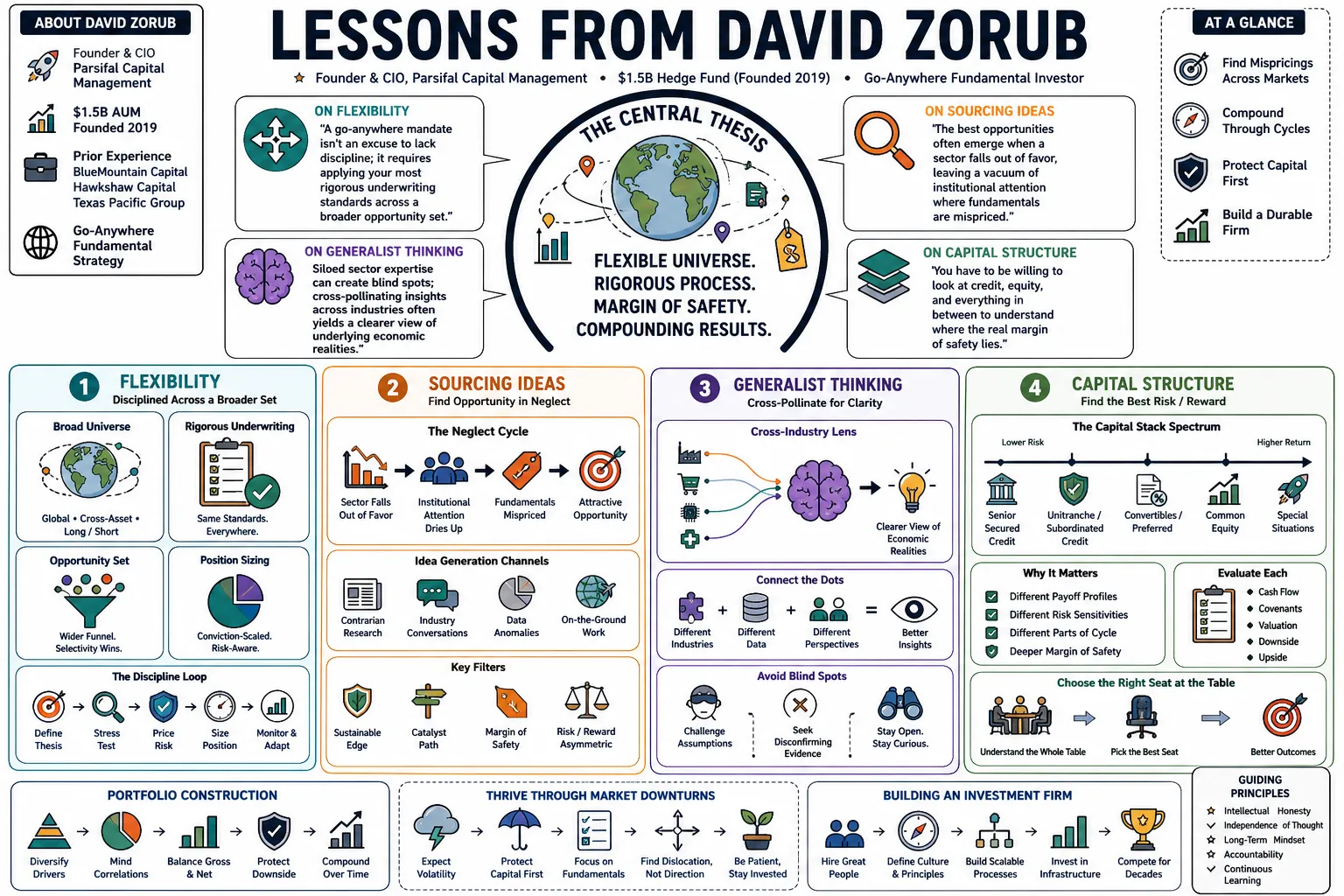
Lessons from David Zorub
David Zorub founded Parsifal Capital Management after investment roles at Merrill Lynch, TPG, Hawkshaw Capital and BlueMountain. He designed Parsifal as a concentrated, flexible strategy spanning public-market opportunities. — Capital Allocators EP96.
Part 1: The Foundation of a Go-Anywhere Strategy
- On Flexibility: Parsifal uses a flexible cross-asset mandate, but screens opportunities for identifiable inefficiency, downside protection and fit with its process before investing. — Capital Allocators EP434.
- On Sourcing Ideas: Zorub searches for recurring structural, informational and behavioral causes of mispricing rather than beginning with a fixed sector or style label. — Capital Allocators EP434.
- On Generalist Thinking: Parsifal combines a generalist perspective with sector expertise; Zorub says that breadth can reveal inflection points specialists may miss. — Capital Allocators EP434.
- On Capital Structure: The mandate spans equity, credit and volatility, and Zorub treats differences in what those markets know or price as possible sources of inefficiency. — Capital Allocators EP434.
- On Adaptability: Zorub says Parsifal kept its core investment philosophy while adapting implementation, notably by diversifying shorts and increasing research readiness. — Capital Allocators EP434.
- On Avoiding Crowded Trades: The firm favors less-contested situations where it believes a specific inefficiency can be researched and exploited. — Capital Allocators EP434.
- On the Value of Patience: Zorub describes waiting for a rare opportunity that satisfies the firm’s criteria for inefficiency, asymmetry, researchability and a catalyst before sizing it meaningfully. — Capital Allocators EP434.
- On Defining the Mandate: Zorub designed Parsifal to cross risk premia and follow compelling opportunities without being forced into a narrow institutional style box. — Capital Allocators EP96.
- On Cross-Asset Analysis: He identifies differences between credit and equity markets as one possible source of information asymmetry to investigate. — Capital Allocators EP434.
- On Geographic Flexibility: Zorub describes a bottom-up global search constrained by where the team can underwrite opportunities and by market-specific risks; he does not invest indiscriminately everywhere. — Capital Allocators EP96.
Part 2: Building and Structuring a Hedge Fund
- On Launching Parsifal: Launching the fund required institutional infrastructure and operating partners from day one as well as the investment strategy. — Capital Allocators EP96.
- On Day One Priorities: Zorub chose the Parsifal name to express values he wanted embedded in the new firm’s culture from the outset. — Capital Allocators EP96.
- On Institutional Alignment: Zorub says a concentrated, longer-horizon portfolio needs capital partners who understand its return and volatility profile through good and bad periods. — Capital Allocators EP96.
- On Scaling AUM: He says asset growth can work against investment performance and argues for sufficient business scale without making size the primary goal. — Capital Allocators EP96.
- On Selecting Partners: Parsifal explains its concentrated, volatile and sometimes complex strategy candidly to prospective partners so they can decide whether it suits them. — Capital Allocators EP434.
- On Early Operating Demands: Even after building a strategy inside another firm, Zorub found launching Parsifal more demanding than expected because he had to coordinate the team, research, marketing and infrastructure. — Capital Allocators EP96.
- On Partner Communication: Zorub credits transparent communication through a 2022 drawdown with strengthening several long-running prospective LP relationships. — Capital Allocators EP434.
Part 3: Navigating Market Headwinds
- On Macro Volatility: Parsifal sought an early structure resilient to adversity and repeatedly tests portfolio risk against scenarios rather than assuming one macro outcome. — Capital Allocators EP434.
- On Rate Environments: Zorub contrasts the earlier period of falling capital costs and expanding multiples with the higher-rate, more volatile environment after 2020. — Capital Allocators EP434.
- On Inflation: Zorub says inflation and interest-rate uncertainty made business fundamentals harder to forecast with the conviction needed for concentrated positions. — Capital Allocators EP434.
- On Short Selling in Volatile Markets: As single-name shorting became more volatile and retail-driven squeezes harder to manage, Parsifal broadened its short-idea inventory and diversified the short book. — Capital Allocators EP434.
- On Rechecking a Thesis: When a position disappoints, Zorub returns to documented assumptions and tests whether the thesis or the market’s priorities have changed; he warns against simply assuming the market is wrong. — Capital Allocators EP434.
- On Identifying Value Traps: He begins by asking why a security is mispriced and whether Parsifal can exploit that gap, not merely whether the business appears cheap. — Capital Allocators EP434.
- On Adaptation: Zorub says higher macro volatility and more short-term nonfundamental moves required greater patience and changes in implementation, while Parsifal retained its core approach. — Capital Allocators EP434.
Part 4: Risk Management and Portfolio Construction
- On Sizing Positions: Parsifal sizes around expected returns and other risks, moving weights up or down as attractiveness changes rather than simply equal-weighting its holdings. — Capital Allocators EP96.
- On Concentration: Zorub argues that his firm should take more risk when it has superior understanding of a rare idea, while acknowledging that concentrated portfolios can underperform sharply. — Capital Allocators EP434.
- On Downside Protection: Its screening applies a credit mindset: consider downside and return of capital before pursuing a possible gain. — Capital Allocators EP434.
- On Portfolio Risk: Zorub asks whether the risk actually embedded in each security and in the portfolio matches the risk the team intends to take, using scenarios and stress tests. — Capital Allocators EP434.
- On Hedging: Parsifal treats single-name shorts as a potential source of alpha as well as protection and funding for a concentrated long book, despite the difficulty of short selling. — Capital Allocators EP434.
- On Portfolio Balance: The strategy combines event-driven and special situations, fundamental long/short investing, and work across equity, credit and volatility. — Capital Allocators EP434.
- On Margin of Safety: His early credit training made repayment and preservation of capital a lasting starting point for investment analysis. — Capital Allocators EP96.
Part 5: Fundamental Analysis and Value Creation
- On Management Quality: Zorub questions management teams that buy back stock merely to offset dilution, treating capital-allocation choices as a meaningful investment signal. — Capital Allocators EP96.
- On Reading the Filings: In the SharkNinja case, Zorub says the team studied limited public filings and purchased category-sales data to test a business that initially lacked broad analyst coverage. — Capital Allocators EP434.
- On Valuation Scenarios: Zorub underwrites upside and downside scenarios and warns that valuation multiples should follow an analysis rather than substitute for it. — Capital Allocators EP96.
- On Catalysts: Parsifal asks what could cause the market to recognize an inefficiency and considers a specific catalyst when deciding whether an idea merits large sizing. — Capital Allocators EP434.
- On Primary Research: Zorub says his team gathers and analyzes raw information, builds its own models, documents its thinking and debates with informed people on the other side of a trade. — Capital Allocators EP434.
Part 6: Team Dynamics and Leadership
- On Hiring Analysts: He looks for self-critical, team-oriented and process-driven people who can admit what they do not know and cope with being wrong. — Capital Allocators EP96.
- On Intellectual Honesty: Zorub expects teammates to share disagreement or feedback professionally, including with him, to help the group stay honest. — Capital Allocators EP96.
- On Decision Making: The team tests ideas through internal and external debate, including discussions with informed investors taking the other side. — Capital Allocators EP434.
- On Mentorship: Zorub credits mentors with teaching him credit analysis, research discipline and judgment, and encourages investors to seek new mentors as their needs change. — Capital Allocators EP96.
- On Firm Culture: Zorub set out values for Parsifal at launch and wanted to build a durable culture with teammates and external partners who shared them. — Capital Allocators EP96.
Part 7: The Evolution of the Hedge Fund Industry
- On Passive vs. Active: Zorub says passive flows and the concentration of large-cap technology returns have made parts of the small- and mid-cap market less favored, which he views as an opportunity for bottom-up investors. — Capital Allocators EP434.
- On Information Parity: He looks for information asymmetry across markets and for situations where a longer time horizon can help exploit a behavioral inefficiency. — Capital Allocators EP434.
- On the Multi-Manager Model: Zorub says the growth of platform funds has made near-term market expectations more efficiently priced, pushing Parsifal toward less-contested and less-defined situations. — Capital Allocators EP434.
- On Retail Participation: He says retail meme-trading risk can create sharp losses for single-name shorts, so Parsifal has diversified that part of its book. — Capital Allocators EP434.
- On the Future of Alpha: Zorub argues that high active share and suitable investment duration are difficult to sustain because both managers and allocators face pressure to avoid unconventional underperformance. — Capital Allocators EP434.
Part 8: Lessons from the Institutional Path
- On Private Equity Roots: Zorub describes his TPG role as his first experience on the principal side of investing after formative credit work at Merrill Lynch. — Capital Allocators EP96.
- On Lessons from BlueMountain: At BlueMountain, a credit-focused firm, Zorub spent nearly eight years helping build an equity business from scratch. — Capital Allocators EP96.
- On Banking: His Merrill Lynch high-yield banking program gave him a credit-oriented capital-preservation mindset that stayed with him. — Capital Allocators EP96.
- On Career Transitions: Even after building an investment strategy at another firm, Zorub found that starting Parsifal required him to manage research, team-building, marketing and operations simultaneously. — Capital Allocators EP96.
- On Resilience: Zorub describes navigating a 2022 drawdown by resetting portfolio risk and communicating candidly with LPs; some prospective partners joined after seeing that response. — Capital Allocators EP434.
- On Continuous Learning: Zorub describes investing as an opportunity to keep learning and links his generalist approach to the multidisciplinary education he pursued at Duke. — Capital Allocators EP96.
- On the End Goal: Zorub connects his creditor’s emphasis on return of capital with a firm built to seek strong investment performance alongside like-minded partners. — Capital Allocators EP96.