Lessons from Daymond John
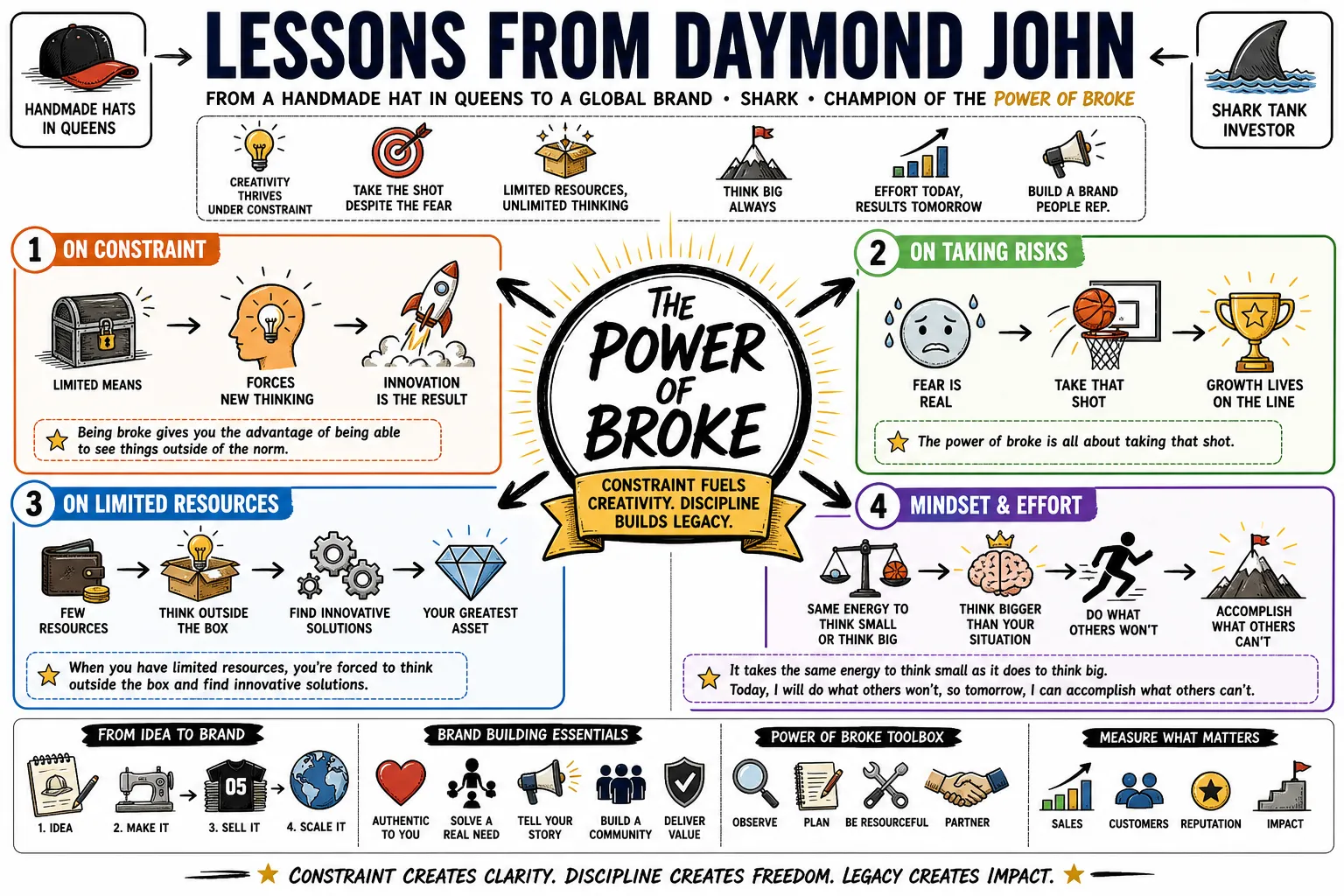
Daymond John founded FUBU and later became a Shark Tank investor. He describes the “power of broke” as a resource-constrained mindset that can push entrepreneurs toward creative solutions instead of simply spending more. — Foundr Daymond John Q&A.
Part 1: The Power of Broke
- Constraint as Fuel: John says limited resources can force entrepreneurs to solve problems creatively rather than spend their way around them. — Foundr Daymond John Q&A.
- Affordable Risks: John says he prefers risks he has thought through and can recover from, not reckless all-or-nothing bets. — Experience Life Daymond John Q&A.
- Longer Horizons: John pairs near-term goals with two-, five-, ten- and twenty-year targets so ambition has a time frame. — CNBC Goal-Setting Interview.
- Sustained Effort: John describes sewing and shipping FUBU hats by day while working restaurant shifts at night for roughly two years. — Tim Ferriss FUBU Interview.
- Begin with the First Product: John says getting from an idea to an actual product was an early FUBU hurdle, followed by sales and production challenges. — Tim Ferriss FUBU Interview.
- Use the Network You Have: John says scarcity pushed him to use relationships and build new community ties that money alone might not have created. — Foundr Daymond John Q&A.
Part 2: Building FUBU
- Authentic Cultural Roots: John says FUBU was created for people who loved hip-hop, not for a single race, and grew from that community. — Mixergy Daymond John Interview.
- Grow Through the Next Obstacle: John describes FUBU’s growth as a series of product, sales and manufacturing problems rather than one sudden breakthrough. — Tim Ferriss FUBU Interview.
- Validate Sales Early: When stores would not buy FUBU outright, John put products on consignment to test demand and get them in front of customers. — Tim Ferriss FUBU Interview.
- Understand the Culture: John says FUBU’s connection to hip-hop came from belonging to and understanding the culture it served. — Mixergy Daymond John Interview.
- Build Capacity for Orders: After demand rose, John had to create a more reliable manufacturing operation; he mortgaged the family house and brought sewing work home. — Tim Ferriss FUBU Interview.
- Seed with Real Fans: John says FUBU gained credibility with passionate local wearers before a major artist such as LL Cool J endorsed it. — Mixergy Daymond John Interview.
- Grassroots Endorsement: John pursued music-video placement and artist relationships as FUBU’s early low-budget marketing channels. — Tim Ferriss FUBU Interview.
- Notice an Unserved Market: John saw hip-hop customers supporting labels that did not represent them and began making hats for that community. — Marie Forleo Daymond John Interview.
- Protect the Brand’s Fit: John warns that an extension outside FUBU’s cultural identity could alienate its core customer. — Inc FUBU Branding Interview.
Part 3: Pitching and Shark Tank
- Invest in Problem Solvers: John says he looks for founders who can learn, collaborate and solve problems even if their first venture fails. — Big Think Daymond John Pitch Talk.
- Credibility Beyond the Pitch: John says he checks a founder’s history and public footprint to judge the person behind a polished presentation. — Big Think Daymond John Pitch Talk.
- Capital Is Not Always the Answer: John says proof of concept matters and that some founders do not need an outside investment at all. — Inc Daymond John Pitch Q&A.
- Lead with the Other Side’s Need: John advises founders to ask what problem the prospective partner needs solved rather than talk only about their own needs. — Big Think Daymond John Pitch Talk.
- Partners with a Shared Vision: John credits FUBU’s early partners with helping him continue when resources were scarce and challenges mounted. — Foundr Daymond John Q&A.
- Explain the Idea Briefly: John favors a short pitch that identifies a customer pain point and shows why people already want the solution. — Inc Daymond John Pitch Q&A.
- Learn the Financials: John says his limited financial knowledge nearly sank FUBU after large orders exposed a cash and production gap. — Young and Profiting Daymond Transcript.
- Prove the Problem Is Real: John looks for market evidence, a real pain point and a plausible path to scale rather than a product claim alone. — Inc Daymond John Pitch Q&A.
- Listen More in Negotiation: John tells pitchers to listen to a potential partner’s needs and objections instead of treating a pitch as a monologue. — Big Think Daymond John Pitch Talk.
- Show Fit Before Asking: John says a pitch is the beginning of a relationship and should show how the deal creates value for both sides. — Big Think Daymond John Pitch Talk.
Part 4: Failure and Resilience
- Review What Went Wrong: When a venture disappoints, John says he asks what failed, why, and whether the right people can help correct it. — Experience Life Daymond John Q&A.
- Turn Mistakes into Learning: John says mistakes are unavoidable; his practice is to ask what each one taught him before deciding what to change. — Experience Life Daymond John Q&A.
- Act, Learn, Repeat: John says the founders he backs have tried, failed, learned and acted again while retaining conviction in the project. — Big Think Daymond John Pitch Talk.
- Solve the Next Obstacle: John says FUBU faced a chain of setbacks; continued problem-solving, not a single dramatic victory, carried it forward. — Tim Ferriss FUBU Interview.
Part 5: Goal Setting
- Specify the Target: John recommends written goals precise enough to visualize, rather than vague hopes without a measurable destination. — CNBC Goal-Setting Interview.
- Read Written Goals: John says he has written goals since his teens and reviews them each morning and evening. — CNBC Goal-Setting Interview.
- Turn Ideas into Products: John distinguishes imagining a business from making a first product and finding a way to sell it. — Tim Ferriss FUBU Interview.
- A Working Routine: John describes a repeated daily routine of making, packing and shipping hats before his restaurant shift. — Tim Ferriss FUBU Interview.
- Give Goals Deadlines: John sets shorter six-month goals alongside longer two-, five-, ten- and twenty-year horizons. — CNBC Goal-Setting Interview.
- Reset After Progress: John says that after achieving a six-month goal, he sets a new one rather than treating goals as permanent. — CNBC Goal-Setting Interview.
- Visualize the Result: John describes closing his eyes to envision a written goal and where he needs to be to reach it. — CNBC Goal-Setting Interview.
- Balance Categories of Life: John groups his personal goals across health, family, faith and business, rather than measuring progress by business alone. — Experience Life Daymond John Q&A.
- Small Steps Matter: John traces later opportunities in investing and Shark Tank back to smaller steps he first took with FUBU. — Daymond John on Small Steps.
Part 6: Financial Literacy
- Treat Money as a Tool: John says his money mistakes came from what he did not understand; learning how money works helped him use it as a tool. — Daymond John on Money as a Tool.
- Save for the Long Term: John says the central money lesson he learned is not only how much one earns, but how much one saves for the future. — Reuters Daymond John Money Q&A.
- Know Your Why: John says his own motivation evolved from making money to building an inclusive brand and educating other entrepreneurs. — CNBC Goal-Setting Interview.
- Teach Financial Intelligence: John says his own financial ignorance nearly cost FUBU and motivates his efforts to teach children how money works. — Young and Profiting Daymond Transcript.
- Control Early Costs: John recounts advice to save startup capital by cutting discretionary spending and raising what he could himself. — Inc Financial Lessons Q&A.
- Understand Borrowing: John’s early FUBU orders exposed how a production funding gap and unfamiliar bank process could put the business and family home at risk. — Inc Financial Lessons Q&A.
- Reinvest Retained Money: John discusses legally retaining more earnings so they can be reinvested in businesses and philanthropy. — Inc Financial Lessons Q&A.
- Create Customer Value: John says listening to customers and making them feel valued helped FUBU build committed advocates. — Marie Forleo Daymond John Interview.
- Make the Exchange Valuable: John urges pitchers to explain how their proposal adds to a partner’s portfolio and how the partner can help them in return. — Big Think Daymond John Pitch Talk.
Part 7: Branding and Marketing
- Guard Personal Endorsements: John says lending his time, face and integrity to a brand is a serious investment, even without an equity stake. — Reuters Daymond John Money Q&A.
- Stay with the Core Customer: John warns that chasing unrelated revenue with a brand extension can drive away the customers who made the brand strong. — Inc FUBU Branding Interview.
- Market from Real Belonging: John describes FUBU as an inclusive brand rooted in hip-hop culture rather than a label manufactured for a demographic. — Mixergy Daymond John Interview.
- Offer Cultural Belonging: John says FUBU’s earliest fans recognized themselves in the brand and helped others see it as part of hip-hop culture. — Mixergy Daymond John Interview.
- Tell the Story Through Placement: John says early music-video exposure showed FUBU how to communicate through the culture surrounding its customers. — Tim Ferriss FUBU Interview.
- Protect Reputation: John says associating his name with a product invests his integrity as well as his time. — Reuters Daymond John Money Q&A.
- Listen to Customer Complaints: John says customers’ responses and complaints can reveal improvements and products a business might otherwise miss. — Marie Forleo Daymond John Interview.
Part 8: Life, Legacy, and Mentorship
- Educate the Next Generation: John names improving financial education for children as a goal beyond his own business success. — Experience Life Daymond John Q&A.
- Choose Candid Mentors: John favors mentors willing to explain their financial mistakes, not only their successes, and says they can be found in one’s community. — CNBC Mentorship Interview.
- Make Room for Family: John includes family among his written goals and says a wish to walk his daughters down the aisle changed his health priorities. — Experience Life Daymond John Q&A.
- Keep Learning from Errors: John says he still makes mistakes and asks what they can teach him so he does not repeat the larger ones. — Experience Life Daymond John Q&A.
- Practice Gratitude Before Goals: John says he thinks of loved ones and what he already has before reviewing his next goals. — Experience Life Daymond John Q&A.
- Protect Time Deliberately: John’s early FUBU account shows how he scheduled production, shipping and paid work rather than waiting for free time. — Tim Ferriss FUBU Interview.
- Give More Than a Check: John says some philanthropic commitments involve his time, visibility and help attracting others, not only money. — Reuters Daymond John Money Q&A.
- Know Your Assets and Gaps: John says he assessed what he lacked in manufacturing and what he had in cultural and marketing connections before growing FUBU. — Marie Forleo Daymond John Interview.