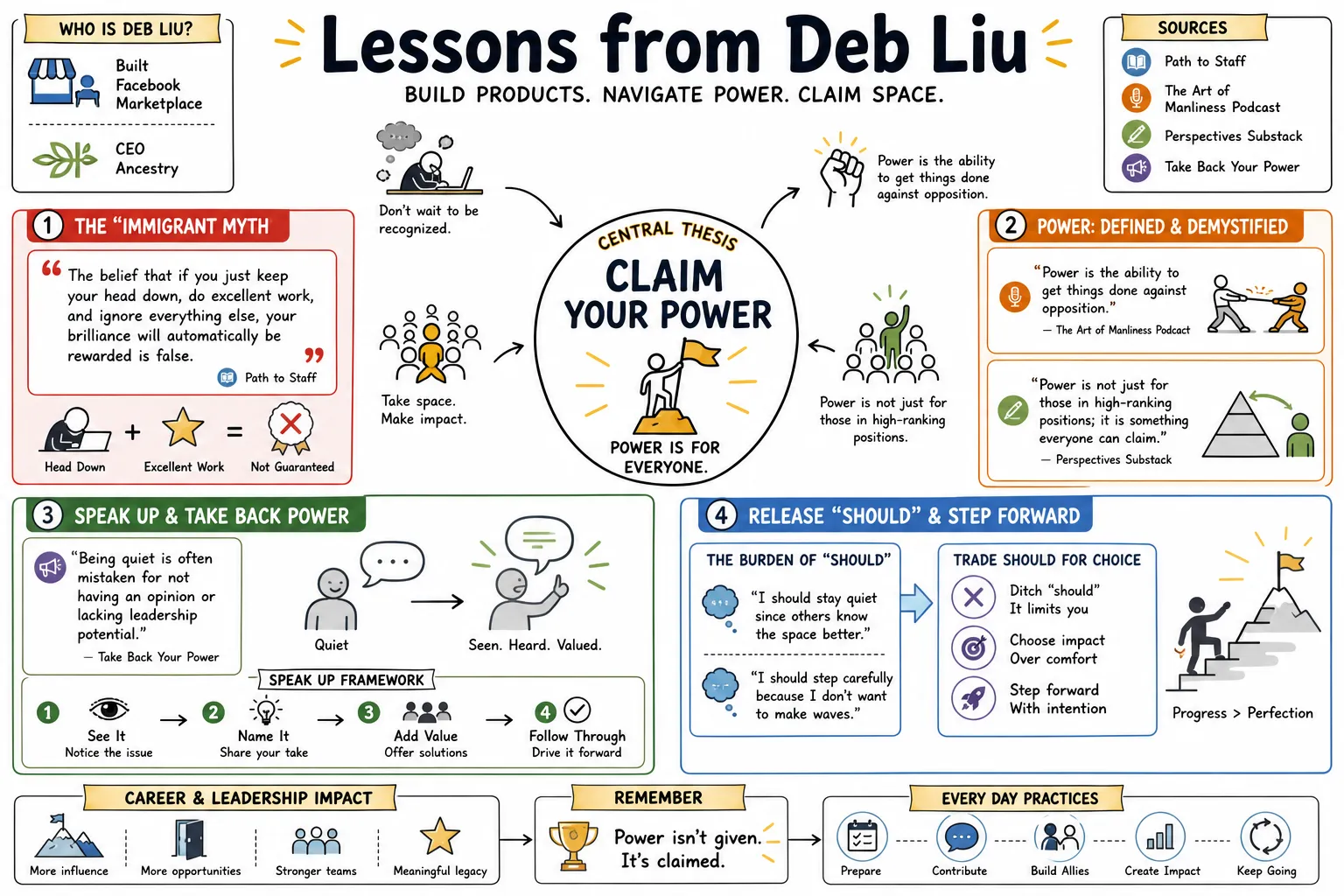
Lessons from Deb Liu
Deb Liu built Facebook Marketplace and was President and CEO of Ancestry. Her writing and interviews explore how she learned to speak up at work, advocated for new products and led teams through change. — Deb Liu Biography.
Part 1: The "Immigrant Myth" and Claiming Space
- Look Beyond Quiet Competence: Liu says she grew up believing that keeping her head down and doing excellent work would be enough. In client-facing work, she learned that speaking and building relationships mattered too. — Stanford Scrappiness Talk.
- Power as Influence: Liu defines power in terms of influencing people and events, and distinguishes that from abusing power. — Women in Product Interview.
- Claim Everyday Agency: For Liu, taking back power includes choosing what to say and how to respond when a meeting does not give you space. — Women in Product Interview.
- Practice Speaking Up: Liu treats speaking up as a learnable skill: prepare a contribution, start small and practice in settings where feedback feels safe. — Women in Product Interview.
- Question the “Shoulds”: Liu describes how internal rules about staying quiet or avoiding labels can keep women from asking for opportunities. — Women in Product Interview.
- Respond to the Fear of Being Difficult: Liu acknowledges that women can be judged harshly for asserting themselves, while warning that silence also has a career cost. — Women in Product Interview.
- Ask for the Opportunity: Liu urges people to state their ambitions and ask for a role or promotion rather than assuming a manager already knows what they want. — Women in Product Interview.
- Navigate an Unfair Workplace: Liu says bias is real and advises people to seek allies and make deliberate choices within the workplace they face. — Women in Product Interview.
- Use Difference Without Hiding: Liu recounts growing up visibly different, hiding to avoid attention and later learning to share her perspective at work. — Women in Product Interview.
Part 2: Strategic Extroversion and Communication
- Strategic Extroversion Is Practice: Liu describes a workplace bias toward those who speak up and says she deliberately practiced participating despite discomfort. — Women in Product Interview.
- Notice Nonverbal Signals: Liu recounts crossing her arms because she was cold during a product review, only to learn that colleagues read it as hostility. — The Hidden Message You’re Communicating.
- Make Others Feel Capable: Liu distinguishes being impressive from leaving someone with a positive impression, and argues that influence grows when leaders listen and make others feel capable. — The Simple Secret to Influence.
- Listen Before Fixing: Starting as Ancestry CEO, Liu used a listening tour to understand people, history and culture before proposing changes. — From Listening Tour to State of the Union.
- Broaden the First-Month Listening Tour: Liu reports meeting 67 Ancestry employees in her first month, using varied one-on-one conversations to surface themes before sharing a company assessment. — From Listening Tour to State of the Union.
- Learn to Sell an Idea Internally: Liu says she tried hackathons, pitches and strategies for years before she could win support for Facebook Marketplace; she later reflected on how her vantage point differed from colleagues’. — Deb Liu Q&A.
- Use Safe Spaces to Practice Communication: Liu credits mentoring and other small circles with helping her practice speaking and get feedback; she recommends beginning with manageable contributions. — Women in Product Interview.
- Turn Listening Into a 60-Day Direction: After a first-month listening tour, Liu recommends communicating a 60-day vision and a 90-day execution plan suited to the organization’s needs. — From Listening Tour to State of the Union.
Part 3: Product Strategy and Building Marketplace
- Persist Through Marketplace Rejection: Liu says she first pitched a Facebook marketplace in a 2009 interview, faced roughly five years of resistance, then iterated through a difficult early product period before it reached more than a billion users. — Stanford Scrappiness Talk.
- Respond to Career Setbacks: After being passed over for a desired job, Liu says she chose to improve the role she already held and seek support rather than treat the rejection as the end of her path. — Women in Product Interview.
- Know Your Marketplace’s Right to Win: Liu advises founders to identify the narrow category, buyer, seller or niche in which their marketplace has an advantage. — a16z Marketplace Interview.
- Build Trust Through Local Identity: Liu attributes part of Facebook Marketplace’s success to sellers being real people in local communities, with mutual connections and account history as trust signals. — The Magic of Marketplaces.
- Value Mostly Exclusive Inventory: Liu says Marketplace inventory was mostly exclusive because sellers did not list widely elsewhere; initial Buy/Sell Group cross-listing still helped seed supply inside Facebook. — The Magic of Marketplaces.
- Design for Serendipitous Discovery: Liu describes Marketplace discovery as partly serendipitous and passively surfaced, helping buyers encounter relevant items while browsing. — The Magic of Marketplaces.
- Connect People Through Commerce: Liu says her Marketplace team’s theme was connecting people through commerce, with value extending beyond a transaction itself. — a16z Marketplace Interview.
- Be Careful With Early Scale Estimates: Liu recalls tentatively telling Mark Zuckerberg that Marketplace might reach a few hundred million people; she later reflected that the product reached a billion users. — The Danger of What’s Next?.
- Build a Scrappy Culture: Liu says scrappiness is cultivated by decision processes, rewards and rapid learning around a customer problem, not a fixed personality trait. — Stanford Scrappiness Talk.
Part 4: Managing Career as a Product
- Product-Manage Your Career: Liu recommends applying product practices—goals, milestones, retrospectives and a roadmap—to career choices. — PM Your Career Like You PM Your Product.
- Plan Beyond the Next Review: Liu encourages product managers to ask where they want to be in two, five and ten years rather than planning only their current role. — PM Your Career Like You PM Your Product.
- Measure Impact, Not Hours: Liu argues that long hours do not automatically create value; outcomes and effectiveness matter more than visible effort alone. — Career Myths That Need to End.
- Own Your Career Direction: After experiencing rapid manager turnover, Liu concluded she needed to advocate for and shape her own career path. — Career Myths That Need to End.
- Ask for Promotion Clarity: Liu urges employees to tell managers when they want promotion, since even a no can reveal a useful roadmap or the need to look elsewhere. — Career Myths That Need to End.
- Identity Exceeds a Job Title: Liu cautions that a current role is only one part of a person’s identity and recommends planning beyond it. — Welcome to the Blank Name Tag Club.
- Accept Career Seasons: Liu says her own path included periods of part-time work and less career ambition while raising children; she rejects the idea that every season must climb continuously. — Ask Me Anything: Family Edition.
- Use a Revisable 30-60-90 Plan: Entering Ancestry, Liu wrote a 30-60-90-day plan, shared priorities and expected to adjust it as she learned. — A Guide for Onboarding into a New Role.
- Learn From Failure Without Freezing: Liu says teams can become risk-averse when a failed attempt is treated as proof that a customer problem cannot be solved; she urges testing and iteration. — Stanford Scrappiness Talk.
- Make Feedback Safe to Give: Liu advises senior leaders to ask specific questions, listen without retaliation and visibly use feedback so colleagues can speak honestly. — How to Get Feedback.
Part 5: Leadership, Trust, and Teams
- Learn From Specialists: Liu challenges the assumption that a manager must be the most expert person at the table; leaders can learn from the people they manage. — How I Beat Impostor Syndrome.
- Lead Without Being the Best Lawyer: Liu uses CEOs and their CFOs or general counsels to illustrate that leaders need not outrank specialists in every craft; they must learn from them. — How I Beat Impostor Syndrome.
- Facilitate Shared Answers: Liu says leaders entering a new organization should listen first and help the company find answers together rather than arrive claiming all the answers. — A Guide for Onboarding into a New Role.
- Earn Trust Through Consistency: Liu says trust in a new leader grows through repeated interactions and keeping one’s word in both small and large matters. — A Guide for Onboarding into a New Role.
- Serve by Empowering: Liu describes servant leadership as empowering people and making decisions that serve customers, employees and stakeholders, not avoiding hard choices. — A Guide for Onboarding into a New Role.
- Look for Psychological Safety: Liu advises candidates to assess whether a prospective team is supportive and psychologically safe, and argues that acceptance matters more than assembling stars alone. — LinkedIn Get Hired Interview.
- Leadership Requires Working Across Friction: Liu says senior leaders cannot always choose their colleagues; learning to work productively across difficult relationships becomes essential. — How to Work With Anyone.
- Understand a Colleague’s Context: Liu advises looking for the incentives, constraints and common ground behind a difficult colleague’s behavior before assuming bad intent. — How to Work With Anyone.
- Challenge the “Lower the Bar” Premise: Liu argues that saying diverse hiring would lower the bar assumes people with different backgrounds are less capable, and asks whether teams are looking widely enough. — Model Minority Myth Panel.
Part 6: Navigating the Invisible Tax and Women in Tech
- Name the Invisible Double Standard: Liu describes how women can be penalized for asserting themselves yet also lose opportunities when they stay silent. — Women in Product Interview.
- Recognize Contradictory Expectations: Liu says women may be judged more harshly for violating workplace norms, making assertiveness and likability a difficult balance. — Women in Product Interview.
- Create a Product Community: Liu recounts helping turn recurring dinners among women product leaders into a Women in Product conference and wider community. — Ten Years Strong: Craft, Courage, Community.
- Sustain Mutual Support: Liu says Women in Product was built because many women product managers felt alone and needed peers to connect, learn and help one another. — Ten Years Strong: Craft, Courage, Community.
- Do Not Wait to Be Noticed: Liu says influence requires speaking up and making deliberate asks rather than assuming good work will automatically be seen. — Women in Product Interview.
- Claim Space Deliberately: Liu recommends deciding before a meeting what contribution to make and calmly reclaiming the floor after interruption. — Women in Product Interview.
Part 7: Handling Obstacles and Reorgs
- Recognize Reorganization Constraints: Liu describes executing a large top-down reorganization she disagreed with while having little latitude to change it and limited room to explain it to her teams. — What Your Manager Doesn’t Tell You.
- Plan for Roles After Reorganization: Liu warns that employees returning from leave can find teams and reporting lines changed; she urges managers to help them return to meaningful roles. — What They Don’t Tell You about Maternity Leave.
- Question Old Organizational Lessons: Liu says earlier failed Facebook commerce efforts created an institutional memory that resisted Marketplace, even though a different product or time might succeed. — Stanford Scrappiness Talk.
- Turn a Different Vantage Point Into Product Insight: Liu says her background with garage sales and used goods helped her see Marketplace’s potential when many colleagues did not. — Deb Liu Q&A.
- Stay With the Customer Problem: Liu argues that staying committed to a customer problem does not mean clinging to one solution; the Marketplace team kept testing through weak early fit. — Stanford Scrappiness Talk.
- Make Failure Inform the Next Test: Liu says teams can learn faster by running and evaluating many experiments instead of penalizing every failed attempt. — Stanford Scrappiness Talk.
- Incubate Zero-to-One Products Through Iteration: Liu’s Marketplace account shows that a large company can build a new product through years of advocacy followed by rapid testing and adaptation. — Stanford Scrappiness Talk.
Part 8: The Spaces In Between: Perspective and Life
- Relationships Color Perspective: Liu describes how prior relationships and assumptions can make the same colleague’s actions look helpful or hostile. — Everyone Is the Hero of Their Own Story.
- Retell a Conflict From the Other Side: Liu learned from a mentor to retell a difficult colleague’s story with that person as the protagonist; doing so exposed shared incentives and reduced animosity. — Everyone Is the Hero of Their Own Story.
- Pause Between Career Chapters: Liu says a pause after leaving a title can reveal parts of identity that a job label had obscured, rather than requiring an immediate next role. — Welcome to the Blank Name Tag Club.
- Use an Abundance Frame Carefully: Describing coach Katia Verresen’s method, Liu says noticing scarcity-driven thought patterns can help people see more possibilities. — Getting Out of Your Own Way.
- Avoid Scorekeeping at Home: Liu describes the “60-60” marriage she and her husband adopted: both aim to contribute generously without keeping a strict tally of duties. — The 60-60 Relationship.
- Share a Personal Health Story Without a Universal Claim: Liu publicly described how a friend’s request led her to screening and later a cancer diagnosis, presenting that support as meaningful in her own life. — Drawing the Cancer Card.
- Notice the Scale of Progress: Liu reflects that Marketplace eventually far exceeded her tentative early user estimate and uses that memory to argue for pausing to recognize achievements. — The Danger of What’s Next?.