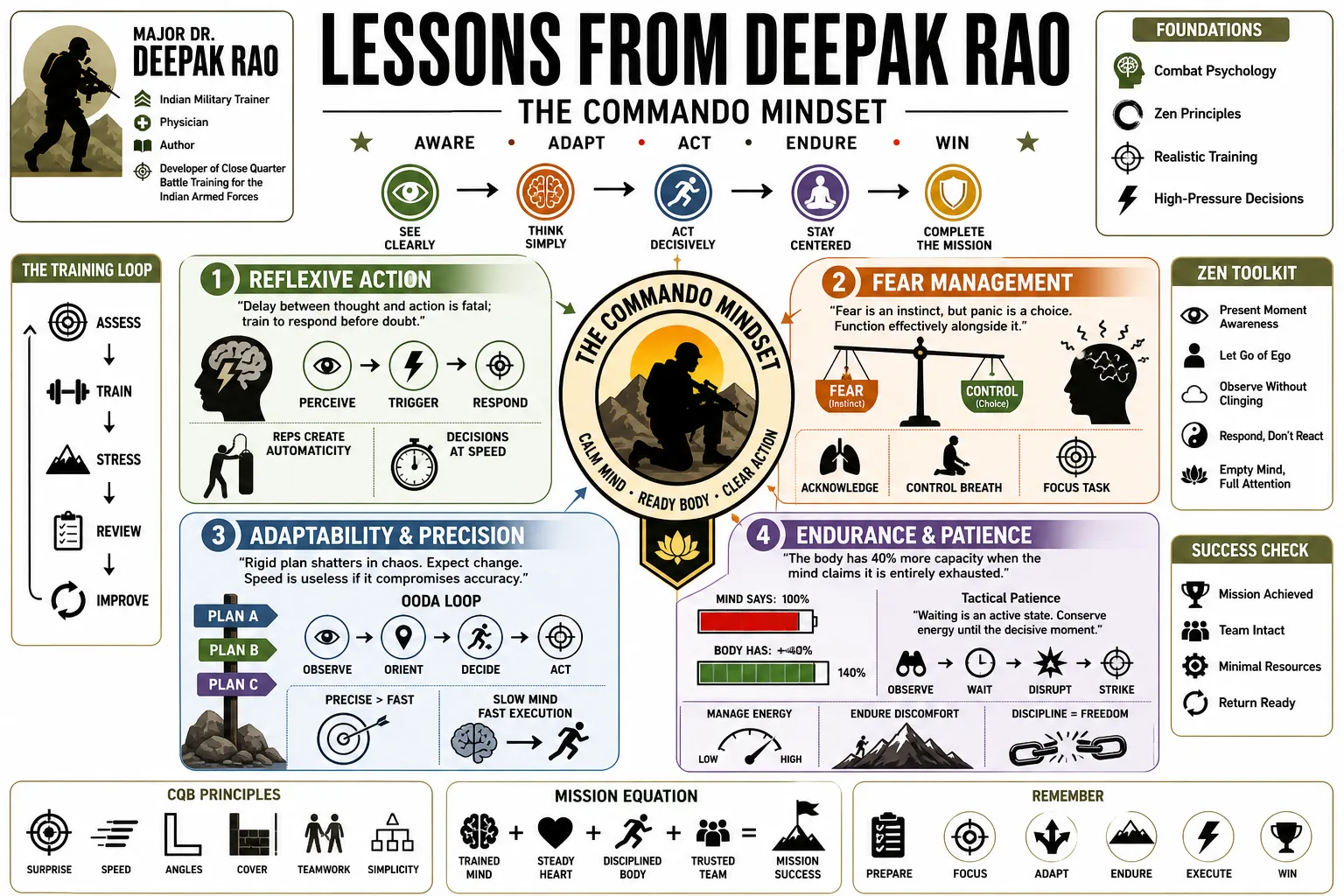
Lessons from Deepak Rao
Major Dr. Deepak Rao is an Indian military trainer, physician, and author who developed Close Quarter Battle training for the Indian Armed Forces. This collection outlines his ideas on mental endurance and tactical decision-making, showing how he applies combat psychology and Zen principles to high-pressure situations.
Part 1: The Commando Mindset
- On Reflexive Action: "In combat, the delay between thought and action is fatal; training must wire the body to respond before the conscious mind can doubt." — Source: [Strike to Kill]
- On Fear Management: "Fear is an instinct, but panic is a choice. You train not to eliminate fear, but to function effectively alongside it." — Source: [Streebal Podcast]
- On Adaptability: "A rigid plan shatters under the chaos of contact. Commandos succeed because they expect the situation to change." — Source: [Encyclopedia of Close Combat Operations]
- On Precision: "Speed is useless if it compromises accuracy. Slow down your mind to accelerate your execution." — Source: [Strike to Kill]
- On Mental Fatigue: "The body usually has forty percent more capacity when the mind claims it is entirely exhausted." — Source: [Unfreak Your Mind: Zen and Psychology]
- On Tactical Patience: "Waiting is an active state in combat. It is the deliberate conservation of energy until the decisive moment arrives." — Source: [Engage4More Keynote]
- On Operational Chaos: "You cannot control the battlefield, but you can strictly control your breathing and your immediate next step." — Source: [Streebal Podcast]
- On Muscle Memory: "Repetition in mundane environments builds the automatic reflexes needed for extreme environments." — Source: [Encyclopedia of Close Combat Operations]
- On Threat Assessment: "Do not look at the size of the adversary; look at their center of gravity and their balance." — Source: [Strike to Kill]
- On Decisiveness: "A suboptimal decision executed immediately with full commitment often beats a perfect decision executed a minute too late." — Source: [Streebal Podcast]
Part 2: Zen and Everyday Mindfulness
- On Present Focus: "Zen is not about emptying the mind; it is about filling it completely with whatever task is right in front of you." — Source: [TEDx: Zen and Mindfulness In Everyday Life]
- On Reactive Anger: "When provoked, count your breaths instead of formulating your response. The pause strips the emotion from the situation." — Source: [Unfreak Your Mind: Zen and Psychology]
- On Detachment: "Caring deeply about the work does not require you to be destroyed by the outcome." — Source: [TEDx: Zen and Mindfulness In Everyday Life]
- On Internal Noise: "The most dangerous enemies are the manufactured anxieties looping inside your own head." — Source: [Unfreak Your Mind: Zen and Psychology]
- On Stillness: "Physical stillness is the first step toward mental clarity. Stop moving to start seeing." — Source: [TEDx: Zen and Mindfulness In Everyday Life]
- On Simplicity: "Complexity is often a hiding place for a lack of understanding. Zen demands boiling things down to their absolute essence." — Source: [Unfreak Your Mind: Zen and Psychology]
- On Breathing: "The breath is the only autonomic function you can consciously control; it is your manual override for the nervous system." — Source: [Medical Survival 101]
- On Routine: "Treat daily habits as practice. How you tie your boots dictates how you handle a crisis." — Source: [TEDx: Zen and Mindfulness In Everyday Life]
- On Ego: "The ego demands to be right, which blinds you to the reality of the situation. Drop it to survive." — Source: [Unfreak Your Mind: Zen and Psychology]
- On Awareness: "Do not just look at the threat; see the room, the exits, and the shadows. Tunnel vision is a killer." — Source: [TEDx: Zen and Mindfulness In Everyday Life]
Part 3: Close Quarter Battle as a Metaphor
- On Proximity: "The closer the conflict, the less time you have for complex strategies. Keep your responses simple and direct." — Source: [Encyclopedia of Close Combat Operations]
- On Initiative: "In a sudden confrontation, whoever moves first dictates the geography of the fight." — Source: [Strike to Kill]
- On Overcommitment: "Never put all your weight into a single strike. Always retain enough balance to recover if you miss." — Source: [Encyclopedia of Close Combat Operations]
- On Angles: "Direct confrontation is a test of strength. Moving slightly off the center line turns it into a test of geometry." — Source: [Strike to Kill]
- On Recovery: "Getting hit is an inevitable part of close quarters. The fight is won in the half-second after you take the blow." — Source: [Streebal Podcast]
- On Spatial Awareness: "Understand the constraints of your environment before you act. The walls and furniture are active participants in the outcome." — Source: [Encyclopedia of Close Combat Operations]
- On Efficiency: "Wasted motion is wasted time. Remove the wind-up from your actions to catch the adversary off guard." — Source: [Strike to Kill]
- On Surprise: "Do what is logically inappropriate for the situation. Predictability is a liability." — Source: [Encyclopedia of Close Combat Operations]
- On Escalation: "Do not match force with force. Match force with redirection." — Source: [Strike to Kill]
Part 4: Resilience and Endurance
- On Tolerance: "Patience is simply the decision to endure your current troubles without letting them corrupt your character." — Source: [Engage4More Keynote]
- On Suffering: "Physical pain is data. It tells you about your body's condition, but it does not have to dictate your next choice." — Source: [Medical Survival 101]
- On Small Victories: "When the objective seems impossible, shrink your horizon. Focus only on surviving the next five minutes." — Source: [Streebal Podcast]
- On Recovery Time: "Rest is a tactical requirement, not a luxury. You cannot operate at peak capacity continuously." — Source: [Medical Survival 101]
- On Emotional Endurance: "Do not let a temporary setback harden into a permanent attitude of defeat." — Source: [Unfreak Your Mind: Zen and Psychology]
- On Discomfort: "Voluntarily seeking out minor discomforts prepares the mind to handle major, involuntary catastrophes." — Source: [Streebal Podcast]
- On Momentum: "Even when you are moving slowly, do not stop entirely. Friction makes it twice as hard to start again." — Source: [Strike to Kill]
- On Mental Anchors: "Keep one irrefutable reason for continuing in your mind. When everything else fails, rely on that single anchor." — Source: [Engage4More Keynote]
- On Complaining: "Vocalizing your misery signals to your brain that it is acceptable to quit." — Source: [Unfreak Your Mind: Zen and Psychology]
Part 5: Applied Psychology and Wellness
- On Physiological State: "Your mental state follows your physical posture. You cannot feel confident while physically mimicking defeat." — Source: [Medical Survival 101]
- On Diet and Clarity: "What you put into your body dictates the quality of fuel your brain has for decision making." — Source: [Medical Survival 101]
- On Sleep Deprivation: "Operating without sleep creates an illusion of competence while actively degrading your reflexes and judgment." — Source: [Medical Survival 101]
- On Rejuvenation: "Healing requires objective distance from the source of stress. You cannot recover in the same environment that broke you." — Source: [Unfreak Your Mind: Zen and Psychology]
- On Trust: "Being trustworthy is a physiological advantage. It reduces the cognitive load of maintaining deception." — Source: [Engage4More Keynote]
- On Optimism: "Optimism is not ignoring the risks. It is the practical belief that you have the skills to manage those risks." — Source: [Unfreak Your Mind: Zen and Psychology]
- On Empathy: "Empathy is a tool for survival. Understanding your enemy's motivations gives you the key to defeating them." — Source: [Strike to Kill]
- On Objectivity: "Analyze your own failures as if you were studying a stranger. Take the emotion out of the autopsy." — Source: [Unfreak Your Mind: Zen and Psychology]
- On Habituation: "The human mind normalizes extreme stress over time, which can lead to catastrophic breakdowns if not actively managed." — Source: [Medical Survival 101]
Part 6: Leadership and the Samurai Code
- On Leading by Example: "Command is not a right to order others; it is the obligation to face the danger first." — Source: [Engage4More Keynote]
- On Honor: "Bushido requires that your actions align with your words, even when no one is watching." — Source: [TEDx: Zen and Mindfulness In Everyday Life]
- On Loyalty: "True loyalty involves telling the leadership when a plan is flawed, not blindly walking into an ambush." — Source: [Encyclopedia of Close Combat Operations]
- On Restraint: "The sword stays in the scabbard until absolutely necessary. True power is having the capability to destroy and choosing not to." — Source: [Engage4More Keynote]
- On Accountability: "When the operation succeeds, credit the team. When it fails, the commander takes the blame entirely." — Source: [Streebal Podcast]
- On Respect: "Treat every adversary with respect. Underestimating an opponent is a failure of character that often proves fatal." — Source: [Strike to Kill]
- On Sincerity: "If you commit to a course of action, do it with absolute sincerity. Half-measures breed disaster." — Source: [TEDx: Zen and Mindfulness In Everyday Life]
- On Courage: "Courage in leadership means making the unpopular decision when it is tactically necessary." — Source: [Engage4More Keynote]
- On Mentorship: "A trainer's success is measured only by how well their students survive without them." — Source: [Encyclopedia of Close Combat Operations]
- On Legacy: "Your reputation is built over decades of disciplined action and can be destroyed by three seconds of lost control." — Source: [Unfreak Your Mind: Zen and Psychology]
Part 7: Strategy and Sun Tzu in Modern Life
- On Avoiding Conflict: "The highest form of strategy is resolving a dispute before physical confrontation becomes necessary." — Source: [Strike to Kill]
- On Deception: "Show weakness when you are strong, and project strength when you are vulnerable. Control the information your adversary receives." — Source: [Encyclopedia of Close Combat Operations]
- On Preparation: "Battles are won in the training room. The actual conflict is merely the manifestation of your prior preparation." — Source: [Engage4More Keynote]
- On Terrain: "Understand the environment better than the enemy. The ground itself can be a weapon if you know how to use it." — Source: [Strike to Kill]
- On Fluidity: "Water has no shape of its own, yet it carves through stone. Adjust your strategy to fit the contours of the resistance." — Source: [TEDx: Zen and Mindfulness In Everyday Life]
- On Timing: "Strike when the enemy is disorganized; wait when they are fully prepared. Patience is a weapon." — Source: [Encyclopedia of Close Combat Operations]
- On Alliances: "A lone warrior is easily surrounded. Build a network of trusted allies before the crisis hits." — Source: [Streebal Podcast]
- On Information: "Operating without accurate intelligence is like fighting blindfolded. Gather facts before committing resources." — Source: [Engage4More Keynote]
- On Exit Strategies: "Never enter a situation without knowing exactly how you will get out if things go wrong." — Source: [Strike to Kill]
Part 8: The Medical Perspective on Performance
- On Anatomy: "Understanding where the body is structurally weak allows you to neutralize threats with minimal effort." — Source: [Medical Survival 101]
- On Adrenaline: "Adrenaline gives you strength but strips you of fine motor skills. Train to operate under its influence." — Source: [Strike to Kill]
- On Trauma: "Immediate medical intervention in the field is about stopping the bleed; definitive care comes later. Prioritize immediate survival." — Source: [Medical Survival 101]
- On Biomechanics: "Power comes from the ground up. If your stance is compromised, your strike will have no force." — Source: [Encyclopedia of Close Combat Operations]
- On Neurological Overload: "When faced with too many threats, the brain freezes. Train to process threats sequentially, not simultaneously." — Source: [Unfreak Your Mind: Zen and Psychology]
- On Hydration: "A dehydrated brain makes errors in judgment long before the body physically collapses." — Source: [Medical Survival 101]
- On Heart Rate: "As your heart rate crosses 140 beats per minute, peripheral vision narrows. You must actively scan your environment to compensate." — Source: [Strike to Kill]
- On Pain Tolerance: "Pain is an electrical signal. With practice, you can acknowledge the signal without letting it hijack your executive function." — Source: [Unfreak Your Mind: Zen and Psychology]
- On Baseline Health: "Your ability to survive extreme physical trauma is directly proportional to your fitness level before the event occurred." — Source: [Medical Survival 101]