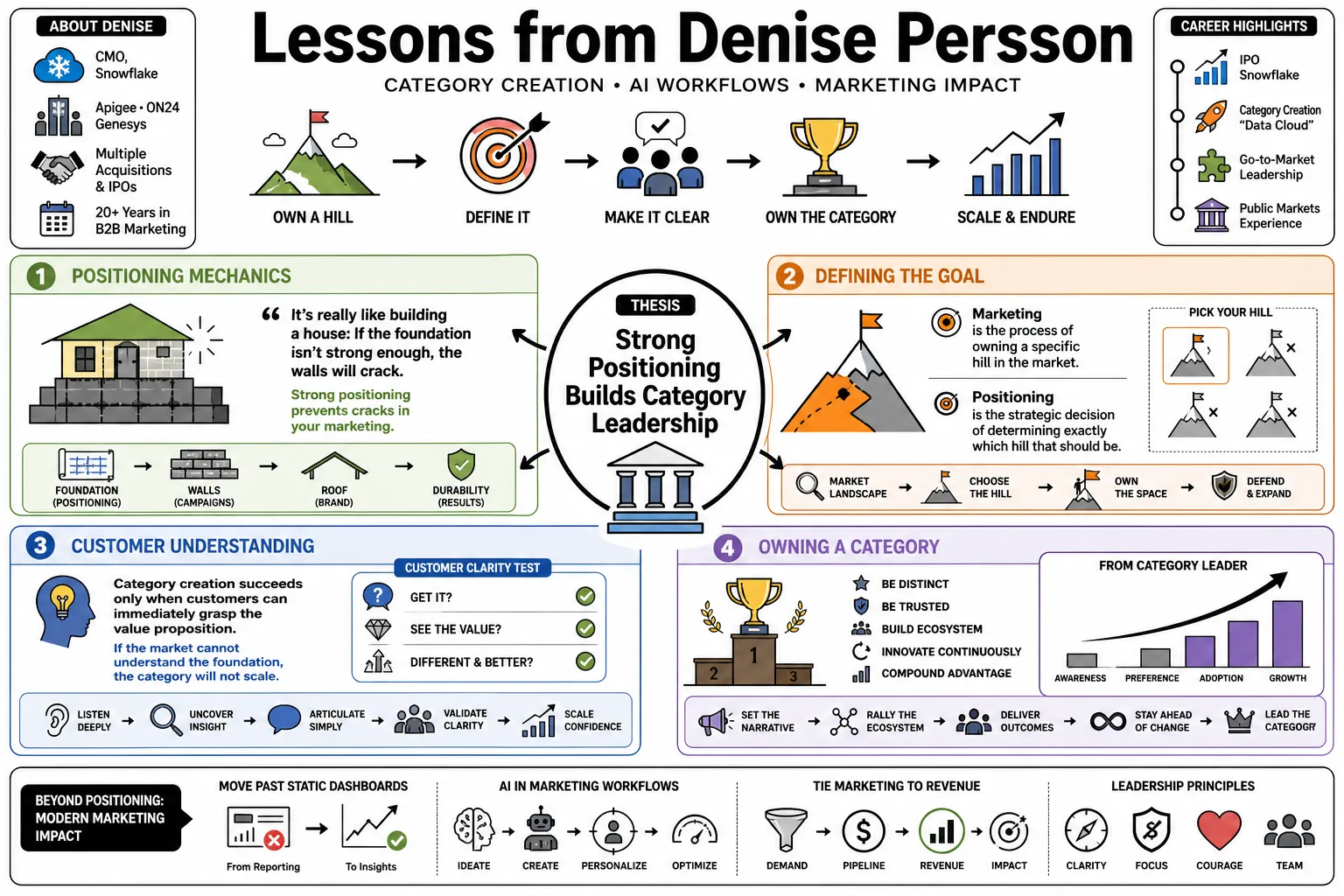
Lessons from Denise Persson
As Snowflake's Chief Marketing Officer, Denise Persson helped define the "Data Cloud" category and steered the company's go-to-market strategy through its IPO. She previously ran marketing at Apigee, ON24, and Genesys, managing multiple acquisitions and public offerings over two decades. This profile covers her advice on moving past static dashboards, incorporating AI into marketing workflows, and tying marketing directly to sales revenue.
Part 1: Category Creation and Positioning
- On Positioning Mechanics: "It’s really like building a house: If the foundation isn’t strong enough, the walls will crack. With strong positioning, you can avoid cracks in your marketing." — Source: SaaStr
- On Defining the Goal: Marketing is the process of owning a specific hill in the market, while positioning is the strategic decision of determining exactly which hill that should be. — Source: SaaStr
- On Customer Understanding: Category creation succeeds only when customers can immediately grasp the value proposition; if the market cannot understand the foundation, the category will not scale. — Source: Ivy Podcast
- On Owning a Category: "When you look at what the most admired brands in the world have in common, they all own their categories, they’re incredibly consistent with a brand experience and they have incredible customer loyalty." — Source: SaaStr
- On Differentiating Early: In Snowflake's early days, defining the product clearly as "The Data Warehouse Built for the Cloud" allowed the company to cleanly separate itself from legacy, on-premise competitors. — Source: Zoom Marketing
- On Long-Term Consistency: A strong category is not built on a single launch, but through a disciplined, consistent foundation that aligns marketing strategy directly with the product's evolving capabilities. — Source: SaaStr
- On The Data Cloud: Evolving from a cloud data warehouse to establishing the "Data Cloud" category required a deliberate expansion of how customers perceived data sharing and interoperability. — Source: SaaStr
- On Market Testing: Defining a category hill must be supported by rigorous market testing with real prospects to guarantee the core messaging genuinely resonates before scaling it. — Source: Zoom Marketing
- On Simplicity: The most effective positioning strips away complex jargon, allowing the core utility of the technology to speak directly to the immediate problems faced by the buyer. — Source: HeySummit
- On Enduring Value: Growth without a trusted, established category foundation is a short-term strategy that breaks down when market conditions tighten. — Source: Snowflake
Part 2: The Dashboard Is Dead: AI in Marketing
- On Static Reporting: "The dashboard is dead." Marketing leaders should move beyond logging into static tools that only explain what happened in the past. — Source: SaaStr
- On Conversing with Data: In LEADERS, Persson says natural language has become a true interface to data, letting business users talk to their data agent and get answers in seconds instead of waiting on analysts or static dashboards. — Reference: LEADERS interview on talking to data through natural language and data agents
- On Removing Friction: Using AI agents to query data directly eliminates the need for back-and-forth Slack messages and endless meetings previously required to interpret performance metrics. — Source: SaaStr
- On Campaign Optimization: Persson's SaaStr AI example was concrete: Snowflake cut cost per opportunity by 30% over six months by consolidating fragmented media data and letting the system recommend daily optimizations rather than waiting until campaigns ended. — Reference: SaaStr AI recap on Snowflake cutting cost per opportunity by 30%
- On Grassroots AI Adoption: Persson describes AI adoption as an inspiration-and-practice effort, using weekly skills training, function-level hackathons, and small team challenges so each group learns workflows that fit its own work rather than absorbing a generic top-down mandate. — Reference: SaaStr AI recap on weekly AI skills training and function-level hackathons
- On Workflow Efficiency: Generative AI tools allow large marketing teams to realize massive time savings on manual tasks like script creation, interview preparation, and content localization. — Source: SaaStr
- On The AI Financial Test: While AI capabilities are impressive, they must pass the ultimate test: "Is it generating more money or saving more money?" — Source: SaaStr
- On Competitive Advantage: "The marketing teams pulling ahead in the AI era are the ones who can act on governed customer data without moving it out of the warehouse." — Source: Business Wire
- On Real-Time Action: As marketing evolves from campaign-centric workflows to real-time decision systems, the ability to respond to customer signals instantly becomes the primary differentiator. — Source: Morningstar
- On Peer Enablement: In Brand Innovators, Persson says executive communities learn most from peers, and she applies that same logic internally through an AI council and quarterly AI marketing days that spread what is actually working across the team. — Reference: Brand Innovators interview on peer learning, the AI Council, and quarterly AI marketing days
Part 3: Data-Driven Foundation and Governance
- On The Prerequisite for AI: An organization cannot successfully implement a comprehensive AI strategy without first establishing a robust, governed data foundation. — Source: MarTech Podcast
- On Data Silos: Data fragmentation remains the primary obstacle for marketers attempting to build a comprehensive, 360-degree view of their customer base. — Source: TipSheet
- On Speed and Governance: "Marketing teams are under pressure to move faster with data, but speed only creates value when it is grounded in governance." — Source: Business Insider
- On The Modern Stack: A modern marketing data stack must prioritize trusted, interoperable customer data to function effectively in an environment driven by automated decisions. — Source: Morningstar
- On Predictive Forecasting: The function of marketing data has shifted away from analyzing historical performance toward predictive forecasting that shapes future go-to-market moves. — Source: MarTech Podcast
- On Source of Truth: A single, unified source of truth is not merely an operational convenience; it is a strict requirement for optimizing spend and targeting across global campaigns. — Source: CMSWire
- On Infrastructure Investments: Marketing leaders must invest deeply in the right data infrastructure before they can expect their teams to adapt and optimize strategies on the fly. — Source: Mission North
- On Privacy and Trust: The most successful marketing organizations use governed, unified data to build personalized experiences without compromising customer privacy or trust. — Source: Snowflake
- On Removing Data Movement: Operating directly on data where it lives, rather than copying it across various marketing platforms, reduces latency and security risks. — Source: Business Wire
- On Measurable Advantage: Building upon a unified data architecture turns every individual marketing campaign into a measurable, compounding competitive advantage. — Source: Snowflake
Part 4: Sales Empathy and Alignment
- On Understanding the Sales Role: "You need to have empathy for sales and make sure that your entire marketing organization has that empathy. Sales is hard. Carrying that bag every day, a number on your head, you get fired if you don't meet your numbers." — Source: Renegade Marketers
- On Organizational Tension: Persson tells LEADERS that friction between sales and marketing is common, but Snowflake treated trust and absolute alignment as a buildable advantage, showing that tension usually reflects operating choices rather than an unavoidable law of GTM. — Reference: LEADERS interview on turning sales-marketing alignment into a competitive advantage
- On Serving Sales: In enterprise software companies with thousands of customers, the sales organization operates as the primary engine, and marketing exists to serve and accelerate that engine. — Source: Selling Sherpa
- On Meaningless Metrics: "The thing that would drive me crazy is marketers that get up there and say, here's how many MQLs we've gotten and the sales team sucks." — Source: Renegade Marketers
- On Shared Goals: Marketing and sales must operate in absolute lockstep, measuring their success against the exact same revenue and pipeline targets rather than isolated departmental goals. — Source: Mission North
- On Feedback Loops: Establishing continuous, bidirectional feedback loops between field sales representatives and product marketing ensures that positioning remains grounded in actual buyer objections. — Source: GTM Now
- On Sales Enablement: True alignment means marketing provides sales with educational content and customer narratives that help them act as trusted advisors, rather than mere product pushers. — Source: Brand Innovators
- On The Partnership Dynamic: A Chief Marketing Officer and a Chief Revenue Officer must maintain a partnership built on transparency, recognizing that one function cannot succeed if the other is failing. — Source: SaaStr
- On Joint Execution: When launching new categories or products, the initial go-to-market motion requires sales and marketing to co-develop the narrative directly with early adopters. — Source: GTM Now
Part 5: The Customer-Centric Ecosystem
- On Building Trust: "In B2B, all relationships start with building trust... Customers want to buy from a true partner, someone who's not only providing the best product, but also valuable advice and educational content." — Source: Mission North
- On Peer Validation: "In B2B technology, people trust their peers more than anything else. Telling the story through the customers... serves two purposes—inspiration and education—and it shows how much we’re putting the customer at the center of everything we do." — Source: Brand Innovators
- On Listening First: "Customers don't want to hear you talk from the inside out about your product and all that. The best sellers are those who listen more than talk." — Source: Brand Innovators
- On B2C Tactics in B2B: To elevate a B2B company from a great vendor to an iconic brand, marketers must adopt a B2C-style obsession with the end-user's emotional and practical experience. — Source: Brand Innovators
- On Customer Stories: Brand Innovators shows Persson leaning hard on customer storytelling because peers trust peers, so the most persuasive marketing is not generic product copy but specific customer narratives that educate while proving real-world value. — Reference: Brand Innovators interview on customers telling the story because peers trust peers
- On Brand Memory: "People may not remember exactly what you did, or what you said, but they will always remember how you made them feel." — Source: Mission North
- On Community Building: Fostering a dedicated community of practitioners and developers creates a self-sustaining ecosystem where users educate and recruit each other. — Source: SACC-SF
- On The Goal of Marketing: "We aim to create the most customer-obsessed technology company on the planet." — Source: Brand Innovators
- On Relevance: Modern marketing is fundamentally about maintaining absolute relevance to the customer's immediate business context and daily operational challenges. — Source: Fivetran
Part 6: Leadership, Hypergrowth, and Scale
- On Managing Scale: Persson frames scale as discipline: Snowflake codified values early, aligned sales and marketing tightly, and kept execution rigorous as the company grew from roughly 100 people and a few million in revenue into a much larger public-company GTM machine. — Reference: LEADERS interview on codifying values and scaling with discipline
- On Delegation and Trust: "Effective leadership is about clarity, accountability, and trust. I believe in hiring great people, setting high expectations, and then giving them ownership." — Source: LEADERS Magazine
- On Crisis Management: During periods of economic uncertainty or crisis, marketing leadership must focus heavily on preserving customer trust and doubling down on core, measurable activities. — Source: Mission North
- On GTM Engineering: Building a specialized operations and engineering function within the marketing department is necessary to handle the technical complexity of scaling digital acquisition. — Source: SaaStr
- On Executive Collaboration: The success of a hypergrowth phase depends heavily on the CMO acting as a strategic peer to the product and engineering leaders, not just a downstream execution arm. — Source: SaaStr
- On Hiring for Impact: When assembling a marketing organization for scale, leaders should prioritize candidates who demonstrate a clear understanding of how their specific role drives overall business revenue. — Source: Poddtoppen
- On Sustaining Culture: Preserving a fast-moving, innovative culture across a 700-person team requires deliberate communication structures that prevent organizational silos from forming. — Source: LEADERS Magazine
- On Navigating IPOs: Preparing a marketing organization for a public offering involves ensuring that the external brand narrative matches the rigorous financial metrics demanded by public markets. — Source: Brand Innovators
- On Continuous Adaptation: A marketing strategy that worked perfectly at $10 million in revenue will inevitably break at $100 million; leaders must proactively dismantle and rebuild their own systems. — Source: SaaStr
Part 7: Moving Beyond Vanity Metrics
- On Redefining KPIs: Persson says marketing has to move beyond vanity metrics and hold itself accountable to revenue impact, so the right KPI set is the one sales and leadership can recognize as business movement rather than dashboard decoration. — Reference: LEADERS interview on moving beyond vanity metrics to revenue impact
- On The MQL Trap: Relying too heavily on Marketing Qualified Leads creates a false sense of security and often masks a fundamental disconnect between marketing activity and closed-won deals. — Source: Renegade Marketers
- On Cost Efficiency: Persson's own proof point at SaaStr AI was not AI usage for its own sake but lower cost per opportunity, reinforcing her broader rule that new tooling only matters when it saves money or produces more revenue. — Reference: SaaStr AI recap on cost-per-opportunity improvement as the proof point
- On Pipeline Velocity: Tracking how quickly deals move through the pipeline from initial engagement to close provides a much more accurate read on marketing effectiveness than top-of-funnel volume. — Source: GTM Now
- On Revenue Accountability: A modern CMO must view their role as directly accountable for revenue generation, sitting alongside the sales leadership in quarterly business reviews. — Source: SaaStr
- On AI Implementation Metrics: The success of internal AI adoption should not be measured by the number of AI agents deployed, but by the specific hours saved and the measurable output increased. — Source: SaaStr
- On Event ROI: Persson's Brand Innovators examples treat big-stage marketing moments like the Olympics as worthwhile when they make Snowflake's product value relatable to a wide audience, which is a more defensible event standard than counting attendance in isolation. — Reference: Brand Innovators interview on using Olympics storytelling to make product value relatable
- On Long-Term Value: Measuring the lifetime value of customers acquired through different channels dictates where marketing should focus its most expensive, high-touch resources. — Source: Mission North
- On Business Language: Marketers must learn to present their results using the financial language of the boardroom rather than the specialized jargon of digital advertising. — Source: LEADERS Magazine
Part 8: Career Philosophy and Personal Growth
- On Facing Fear: "The best things in life are on the other side of fear. You just have to walk right through it." — Source: Zoom Marketing
- On Taking Risks Early: Professionals in the early stages of their careers should actively seek out high-risk, high-reward environments like early-stage startups to accelerate their learning curve. — Source: Poddtoppen
- On Seeking Impact: Instead of focusing purely on title progression, career development should be guided by asking, "How am I directly moving this business forward?" — Source: LEADERS Magazine
- On The Value of Mentorship: Surrounding yourself with experienced mentors who can provide unvarnished feedback is critical for navigating the transition from functional expert to executive leader. — Source: Poddtoppen
- On Global Perspectives: Accepting challenging international assignments early in a career forces the development of adaptability and broadens an executive's understanding of diverse market dynamics. — Source: Zoom Marketing
- On Intellectual Curiosity: The most successful marketing leaders maintain a relentless curiosity about how the underlying technology actually works, allowing them to speak credibly with technical founders. — Source: Brand Innovators
- On Bouncing Back: Setbacks in a fast-paced technology environment are inevitable; the defining trait of a successful career is the speed and grace with which a leader recovers and pivots. — Source: The Key Executives
- On Building Teams: A leader's legacy is ultimately defined by the caliber of the team they assemble and their ability to elevate those individuals to perform beyond their own expectations. — Source: LEADERS Magazine
- On Lifelong Learning: "What people are building with AI, both individually and across enterprises, is nothing short of extraordinary," proving that executives must continuously adapt to fundamental technological shifts. — Source: TMX