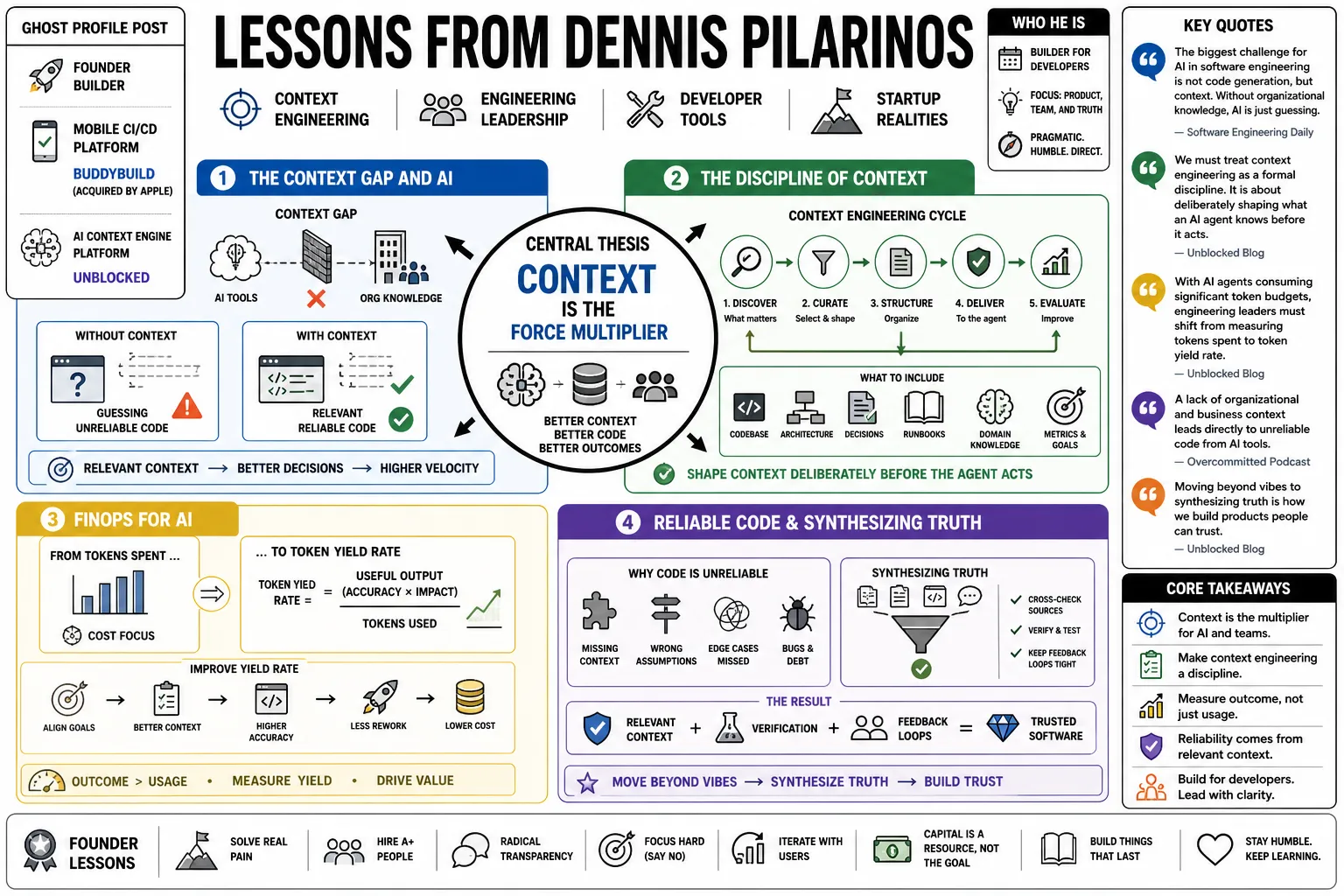
Lessons from Dennis Pilarinos
Dennis Pilarinos built the mobile CI/CD platform Buddybuild, acquired by Apple, and the AI context engine Unblocked. He argues that AI coding tools fail without a company's specific organizational knowledge, defining this problem as context engineering. This profile gathers his insights on building developer tools, managing engineering teams, and the realities of founding startups.
Part 1: The Context Gap and AI
- On Context engineering: "The biggest challenge for AI in software engineering is not code generation, but context. Without organizational knowledge, AI is just guessing." — Source: Software Engineering Daily
- On The discipline of context: "We must treat context engineering as a formal discipline. It is about deliberately shaping what an AI agent knows before it acts." — Source: Unblocked Blog
- On FinOps for AI: "With AI agents consuming significant token budgets, engineering leaders must shift from measuring tokens spent to token yield rate." — Source: Unblocked Blog
- On Reliable code: "A lack of organizational and business context leads directly to unreliable code from AI tools." — Source: Overcommitted Podcast
- On Synthesizing truth: "Moving beyond simple prompts means creating a context engine that synthesizes the actual organizational truth." — Source: Unblocked Blog
- On Knowledge aggregation: "Effective AI requires aggregating knowledge from source code, pull requests, documentation, chat systems, and issue trackers." — Source: Software Engineering Daily
- On Legacy code modernization: "Context debt is the primary roadblock when using AI to modernize legacy code." — Source: Unblocked Blog
- On The cost of guessing: "When an AI coding agent lacks context, the resulting guess often creates more work for human engineers to review and fix." — Source: Overcommitted Podcast
- On Onboarding speed: "Providing context does not simply help AI; it fundamentally accelerates how quickly new engineers can understand a codebase." — Source: The Logic
- On Reducing interruptions: "An AI context engine should serve as the first line of inquiry, saving senior engineers from constant context-switching." — Source: The Logic
Part 2: Designing Tools for Developers
- On The developer audience: "Building for developers is a unique challenge that requires a deep, uncompromising understanding of their workflows." — Source: It Shipped That Way
- On Opinionated users: Pilarinos treats developer trust as fragile: developers have strong opinions, dislike being sold to, and only give a product room when it solves an acute workflow pain. — Reference: First Round podcast on developer audiences and product utility
- On Solving hard problems: "Build products that are genuinely difficult to solve. That difficulty is what creates a defensible position in the market." — Source: It Shipped That Way
- On Workflow integration: "A great developer tool does not ask engineers to change how they work; it seamlessly integrates into how they already work." — Source: QCon London
- On Mobile CI/CD: "Mobile teams require specialized tooling because shipping software to app stores is fundamentally different from deploying to the web." — Source: LeadDev
- On The evolution of tooling: "The bottlenecks in software development constantly shift; our tooling must evolve to address wherever the new constraints lie." — Source: Software Engineering Daily
- On Seamless deployment: "The goal of a platform like Buddybuild was always to make the continuous integration process invisible to the developer." — Source: QCon London
- On Building what you know: "Having spent time at Microsoft, Amazon, and Apple, I saw firsthand what developers needed at scale." — Source: Code Story
- On Curiosity and product gaps: "Stay deeply curious about what is not working in a product. That is where the next feature lies." — Source: It Shipped That Way
- On Unblocking teams: "The ultimate metric for developer tools is how much time you save engineers who would otherwise be blocked by infrastructure." — Source: Unblocked Blog
Part 3: Building a Sustainable Company
- On The sprint trap: Pilarinos now sees his Buddybuild pace as a warning sign; a founder can sprint for a while, but company-building is closer to a marathon than a burst of heroic effort. — Reference: First Round Review on repeat-founder lessons and founder pacing
- On Marathons versus sprints: Pilarinos had to unlearn the instinct to prove he could outwork the marathon; the second time around, he protects the endurance required to keep making good decisions. — Reference: First Round Review on marathon-versus-sprint founder pacing
- On Distance from the problem: Pilarinos learned that distance is not retreat; stepping away can restore the forest-level view that is hard to keep while hacking at one problem for too long. — Reference: First Round Review on distance improving founder decision-making
- On Mental health: Pilarinos treats mental health as part of the operating system for a second-time founder, not a side issue to deal with after the company is stable. — Reference: First Round podcast and Review article on founder mental health
- On Taking a day away: Pilarinos uses time away as a problem-solving tool; when a hard issue becomes too tangled, a deliberate break can make the solution clearer. — Reference: First Round Review on taking time away from founder problems
- On Enduring companies: "Building an enduring company requires persistence in the face of the difficult process of finding product-market fit." — Source: Borderless AI Podcast
- On Minimizing meetings: "Minimize recurring meetings, particularly in the early stages of a company, to keep teams focused and productive." — Source: It Shipped That Way
- On Operational speed: "Startups must operate at a speed that large companies cannot match, but speed should not mean chaos." — Source: It Shipped That Way
- On Protecting focus: "The most valuable resource an early-stage team has is uninterrupted focus time." — Source: It Shipped That Way
Part 4: The Realities of Being a Repeat Founder
- On The second-time advantage: Pilarinos sees the second company as familiar but still uncertain: experience gives you a rough map of the room, not immunity from hitting the furniture. — Reference: First Round Review on second-time founder advantages and limits
- On Walking in the dark: Pilarinos' second-founder metaphor is practical humility: having been in the room before helps, but it does not remove the dark. — Reference: First Round Review on the repeat-founder dark-room analogy
- On Reassembling teams: "Working with people who already understand each other's roles and idiosyncrasies allows a team to move significantly faster." — Source: BetaKit
- On Trust in early teams: Pilarinos rebuilt with people who already knew one another's working styles, because shared trust and normalized roles let a small team move faster. — Reference: BetaKit interview on reassembling the Buddybuild team at Unblocked
- On Navigating ambiguity: "Experience does not remove the ambiguity of building a company, but it changes how you react to it." — Source: Code Story
- On The illusion of ease: Pilarinos' repeat-founder lesson is that experience changes your reactions, not the difficulty of the work; product-market fit and uncertainty still have to be earned again. — Reference: First Round Review on why second companies are not automatically easy
- On Sliding door moments: "Company trajectories are often defined by sliding door moments where a single decision alters everything." — Source: Borderless AI Podcast
- On The acquisition transition: Pilarinos' Buddybuild outcome moved him from founder-CEO into Apple's development-technology organization, a shift from startup ownership to operating inside a much larger platform company. — Reference: CNBC and First Round bio context on Buddybuild's acquisition by Apple
- On Starting over: Pilarinos treats starting over as psychologically different from starting once; the prior exit creates perspective, but the next company still begins with fresh uncertainty. — Reference: First Round Review on the psychology of starting a second company
Part 5: Fostering Engineering Culture
- On Understanding roles: "When colleagues understand each other's idiosyncrasies, they waste less time on friction and more time building." — Source: BetaKit
- On Developer support: "Providing exceptional developer support is an essential component of a healthy product culture." — Source: It Shipped That Way
- On Scaling teams: "Scaling an engineering team means deliberately scaling the organizational context so new hires are not lost." — Source: Software Engineering Daily
- On The value of documentation: "Documentation is only useful if it is accessible and trusted; otherwise, it becomes context debt." — Source: Unblocked Blog
- On Slack as knowledge: "So much critical engineering context lives in chat threads, which is why extracting that knowledge is vital." — Source: Software Engineering Daily
- On Nimble execution: "A nimble company culture allows you to ship things in days that take large tech giants quarters." — Source: It Shipped That Way
- On Context debt: "We talk a lot about technical debt, but context debt, the loss of why a system was built a certain way, is often more damaging." — Source: Unblocked Blog
- On Engineering bottlenecks: Pilarinos looks for the workflow pain that engineers have normalized, then asks whether the system itself is broken enough to deserve a product. — Reference: It Shipped That Way transcript on Buddybuild's origin in mobile workflow pain
- On Large vs small companies: "Large organizations excel at scale and stability; startups must excel at speed and iteration." — Source: Vancouver Tech Journal
- On Empowering engineers: "The best engineering cultures empower developers to find answers themselves without waiting on external dependencies." — Source: QCon London
Part 6: Customer Obsession and Support
- On Customer obsession: Pilarinos connects developer-tool product work to customer reality: the team has to stay close enough to users to learn where the product is failing and why. — Reference: First Round podcast on customer obsession and feedback
- On The window to apologize: Pilarinos' developer-audience lesson is that mistakes compound quickly; once developers decide a tool wasted their time, winning back attention is difficult. — Reference: First Round podcast on developers' first impressions and trust
- On Support as a feature: "Support is not a department; it is a fundamental feature of the product itself." — Source: It Shipped That Way
- On Listening to users: Pilarinos keeps support close to product work because frustrated users expose the sharp edges that a team will otherwise rationalize away. — Reference: It Shipped That Way episode on support and product curiosity
- On Rebuilding trust: Pilarinos knows developer trust is expensive to regain; the product has to show real utility before the audience will reconsider a bad early impression. — Reference: First Round podcast on developer trust and second chances
- On Feedback loops: "A tight feedback loop between the engineering team and the customer is the lifeblood of a dev tools startup." — Source: QCon London
- On Empathy in support: "Support interactions are an opportunity to show empathy for the developer's time and frustration." — Source: It Shipped That Way
- On Working backward: Pilarinos' product pattern starts with a painful developer workflow, then works backward to the simplest system that can remove that friction. — Reference: It Shipped That Way transcript on product leadership and developer workflow pain
- On Superficial fixes: "Do not build superficial solutions to appease customers; fix the underlying hard problem." — Source: It Shipped That Way
Part 7: Competing as a Startup
- On Defensible moats: "Tackling hard technical problems is the most reliable way to build a defensible moat against larger competitors." — Source: It Shipped That Way
- On Startup agility: "Startups can effectively compete with giants by focusing on specific, underserved developer needs." — Source: It Shipped That Way
- On Distribution: "Even the best product needs a distribution strategy. You have to figure out how developers will discover your tool." — Source: It Shipped That Way
- On Iteration speed: "The advantage of a startup is the ability to iterate faster than a large company can schedule a meeting." — Source: It Shipped That Way
- On Finding fit: Pilarinos treats product-market fit as an evidence-gathering process: early rejection is painful, but churn and failed use are still data about what the product has not solved. — Reference: First Round podcast on product-market-fit signals and learning
- On Focus: Pilarinos links startup advantage to focused execution on a hard problem; a small team has to protect its time, learn fast, and avoid complexity that slows the work down. — Reference: It Shipped That Way episode on hard problems, focus, and startup execution
- On David vs Goliath: "You do not beat a large competitor by out-resourcing them; you beat them by out-focusing them." — Source: It Shipped That Way
- On The cost of complexity: "Large companies get bogged down by internal complexity; startups must ruthlessly protect their simplicity." — Source: It Shipped That Way
- On Betting on the team: "Investors are not just betting on the idea; they are betting on the team's ability to navigate the inevitable pivots." — Source: BetaKit
Part 8: Navigating the AI Transition in Software
- On AI tooling maturity: "We are moving from an era of AI novelties to an era where AI must deliver verifiable utility in enterprise codebases." — Source: The Logic
- On The shift in bottlenecks: "AI generates code fast, which means the bottleneck has shifted from writing code to reading and verifying it." — Source: Software Engineering Daily
- On Token yield: "Engineering leaders must start asking what actual business value they are yielding from their AI token expenditure." — Source: Unblocked Blog
- On Augmentation over replacement: "AI will not replace software engineers; it will augment them by removing the friction of finding context." — Source: Borderless AI Podcast
- On Organizational truth: "An AI cannot reason about a codebase if it cannot access the underlying organizational truth of why decisions were made." — Source: Unblocked Blog
- On Context as infrastructure: "Providing context to AI agents should be treated as core infrastructure, not an afterthought." — Source: Unblocked Blog
- On Trusting AI output: "Developers will only trust an AI's answer if they can trace it back to the original source material." — Source: Unblocked Blog
- On Legacy systems: "AI has the potential to dramatically accelerate legacy code modernization, provided it understands the historical context of the system." — Source: Unblocked Blog
- On The future of development: "The future of software engineering belongs to teams that can effectively marry human ingenuity with perfectly contextualized AI." — Source: Software Engineering Daily