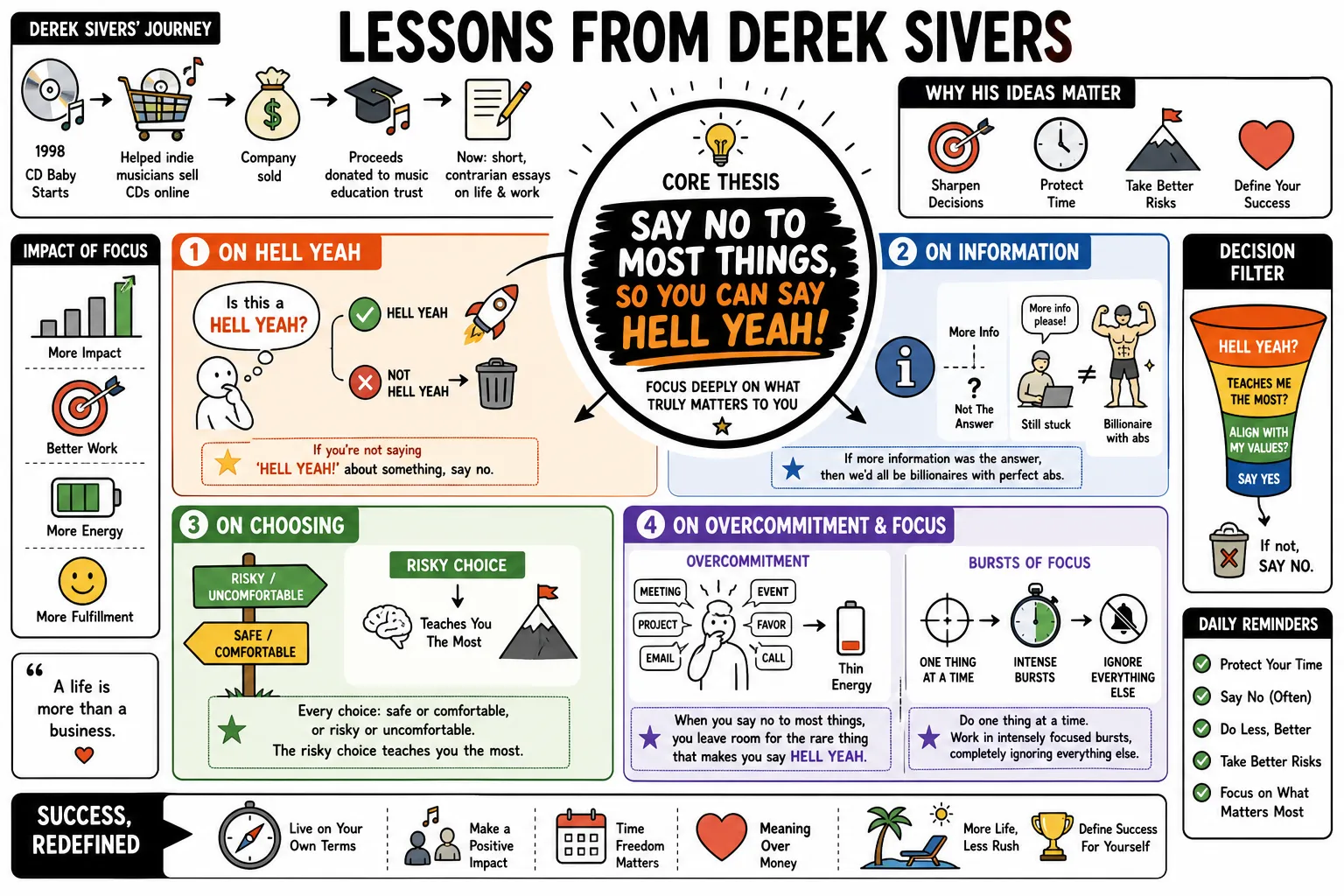
Lessons from Derek Sivers
Derek Sivers founded CD Baby around 1998 to help independent musicians sell CDs online. Before its sale, he transferred ownership into a charitable trust that would benefit music education. He now writes short essays on entrepreneurship, decision-making, and ways to live. This profile collects lessons from his own writing and interviews. — CD Baby Retrospective. — Why I Gave My Company to Charity.
Part 1: Decision Making and Focus
- On Hell Yeah: When already overcommitted, decline merely acceptable opportunities so you can give full attention to the rare ones that make you enthusiastic. — Hell Yeah or No.
- On Choosing: Sivers has described taking uncomfortable paths as a way to discover what he can do; discomfort can be informative, though it is not automatically the right choice. — Good Life Interview.
- On Focus: Sivers describes working on one thing at a time until completion, sometimes sustaining that focus for years. — Derek Sivers — About.
- On Goals: Public praise for a declared goal can create a premature sense of accomplishment. Sivers suggests keeping intentions private, or seeking accountability that pushes you to act. — Announcing Your Plans.
- On Options: In one of How to Live’s deliberately contrasting approaches, commitment means closing some options so attention and practice can deepen. — How to Live — Commit.
- On Refusal: Say yes widely while exploring; once a direction matters deeply, refusing other requests can protect the time needed to pursue it. — Far Out Podcast.
- On Priorities: Sivers distinguishes being able to pursue almost any one goal from pursuing every attractive goal at once: meaningful choices require trade-offs. — Chiwi Journal Interview.
- On Stopping: Sivers sold CD Baby after it had exceeded his original goals and he no longer wanted to lead its next chapter; finishing one ambition need not mean scaling it forever. — How I Knew I Was Done with My Company.
Part 2: Ideas and Execution
- On Execution: “Ideas are worth nothing unless executed. They are just a multiplier. Execution is worth millions.” — Ideas Are a Multiplier of Execution.
- On Originality: An idea that seems obvious to its creator can be surprising and valuable to other people, so share it. — Obvious to You, Amazing to Others.
- On Invention: CD Baby began with Sivers solving his own problem of selling music online; other independent musicians then wanted the same service. — Lex Fridman Interview.
- On Details: At CD Baby, small human touches—not just a large strategy—helped make the service memorable to musicians and buyers. — Little Things Make All the Difference.
- On Demand: If a new offer does not draw genuine interest, Sivers advises improving it or switching rather than trying to persuade people to want what they do not. — If It’s Not a Hit, Switch.
- On Launching: Begin with a small useful version: CD Baby’s first site was simple, but it solved the immediate problem of selling independent music online. — Start Now. No Funding Needed.
- On Iteration: Persistence should mean improving and inventing in response to actual demand, not repeatedly doing the same thing when it is not working. — If It’s Not a Hit, Switch.
- On Simplicity: For public writing and talks, Sivers aims to give people one clear takeaway and edits away ambiguity and unnecessary words. — APSS Interview.
- On Multiple Solutions: When facing a problem, Sivers deliberately generates many possible solutions; his first idea is not automatically the best. — All the Hacks Interview.
Part 3: Independence and Non-Conformity
- On Making Ideas Yours: When an idea resonates, Sivers recommends internalizing it and explaining it in your own words rather than leaning on a borrowed quotation; he still identifies sources when asked. — Don’t Quote. Make It Yours.
- On Being a Slow Thinker: Sivers often needs hours or days to form a considered answer. “I don’t know” can be an honest temporary response instead of a rushed opinion. — I’m a Very Slow Thinker.
- On Advice: After following career advice that drained him, Sivers learned to test advice against his own energy and aims rather than assuming the advisor’s path fit him. — Ignore Advice That Drains You.
- On Freedom: For Sivers, modest financial security mattered partly because it let him decline work and obligations he did not want; freedom is a personal goal, not a universal definition of wealth. — Keep Talking Interview.
- On Weirdness: Sivers takes “weird” as a compliment when it reflects making independent choices instead of defaulting to convention. — Clearer Thinking Interview.
- On Quitting: Sometimes leaving even something enjoyable creates room for change; Sivers describes quitting a job and other commitments he liked when he needed a different direction. — Quitting Something You Love.
- On Gurus: Sivers treats competing philosophies as perspectives to try, not one universally correct prescription for how everyone should live. — Reframeables Interview.
- On Rules: A rule can be reconsidered after understanding what it protects; Sivers argues for thoughtful exceptions that do not harm others, not rule-breaking without limits. — Useful Not True — Rules.
- On Defining Success: One approach in How to Live asks you to define the outcome you actually want rather than inherit somebody else’s measure of success. — How to Live — Master Something.
Part 4: Business and Entrepreneurship
- On the Purpose of Business: “Business is not about money. It’s about making dreams come true for others and for yourself.” Sivers presents this as one of the philosophies behind CD Baby. — Anything You Want — What’s Your Compass?.
- On Starting: Sivers advocates starting by solving a problem for other people, as CD Baby did for independent musicians, instead of designing a company solely around the founder’s gain. — Care About Your Customers.
- On Customers: At CD Baby, Sivers invested heavily in prompt, personal phone and email replies to musicians, making attentive service part of the company’s operation. — Customer Service Is Everything.
- On Scaling: A business need not pursue maximum size. Sivers describes shaping CD Baby around the kind of company he wanted, even when that meant limiting growth. — Make It Anything You Want.
- On Pricing: Sivers once priced a shorter concert higher because travel was the onerous part and he enjoyed playing longer; pricing can reflect the real shape of the work. — Pricing Philosophy.
- On Selling: Sivers frames marketing as consideration for people who might benefit from what you offer, not merely pushing an offer for your own gain. — Marketing Just Means Being Considerate.
- On Funding: CD Baby’s lack of outside investors let Sivers prioritize musicians and his own goals without investor demands; he presents this as an advantage of his path, not a ban on all funding. — The Advantage of No Funding.
- On Delegation: Sivers taught staff the principles behind his decisions and delegated authority until CD Baby could operate without depending on him day to day. — Delegate or Die.
- On Customer Service: The playful CD Baby shipping email made customers feel noticed and spread by word of mouth; a human touch can make routine service memorable. — The Most Successful Email I Ever Wrote.
Part 5: Learning and Mindset
- On Usefulness: Sivers treats some personal beliefs as perspectives to test for usefulness, while keeping empirical facts separate from chosen interpretations. — René Vidal Interview.
- On Changing Your Mind: Journaling and arguing against your own assumptions can reveal when an old belief is no longer serving you. — Rhodium Weekend Interview.
- On Confidence: After a year of major personal and business losses, Sivers found confidence in having handled those setbacks, rather than in expecting life to go as planned. — My Loss.
- On Unlearning: Knowledge that once worked can become obsolete as circumstances change. Sivers recommends questioning old expertise and asking for current evidence. — Unlearning.
- On Mistakes: Looking back at costly CD Baby errors, Sivers says he learned lessons important enough that he eventually valued having faced those mistakes. — Radical Tribe Interview.
- On Studying: Sivers takes notes on the parts of books that surprise or matter to him, then revisits and reflects on those ideas rather than trying to summarize the whole book. — Just Get Started Interview.
- On Curiosity: Sivers sometimes follows a small spark of interest without a practical goal, as when he spent hours learning Esperanto simply to see where the curiosity led. — Feeding Curiosity Interview.
Part 6: Communication and People
- On Leadership: In his first-follower example, Sivers argues that the first person to join a lone initiator helps transform that person into a leader. — First Follower TED Talk.
- On Introversion: Sivers values long stretches alone while also cultivating many relationships through correspondence and one-to-one conversations; connection need not require constant company. — Solitary Socialite.
- On Empathy: Before advising a musician, Sivers wants to understand that person’s goals, skills, habits, and circumstances; generic advice can miss the actual problem. — Listen to My Music.
- On Directness: Before sending a message broadly, Sivers edits for concision and possible misunderstanding, including by readers whose first language is not English. — APSS Interview.
- On Listening: At CD Baby, Sivers asked musicians an open-ended question, then read and organized their replies to learn what they actually wanted. — Mortgage Architects Interview.
- On Criticism: Sivers welcomes critique while a work is still being revised; after publishing something he loves, he does not treat every negative reaction as a demand to change it. — London Writers’ Salon Interview.
- On Giving: Sivers recommends sharing knowledge or resources people need; CD Baby and other ventures grew from making useful things he already had available to others. — The Co-op Business Model.
Part 7: Time and Pace
- On Rushing: A demanding teacher helped Sivers move through music theory faster than the usual course sequence; his experience shows that a standard timetable need not define one learner’s pace. — There’s No Speed Limit.
- On Patience: When starting Wood Egg, Sivers expected an imperfect first guide and imagined improving it over years. That was his initial approach, though he later stopped the project. — Infinite Loops Interview.
- On Relaxing: On a familiar bike ride, Sivers found that a relaxed effort took almost as little time as an exhausting one, prompting him to question needless urgency elsewhere. — Relax for the Same Result.
- On Disconnecting: Sivers limits online time to protect stretches for writing, coding, and independent thought; his routine is an example, not a requirement for everyone. — Offline 23 Hours a Day.
- On Scheduling: Sivers deliberately keeps substantial unscheduled time for journaling, daydreaming, and thinking instead of filling every hour with obligations. — Reframeables Interview.
- On Long-Term Thinking: For major decisions, Sivers suggests considering three things together: what makes you happy, what serves your long-term interests, and what is useful to others. — Happy, Smart, and Useful.
- On Daily Practice: In one of How to Live’s contrasting approaches, mastery grows from a daily practice rather than waiting for inspiration. — How to Live — Master Something.
- On Waiting: One How to Live chapter argues that action is not always required: delaying a decision can reveal information that makes the choice clearer. — How to Live — Do Nothing.
- On Present Focus: One of How to Live’s contrasting philosophies asks what you want to do now instead of living entirely for a remembered past or imagined future. — How to Live — Do Whatever You Want Now.
Part 8: Meaning and Life Philosophy
- On Regret: “Don’t be on your deathbed someday, having squandered your one chance at life, full of regret because you pursued little distractions instead of big dreams.” — Anything You Want — What’s Your Compass?.
- On Reinvention: One How to Live chapter invites readers to loosen fixed identity labels and try new ways of living rather than treating a past role as permanent. — How to Live — Reinvent Yourself.
- On Happiness: In one How to Live approach, changing how you interpret an event can change your response to it; Sivers presents this as a practice, not a guaranteed formula for happiness. — How to Live — Prepare for the Worst.
- On Letting Go: A deliberately austere How to Live chapter explores owning less so that possessions and comfort do not become conditions for feeling secure. — How to Live — Prepare for the Worst.
- On Generosity: After deciding he already had enough, Sivers transferred CD Baby to a charitable trust before its sale so the value could ultimately support music education. — Why I Gave My Company to Charity.
- On Assumptions: Sivers questions social expectations that sound like hard facts, asking whether they reflect a chosen perspective rather than an unavoidable rule. — Clearer Thinking Interview.
- On Solitude: For Sivers, solitude reduces friction and gives him space to concentrate, think, and create; he does not claim it is the only path to good ideas. — Mojo Radio Show Interview.
- On Meaning: Sivers says he does not think life has inherent meaning; he treats meaning as a perspective people can choose and test for whether it helps them act well. — Knowledge Project Interview.