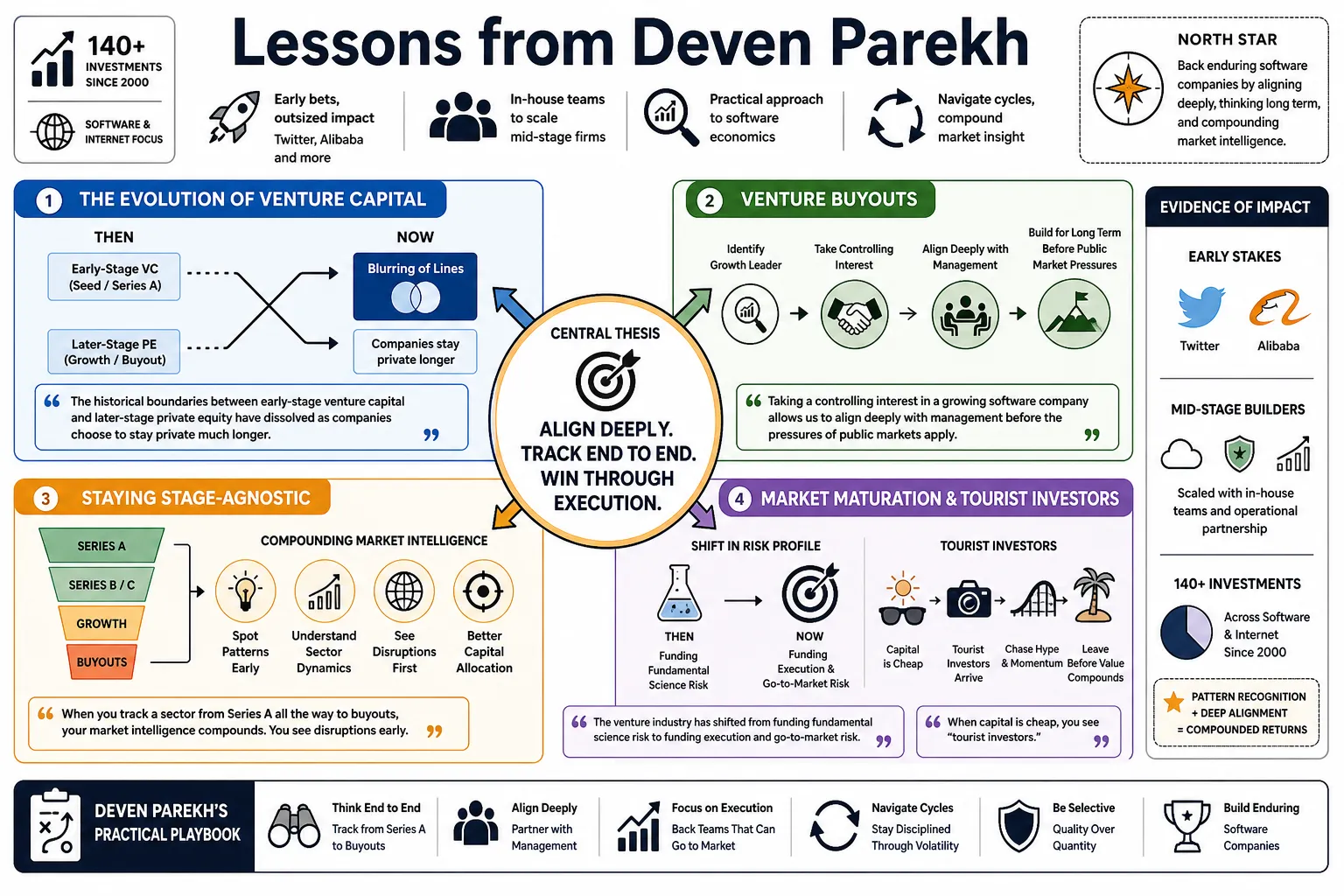
Lessons from Deven Parekh
Deven Parekh is a managing director at Insight Partners and has made more than 140 investments. His work spans software companies from early-stage venture through buyouts; Insight also uses its Onsite operating group to help portfolio companies scale. These notes examine his investing approach across company stages and market cycles. — Columbia Business School — Capital for Good.
Part 1: The Evolution of Venture Capital
- the Blurring of Lines: Venture and buyout techniques can meet in Insight’s venture buyouts: the firm may acquire a controlling stake in a growing software company and consolidate a fragmented shareholder base. — Masters in Business Transcript.
- Venture Buyouts: Parekh describes buying a majority stake in some venture-backed software companies to align shareholders and management around strategy, including potential acquisitions. — Masters in Business Transcript.
- Staying Stage-Agnostic: Insight concentrates on software but invests from Series A through buyouts. Parekh says seeing companies across that continuum informs both early- and later-stage decisions. — Masters in Business Transcript.
- Market Maturation: Insight’s expansion-stage strategy starts with companies that already have a product and customers. That reduces basic technology and adoption uncertainty, leaving much of the risk in execution. — SALT Talks #94 Transcript.
- Tourist investors: Parekh says the remote-investing boom reduced deal friction and compressed fundraising timelines. When companies later struggle, he argues that investors must help them rethink their operating and cost models, not merely provide capital. — This Week in Startups — Deven Parekh Interview.
- Capital as a Commodity: Parekh presents operating support as a central part of Insight’s role beyond providing capital: its Onsite team helps portfolio companies with recruiting, marketing and sales. — Insight Partners — Upfront Summit Interview.
- IPO timing: Parekh says he repeatedly expected the IPO market to reopen sooner than it did. Large marquee offerings could absorb public-market capital, so other companies may wait to see how those debuts trade. — iCapital — The Bridge Interview.
- Patience: Parekh says investors have underestimated how long leading software businesses can compound, and acknowledges that Insight has sometimes sold or distributed winners too early. — SALT Talks #94 Transcript.
- Structural Advantage: Insight pairs software-focused investors with dedicated sourcing and operating teams. Parekh describes this specialization as part of its multistage investing approach. — Masters in Business Transcript.
Part 2: Software and SaaS Dynamics
- Software Eating the World: Parekh argues that software already underpins many everyday activities and that the pandemic accelerated digital investment by traditional businesses. — SALT Talks #94 Transcript.
- SaaS economics: Parekh explains that strong gross retention and margins once supported high terminal-value multiples for software businesses. Investors now question whether AI changes those moats, so the same cash flows may receive lower multiples. — iCapital — The Bridge Interview.
- Growth Sustainability: Rather than extrapolating a single exceptional year, Parekh says Insight tries to estimate how long a company can sustain growth over a decade or more. — SALT Talks #94 Transcript.
- Complexity: Parekh says a software moat can come from the difficulty of replicating a product or from understanding a complex industry process, not simply from the number of lines of code. — CIBC Innovation Banking Podcast.
- Vertical software: Parekh argues that software deeply embedded in an industry’s workflows and back-end integrations can be harder for an AI entrant to displace than a generic horizontal app, though incumbents still need to adapt. — iCapital — The Bridge Interview.
- Hybrid Work: Remote collaboration tools allowed Insight to keep operating during the pandemic, but Parekh worried that less informal contact would make junior mentoring and relationship-building harder. — SALT Talks #94 Transcript.
- Gross retention: Parekh treats gross retention as an important software-investing signal and discusses why it can be more revealing than net retention. — Summation — Deven Parekh Interview.
- Platform shifts: Parekh compares the current AI transition with earlier moves from licensed software to cloud and mobile. He says this shift is unfolding faster, shortening the time companies have to adjust. — iCapital — The Bridge Interview.
Part 3: The Scale-Up Phase and Operational Support
- Insight OnSite: Insight created its Onsite group to bring operating expertise in functions such as recruiting, sales, marketing and product to portfolio companies, with support tailored to their stage. — Masters in Business Transcript.
- Pricing opportunities: Parekh points to Splice as a product whose price had stayed constant while functionality expanded; he sees room to revisit that price because some competitors charge more for less. — This Week in Startups — Deven Parekh Interview.
- M&A as a Growth Lever: In a venture buyout, Parekh says Insight can align a fragmented board and provide capital for a software company’s acquisition strategy when that is the management team’s goal. — Masters in Business Transcript.
- AI spend metrics: Parekh questions token spend as a measure of enterprise AI progress. He expects companies eventually to ask what productivity they receive for the money and to optimize model spending by task. — iCapital — The Bridge Interview.
Part 4: Market Cycles and Resilience
- Booms and Busts: Having invested through several cycles, Parekh says a severe downturn can feel permanent while it is happening, even though cycles eventually turn. — Masters in Business Transcript.
- Navigating downturns: Parekh says difficult markets teach investors valuable skills because troubled portfolio companies need hands-on work: reassessing product-market fit, cost structure and available runway. — This Week in Startups — Deven Parekh Interview.
- Over-capitalization: Parekh distinguishes a high purchase price from mistaken growth assumptions: a company can grow into an expensive valuation, but slow growth plus a large preference stack can leave founders and employees with little incentive to continue. — This Week in Startups — Deven Parekh Interview.
- the Dot-Com Crash: Parekh says the dot-com downturn exposed businesses that depended on further fundraising and forced him to learn by working through difficult portfolio situations. — Masters in Business Transcript.
- Valuation Discipline: Parekh says valuation does matter and Insight can lose deals on price. Paying a high revenue multiple requires strong conviction that growth will persist. — Masters in Business Transcript.
- Cash management: For companies facing another financing round, Parekh advises reducing costs early to extend runway and minimize the capital they need to raise. He says investor conversations should begin before a payroll crisis. — This Week in Startups — Deven Parekh Interview.
- Cleaning Cap Tables: In some venture buyouts, Insight consolidates diffuse shareholder bases so management and the board can agree on a strategy and fund its execution. — Masters in Business Transcript.
- Rapid adaptation: Parekh says the pace of AI innovation leaves companies less time to retool than earlier software transitions. — iCapital — The Bridge Interview.
- Market Timing: Parekh sees software taking a larger share of value across industries over the long term, alongside continued software and cloud adoption. — CIBC Innovation Banking Podcast.
Part 5: The AI Paradigm Shift
- Ubiquity: Parekh says AI is relevant to virtually every company Insight considers, and that its portfolio boards regularly discuss the technology’s effect on products and operations. — Masters in Business Transcript.
- Business Model Impact: Even companies that are not AI-native need to consider how AI could affect their business model, create products or improve costs, Parekh argues. — Masters in Business Transcript.
- Valuing AI Startups: When an AI company commands a high revenue multiple, Parekh says an investor needs correspondingly high conviction in its future growth. — Masters in Business Transcript.
- Incumbents vs. Upstarts: Parekh says it remains uncertain how AI value will split between model providers and applications; vertical software with deep domain expertise and data may be more defensible than generic tools. — Masters in Business Transcript.
- AI and work outcomes: Parekh describes AI vendors selling customers outcomes tied to reducing the labor required for a task, rather than competing only over software subscription spending. — iCapital — The Bridge Interview.
- Data Defensibility: Parekh sees a stronger moat in vertical applications that combine specialized business-process knowledge with valuable data than in generic software. — Masters in Business Transcript.
- AI infrastructure economics: Parekh says leading AI companies consume capital at unusual rates, while compute, chips and energy can constrain growth. He also cautions that current gross margins may not support future profitability unless costs or pricing change. — iCapital — The Bridge Interview.
- AI governance: Parekh warns that AI can still hallucinate. For critical uses such as public-company financial consolidation, he says an application needs an audit trail and data governance rather than relying on a raw model output. — iCapital — The Bridge Interview.
Part 6: Deal Evaluation and Human Judgment
- Founder Assessment: Parekh looks for strong management teams and founders who are genuinely passionate about the problem their software solves, alongside large markets, a moat and customer demand. — CIBC Innovation Banking Podcast.
- Pattern Recognition: At earlier stages, Parekh says investors must estimate market potential using data and pattern recognition, while growth-stage and buyout deals provide more financial evidence. — Masters in Business Transcript.
- Technical Diligence: Insight spends substantial time speaking with customers and has a team assess the technology to judge how difficult a product would be for competitors to replicate. — CIBC Innovation Banking Podcast.
- Market Size: Parekh warns that a market’s size is not static: Insight underestimated Uber by measuring the existing taxi market rather than the demand a new service could create. — Masters in Business Transcript.
- Competitive Moats: Parekh looks for software that is hard to replicate and for evidence that customers are buying more of it; he considers both technical difficulty and industry-process knowledge. — CIBC Innovation Banking Podcast.
- Independent investment judgment: Parekh says private investors can reach different judgments about the same business model, act on those judgments, and learn from the outcome. — This Week in Startups — Deven Parekh Interview.
- Overpaying for Quality: Parekh is willing to pay a high price for a company if he believes its fast growth can last; he says a low price does not help much when the growth estimate is wrong. — CIBC Innovation Banking Podcast.
Part 7: The Double Down Investment Strategy
- Staging Capital: Parekh says smaller initial checks let Insight observe which companies are succeeding before committing more capital to the strongest performers. — Insight Partners — Upfront Summit Interview.
- Keeping relationships alive: Parekh describes how an Insight partner kept a relationship with Armis after losing its initial financing round, made a small investment, and later led a much larger buyout. The example shows why maintaining access can matter for a later investment. — TechCrunch — Deven Parekh Interview.
- Risk in follow-on rounds: Parekh says a follow-on round normally lets an investor pay more for a company after learning more, but fast rounds with little new evidence can raise price without reducing risk. — TechCrunch — Deven Parekh Interview.
- Cap-table clarity: Parekh says simplifying a complicated preference stack can make a distressed company easier for a new investor to finance. A recapitalization may also require fresh management incentives. — This Week in Startups — Deven Parekh Interview.
- Flexible Mandates: Parekh says Insight is willing to buy either a minority or majority stake in a strong software business instead of being constrained to one deal structure. — SALT Talks #94 Transcript.
- Founder relationships in hard markets: Parekh says investor-founder relationships matter most when a company runs into trouble; difficult operating and financing discussions draw on trust built before the downturn. — This Week in Startups — Deven Parekh Interview.
- Diversification and follow-ons: Parekh favors diversification across a long investment horizon while making larger follow-on investments in companies that demonstrate progress. He says Insight reviews its portfolio for inflection points rather than concentrating a fund in a single AI name. — TechCrunch — Deven Parekh Interview.
Part 8: Global Markets and Civic Engagement
- Global Ambition: Parekh says strong technology and management teams can be found outside Silicon Valley and describes Insight’s investments across Israel, Australia, China and Europe. — SALT Talks #94 Transcript.
- International expansion: In the Campaign Monitor investment, Parekh saw an Australian software company with customers across many countries and said Insight’s capital would help it build a global team to serve that demand. — Insight Partners — Campaign Monitor Investment.
- M&A platforms: Parekh says Insight’s growth-equity approach includes M&A-platform companies that can pursue both organic growth and acquisitions. — Insight Partners — Fund X Announcement.
- Public Service: Parekh says his civic and nonprofit board work reflects both a belief that successful people should give back and a longstanding interest in public policy. — Masters in Business Transcript.
- Inclusive Opportunity: Parekh argues that long-term investment in education and wider broadband access can help people who have talent but lack the opportunities and tools he had. — SALT Talks #94 Transcript.
- Educational Endowment: Parekh says his early interest in medicine now informs philanthropic support for NYU Langone and research into new approaches to psychiatric conditions. — Masters in Business Transcript.