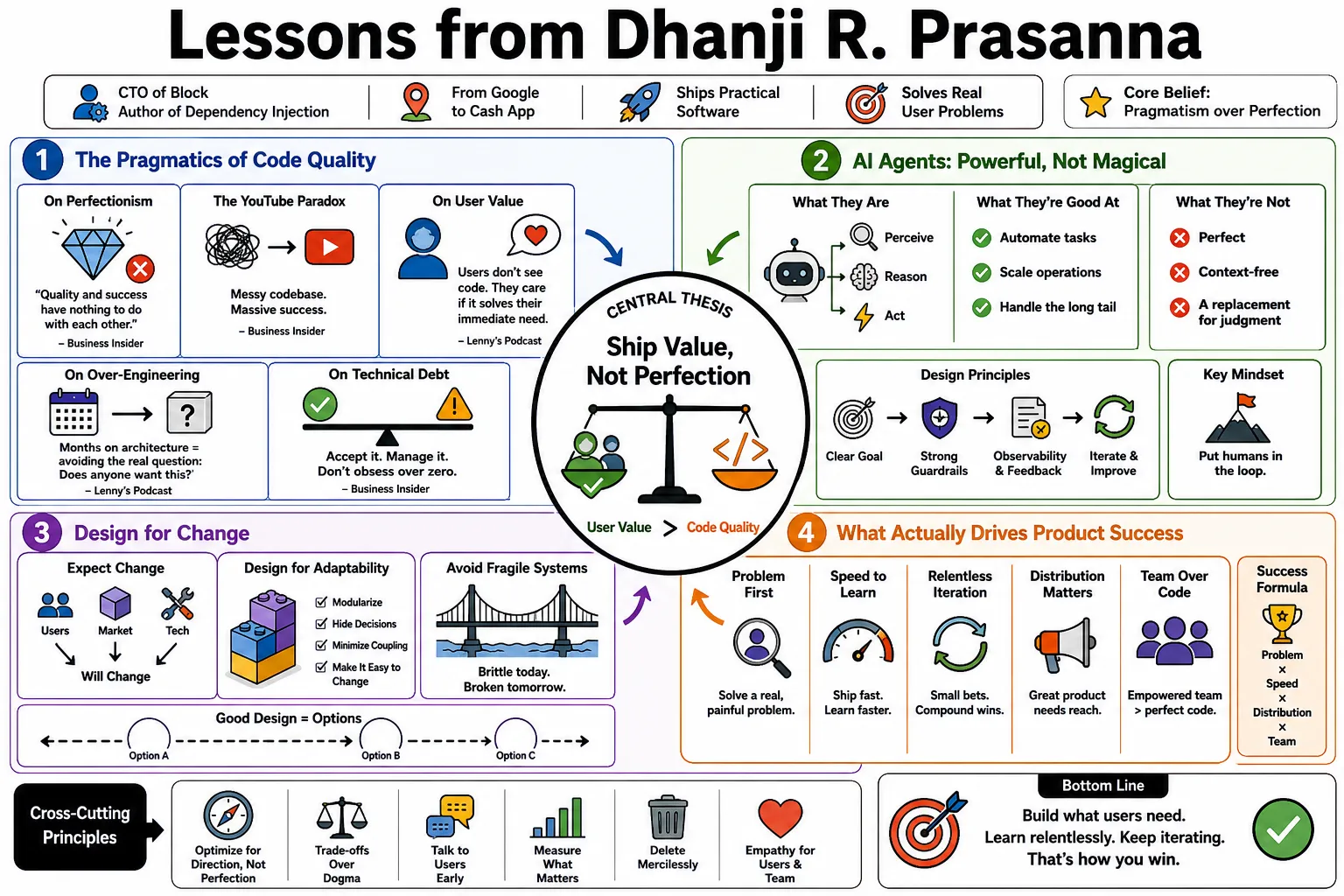
Lessons from Dhanji R. Prasanna
Dhanji R. Prasanna is Block’s CTO. In direct interviews, he explains how the company is connecting existing business capabilities to AI agents while keeping customer utility in view. — Training Data Interview.
Part 1: The Pragmatics of Code Quality
- On code and product: Prasanna distinguishes the source code beneath a service from the customer-facing product: code can depreciate even when a useful product keeps creating value. — Source Code Is Dead!.
- On user value: In Block’s financial products, a simple interface matters because customers need to make a sale or move money; the backend’s capabilities have value only when people can use them. — Training Data Interview.
- On product assumptions: A working prototype exposed mistakes in Prasanna’s product assumptions that months of private thought had not; early user feedback was more valuable than further speculation. — Mythical Weekend Coding Project.
- On rewrites: Treat existing source code as a means to serve a product, not as the product itself; judge major code changes by whether they improve what customers can do. — Source Code Is Dead!.
- On the feeling after launch: After building and launching a small app over one weekend, Prasanna describes an anticlimax and says seeing real users exposed mistaken product assumptions. — Mythical Weekend Coding Project.
- On engineering priorities: Engineering work should make useful capabilities accessible to customers; a technically powerful system is not enough if its interface does not help them make a sale or move money. — Training Data Interview.
Part 2: Dependency Injection and Architecture
- On assembling dependencies: Prasanna presents dependency injection as a way to assemble collaborating components outside the classes that use them, making application structure more modular. — InfoQ Dependency Injection Interview.
- On Guice configuration: He describes Guice modules in Google Wave as a way to compose services, including authentication and web concerns, while reducing XML configuration. — InfoQ Dependency Injection Interview.
- On testability: Injecting a dependency lets a test substitute a mock or another implementation without changing the consumer’s code. — InfoQ Dependency Injection Interview.
- On object lifecycles: The book treats object scopes and application lifecycle as explicit design choices for managing state, rather than incidental framework settings. — InfoQ Dependency Injection Interview.
- On component boundaries: Prasanna connects dependency injection to loose coupling and modular design: the way components relate to one another is an architectural concern. — InfoQ Dependency Injection Interview.
- On framework limits: He warns that using dependency injection as a hammer for every problem can obscure the underlying design; the container cannot replace judgment about the application. — InfoQ Dependency Injection Interview.
- On state and singletons: He treats static singletons and poorly managed scopes as risks to clear dependency structure and state management, not as automatic errors in every use. — InfoQ Dependency Injection Interview.
- On lighter Java frameworks: Sitebricks combined concise Java page objects with Guice and aimed to remove much of the old web.xml configuration burden; Prasanna framed the aim as faster, less painful web development. — InfoQ Sitebricks Interview.
Part 3: Engineering Execution at Cash App
- On early Cash App: Prasanna says Cash App gained autonomy to pursue a focused consumer mission, while its simple balance concealed substantial financial complexity behind the interface. — Training Data Interview.
- On changing organizational design: The structure that gave Cash App focus as it grew was not Block’s permanent answer: Prasanna later favored functional alignment to share technical capabilities and policies across products. — Training Data Interview.
- On momentum: During a concentrated weekend build, small visible achievements and encouragement from others helped Prasanna stay engaged through frustrating technical work. — Mythical Weekend Coding Project.
- On functional alignment: Block funded small AI bets, then brought engineering and platform capabilities together across former business-unit silos so teams could share policies and technical depth. — Training Data Interview.
- On technical strategy: Prasanna argued for a company-wide AI investment and an agent layer over existing Block capabilities, rather than treating AI as a set of isolated tool licenses. — Training Data Interview.
- On questioning the feature: Prasanna’s weekend prototype showed that technically sound choices did not validate his assumptions about what users wanted; put a working product in front of people before optimizing its implementation. — Mythical Weekend Coding Project.
- On giving experiments room: He says Goose began as one of several small bets and was ring-fenced with a small team; allowing engineers room to try ideas helped some of those experiments become products. — Training Data Interview.
Part 4: The AI-Native Enterprise
- On reported productivity: Prasanna says Block engineers reported saving about eight to ten hours a week with Goose; that is Block’s reported internal measure, not an independently verified productivity result. — Training Data Interview.
- On AI limitations: He says current agents struggle with very large proprietary codebases, higher-level architecture, race conditions and coordination across systems, leaving important work for experienced engineers. — Training Data Interview.
- On agent autonomy: Goose can attempt multi-step tasks and retry after obstacles, but Prasanna describes full self-rewriting releases as a goal rather than a capability already achieved. — Training Data Interview.
- On connecting internal tools: Block treats payments, documents, issue tracking and other systems as capabilities that Goose can reach through an agent layer and MCP connections. — Training Data Interview.
- On legacy systems: Prasanna says AI-assisted coding is easier for small dashboards than massive legacy codebases because context limits and proprietary frameworks still require human intervention. — Training Data Interview.
- On reviewing agent work: Block’s Headless Goose can propose vulnerability fixes in CI, but Prasanna says a human must examine and approve them before they enter production. — Training Data Interview.
- On non-engineering uses: Prasanna describes non-technical Block employees using Goose to build dashboards, reports and small applications, including in sales and finance work. — Training Data Interview.
- On measuring utility: Block tracks manual hours saved by Goose and Prasanna emphasizes removing routine work; he presents broader enterprise value as an effort still in progress. — Training Data Interview.
Part 5: Goose and Open Source AI
- On opening Goose: Prasanna says Block released Goose as open source so a wider engineering community could inspect it, contribute ideas and benefit from the tool. — Training Data Interview.
- On MCP: He describes MCP as a common way to expose existing tools and capabilities to agents; Goose uses those connections to act across Block systems. — Training Data Interview.
- On bounded autonomy: Goose can carry out multi-step workflows, while users can choose review-heavy safety modes and interrupt or redirect the agent. — Training Data Interview.
- On agent permissions: Prasanna says desktop Goose acts with the user’s access rights, and consequential automated code fixes face human audit before production. — Training Data Interview.
- On maintaining open source: In a signed essay, Prasanna warns that releasing code without an ongoing commitment to maintain it and cultivate contributors brings little benefit. — Source Code Is Dead!.
- On model choice: Goose has a pluggable provider system: Prasanna says users can select different hosted, open or local models according to their needs. — Training Data Interview.
- On reusable workflows: Prasanna describes turning a useful Goose workflow into a shareable recipe after it has been tried, instead of designing every path in advance. — Training Data Interview.
- On context limits: He identifies limited context and proprietary APIs as present constraints on agents making large changes to complex legacy codebases. — Training Data Interview.
Part 6: Frameworks and Tooling
- On Sitebricks: Prasanna designed Sitebricks around concise, type-checked Java pages that expose rather than hide HTTP’s resource model. — InfoQ Sitebricks Interview.
- On reducing ceremony: He found existing Java web frameworks verbose for prototyping and built Sitebricks to make pages and reusable fragments concise without extra configuration classes. — InfoQ Sitebricks Interview.
- On Warp Persist: He describes Warp Persist as a thin Guice integration that simplifies persistence and transaction setup for Java applications. — InfoQ Sitebricks Interview.
- On validating storage choices: In a weekend prototype, Prasanna used focused tests to check unfamiliar MongoDB driver behavior; he later judged the technical platform and storage choices sound even though user feedback challenged product-feature assumptions. — Mythical Weekend Coding Project.
- On safe immutability: Prasanna shows that a final field or unmodifiable collection alone may still expose mutable state; safe shared objects require attention to the whole dependency graph and defensive copies. — Concurrency and Immutability.
- On accessible tooling: Prasanna wanted Sitebricks developers to be able to prototype and compose pages without specialized tools or even an IDE, while retaining static checks on page expressions. — InfoQ Sitebricks Interview.
- On build health: In Google Wave, he says maintaining a healthy build while a codebase grew past fifty engineers was a major challenge alongside onboarding and real-time scaling. — InfoQ Google Wave Interview.
- On HTTP abstractions: Prasanna criticized Java web frameworks that hid HTTP semantics and made prototyping verbose; Sitebricks deliberately represented resources and messages directly. — InfoQ Sitebricks Interview.
- On sharing implementation code: Wave used the Google Web Toolkit so the same operational-transformation Java code could run on both client and server, reducing duplicated implementation work. — InfoQ Google Wave Interview.
Part 7: Engineering Culture and Focus
- On Google Wave architecture: Wave used operational transformation to preserve document consistency as several people edited simultaneously, with shared Java logic running on client and server. — InfoQ Google Wave Interview.
- On concentration and breaks: A focused two-day build was difficult amid interruptions; Prasanna also found small breaks and outside encouragement helped him stay engaged rather than sustaining one unbroken block of work. — Mythical Weekend Coding Project.
- On testing pragmatically: In a short prototype, he used a handful of targeted tests to probe an unfamiliar library and stopped once he had enough visibility; he explicitly rejected test-driven development as a rigid rule. — Mythical Weekend Coding Project.
Part 8: The Trajectory of Software Engineering
- On an agent layer: Prasanna describes Goose as an agent layer above existing tools and business capabilities, using MCP to turn model output into actions across systems. — Training Data Interview.
- On technical leadership: As Block CTO, he describes investing in shared technical capability while judging its success by useful outcomes for customers and the community. — Training Data Interview.
- On production concurrency: Prasanna argues that a system that works for one user can fail under real load unless engineers design for contention and use resources efficiently. — The Art of Concurrency.
- On adapting to model advances: He cautions that elaborate scaffolding for today’s agent limitations can become obsolete as model providers improve, favoring experiments with actual workflows. — Training Data Interview.
- On open infrastructure: Prasanna argues that accessible libraries let new teams start farther ahead, while a useful open-source project still requires active maintenance and community work. — Source Code Is Dead!.
- On customer-facing agents: He describes Square AI in public beta using merchant financials to answer operational questions and sees agent interfaces as a way to expose existing product capabilities. — Training Data Interview.