Diane Greene co-founded and led VMware from 1998 to 2008 and later served as CEO of Google Cloud. Before those roles, she worked in naval architecture and engineering at Sybase, Tandem, and SGI. — CHM Diane Greene Biography.
On Leadership and Management
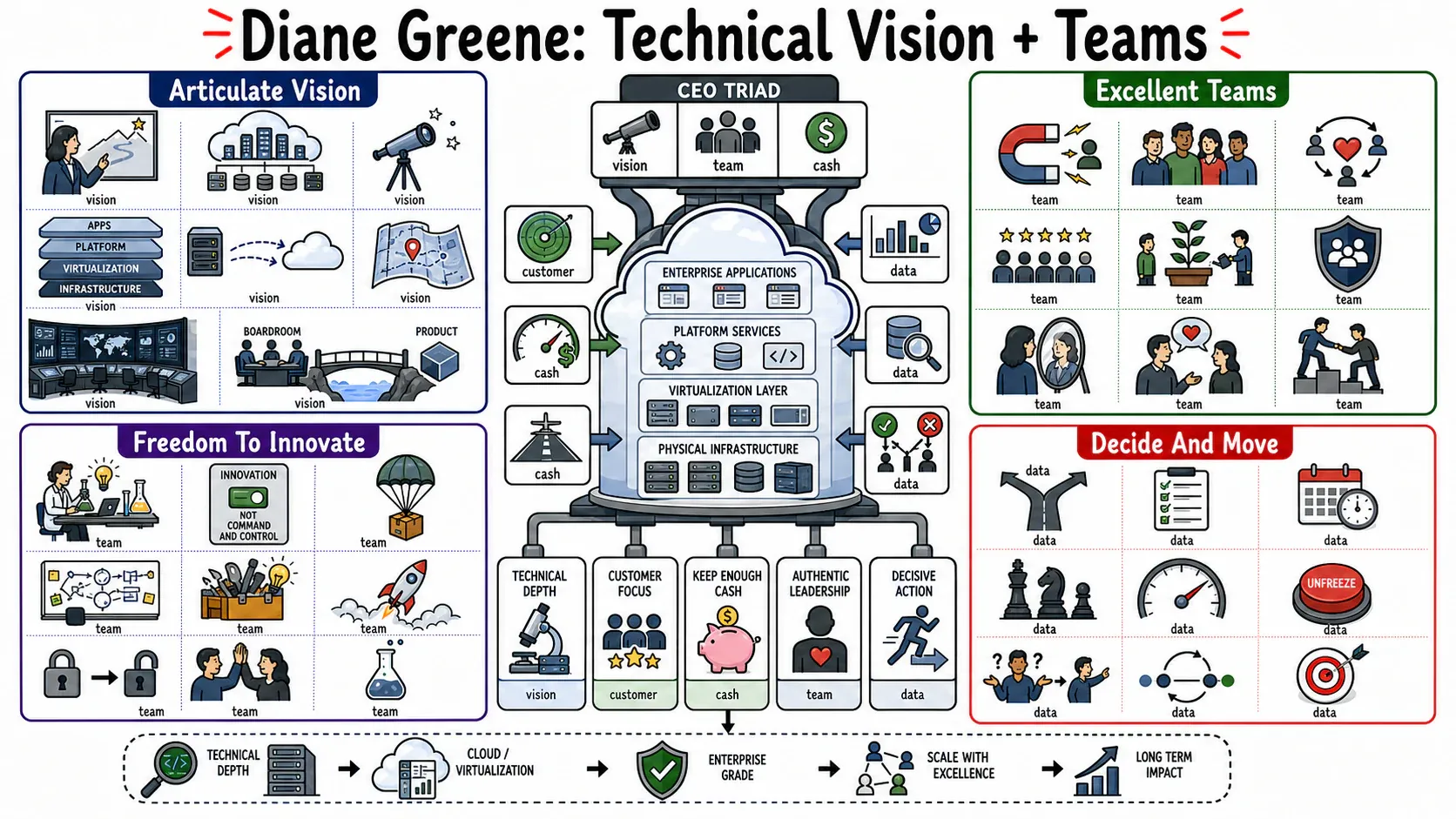
Greene’s account of building VMware emphasizes the right people in the right roles, an open culture for collaboration, and continued value for customers and partners. — Diane Greene’s Advice for Founders.
- Share the Long-Term Technical Vision: Greene recalls telling an early VMware hire that she expected virtualization technology to become useful across computer systems, even before the market was clear. — Masters of Scale: Diane Greene.
- Build a Team with Complementary Strengths: Greene says founders need the right mix of talents and personalities, with people working harmoniously in the right roles. — Diane Greene’s Advice for Founders.
- Make Room for Collaboration and Ideas: At VMware, Greene worked to create an open culture in which people could communicate, collaborate, and share ideas. — Diane Greene’s Advice for Founders.
- Reevaluate the Plan, Then Decide: Greene compares building a company with racing a sailboat: reassess the plan as conditions change, question your decisions, and make the call when the moment arrives. — Diane Greene’s Advice for Founders.
- Give Engineers a Customer Impact: Greene says VMware engineers enjoyed delivering value to customers and that Google Cloud gave engineers a chance to extend the impact of their technology to more enterprises. — InfoWorld Interview with Diane Greene.
- Connect Every Role to the Company’s Objectives: Greene says VMware sought to help each person understand the importance of their work and its role in the company’s objectives. — Diane Greene’s Advice for Founders.
- Turn Setbacks into Alternate Routes: When VMware could not sell directly through IBM because of IP issues, Greene’s team instead worked with IBM’s leading resellers to reach the market. — Diane Greene’s Advice for Founders.
- Test the Go-to-Market Approach: Greene says VMware tried multiple ways to reach users before learning which early groups valued the product and could spread it further. — Masters of Scale: Diane Greene.
On Entrepreneurship and Building VMware
VMware grew from Rosenblum’s operating-systems research into x86 virtualization designed to let customers keep existing workloads while gaining new flexibility. — CRN Interview with Diane Greene.
- Bring Research to Standard Computing Systems: Greene says Rosenblum’s operating-systems research led the founders to bring virtualization to industry-standard x86 systems without forcing customers to abandon existing workloads. — CRN Interview with Diane Greene.
- Make a Radical Innovation Easy to Adopt: Greene says a major innovation gains traction when its adoption fits existing workflows; VMware built a tool that moved physical-machine workloads into virtual machines with little disruption. — Diane Greene’s Advice for Founders.
- Let the Market Emerge from Early Users: Greene recalls VMware moving from professors and cost-conscious companies to Linux developers and system administrators before its server product reached a broader enterprise market. — Masters of Scale: Diane Greene.
- Start with a Sharp User Pain Point: VMware first targeted Linux developers who needed Windows email alongside Linux tools; Greene says the team chose them because the use case was clear and the users were technically adventurous. — Masters of Scale: Diane Greene.
- Keep Customers and Partners Close: After VMware’s IPO, Greene described the company’s work as continuing to grow the business while keeping customers and partners satisfied. — CRN Interview with Diane Greene.
- Negotiate Independence After an Acquisition: Following VMware’s 2003 sale to EMC, Greene negotiated rules that kept EMC from selling VMware’s product through a conflicting channel, leaving VMware to operate as an independent subsidiary. — CRN Interview with Diane Greene.
- Value the Time After Leaving VMware: Greene says that although she had misgivings about selling VMware, in hindsight she valued the years at home with her children after leaving the company. — YC Interview with Diane Greene.
- Scale Research into an Industry: Greene and VMware’s founders brought Stanford virtualization research into x86 products, and VMware grew under her leadership into a major public company. — CHM VMware Founders Collection.
On Cloud Computing and Leading Google Cloud
At Google Cloud, Greene says her team integrated sales, marketing, products, training, partnering, and customer engineering to build a more enterprise-ready organization. — Transitioning Google Cloud.
- See the Enterprise Shift to Cloud: Greene described enterprise migration to the cloud as a larger revolution than VMware’s virtualization wave, with major implications for scale, security, and advanced technology. — YC Interview with Diane Greene.
- Build an Enterprise-Ready Cloud: Greene introduced Google Cloud as a combined portfolio engineered for enterprise service and cost requirements, with customer-facing engineers supporting migration and deployment. — Introducing Google Cloud.
- Compete on Security and AI Capability: At Cloud Next 2018, Greene positioned security and AI as major areas of Google investment while acknowledging competition among the three major clouds for infrastructure customers. — Google Cloud Next 2018.
- Do the Work of Enterprise Readiness: Greene says analysts doubted Google Cloud could become enterprise-ready quickly, prompting a focused effort on customer support and enterprise execution. — Google Cloud Next 2018.
- Combine Infrastructure, Data, and Machine Learning: Greene presented Google Cloud as infrastructure and enterprise applications joined with smart data, analytics, and machine-learning capabilities. — Introducing Google Cloud.
- Use Kubernetes as an Open-Cloud Foundation: Greene highlighted Kubernetes among Google’s open-source projects and said its underlying technology had been used inside Google for more than a decade. — Google Cloud Next 2018.
- Extend Reach Through Partners: Greene described strategic, channel, integration, and systems-integrator partners as central to Google Cloud’s reach and customer delivery. — Google Cloud Next 2018.
- Build the Enterprise-Facing Organization: Greene says Google Cloud integrated sales and marketing with its platforms, then expanded training, professional services, partnering, and customer engineering. — Transitioning Google Cloud.
- Leave After Building the Cloud Organization: Greene wrote that she had planned to spend two years leading Google Cloud, stayed three, and would turn toward mentoring and education after the transition. — Transitioning Google Cloud.
- Plan for Hybrid and Multicloud Customers: Greene said sizable enterprises would use more than one cloud while still needing to connect on-premises systems, so providers had to support hybrid and cross-cloud operation. — InfoWorld Interview with Diane Greene.
On Technology and Innovation
- Run Multiple Systems on One Machine: VMware’s x86 virtualization let a single physical computer run multiple virtual machines with separate operating systems, improving hardware utilization and reducing resource use. — CHM VMware Founders Collection.
- Treat AI as a Major Customer Opportunity: At Cloud Next 2018, Greene called AI the biggest collective opportunity and described work to make Google’s AI capabilities easier for customers to use. — Google Cloud Next 2018.
- Make Data Useful to the Business: Greene argued that smart data, analytics, machine learning, and digital communications would help differentiate businesses moving to the cloud. — Introducing Google Cloud.
- Set Explicit Boundaries for AI Use: In 2018, Greene said Google Cloud would not support weaponized AI systems or pursue follow-on Project Maven contracts, while continuing permitted government work. — Greene on Google Cloud AI Principles.
- Build With Open Source: Greene highlighted Google’s open-source work, including TensorFlow and Kubernetes, and pointed to Kubernetes’ large contributor community. — Google Cloud Next 2018.
- Extend Virtualization Beyond Servers: After virtualizing individual computers, VMware turned its attention to networks and developed methods to virtualize more parts of enterprise infrastructure. — CHM VMware Founders Collection.
- Treat Security as a Core Cloud Requirement: Greene called security customers’ leading concern and described security as built into multiple layers of Google Cloud’s operations. — Google Cloud Next 2018.
On Career, Diversity, and Personal Growth
- Encourage Women Engineers to Found Companies: Greene said she wanted to invest in and mentor female founder CEOs with engineering or science backgrounds, and encourage more women engineers and scientists to start companies. — Transitioning Google Cloud.
- Take an Unconventional Route into Technology: Greene moved from mechanical engineering and naval architecture into computer science and technology leadership before cofounding VMware. — CHM Diane Greene Biography.
- Build Family Support Around Startup Work: Greene recalls bringing her baby to VMware’s early office and later arranging family and childcare support while traveling for the growing company. — YC Interview with Diane Greene.
- Use the Next Chapter for Mentoring and Education: On leaving Google Cloud, Greene said she planned to invest in and mentor female founder CEOs with technical backgrounds and support technology-enabled education. — Transitioning Google Cloud.
- Learn a New Field When the Work Demands It: Before her software career, Greene taught herself to program while working in oil and gas and later pursued computer science at UC Berkeley. — CHM: From Sailboats to Startups.
- Learn from Competitive Sailing: Greene credits sailing with strengthening her independence, careful observation, and ability to execute toward a goal under changing conditions. — Diane Greene’s Advice for Founders.
- Commit to the Work Despite the Chance of Failure: Greene urged founders to enjoy building and creating value; she said that commitment to a worthy goal can make them less afraid of failure. — Diane Greene’s Advice for Founders.