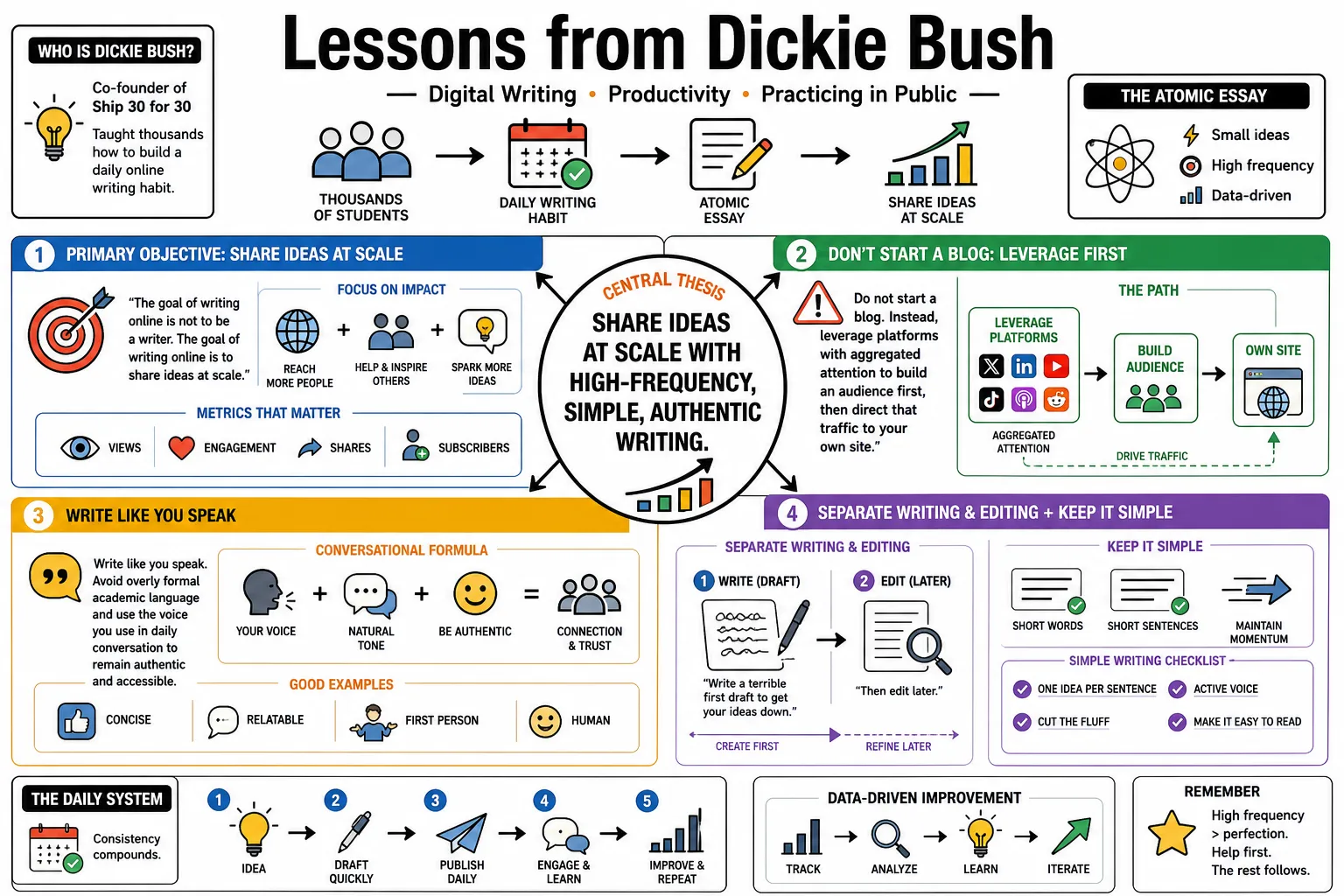
Lessons from Dickie Bush
Dickie Bush and Nicolas Cole co-founded Ship 30 for 30, a program built around publishing short online essays consistently and using reader feedback to develop ideas. — Ship 30 Ultimate Guide.
Part 1: The Foundations of Digital Writing
- Share Ideas Through Online Writing: Bush and Cole treat online writing as a way to publish useful ideas and learn what resonates with readers, rather than waiting for a traditional writer’s credential. — Ship 30 Ultimate Guide.
- Begin Where Readers Already Are: For a new writer, Bush and Cole recommend publishing on social platforms with built-in distribution before relying on a personal blog that has no audience yet. — Ship 30 Ultimate Guide.
- Write in a Conversational Voice: Bush and Cole recommend prose that sounds like natural conversation; reading it aloud helps reveal wording that feels stiff or hard to follow. — Ship 30 Editing Checklist.
- Separate Drafting from Refinement: A first draft is for getting ideas and an outline onto the page. Bush and Cole recommend refining structure and wording in later passes instead of editing each sentence as it appears. — How To Write A First Draft.
- Format for Skimming: Use short openings, subheads, and lists to make online writing easier to skim, then simplify wording that causes a stumble when read aloud. — Ship 30 Editing Checklist.
- Read Drafts Aloud: Reading a draft aloud can expose run-on sentences, jargon, and phrases that interrupt a natural rhythm. — Ship 30 Editing Checklist.
- Use the Atomic Essay Constraint: An Atomic Essay is a roughly 250-word piece focused on one idea. The compact format lowers the friction of publishing and lets writers test ideas before investing in longer work. — Atomic Essay Beginner’s Guide.
- Identify a Specific Reader: Before drafting, Bush and Cole advise identifying whose problem the piece solves and what outcome the reader should take from it. — How To Write A First Draft.
- Use AI for Writing Tasks Without Delegating Judgment: Bush and Cole describe AI as an assistant for outlining, formatting, and rewriting drafts while the writer supplies the idea, constraints, and judgment. — Ship 30 Guide to ChatGPT for Writers.
- Remix Proven Ideas into New Formats: Bush says he revisits ideas that resonated, identifies the core thought or format, and presents it in a new way for a different context or audience. — Streamlined Solopreneur Interview.
Part 2: Overcoming Imposter Syndrome and the Fear of Publishing
- Build Confidence Through Publishing: Bush and Cole argue that confidence as a writer grows through repeated publishing and practice, not from waiting until one feels ready. — Ship 30 Ultimate Guide.
- Write from Lived Experience: New writers need not claim comprehensive expertise. Bush and Cole recommend explaining the experiences and problems that make their perspective useful to readers. — Build Trust When You’re Not an Expert.
- Teach People a Few Steps Behind You: Bush advises writers to share lessons that would have helped their earlier selves, rather than waiting to become the leading expert in a field. — Bootstrapped Founder Interview.
- Treat Reader Feedback as Data: Publishing short ideas gives a writer feedback about which topics readers find useful, allowing the next piece to be informed by observation rather than assumption. — Creators on Air Interview.
- Use Templates to Start: When a blank page stalls a writer, Bush and Cole suggest headline templates and prepared structures as prompts for a first draft. — 13 Headline Templates.
- Publish Before Feeling Ready: Bush and Cole encourage writers to publish useful work before they feel fully ready so they can learn from actual reader feedback. — Seven Rules of Digital Writing.
- Avoid Planning as Procrastination: Bush and Cole warn that elaborate plans for a writing debut can become a substitute for publishing; start with a small public piece and learn from the response. — Seven Rules of Digital Writing.
- Learn in Public Without Posing as an Expert: Sharing specific experiences and curating relevant material lets a beginning writer contribute while continuing to learn. — Build Trust When You’re Not an Expert.
Part 3: Daily Habits and Systems for Consistency
- Build a Repeatable Writing System: Bush and Cole recommend making daily writing easier through repeatable idea, drafting, and publishing systems instead of relying on willpower alone. — Create Your Own Writing System.
- Prepare Tomorrow’s Idea Tonight: Bush has described choosing one topic before bed and jotting ten bullet points so the next morning’s writing begins with a prepared outline. — Dickie Bush’s Evening Brain-Dump Thread.
- Protect a Morning Writing Block: In an interview, Bush said his goal was to write for 90 minutes a day, preferably before messages and notifications made the work harder to complete. — VeryGoodCopy Interview.
- Experiment with an Early-Morning Routine: In one account of his routine, Bush described waking at 5:30, doing mobility, and spending an hour journaling and writing before a walk. — Dickie Bush Morning-Routine Post.
- Protect Time When Writing Is Most Likely to Happen: Bush has said that putting exercise and writing early in the day helped him complete them before other demands intervened. — VeryGoodCopy Interview.
- Keep Executing the Basics: In his year-end review, Bush describes progress as repeatedly carrying out a few important fundamentals over a long period instead of continually adding complexity. — My 2022 Yearly Review.
- Make Progress Visible: Bush has recommended marking each day of writing and publishing on a large calendar as a simple way to track a streak. — Dickie Bush Daily-Writing Habits Post.
- Build an Energy Routine You Can Sustain: In his 2022 review, Bush describes combining strength work, running, yoga, and a simplified diet into a routine that felt sustainable to him; he says he had tried fasting previously, not that an espresso-and-water fast was his standing recommendation. — Dickie Bush 2022 Yearly Review.
- Treat Daily Output as a System Result: Bush describes consistent publishing as an output of capturing ideas throughout the week, so sitting down to write begins with material already in hand. — Creators on Air Interview.
- Separate Growth from Maintenance: Bush says to choose a small number of priorities for active growth, give them concentrated effort, and run everything else at a maintenance level until the next season of focus. — Dickie Bush 2022 Yearly Review.
Part 4: Productivity, Deep Work, and Focus
- Batch Meetings to Protect Focus: Bush has described a “meeting barbell”: clustering meetings in one part of the day and leaving the other part open for uninterrupted work. — 24 Lessons I’ve Learned So Far This Year.
- Keep the First Hours Free of Input: Bush says his creative flow is strongest when he begins the day without his phone or other incoming media, using the time to process his own ideas. — 24 Lessons I’ve Learned So Far This Year.
- Define Active Projects by an Outcome: In one productivity system Bush used, an active project was an actionable outcome he could finish within twelve weeks and work on within the next two. — Dickie Bush’s Productivity-System Post.
- Separate Current and Later Projects: Bush kept upcoming and later lists separate from active projects to reduce the temptation to chase new work during a two-week sprint. — Dickie Bush’s Productivity-System Post.
- Remove Distractions from Writing Time: Bush and Cole recommend arranging a writing environment to avoid both obvious interruptions and “productive” distractions that pull attention from the current piece. — Six Tips for a Writing Routine.
- Prefer Steady Momentum: Bush wrote that, for him, slow progress that preserves momentum can be better than a large leap followed by stagnation. — 24 Lessons I’ve Learned So Far This Year.
- Create Before Taking in More Input: Bush reports his most creative mornings start with time to write or think before music, phone use, and other inputs. — 24 Lessons I’ve Learned So Far This Year.
- Track a Few Observable Work Habits: Bush says he checks whether he completed a distraction-free 90-minute morning block, finished one high-leverage task, and limited social media to a planned 30-minute window. — Dickie Bush on Three Work Habits.
Part 5: Audience Building and Practicing in Public
- Practice in Public: Bush and Cole recommend publishing developing ideas where readers can respond, then using that feedback to decide what deserves more work. — Lean Writing Method.
- Build a Durable Library: Bush and Cole recommend making some work useful beyond the short social-media news cycle so readers can continue finding it over time. — Ten Hard Lessons from Writing Online.
- Move from Rented Reach to an Email Relationship: Bush and Cole recommend using social platforms to reach readers, then inviting interested people to a newsletter where the writer can communicate directly with them. — Ship 30 Newsletter Guide.
- Use Community for Writing Accountability: Bush says his initial solo writing challenge felt lonely; Ship 30 began as an accountability group where members published alongside one another. — Bootstrapped Founder Interview.
- Let Audience Problems Inform Offers: Bush and Cole argue that even a modest audience can support a product or service if the writer understands and solves a specific reader problem. — Ten Hard Lessons from Writing Online.
- Make the Headline Earn Attention: Bush and Cole advise treating the headline as a clear promise to the right reader because it determines whether someone opens the work beneath it. — 13 Headline Templates.
- Treat the First Niche as Provisional: Bush and Cole advise choosing a topic one can discuss now, publishing enough to learn what readers value, and allowing the niche to evolve. — Choose Your First Niche.
Part 6: Monetization and Creating Digital Leverage
- Position Ghostwriting as a Premium Service: Bush and Cole recommend positioning ghostwriting around the business outcome a client needs rather than selling undifferentiated word counts. — Ship 30 Ghostwriting Guide.
- Turn Solved Problems into Digital Products: Bush and Cole suggest packaging a problem one has solved into a useful template or other digital product for readers facing the same challenge. — Ship 30 Guide to Productizing Expertise.
- Treat a Paid Newsletter as a Product: Bush and Cole describe a paid newsletter as an entry-level product for writers who already know what their audience values and have a way to reach new readers. — Ship 30 Newsletter Guide.
- Build Offers Around Proven Reader Problems: Before selling, Bush and Cole recommend checking which topics perform well and which problems readers ask about, then making the paid offer a deeper solution. — Ship 30 Digital-Writing Business Guide.
- Price Ghostwriting by Client Outcome: For premium ghostwriting, Bush and Cole advise discussing the asset or business result created for the client rather than simply charging by word or hour. — Why Premium Ghostwriting Can Monetize Writing Skills.
- Consider Services Before Products: Bush says his first online revenue came from two ghostwriting clients, while building a portfolio of digital products took years; he recommends services as an earlier income route for beginners. — Dickie Bush on Starting with Services.
- Productize Reusable Knowledge: Bush and Cole describe moving from manual services toward documented intellectual capital and reusable digital products after learning which customer problems matter. — Ship 30 Path to Productized Knowledge.
- Earn Trust Before Pitching: Bush and Cole recommend demonstrating useful help through free writing and a newsletter before asking engaged readers to pay for a deeper solution. — Ship 30 Digital-Writing Business Guide.
- Test a Product Idea in Public: Bush says his writing and business ideas begin as short posts; he studies views, likes, and comments before expanding ideas into products or businesses. — Dickie Bush on Testing Business Ideas.
Part 7: Generating Ideas and the "Two-Year Test"
- Find Topics with the Two-Year Test: When short of writing topics, Bush recommends looking back over the past two years at skills, transitions, mistakes, and questions that would have mattered to an earlier version of yourself. — Bootstrapped Founder Interview.
- Use Curation to Help Readers: Bush and Cole recommend selecting and distilling useful ideas from credible experts when a writer is still developing firsthand expertise, while clearly crediting the original thinkers. — Ship 30 Guide to Curation.
- Capture Ideas for Weekly Review: Bush says he records possible ideas in a note and reviews it weekly, turning promising thoughts into short posts that can be tested with readers. — Bootstrapped Founder Interview.
- Study Successful Content Structures: Bush and Cole suggest examining why a useful high-engagement post works, then adapting its structure to a topic from one’s own experience rather than copying its substance. — Ship 30 Twitter Creator Guide.
- Combine Unexpected Subjects: Bush and Cole include the pairing of seemingly unrelated subjects as one headline format for making an idea more interesting; the original finance-and-fitness example is not established by the source. — Ship 30 Writing Guide.
- Turn Reader Questions into Essays: Bush says a question from even one reader can reveal what to write next; he uses follow-up questions on published work as an ongoing source of topics. — Streamlined Solopreneur Interview.
- Expand One Topic into Specific Essays: Bush and Cole advise narrowing a broad topic, then using different angles, reader questions, and formats to turn one idea into many focused pieces rather than trying to produce a definitive guide first. — Ship 30 Writing Guide.
Part 8: Mindset, Patience, and Long-Term Thinking
- Move from Scarcity to Abundance: In his yearly review, Bush describes shifting from protecting a fixed salary and minimizing spending toward investing in health, experiences, and opportunities he can build himself. — Dickie Bush 2022 Yearly Review.
- Calibrate Intensity for Sustainability: Bush distinguishes short, intense growth periods from a pace he can sustain afterward, and says ongoing writing should fit a repeatable routine rather than depend on uninterrupted maximum effort. — Dickie Bush 2022 Yearly Review.
- Build a Timeless Library: Bush and Cole recommend writing material that can stay useful beyond a brief news cycle, because a durable library can continue reaching relevant readers over time. — Ship 30 Hard Lessons from Writing Online.
- Extend the Time Horizon: Bush says he wants to plan and execute over progressively longer horizons, balancing today’s work against outcomes that may compound for years; one low-engagement day need not define the project. — Dickie Bush 2022 Yearly Review.
- Define Success on Your Own Terms: Bush and Cole argue that writers can pursue different kinds of status, impact, or legacy, and should choose the outcome they value instead of adopting someone else’s standard. — Ship 30 Writing-Career Guide.
- Let Small Tests Build Momentum: Bush and Cole describe a writing loop in which small published ideas yield feedback, reveal promising patterns, and make the next piece easier to write. — Ship 30 Lean Writing Method.
- Use Writing to Create More Choice over Time: Bush says online writing led to paid ghostwriting and eventually gave him more control over where and how he works; this is his personal outcome, not a guaranteed result of online leverage. — Dickie Bush on Writing and Time Freedom.