Dini Mehta is a software executive who scaled Lattice's revenue from $3 million to $100 million as its Chief Revenue Officer. She is known for proving that hyper-growth sales organizations can operate with near-zero voluntary attrition by prioritizing competency-based hiring and psychological safety over aggressive internal competition. This compilation organizes her specific approaches to moving upmarket, executing multi-product strategies, and advising founders through her roles at Peak XV Partners and Operator Collective.
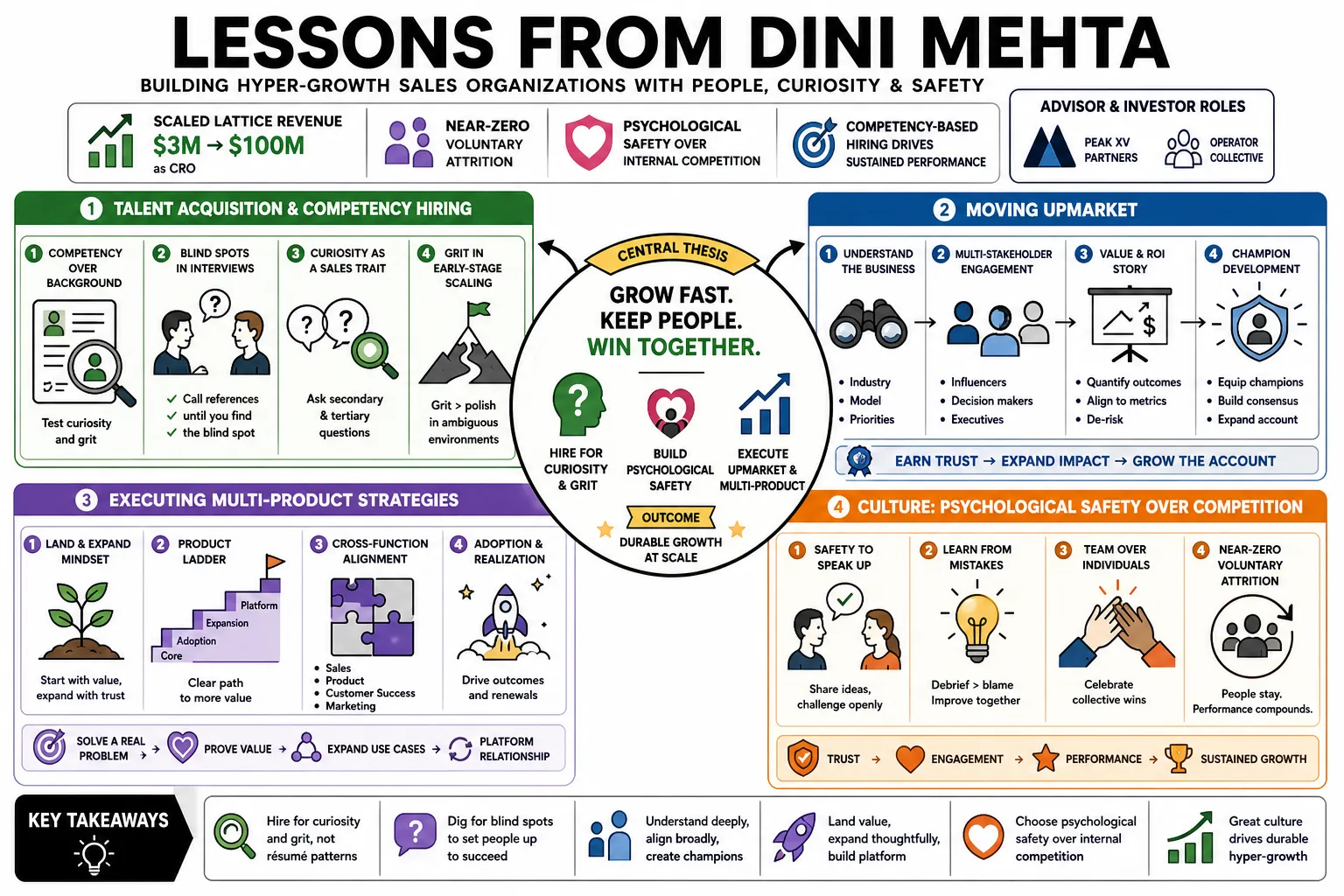
Part 1: Talent Acquisition and Competency Hiring
- On Competency Over Background: "You learn more about a candidate by testing their curiosity and grit than by checking if they previously sold HR software." — Source: [The Debrief Podcast]
- On Blind Spots in Interviews: "Keep calling references until you find the candidate's actual blind spot. If everyone only says glowing things, you haven't dug deep enough to manage them effectively." — Source: [Operator @ PeakXV]
- On Curiosity as a Sales Trait: "The best reps are deeply curious about how businesses function, which allows them to ask the secondary and tertiary questions that uncover actual pain points." — Source: [Grow & Tell]
- On Grit in Early-Stage Scaling: "Early-stage sales is a series of rejections and broken processes. You have to index heavily on individuals who find energy in fixing the engine while flying the plane." — Source: [Stage 2 Capital Insights]
- On the Value of Reference Checks: "A reference check shouldn't be a final box to check before an offer goes out; it should be an investigative tool used to design the candidate's first 90 days." — Source: [The Debrief Podcast]
- On Casual Candidate Interactions: "Taking a candidate out of the office setting reveals how they handle unstructured environments, which mirrors the unpredictability of a complex sales cycle." — Source: [Operator @ PeakXV]
- On Building a Passive Talent Pipeline: "Spend time meeting potential candidates even when you have zero open headcount. The best hires rarely happen when you are desperate to fill a seat." — Source: [Operator Collective]
- On Ignoring Industry Experience: "Hiring exclusively from your direct competitors often brings inherited bad habits. I prefer athletes who know how to learn a new playbook." — Source: [The Debrief Podcast]
- On Aligning Values During Interviews: "If a candidate's personal definition of accountability doesn't match the company's operating rhythm, the friction will eventually cause them to leave." — Source: [Grow & Tell]
Part 2: The Onboarding Experience and Accountability
- On Uncomfortable Onboarding: "Senior hires should feel intentionally uncomfortable during onboarding. If it feels too easy, they aren't unlearning their past assumptions fast enough." — Source: [Operator @ PeakXV]
- On Accelerating Ramp Time: "Speed to productivity is less about cramming product knowledge and more about teaching the rep how your specific buyer makes internal decisions." — Source: [Stage 2 Capital Insights]
- On Trust and Accountability: "Great teams are built on the foundation of trust and accountability. You cannot hold someone to a high standard if they don't trust your intentions." — Source: [Grow & Tell]
- On Setting Expectations Early: "The first 30 days dictate the next three years. If you tolerate missed deadlines in month one, you've established the actual baseline for performance." — Source: [Operator Collective]
- On Feedback During the First 30 Days: "Deliver hard feedback early. Waiting until a formal review cycle guarantees the rep will build muscle memory around the wrong motions." — Source: [The Debrief Podcast]
- On Avoiding False Harmony: "A culture where everyone agrees in the room and complains in the hallway will destroy a sales organization faster than a bad product." — Source: [Grow & Tell]
- On Role-Play in Training: "Role-playing shouldn't be a compliance exercise. It has to simulate the exact objections your competitors are feeding to your prospects right now." — Source: [SaaStr Annual]
- On Coaching Over Managing: "Managers stare at dashboards and ask for forecast updates. Coaches sit on calls and identify the exact moment the prospect disengaged." — Source: [Operator @ PeakXV]
- On Measuring Early Success: "Look at activity quality, not just volume, in the first quarter. A rep booking fewer meetings with the right economic buyers is ramping better than one spamming low-level users." — Source: [Stage 2 Capital Insights]
Part 3: Moving Upmarket and Enterprise Sales
- On the Transition to Enterprise: "Moving upmarket breaks everything. Your messaging, your post-sales motion, and your legal team all have to be rebuilt to survive enterprise procurement." — Source: [Grow & Tell]
- On Segmenting the Sales Team: "You cannot ask the same rep to close a $5,000 transactional deal in three days and a $250,000 enterprise deal in nine months. You have to bifurcate the team early." — Source: [Grow & Tell]
- On Increasing Average Contract Value: "Driving a 5x increase in ACV requires the company to stop selling features and start selling business transformation to the C-suite." — Source: [SaaStr Annual]
- On Patience in Longer Deal Cycles: "Enterprise reps need the psychological stamina to work a deal for six months without a clear signal of success." — Source: [Operator Collective]
- On Executive Sponsorship in Deals: "If your competitor has the CEO's ear and you are talking to a director, you are already losing the deal, even if your product is better." — Source: [Grow & Tell]
- On Identifying the True Economic Buyer: "The person evaluating your software is rarely the person who can sign a six-figure check. Teach reps to navigate upward without alienating their champion." — Source: [Stage 2 Capital Insights]
- On Managing Upmarket Churn Risk: "Losing a mid-market customer is a data point. Losing an early enterprise anchor customer is a threat to the entire upmarket strategy." — Source: [SaaStr Annual]
- On Adjusting the Sales Pitch: "Mid-market buyers care about implementation speed. Enterprise buyers care about risk mitigation, compliance, and change management." — Source: [Grow & Tell]
- On Navigating Procurement Processes: "Treat the procurement team as a separate persona with entirely different motivations. You have to sell them on risk reduction while you sell the business unit on revenue gains." — Source: [Operator @ PeakXV]
- On Building Enterprise Trust: "Enterprise buyers expect you to understand their industry's regulatory environment better than they do. That level of fluency earns you the right to ask for their budget." — Source: [SaaStr Annual]
Part 4: Executing a Multi-Product Strategy
- On the Risk of Multi-Product Expansion: "Launching a second product always feels risky, but staying a single-product company in a consolidating market is an eventual death sentence." — Source: [Grow & Tell]
- On Sequencing Resource Allocation: "You can't starve your core engine to fund the new product, nor can you launch the new product without dedicated GTM support. The sequencing requires extreme discipline." — Source: [SaaStr Annual]
- On Upskilling the Sales Team: "Selling a platform requires a different diagnostic skill set than selling a point solution. You have to retrain the entire floor on how to uncover adjacent pain." — Source: [Grow & Tell]
- On Packaging and Pricing Strategy: "If you get the bundling right, the second product pulls the first product into new accounts. If you get it wrong, you end up discounting everything to zero." — Source: [Stage 2 Capital Insights]
- On Outpacing Single-Product Competitors: "A multi-product strategy allows you to change the conversation from 'who has the best feature' to 'who can consolidate your vendor stack'." — Source: [Grow & Tell]
- On Cross-Selling to Existing Customers: "Your customer success team has to transition from defensive adoption monitoring to proactive value expansion without losing the customer's trust." — Source: [Operator Collective]
- On Messaging the Platform Value: "The sum of the platform must clearly exceed the value of the individual parts. If reps are just pitching two disparate tools in one meeting, the narrative has failed." — Source: [SaaStr Annual]
- On Handling Feature Requests: "When you run a multi-product engine, product feedback from the field has to be ruthlessly prioritized against the overarching platform vision, not individual account demands." — Source: [Grow & Tell]
- On Compensating Multi-Product Sales: "Your comp plan tells the reps what the company actually values. If you want them to sell the new product, you have to temporarily over-incentivize those deals." — Source: [Stage 2 Capital Insights]
- On Maintaining Core Product Momentum: "The biggest risk in a multi-product launch is that the sales team gets distracted by the shiny new toy and misses the quarterly target on your cash-cow product." — Source: [Operator @ PeakXV]
Part 5: Scaling the Go-To-Market Engine
- On Building from $3M to $100M: "The processes that get you to $10 million will actively prevent you from reaching $50 million. You have to be willing to tear down your own work every few years." — Source: [Grow & Tell]
- On Data Consolidation in GTM: "Don't wait to shore up your data. Fragmented intent data across five different tools creates a massive blind spot for your frontline managers." — Source: [Salesforce Blog]
- On Doing More With Less: "In tighter macroeconomic environments, scaling is about increasing the output per rep through better enablement and tooling, rather than just adding headcount." — Source: [Stage 2 Capital Insights]
- On AI in Sales Enablement: "Use AI to automate the administrative burden of selling. Reps should be spending their time on strategic deal design, not summarizing call transcripts." — Source: [Stage 2 Capital Insights]
- On Designing the Early Sales Motion: "Before you scale, the founder and the early sales leaders must manually validate the repeatable motion. You cannot outsource product-market fit to a newly hired AE." — Source: [Operator Collective]
- On Predictable Revenue Forecasting: "A mature GTM engine runs on a boring, highly predictable forecast. Surprises at the end of the quarter mean your qualification framework is broken." — Source: [SaaStr Annual]
- On Managing Hyper-Growth Chaos: "Chaos is inevitable in hyper-growth. The CRO's job is to absorb that chaos at the executive level and deliver clarity and focus to the front line." — Source: [Grow & Tell]
- On Transitioning from Founder-Led Sales: "Founders close deals through sheer willpower and product vision. Sales teams close deals through repeatable process and commercial rigor." — Source: [Operator @ PeakXV]
- On Evaluating the Tech Stack: "Every tool in your sales stack should either demonstrably increase win rates or significantly reduce the time spent on non-selling activities. Delete the rest." — Source: [Salesforce Blog]
Part 6: Solutions Consulting and Cross-Functional Alignment
- On Unlocking the Solutions Consultant: "Pre-sales should never be treated as a demo-generating back office. They are highly strategic GTM partners who validate the technical win." — Source: [PreSales Podcast]
- On Sales and Product Collaboration: "If Sales and Product are fighting, the customer loses. Establish a rigid, data-driven feedback loop so product roadmaps reflect actual market friction." — Source: [Grow & Tell]
- On Feedback Loops with Engineering: "Engineers need to hear unvarnished customer feedback. Bring them onto the occasional lost-deal autopsy call so they understand why the product missed the mark." — Source: [Operator Collective]
- On Marketing as a Revenue Partner: "Marketing cannot operate in a vacuum measuring lead volume, while Sales measures closed revenue. Both teams must be held accountable to the same pipeline targets." — Source: [SaaStr Annual]
- On Bridging Pre-Sales and Post-Sales: "The gap between what was sold and what is delivered is where churn is born. The handoff process requires absolute transparency regarding what the product can currently do." — Source: [PreSales Podcast]
- On Technical Validation in Deals: "In complex environments, the business buyer says yes, but the technical buyer has veto power. Solutions consultants neutralize that veto." — Source: [PreSales Podcast]
- On Avoiding Siloed Departments: "When departments optimize for their own functional metrics instead of company revenue, you create massive friction for the buyer." — Source: [Stage 2 Capital Insights]
- On Shared GTM Metrics: "If the CRO and the CMO are looking at different dashboards to determine the health of the business, you have a fundamental alignment problem." — Source: [SaaStr Annual]
- On Customer Success Handoffs: "Customer Success shouldn't discover a new client on the day the contract is signed. They need to be involved during the final stages of the evaluation to map the implementation." — Source: [Grow & Tell]
Part 7: Culture, Retention, and Psychological Safety
- On Achieving 1% Voluntary Attrition: "Keeping turnover under three percent requires building a culture where top performers feel they are doing the best work of their careers, safely." — Source: [Operator @ PeakXV]
- On Psychological Safety in Sales: "Reps need to know they can lose a deal, report it honestly, and be coached rather than shamed. Fear creates inaccurate forecasts." — Source: [Across the Lines Podcast]
- On Authentic Leadership: "You cannot manufacture executive presence. Leading with authenticity and showing your own flaws builds infinitely more credibility than projecting perfection." — Source: [Salesforce Blog]
- On Diverse Sales Organizations: "Diversity in a sales team isn't a quota to hit. It creates a cognitive variety that allows your team to connect with a much broader base of buyers." — Source: [Across the Lines Podcast]
- On Rejecting Sleazy Tactics: "Move away from manufactured urgency and aggressive manipulation. Modern buyers are highly educated and will ghost you the moment they sense a lack of integrity." — Source: [Grow & Tell]
- On Building High-Trust Environments: "Trust is built in the micro-interactions. It’s how a manager reacts when a rep admits they forgot to ask a critical qualification question." — Source: [The Debrief Podcast]
- On Handling Opposing Opinions: "I want a leadership team that argues fiercely behind closed doors and commits fully once we leave the room. Silence in meetings usually means apathy." — Source: [Operator @ PeakXV]
- On Vulnerability at the Executive Level: "When a CRO admits they misjudged a market trend, it gives the entire organization permission to take calculated risks." — Source: [Operator Collective]
- On Recognizing Burnout: "In hyper-growth, burnout looks like cynicism. When your most optimistic reps start complaining about minor process changes, you are grinding them too hard." — Source: [Stage 2 Capital Insights]
- On Inclusive Team Rituals: "Culture is defined by what you celebrate. If you only celebrate massive closed-won deals and ignore the operational heavy lifting, you fracture the team." — Source: [Across the Lines Podcast]
Part 8: Advising Founders and Venture Operations
- On the Virtuous Cycle of Operating and Investing: "Applying day-to-day operating experience to venture capital allows you to spot structural flaws in a startup's GTM engine before they become fatal." — Source: [Operator Collective]
- On Guiding Cross-Border Founders: "Founders expanding into the US market often underestimate the necessary changes in sales aggression and messaging required to break through the noise." — Source: [Peak XV Partners]
- On Vetting GTM Capability in Startups: "When evaluating an investment, look at how the founder talks about their lost deals. Blaming the customer indicates a dangerous lack of commercial awareness." — Source: [Operator Collective]
- On Surviving High-Interest Rate Environments: "Capital is no longer free. Startups must prioritize gross margin and sales efficiency over raw, unprofitable top-line growth." — Source: [Stage 2 Capital Insights]
- On Founder Self-Awareness: "The best founders know exactly when their own sales abilities have become the bottleneck for the company's growth." — Source: [Operator @ PeakXV]
- On When to Hire a CRO: "Hiring a CRO too early results in expensive strategy presentations without execution. Hire a sales leader who can build the engine first, then scale the title later." — Source: [Operator Collective]
- On Data-Driven Decision Making: "Advising founders means forcing them to look at their conversion rates rationally, stripping away the emotional attachment they have to their product." — Source: [Salesforce Blog]
- On Shoring Up Data Early: "If you wait until Series C to establish clean CRM hygiene, the technical debt in your sales operations will take a year to untangle." — Source: [Stage 2 Capital Insights]
- On Mentoring the Next Generation of Leaders: "The true measure of a CRO's career isn't just the revenue they drove, but the number of directors they developed into future revenue leaders." — Source: [Operator Collective]