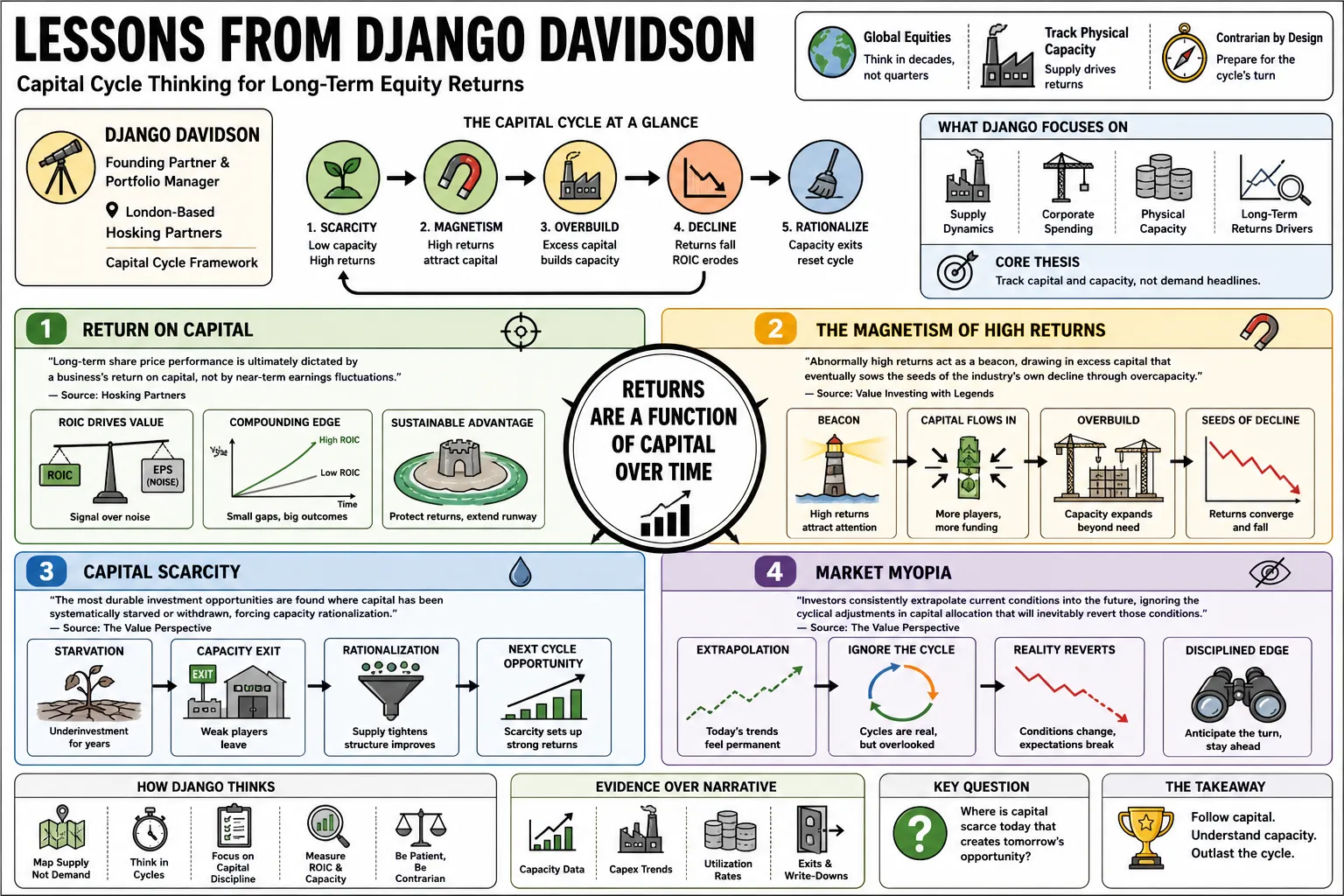
Lessons from Django Davidson
Django Davidson is a partner and portfolio manager at Hosking Partners, where he joined at the firm’s inception. His capital-cycle approach examines how investment changes industry supply and, in turn, the returns available to businesses over time. — Where’s a Copper When You Need One.
Part 1: The Core of Capital Cycle Theory
- On Return on Capital: Davidson’s capital-cycle framework looks past a story about future profits to the returns a business can earn on capital over time, which competition within its industry can erode. — Rolling in the Deep.
- On the Magnetism of High Returns: When investment flows into an industry, Davidson argues, the added supply tends to put pressure on returns available to existing capital, all else equal. — Where’s a Copper When You Need One.
- On Capital Scarcity: Davidson looks for industries where curtailed investment constrains new capacity, while treating any improvement in investor returns as a thesis rather than a certainty. — Rolling in the Deep.
- On Market Myopia: Davidson warns that compelling stories about future demand can distract investors from measurable changes in industry capacity. — Where’s a Copper When You Need One.
- On the Life Cycle of Margins: Strong current profitability can attract competing capital, so Davidson examines whether new capacity could make those returns harder to sustain. — Rolling in the Deep.
- On Consolidation: In Davidson’s PGM analysis, prolonged underinvestment and low valuations may encourage producers to curtail capacity or consolidate; he presents this as an expected response, not a guaranteed cycle endpoint. — Rolling in the Deep.
- On the Role of Management: Davidson describes a multi-manager structure at Hosking Partners that invites second opinions rather than relying on a single dominant portfolio manager. — Value Investing with Legends Podcast.
- On Cyclicality: Davidson’s Micron example shows that an industry can remain cyclical even as consolidation and supply discipline may reduce the severity of its troughs. — Value Investing with Legends Podcast.
- On Measuring the Cycle: Davidson starts with capacity across an industry and the capital flowing into or out of it, rather than relying on one company’s demand forecast. — Where’s a Copper When You Need One.
- On Creative Destruction: Davidson’s PGM case shows how years of low prices and constrained investment can leave an industry with limited new supply, creating a possible recovery thesis for survivors. — Rolling in the Deep.
Part 2: Supply Over Demand
- On the Certainty of Supply: Davidson argues that much industry capacity is observable, while long-range demand estimates are more sensitive to assumptions and therefore less reliable. — Where’s a Copper When You Need One.
- On Forecasting Errors: Rather than anchor a copper thesis to a precise long-range demand forecast, Davidson examines investment budgets, discoveries and the years required to add mined supply. — Where’s a Copper When You Need One.
- On Asymmetric Information: Davidson urges investors to weigh a few important industry facts—especially observable capital spending and supply—rather than accumulate ever more data about uncertain demand. — Value Investing with Legends Podcast.
- On Capacity Addition: In copper mining, the lag from discovery to production can stretch for many years; Davidson cites an almost 14-year average as of 2021 when assessing future supply. — Where’s a Copper When You Need One.
- On Demand Mirages: Even a promising demand story may not translate into durable returns if the industry builds too much capacity in response; Davidson examines supply as well as demand. — Where’s a Copper When You Need One.
- On Identifying Inflection Points: Davidson’s PGM thesis examines a sector after years of weak prices and reduced investment, when replacement-cost valuations and constrained capacity may point to improving returns. — Rolling in the Deep.
- On the Cost of Capital: Davidson notes that permitting delays, environmental requirements and miners’ carbon intensity can raise the cost of adding copper supply and delay the industry’s response to higher prices. — Where’s a Copper When You Need One.
- On Lead Times: Copper projects can take years to move from discovery to production; Davidson treats that delay as central to assessing when new supply might affect returns. — Where’s a Copper When You Need One.
- On Ignoring the Macro: Davidson prefers observable industry supply data to precise commodity-demand or macro forecasts, while acknowledging that a directional view of demand remains part of the analysis. — Where’s a Copper When You Need One.
- On Pricing Power: In Davidson’s capital-cycle analysis, scarce capacity can support returns, but higher prices eventually invite more investment, recycling and substitution; that response may take time. — Where’s a Copper When You Need One.
Part 3: The Illusion of Forecasting
- On Analyst Estimates: Long-range demand estimates can depend on assumptions that are difficult to know in advance; Davidson therefore gives observable supply and investment plans substantial weight. — Where’s a Copper When You Need One.
- On Narrative Fallacies: Davidson compares speculative technology booms with earlier infrastructure manias to show how a persuasive innovation story can outrun the economics of the companies financing it. — The End of the Beginning.
- On Terminal Value: In his 2019 technology analysis, Davidson questions valuations that rely on distant profits for businesses still consuming large amounts of capital. — The End of the Beginning.
- On the Danger of Consensus: When many investors fund the same compelling industry story, added capacity can undermine the returns they expect; Davidson treats that supply response as a central investment question. — Where’s a Copper When You Need One.
- On Recognizing Ignorance: Davidson cautions that long-range demand cannot be known with precision, whereas much of today’s supply capacity and planned investment can be examined directly. — Where’s a Copper When You Need One.
- On Historical Blindness: Davidson uses the railway boom as a historical comparison for later technology investment: useful innovations can coexist with poor returns for investors who fund excessive capacity. — The End of the Beginning.
- On Extrapolation: A period of high growth or high returns can invite investors to project the same conditions far into the future; Davidson argues that competition and capital supply can change that outcome. — Death of the Brand.
- On Adaptability: For an uncertain industry recovery, Davidson describes owning a basket of producers rather than making the outcome depend on one precisely chosen company. — Rolling in the Deep.
Part 4: Contrarianism and Crowded Trades
- On True Contrarianism: Davidson’s contrarian approach starts with industries where capital has retreated and prospective supply is constrained, rather than simply buying what has recently fallen in price. — Rolling in the Deep.
- On Hype Cycles: Davidson’s comparison with railways cautions that an important technology can attract more investment than its early backers will earn back. — The End of the Beginning.
- On Uncrowded Spaces: Davidson looks for possible opportunities where investor attention and capital have left an industry, as in his analysis of underinvested platinum-group metals. — Rolling in the Deep.
- On the Pain of Being Early: Supply-led investment cycles can take years to develop and produce uneven returns; Davidson’s approach therefore requires patience with the timing of a thesis. — Where’s a Copper When You Need One.
- On Passive Flows: In his 2025 AI analysis, Davidson notes that passive investors can acquire concentrated exposure to Nvidia and other AI-linked companies through index ownership. — The AI Paradox.
- On Growth Traps: Davidson distinguishes rapid AI adoption from attractive investment economics, asking whether large capital commitments and competitive pressure will leave durable returns. — The AI Paradox.
- On Market Sentiment: In 2025, Davidson contrasted concentrated enthusiasm for U.S. AI leaders with the neglected capital needs of physical industries such as mining. — Q3 2025 Quarterly Commentary.
- On Institutional Imperatives: Davidson describes Hosking Partners’ long-term investment architecture as designed to support positions that can be uncomfortable while a contrarian thesis develops. — Death of the Brand.
Part 5: The Geography of Capital
- On Geographic Arbitrage: Davidson applies capital-cycle analysis across countries, examining how capital flight and depressed valuations can create possible opportunities when conditions later stabilize. — Sri Lanka: You Will Come Back for More.
- On Emerging Markets: In Davidson’s Sri Lanka analysis, currency stress and capital flight are part of a country-level capital cycle that can leave assets neglected, though recovery depends on subsequent conditions. — Sri Lanka: You Will Come Back for More.
- On Japan’s Corporate Reforms: In his third-quarter 2025 commentary, Davidson saw possible improvements from Japanese corporate restructuring and consolidation; he presented this as an investment thesis rather than a completed outcome. — Q3 2025 Quarterly Commentary.
- On Strategic Capital Investment: Davidson notes that China built a large share of global copper smelting and refining capacity through long-term strategic investment, leaving Western supply chains less adaptable. — Where’s a Copper When You Need One.
- On Currency Impacts: Davidson’s Sri Lanka case illustrates how a currency crisis and capital flight can affect local valuations and the supply of investment capital. — Sri Lanka: You Will Come Back for More.
- On Supply-Chain Resilience: Davidson argues that rebuilding resilience in Western energy and chemicals supply chains requires substantial capital and changes to how heavy infrastructure is built. — Value Investing with Legends Podcast.
- On Regulatory Constraints: Copper mine permitting, environmental requirements and community opposition can delay new capacity; Davidson includes those constraints in his supply analysis. — Where’s a Copper When You Need One.
- On U.S. Tech Dominance: In 2025, Davidson viewed U.S. market concentration and AI-linked valuations as a risk and described a relatively greater search for opportunities outside those crowded exposures. — Q3 2025 Quarterly Commentary.
- On Frontier Markets: Davidson’s Sri Lanka example shows why his capital-cycle lens can extend to smaller markets after capital flight, while a recovery remains contingent on reform and investor confidence. — Sri Lanka: You Will Come Back for More.
Part 6: ESG and the Green Energy Transition
- On the Cost of Green Infrastructure: Davidson’s copper analysis emphasizes that electrification requires large physical investments in mines and metal supply, with long lead times before capacity can expand. — Where’s a Copper When You Need One.
- On ESG Capital Distortions: Davidson argues that environmental requirements, permitting and local opposition can make new copper mines harder and more expensive to develop, potentially restricting future supply. — Where’s a Copper When You Need One.
- On a Possible Metals Cycle: Davidson’s copper thesis combines years of restrained mining investment with possible growth in electrification demand, while leaving the eventual price and return outcome uncertain. — Where’s a Copper When You Need One.
- On Transition Bottlenecks: Copper supply cannot expand instantly in response to transition demand: Davidson highlights exploration-to-production lead times and permitting constraints. — Where’s a Copper When You Need One.
Part 7: AI and Technological Bubbles
- On the AI Arms Race: Davidson compares the scale of AI infrastructure spending with earlier capital-intensive booms, asking whether future revenues will justify the investment rather than assuming they will. — The AI Paradox.
- On Semiconductor Cycles: Davidson’s Micron case links memory-industry consolidation and more disciplined capacity to a potentially less severe earnings cycle, while emphasizing that the company remains cyclical. — Value Investing with Legends Podcast.
- On Beneficiaries of Hype: Davidson’s historical technology comparison distinguishes the lasting social value of an innovation from the returns earned by late investors who financed excessive capacity. — The End of the Beginning.
- On Software Margins: Davidson notes that capital-cycle logic is not limited to mines: when digital capacity can be added readily, competition can also challenge expected returns in a software-linked market. — Where’s a Copper When You Need One.
- On Disruption Narratives: Davidson accepts that AI may transform work while asking whether the companies financing its buildout will earn attractive returns after capital costs and competition. — The AI Paradox.
- On Capital Burn: In his 2019 technology essay, Davidson warned that investors were financing fast-growing businesses with continuing losses in the expectation of much larger future profits. — The End of the Beginning.
- On Data Center Constraints: Davidson asks whether the energy needs and depreciation of expensive AI data centers will limit the returns from current infrastructure spending. — The AI Paradox.
- On the Illusion of Monopoly: Davidson treats a winner-take-most AI market as one possibility, not a certainty, and asks whether switching and competition could instead make parts of the infrastructure more commodity-like. — The AI Paradox.
- On Normalization: Davidson’s historical analogy cautions that a technological breakthrough can become widely useful even when the investors funding a crowded buildout earn disappointing returns. — The End of the Beginning.
Part 8: Patience and Long-Term Value
- On Time Arbitrage: Davidson studies supply cycles that may unfold over many years; the long horizon lets him investigate opportunities that are hard to judge from near-term demand forecasts. — Where’s a Copper When You Need One.
- On Enduring Volatility: Because the returns from a supply-driven investment cycle can arrive unevenly, Davidson presents patience as important to assessing the thesis over time. — Where’s a Copper When You Need One.
- On Evaluating Management: In his AI discussion, Davidson treats a major company’s shift from repurchasing to issuing shares as a signal worth weighing when assessing its capital needs. — Value Investing with Legends Podcast.
- On the Limits of Scale: In his 2019 technology analysis, Davidson argued that the very size of leading firms and their market valuations could make continued exceptional shareholder returns harder to achieve. — The End of the Beginning.
- On Staying Power: Davidson describes Hosking Partners’ investment structure as supporting patient, contrarian decisions through periods when a thesis is unpopular. — Death of the Brand.