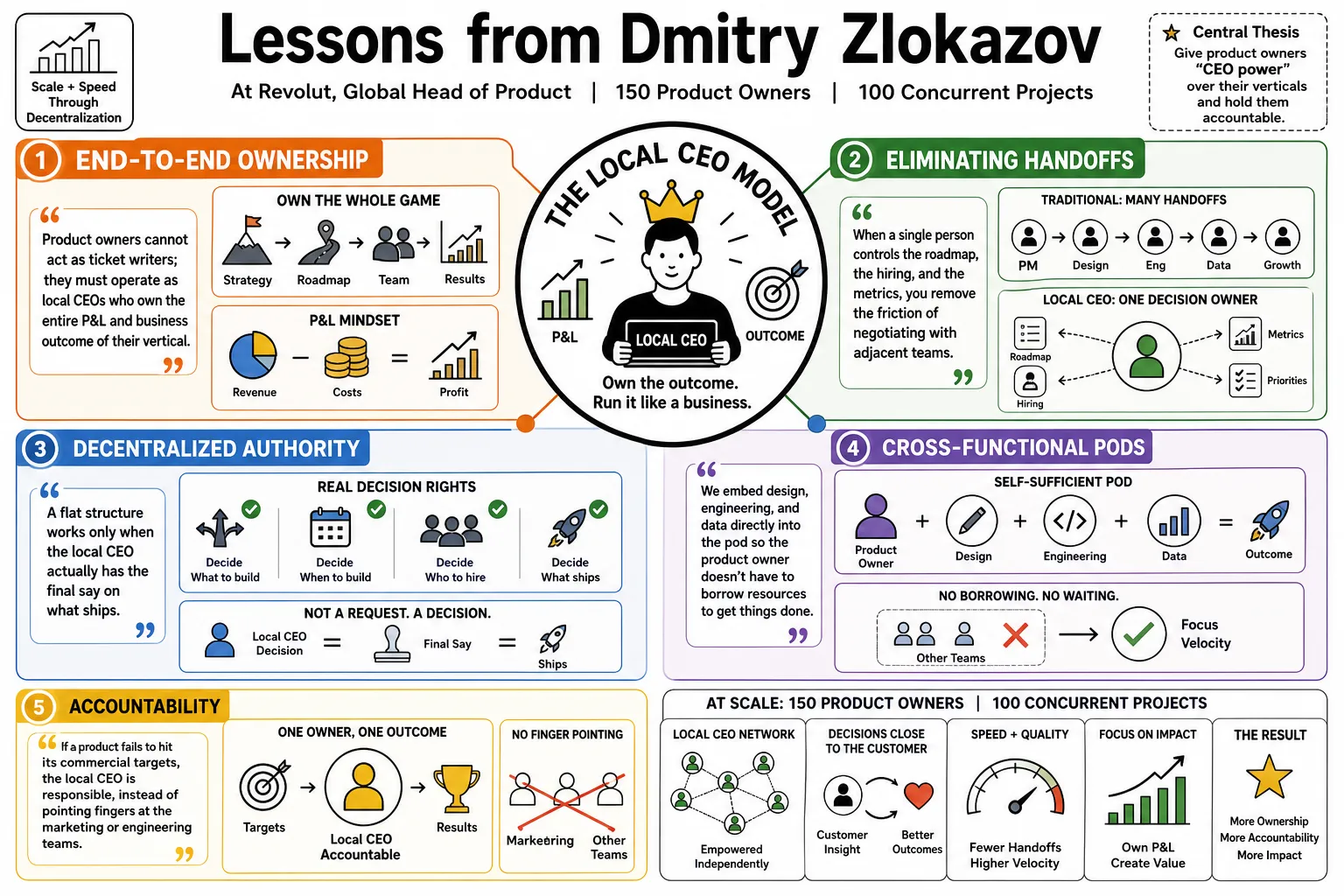
Lessons from Dmitry Zlokazov
At Revolut, Global Head of Product Dmitry Zlokazov manages 150 product owners across 100 concurrent projects. He established the company's "local CEO" structure, which hands product managers complete authority over their verticals. This profile breaks down his methods for hiring, daily execution, and quality control.
Part 1: The Local CEO Model
- On End-to-End Ownership: "Product owners cannot act as ticket writers; they must operate as local CEOs who own the entire P&L and business outcome of their vertical." — Source: [Lenny's Podcast]
- On Eliminating Handoffs: "When a single person controls the roadmap, the hiring, and the metrics, you remove the friction of negotiating with adjacent teams." — Source: [Lenny's Podcast]
- On Decentralized Authority: "A flat structure works only when the local CEO actually has the final say on what ships." — Source: [Reddit AMA]
- On Cross-Functional Pods: "We embed design, engineering, and data directly into the pod so the product owner doesn't have to borrow resources to get things done." — Source: [Lenny's Podcast]
- On Accountability: "If a product fails to hit its commercial targets, the local CEO is responsible, instead of pointing fingers at the marketing or engineering teams." — Source: [Lenny's Podcast]
- On Managing Projects at Scale: "You cannot manage a hundred parallel workstreams through central planning; you must trust the local leaders to run them independently." — Source: [Lenny's Podcast]
- On Scope of Influence: "A local CEO at a scale-up should feel the exact same pressures and freedoms as a founder at a seed-stage startup." — Source: [Reddit AMA]
- On Founder Mentality: "We expect product owners to fight for their business area as if their own money were on the line." — Source: [Lenny's Podcast]
- On P&L Responsibility: "You are building businesses to drive revenue, rather than building features to merely increase engagement." — Source: [eFinancialCareers]
Part 2: Hiring and Talent Density
- On Raw Intellect: "We hire for raw cognitive ability and hunger instead of someone who relies on ten years of standard industry experience." — Source: [Lenny's Podcast]
- On Internal Transfers: "Some of our best product leaders transitioned internally from engineering or operations roles because they already understood the business deeply." — Source: [Lenny's Podcast]
- On Industry Veterans: "Experience can sometimes be a liability if it means you are anchored to how things were done at a legacy bank." — Source: [Reddit AMA]
- On Interviewing: "During interviews, we index heavily on how quickly a candidate can absorb new variables and solve a problem they haven't seen before." — Source: [Lenny's Podcast]
- On Hunger: "You can teach someone how to run a sprint, but you cannot teach them to care intensely about the outcome." — Source: [eFinancialCareers]
- On Product Management Backgrounds: "A PM doesn't necessarily need a traditional PM background. Analytical thinkers who bias toward action often outperform career product managers." — Source: [Reddit AMA]
- On Retaining Top Performers: "High performers stay because we give them autonomy and remove the bureaucratic ceilings that exist at older companies." — Source: [Lenny's Podcast]
- On Onboarding: "The best onboarding is throwing someone into a hard problem immediately and letting them sink or swim with support." — Source: [eFinancialCareers]
- On Over-Indexing on Pedigree: "Having a big tech name on your resume gets you an interview, but your ability to execute fast keeps you in the job." — Source: [Reddit AMA]
- On Talent Density: "A single exceptional product owner can replace five average ones by simply making better decisions faster." — Source: [Lenny's Podcast]
Part 3: The Definition of Done
- On Nearing Completion: "If a feature is 99% done, it is effectively 0% done. It provides zero value to the customer until it ships." — Source: [Lenny's Podcast]
- On Shipping: "The gap between almost ready and live in the app is where most companies lose their momentum." — Source: [Lenny's Podcast]
- On Minimum Viable Products: "An MVP shouldn't mean a broken product. It means fewer features executed at a high standard." — Source: [Reddit AMA]
- On Launch Delays: "Delays usually happen in the last mile of polish; forcing a strict definition of done prevents scope creep at the finish line." — Source: [Lenny's Podcast]
- On Customer Value: "We do not celebrate writing code; we celebrate getting working software into the hands of users." — Source: [Reddit AMA]
- On Quality Assurance: "Quality is a core requirement that must be baked into the initial specifications before development begins." — Source: [Lenny's Podcast]
- On Perfectionism vs. Velocity: "You have to know when a design is good enough to ship and when it is so flawed it damages the brand. That instinct separates average PMs from great ones." — Source: [Reddit AMA]
- On False Progress: "A roadmap full of features currently in development is an inventory of uncaptured value." — Source: [Lenny's Podcast]
- On Execution Culture: "The difference between a good idea and a massive business is entirely in the execution of the final one percent." — Source: [eFinancialCareers]
Part 4: Technical Depth and Hands-on Management
- On Technical Proficiency: "Product managers here need to be hands-on. You cannot effectively lead engineers if you don't understand the technical trade-offs." — Source: [eFinancialCareers]
- On Reading the Code: "Although PMs rarely commit code daily, they should be able to read an API doc and challenge an engineering estimate." — Source: [Lenny's Podcast]
- On Delegating Complexity: "If you abstract away the technical details to an engineering lead, you lose your grip on why a feature is taking three months instead of three weeks." — Source: [Reddit AMA]
- On System Architecture: "A great product owner understands the backend constraints because those constraints directly dictate the user experience." — Source: [Lenny's Podcast]
- On Data Fluency: "You should be able to write your own SQL queries. Relying on an analyst for basic data cuts slows you down." — Source: [eFinancialCareers]
- On Managing Technical Debt: "Refactoring is an operational requirement; the PM must balance debt repayment with feature velocity." — Source: [Lenny's Podcast]
- On Respect from Engineers: "Engineers respect PMs who get into the weeds with them to solve a logic problem." — Source: [Reddit AMA]
- On Problem Solving: "When a system goes down, the product owner should be in the war room understanding the root cause alongside the developers." — Source: [Lenny's Podcast]
- On Abstraction Layers: "High-level PMs often fail here because they expect someone else to handle the messy implementation details." — Source: [eFinancialCareers]
- On Rapid Prototyping: "Being able to mock up a technical workflow on a whiteboard saves weeks of misaligned development." — Source: [Lenny's Podcast]
Part 5: Fostering a Wow Experience
- On Customer Expectations: "We aim to build products that have a high appetite for generating a wow reaction from the user the first time they open it." — Source: [Lenny's Podcast]
- On Design Standards: "If a financial app looks cheap, users assume the backend security is compromised." — Source: [Reddit AMA]
- On the Founders' Eye: "Having founders who routinely review UI elements ensures the bar for quality never drops as the company scales." — Source: [Lenny's Podcast]
- On Micro-Interactions: "The difference between an app you use and an app you love often comes down to millisecond animations and tight copy." — Source: [Reddit AMA]
- On Copywriting: "The words on the screen are as much a part of the user experience as the code running behind it." — Source: [Lenny's Podcast]
- On Friction: "Every extra tap required to complete an action is a failure in product design." — Source: [eFinancialCareers]
- On First Impressions: "Onboarding flows must be flawless because you get exactly one chance to prove your app is better than their current bank." — Source: [Lenny's Podcast]
- On Standardizing UI: "We maintain strict design tokens so that no matter which of the 100 pods builds a feature, it feels like the same unified app." — Source: [Reddit AMA]
- On Emotional Resonance: "Finance is inherently stressful. A great product replaces that stress with a feeling of total control." — Source: [Lenny's Podcast]
Part 6: Organizational Velocity
- On Flat Hierarchies: "Middle management is where speed goes to die. We keep the hierarchy ultra-flat to maintain direct lines of communication." — Source: [Lenny's Podcast]
- On Decision Making: "Decisions should be made by the person closest to the data, completely independent of their title." — Source: [Reddit AMA]
- On Meetings: "If a meeting isn't driving a specific decision or unblocking a team, it should be an email or a Slack message." — Source: [eFinancialCareers]
- On Over-Coordination: "Too much alignment across departments slows down delivery. It is frequently better to move fast and fix the overlap later." — Source: [Lenny's Podcast]
- On Async Communication: "Writing a clear, detailed brief forces clear thinking and eliminates hours of conversational back-and-forth." — Source: [Reddit AMA]
- On Bureaucracy: "We actively fight the introduction of processes that only exist to make executives feel comfortable." — Source: [Lenny's Podcast]
- On Approvals: "The local CEO doesn't need six sign-offs to launch a feature if they have already hit their quality constraints." — Source: [Reddit AMA]
- On Correcting Mistakes: "It is safer to launch quickly, learn it was wrong, and revert it, than to spend six months debating if it might be wrong." — Source: [Lenny's Podcast]
- On Momentum: "Velocity is a cultural trait. Once a team gets used to shipping weekly, anything slower feels agonizing." — Source: [eFinancialCareers]
Part 7: Business Acumen and Commercial Reality
- On Financial Literacy for PMs: "A product manager who doesn't understand the unit economics of their feature is flying blind." — Source: [Lenny's Podcast]
- On Monetization: "You have to think about monetization from day one, rather than treating it as an afterthought once you have users." — Source: [eFinancialCareers]
- On Vanity Metrics: "We don't care about page views if they don't eventually translate into transaction volume or subscription revenue." — Source: [Reddit AMA]
- On Cost Centers: "Every pod must justify its existence by drawing a clear line from its work to the company's bottom line." — Source: [Lenny's Podcast]
- On Competitive Analysis: "Look past what incumbents do. Understand why they do it, and then figure out how to achieve the same result at a fraction of the cost." — Source: [Reddit AMA]
- On Risk: "In fintech, commercial acumen means treating compliance and fraud as parameters of the game." — Source: [Lenny's Podcast]
- On Pricing: "Pricing power comes from building a product so good that returning to a traditional alternative feels broken." — Source: [Lenny's Podcast]
- On Cross-Selling: "The app ecosystem works when users naturally discover new financial products without feeling aggressively sold to." — Source: [eFinancialCareers]
- On Margins: "A hands-on PM will look for ways to optimize vendor costs in their vertical to improve their own margins." — Source: [Reddit AMA]
- On Long-Term Value: "Short-term engagement hacks ruin trust. Financial products require a long-term view of customer lifetime value." — Source: [Lenny's Podcast]
Part 8: Scaling the Culture
- On Cultural Dilution: "The biggest threat to a hyper-growth company is new hires bringing in the slow habits of their previous employers." — Source: [Lenny's Podcast]
- On Sink or Swim: "Our culture is intense by design. It quickly filters out people who want to coast." — Source: [eFinancialCareers]
- On Founder Involvement: "Founders staying deep in the details sets a standard that trickles down to every single junior PM." — Source: [Lenny's Podcast]
- On Leading by Example: "You cannot demand velocity from your team if you take three days to review a simple document." — Source: [Reddit AMA]
- On Transparency: "When metrics are visible to everyone, there is nowhere to hide poor performance, which naturally raises the bar." — Source: [Lenny's Podcast]
- On Handling Failure: "We tolerate ambitious failures, but we do not tolerate repeating the same avoidable mistake." — Source: [Reddit AMA]
- On Feedback: "Radical candor is required. If a product design is bad, the team needs to hear it immediately, without sugarcoating." — Source: [Lenny's Podcast]
- On Managing Teams: "You scale PMs by giving them hard boundaries and absolute freedom within those boundaries." — Source: [Reddit AMA]
- On Legacy: "The objective is building a machine that continuously outputs exceptional features, rather than launching a single successful product." — Source: [Lenny's Podcast]