Don Faul served as a Marine Corps platoon commander before taking operational leadership roles at Google, Facebook and Pinterest. He later led the sports-technology company Athos and served as CrossFit CEO from 2022 until March 2026. His interviews connect military lessons in service and preparation with the challenges of leading teams through growth and change. — CrossFit — Don Faul Biography.
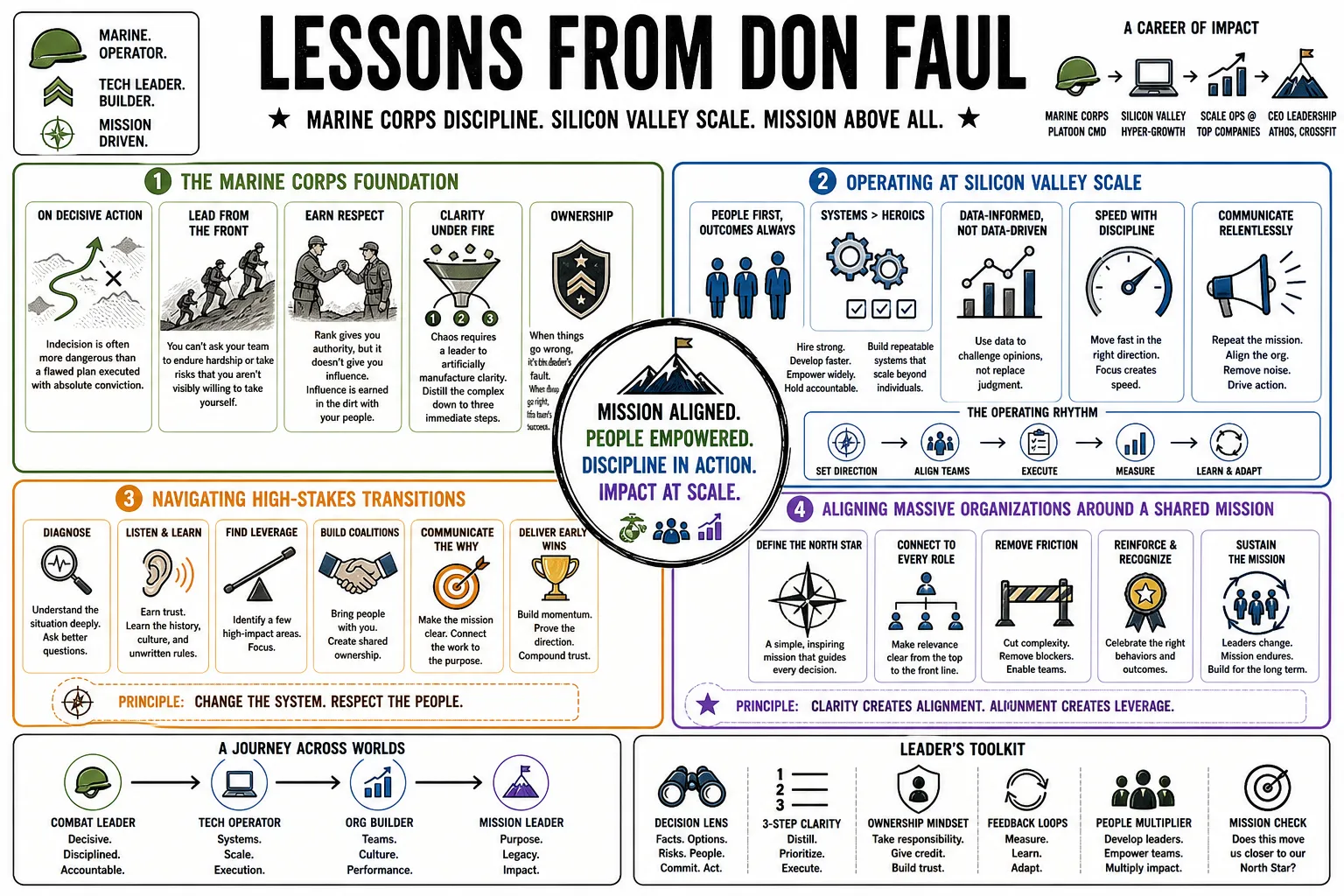
Part 1: The Marine Corps Foundation
- On Decisions Under Pressure: When a decision had to be made quickly in the Marines, Faul said his team needed the trust and preparation to execute without a lengthy discussion. — WorkLife — Don Faul Interview.
- On Serving at Every Rank: Faul recalls General Mattis sitting with junior Marines to ask how they were doing and whether they had what they needed. He treats that kind of presence as servant leadership. — WorkLife — Don Faul Interview.
- On Earning Influence: Faul argues that even a senior leader can build trust by showing personal concern for junior team members, as he saw General Mattis do with Marines in the field. — WorkLife — Don Faul Interview.
- On Ownership: Faul says Marine training set a high bar for taking ownership and not making excuses, an expectation he carried into later leadership roles. — WorkLife — Don Faul Interview.
- On Teams in Adversity: Faul believes the strongest team cultures can be shaped in difficult periods when members are connected to a common purpose and support one another. — First Round — Don Faul Interview.
- On Mission Clarity: Faul says decentralized decisions work when team members understand what success looks like and have been prepared to act toward that mission. — WorkLife — Don Faul Interview.
- On Preparing the Team: Faul describes military leadership as largely training and preparation before action, so teams can make decisions when circumstances become uncertain. — WorkLife — Don Faul Interview.
- On Emotional Tone: Faul recalls realizing in Afghanistan that his Marines watched how he responded emotionally when teammates were injured. He later urged leaders to create space before reacting in anger. — WorkLife — Don Faul Interview.
Part 2: Transitioning to Silicon Valley
- On Shifting Cultures: At Google, Faul found a stronger expectation that employees receive context and join the conversation. He shifted toward giving people information and room to decide, rather than importing military hierarchy unchanged. — First Round — Don Faul Interview.
- On Learning from Tech: Faul said the technology industry’s pace of change and willingness to challenge the status quo contrasted with a more tradition-oriented Marine Corps culture, and that he found the difference invigorating. — Jedburgh Podcast #096.
- On Transferable Leadership: Faul found that building relationships, connecting a team to a mission, and communicating a path forward remained useful after he moved from the Marines to Google, even though the culture and language differed. — WorkLife — Don Faul Interview.
- On Finding Mission in New Work: Faul says that, from the Marines to Facebook, helping people see why their work matters has been important in retaining commitment through hard periods. — First Round — Pivotal Stories.
- On Leading Without Certainty: Faul says leaders need enough humility to acknowledge uncertainty and bring others together to find an answer, rather than pretending to know everything. — WorkLife — Don Faul Interview.
- On Entering an Unfamiliar Industry: Faul recalls being intimidated by a Google internship because he knew little about the technology he was assigned, then discovering that his military leadership experience still had value. — WorkLife — Don Faul Interview.
- On Learning First Principles: At Pinterest, Faul found that importing a Facebook playbook only partly worked. He learned to step back, define the problem afresh, and use prior experience selectively. — First Round — Don Faul Interview.
Part 3: Operational Leadership at Google and Facebook
- On Scaling a Difficult Operation: At Facebook, Faul helped build content-policy processes and infrastructure intended to be replicable at platform scale, while acknowledging how hard moderation decisions remained. — WorkLife — Don Faul Interview.
- On Outgrowing a Role: Faul recounts Sheryl Sandberg splitting his Facebook remit as the company grew faster than one leader could scale; he later judged the narrower focus better for the company and his own development. — WorkLife — Don Faul Interview.
- On Operating Rhythms: Faul recommends a planning cadence and recurring reviews that check progress, surface learning, and let teams revise their assumptions as conditions change. — First Round — Don Faul Interview.
- On Hiring for Scale: Faul says Sandberg brought in another strong leader when his Facebook scope outgrew what he could personally handle, a change he initially resisted but later saw as valuable. — WorkLife — Don Faul Interview.
- On Frontline Feedback: Faul uses skip-level conversations to test whether people understand company priorities and to hear what leaders should improve. — First Round — Don Faul Interview.
- On Reviewing the Important Problems: In operating reviews, Faul says teams should establish clear goals, spend attention on red or yellow results, and attach plans to getting those back on track. — First Round — Don Faul Interview.
- On Cross-Functional Reviews: At CrossFit, Faul made operating reviews intentionally cross-functional to reduce silos, surface blockers, and distribute decisions and context beyond the meeting attendees. — First Round — Don Faul Interview.
- On Learning Velocity: Faul argues that well-designed experiments and fast learning matter more than judging each individual bet only by its immediate outcome. — First Round — Don Faul Interview.
Part 4: Scaling Pinterest
- On Making Culture Deliberate: Faul says founders can shape early culture personally, but larger organizations must articulate their principles and embed them deliberately in day-to-day work. — First Round — Don Faul Interview.
- On Learning Pinterest’s Product Identity: Faul says Pinterest learned from users that it had become a place to find and save personal sources of inspiration, not merely a tool for collecting web images. — Entrepreneur — Pinterest Interview.
- On Revising an Imported Playbook: At Pinterest, Faul learned that practices he had used at Facebook only partly fit a different company. He began to work from the problem and local context rather than importing a ready-made operating model. — First Round — Don Faul Interview.
- On Surfacing Disagreements: Faul recommends using operating reviews to surface blockers or misalignments, then escalating unresolved decisions quickly so teams can move. — First Round — Don Faul Interview.
- On Coaching and Unblocking: Faul says a leader should coach people through challenges and help them navigate obstacles, including working across other parts of the organization. — First Round — Don Faul Interview.
- On Honest Context: At Athos, Faul says excessive optimism reduced his team’s trust. He changed course by sharing difficult realities while still explaining a credible path forward. — First Round — Don Faul Interview.
- On Adapting Process: Faul says CrossFit assessed existing meeting and planning rhythms, tried changes as a six-month experiment, and revisited what worked instead of copying another company’s model. — First Round — Don Faul Interview.
Part 5: Navigating Athos
- On Wearable Feedback: Faul described Athos as sports-performance technology that measured muscle activation, bringing together his interests in fitness and technology. — Jedburgh Podcast #096.
- On Choosing Initial Users: Faul said Athos narrowed its focus after seeing its strongest early value among competitive athletes working with sophisticated coaches, while retaining a longer-term consumer ambition. — Sports Business Journal — Athos Interview.
- On Transparency as CEO: While leading Athos through an uncertain period, Faul learned to be frank about risks while giving employees the best plan and path forward he could see. — First Round — Don Faul Interview.
- On Facing a Nonviable Trajectory: Faul says Athos eventually could not reach the needed revenue growth and was sold or wound down. He was open with the team about the possibility during the preceding year. — First Round — Don Faul Interview.
- On Learning from Elite Athletes: Faul said professional, collegiate and serious high-school athletes using Athos with knowledgeable coaches gave the company useful feedback about training-load insights and its product focus. — Sports Business Journal — Athos Interview.
- On Balancing Stakeholder Interests: Faul distinguishes the interests of CrossFit’s community, employees, and investors. He says many priorities overlap, while financial expectations still create tradeoffs that leaders must discuss openly. — Future of Fitness — Don Faul Interview.
Part 6: Rebuilding CrossFit
- On Earning Community Trust: Faul said CrossFit headquarters had to earn community trust through its decisions and work closely with affiliates and coaches, rather than assuming that trust came with the brand. — Herd FIT — Don Faul Interview.
- On the Work of Coaches: Faul located CrossFit’s impact in affiliate gyms and the coaches who work with members, while describing headquarters’ role as supporting their education and businesses. — Jedburgh Podcast #096.
- On Everyday Stories: Faul wanted CrossFit media to show real stories from local gyms so newcomers could see who participates, rather than rely only on elite competition. — Herd FIT — Don Faul Interview.
- On Affiliate Economics: Faul said strong coaching alone is insufficient if gym owners cannot build sustainable businesses; headquarters was investing in business education and support for affiliates. — Future of Fitness — Don Faul Interview.
- On Preserving the Core While Changing: Faul argued that CrossFit could evolve how it worked and reached people while remaining clear about the core principles that made its community distinctive. — Herd FIT — Don Faul Interview.
- On Choosing Headquarters Priorities: Faul described a small headquarters responsible for education, affiliation and a sport; he argued it should focus on work central to its strengths rather than try to do everything itself. — Future of Fitness — Don Faul Interview.
- On Listening to Affiliates: Faul said he began his CrossFit tenure by meeting members, coaches, and affiliate owners to learn their concerns before setting priorities. — Jedburgh Podcast #096.
- On Affiliate-Led Growth: Faul described gyms as the strongest expression of CrossFit and sought to support affiliates while also reaching people who could not access one. — Herd FIT — Don Faul Interview.
Part 7: Core Leadership Philosophy
- On Measured Vulnerability: Faul advises leaders to begin by sharing difficult experiences with a trusted few, while coupling honesty about uncertainty with a path forward rather than leaving a team alarmed. — First Round — Pivotal Stories.
- On Encouraging Upward Feedback: Faul says leaders should reward constructive feedback, including feedback directed at senior managers, and tell stories that make such candor safer for others. — First Round — Pivotal Stories.
- On Listening for Reality: Faul uses open-ended questions and skip-level conversations to learn whether priorities are understood and where leadership may be missing problems. — First Round — Don Faul Interview.
- On Meaningful Work and Retention: Faul says connecting people’s everyday work to a meaningful mission helped retain talent through difficult periods. — First Round — Pivotal Stories.
- On Managing Reactions: Faul says leaders should recognize their emotional triggers and give themselves space before reacting, because the tone they set affects people around them. — WorkLife — Don Faul Interview.
- On Delegating Decisions: Faul says new managers often struggle to give up details; their job becomes clarifying success, coaching people, and letting team members make decisions and learn from mistakes. — First Round — Don Faul Interview.
- On Connecting Roles to Goals: Faul checks whether individual employees can explain how their work relates to the organization’s priorities, treating that understanding as a test of leadership clarity. — First Round — Don Faul Interview.
- On Moral Courage: Faul says some of his greatest regrets came from failing to advocate for what he believed was right when Facebook faced difficult policy and team decisions. — WorkLife — Don Faul Interview.
- On Connecting Authentically: Faul tries to understand what people are frustrated or hopeful about before addressing them, so his message meets the team where they are. — First Round — Don Faul Interview.
Part 8: Culture and Team Building
- On Living a Distinct Culture: Faul argues that an authentic company culture needs a clear point of view and deliberate reinforcement as an organization grows; generic value statements are not enough. — First Round — Don Faul Interview.
- On Candor With Leaders: Faul says leaders must create conditions in which colleagues feel comfortable challenging them, by admitting mistakes, asking open questions and recognizing people who speak up. — First Round — Don Faul Interview.
- On Hiring Athlete Experience: As Athos CEO, Faul valued accomplished athletes’ work ethic, grit, teamwork, confidence and humility when hiring for a growing sports-technology business. — Front Office Sports — Athos Interview.
- On Recognizing Behind-the-Scenes Work: Faul recommends telling concrete stories about support and operations staff whose work helps customers and advances company goals, so those contributions are visible to the whole team. — First Round — Pivotal Stories.
- On Sustaining Purpose: Faul locates durable team motivation in meaningful work and mutual support rather than perks or a fashionable office. — First Round — Don Faul Interview.