Lessons from Doug Irwin
Douglas A. Irwin is the John French Professor of Economics at Dartmouth College. His research covers U.S. trade-policy history, tariffs, the World Trade Organization and globalization; his books include Clashing over Commerce and Free Trade Under Fire. — Dartmouth Economics — Douglas A. Irwin.
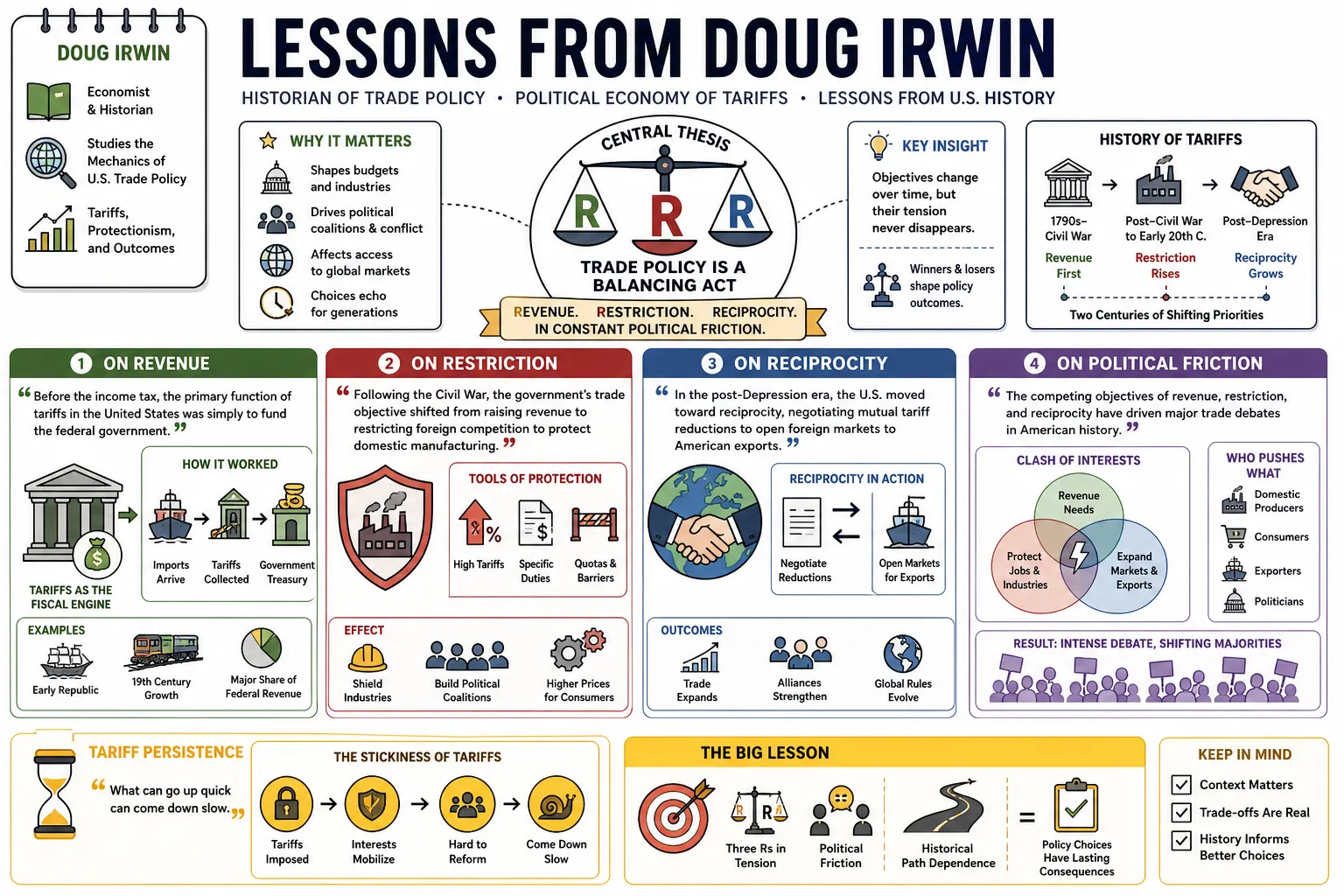
Part 1: The Three Rs of Trade Policy
- Revenue: From the founding through the Civil War, federal tariffs primarily raised revenue; import duties were relatively easy to collect at a small number of ports. — Richmond Fed — Douglas Irwin Interview.
- Restriction: After the Civil War shifted political power toward Northern Republicans, protecting import-competing industries became the dominant tariff objective. — Richmond Fed — Douglas Irwin Interview.
- Reciprocity: The 1934 Reciprocal Trade Agreements Act began a period in which the United States negotiated tariff reductions in exchange for other countries lowering barriers. — Richmond Fed — Douglas Irwin Interview.
- Political Friction: Irwin divides U.S. tariff history into revenue, restriction and reciprocity eras, while stressing that all three motives coexist and political disputes persist within each era. — Macro Musings — History of US Trade Policy.
- Tariff Persistence: Once protective tariffs are in place, affected industries resist their removal; Irwin notes that the high-tariff regime outlasted the period when the United States became a net exporter of manufactured goods. — Richmond Fed — Douglas Irwin Interview.
- Constitutional Design: Under the Articles of Confederation Congress could not levy taxes; giving the federal government revenue-raising power was an important reason for the Constitutional Convention, and tariffs became an early federal revenue tool. — Richmond Fed — Douglas Irwin Interview.
- Logrolling: The Smoot–Hawley tariff became entangled in special-interest lobbying and congressional vote trading over individual duties, even though its initial political impetus was a promise to help farmers. — Peddling Protectionism — Introduction.
- Shift in Trade Authority: Congress last enacted a general tariff schedule in 1930; the 1934 act then delegated authority for the president to negotiate reciprocal reductions, changing the process without ending congressional oversight. — Macro Musings — History of US Trade Policy.
Part 2: Smoot-Hawley and the Great Depression
- Historical Reputation: Smoot and Hawley became enduring symbols of 1930s protectionism, but Irwin cautions that its association with the collapse of trade and the Depression is often exaggerated into an incorrect causal story. — Peddling Protectionism — Introduction.
- Depression Causation: Irwin argues that Smoot–Hawley did not cause the Great Depression or materially drive its macroeconomic contraction; monetary and financial shocks were much more important, although the tariff still damaged trade. — Peddling Protectionism — Introduction.
- Retaliation: The tariff prompted foreign measures that discriminated against U.S. exports; Irwin says their timing and form strongly suggest retaliation, even where governments did not describe them that way. — Peddling Protectionism — Introduction.
- Agricultural Origins: The tariff began as a Republican effort to appeal to farmers in the 1928 election, then expanded in Congress; Irwin notes that import duties were poorly suited to many farmers who depended on export markets. — Peddling Protectionism — Introduction.
- Export Harm: Foreign retaliation and discriminatory trade barriers harmed U.S. farm and factory exports; Irwin does not attribute the entire collapse in exports to Smoot–Hawley alone. — Richmond Fed — Douglas Irwin Interview.
- Gold Standard Constraints: Irwin and Barry Eichengreen found that countries remaining on the gold standard faced stronger protectionist pressures under deflation, while countries leaving it earlier had more monetary room to respond. — Richmond Fed — Douglas Irwin Interview.
- Deflation and Specific Duties: Deflation raised the protective effect of specific duties during the Depression and pushed measured tariffs toward near-record levels, beyond the original legislated increase. — Peddling Protectionism — Introduction.
Part 3: Classical Economists and Trade Philosophy
- Smith and Ricardo: Irwin values Adam Smith’s broad account of specialization and trade policy while treating Ricardo’s comparative-advantage model as a narrower but still useful analytical tool. — Ideas of India — Doug Irwin on Trade Policy.
- Reading Smith: If choosing one classical author to read, Irwin recommends Smith for the breadth and richness of his discussion; he finds Ricardo more like a technical textbook. — Ideas of India — Doug Irwin on Trade Policy.
- Markets without Central Direction: In Irwin’s account of Smith, trade can enlarge the market and permit greater specialization without a government directing production toward favored industries. — A Brief History of International Trade Policy.
- Division of Labor: Irwin explains Smith’s point that a larger market supports finer specialization, which can increase productivity and make international exchange mutually beneficial. — A Brief History of International Trade Policy.
- Intellectual History: Irwin traces how the case for free trade developed from Smith through the classical economists and survived later theoretical challenges concerning infant industries, terms of trade and market imperfections. — A Brief History of International Trade Policy.
- Mercantilism: Irwin describes mercantilist writing as favoring export surpluses and state direction of commerce, while noting that scholars disagree over whether mercantilists simply equated precious-metal holdings with national wealth. — A Brief History of International Trade Policy.
- John Stuart Mill: Irwin credits Mill’s theory of reciprocal demand with clarifying how international demand affects the terms at which countries exchange exports for imports. — A Brief History of International Trade Policy.
- Infant Industries: Mill allowed a narrow case for temporary protection where a young industry could become competitive; Irwin notes the practical difficulty of identifying such industries and preventing protection from becoming permanent. — A Brief History of International Trade Policy.
- Consumer Welfare: Irwin’s account of Smith emphasizes that import restrictions can protect producers while raising prices and reducing competition for consumers. — A Brief History of International Trade Policy.
- Economic Consensus: Irwin says economists generally recognize broad gains from trade, while also recognizing distributional losses and enduring public and political disagreement over trade policy. — A Brief History of International Trade Policy.
Part 4: The Mechanics of the Trade Deficit
- Trade Balance as a Metric: A national trade deficit is not a firm’s profit-and-loss statement or, by itself, a measure of whether a country is gaining from trade. — The Truth About Trade.
- Savings and Investment: The current-account balance reflects the gap between domestic saving and investment; U.S. deficits have accompanied capital inflows and relatively low national saving. — The Truth About Trade.
- Tariffs and the Overall Deficit: A tariff may reduce particular imports, but it need not shrink the overall trade deficit: exchange-rate movements, retaliation and capital flows can affect exports and the balance. — EconTalk — Economics of Tariffs and Trade.
- Capital Flows: For the United States, a goods-and-services trade deficit has a financial-account counterpart: net foreign investment in U.S. assets. — EconTalk — Economics of Tariffs and Trade.
- Bilateral Deficits: Bilateral balances do not need to equal zero: trade can circulate through several countries, just as an individual buys from a grocer without selling to that same grocer. — EconTalk — Economics of Tariffs and Trade.
- Growth and the Deficit: Irwin observes that U.S. trade deficits have often widened during growth and job creation and narrowed during downturns, so a smaller deficit is not necessarily good economic news. — The Truth About Trade.
- Jobs and the Trade Balance: A shrinking trade deficit does not guarantee more jobs: Irwin points to the large narrowing of the U.S. current-account deficit from 2006 to 2009 while employment was falling. — The Truth About Trade.
- Exchange-Rate Adjustment: When tariffs affect imports, an appreciating currency can offset some of the effect on the overall trade balance by making exports less competitive. — EconTalk — Economics of Tariffs and Trade.
- Political Rhetoric: Irwin criticizes the use of bilateral and aggregate trade deficits as proof that another country is “winning,” because these measures leave out the investment flows and wider economic context. — EconTalk — Economics of Tariffs and Trade.
Part 5: Globalization, Automation, and Labor
- Manufacturing Dislocation: In his 2016 assessment, Irwin attributes most U.S. manufacturing job loss from 2000 to 2010 to productivity growth rather than trade, while acknowledging that imports caused serious losses in some industries and communities. — The Truth About Trade.
- Beyond a Single Cause: Irwin argues that the political backlash against trade cannot be explained by imports alone: weak growth, the Great Recession and technological change also shaped workers’ opportunities. — The Truth About Trade.
- Output and Employment: Irwin notes that U.S. manufacturing output continued to grow even as technology allowed production with many fewer workers. — The Truth About Trade.
- The China Shock: Irwin recognizes severe, geographically concentrated labor-market harm from Chinese import competition while noting that lower consumer prices and cheaper inputs are benefits that displacement studies do not measure. — Richmond Fed — Douglas Irwin Interview.
- Adjustment Costs: Irwin says research on the China shock revealed that displaced workers sometimes left the labor force or did not move readily into new jobs or regions. — Richmond Fed — Douglas Irwin Interview.
- Helping Displaced Workers: Irwin favors support such as the Earned Income Tax Credit for workers hurt by economic change, but cautions that existing government-directed trade retraining programs have often performed poorly. — Richmond Fed — Douglas Irwin Interview.
- Concentrated Costs: Trade barriers can produce visible gains for a protected industry while spreading the costs across consumers and downstream users, making the political balance uneven. — Richmond Fed — Douglas Irwin Interview.
- Cross-Border Supply Chains: Irwin uses iPhone assembly to show how a finished good can incorporate components from several countries; assigning its whole import value to the assembly country obscures the supply chain. — EconTalk — Economics of Tariffs and Trade.
- Downstream Producers: Tariffs on imported inputs can raise costs for domestic firms that use them; Irwin cites nineteenth-century tinplate production as an example of protection for one input hurting a downstream industry. — Richmond Fed — Douglas Irwin Interview.
- Economic Dynamism: Irwin cautions that freezing existing jobs or production methods to avoid adjustment can foreclose new opportunities, even though transitions are painful for affected workers. — EconTalk — Economics of Tariffs and Trade.
Part 6: Trade Agreements and Institutions
- The GATT: After World War II, the United States helped establish the GATT as a multilateral framework for negotiating lower tariffs, extending the reciprocal approach that began in the 1930s. — Macro Musings — History of US Trade Policy.
- The WTO’s Role: Irwin distinguishes the WTO’s two central functions—trade negotiations and dispute settlement—and says the latter became particularly important as consensus-based negotiations stalled. — Conversations with Tyler — Doug Irwin.
- How Reciprocity Built Support: Irwin says Cordell Hull advanced reciprocal trade agreements as a policy innovation and export interests then rallied behind it; the process was not simply exporters demanding reform first. — Macro Musings — History of US Trade Policy.
- Sovereignty and Investor Arbitration: Irwin is uneasy about investor–state arbitration in trade agreements: he sees it as a distraction from reducing barriers, while recognizing that some developing countries request it to signal fair treatment of investors. — Conversations with Tyler — Doug Irwin.
- NAFTA: Irwin argues that NAFTA strengthened the U.S.–Mexico relationship and benefited Mexico, while cautioning that already-low U.S. barriers limited the direct consumer gains and that the agreement was no cure-all. — Conversations with Tyler — Doug Irwin.
- Regulatory Barriers: With many tariffs already low, Irwin says major trade agreements increasingly address regulatory provisions; these may curb disguised protectionism but can also impose costly or exclusionary standards. — Conversations with Tyler — Doug Irwin.
- Developing Economies: Irwin argues that trade barriers can keep developing economies from the technological frontier and that openness may yield growth gains, while distinguishing those gains from the smaller effect he expects for already-rich economies. — Richmond Fed — Douglas Irwin Interview.
- Institutional Erosion: Irwin warns that if WTO dispute settlement loses effectiveness while negotiations remain deadlocked, the organization’s role becomes uncertain and countries may increasingly use narrower regional or bilateral agreements. — Conversations with Tyler — Doug Irwin.
Part 7: Historical Shifts in American Commerce
- Civil War and Protection: Southern secession removed much congressional opposition to higher tariffs; wartime rates rose for revenue, and Northern protectionist interests helped keep them high afterward. — Macro Musings — History of US Trade Policy.
- The Income Tax: As domestic taxes expanded after the Civil War and an income tax began in 1913, customs duties became a much smaller share of federal revenue, leaving protection rather than revenue as the dominant tariff rationale. — Trade Policy in American Economic History.
- Postwar Engagement: After World War II, U.S. leaders connected lower trade barriers and the GATT to a broader foreign-policy strategy of international engagement and alliance-building. — Macro Musings — History of US Trade Policy.
- Renewed Protectionist Pressure: Irwin recalls protectionist pressure during the early-1970s recession and again amid concern about Japanese imports in the early 1980s; support for openness did not eliminate sectoral conflict. — Macro Musings — Free Trade and American Economic History.
- Regional Alignments: The old North–South tariff divide reflected manufacturing and export interests; Irwin says later party realignment and the movement of industries made that geographic pattern less clear. — Trade Policy in American Economic History.
- Trade as Cold War Strategy: Irwin says Cold War foreign-policy goals helped sustain bipartisan support for open trade and stronger Western allies, alongside economic arguments. — Macro Musings — History of US Trade Policy.
- Partisan Realignment: Irwin documents a decline in Democratic support for trade liberalization after the 1993 NAFTA vote and links the broader partisan reversal mainly to changes in the regions represented by each party. — Trade Policy in American Economic History.
- New Republican Tariff Politics: Irwin contrasts the mid-twentieth-century bipartisan support for liberalization with the Trump-era Republican turn toward higher tariffs and import restrictions. — Trade Policy in American Economic History.
Part 8: The Future of the Free Trade Consensus
- Economic Nationalism: Irwin describes a recurring economic-nationalist story in U.S. politics that treats trade as zero-sum and credits high tariffs for American prosperity; he disputes that historical interpretation. — Macro Musings — History of US Trade Policy.
- Industrial Policy: Irwin warns that a single centralized trade-and-industrial-policy agency could lose the checks supplied by the existing interagency process; he does not argue that every domestic intervention is illegitimate. — Conversations with Tyler — Doug Irwin.
- Geopolitical Trade-Offs: Irwin acknowledges security concerns about China but cautions that unraveling a deeply integrated trade relationship imposes real costs and takes time for supply chains to adjust. — Hoover — Trade-Offs on Tariffs and International Trade.
- Supply-Chain Resilience: Irwin says firms were already reassessing dependence on China and that the pandemic and tariff threats accelerated movement toward less integration, while such shifts entail adjustment costs. — Hoover — Trade-Offs on Tariffs and International Trade.
- National-Security Tariffs: Irwin questions the national-security rationale for broad steel tariffs on imports largely from allies, noting that the Defense Department saw no dependence requiring them and that retaliation followed. — Hoover — Trade-Offs on Tariffs and International Trade.
- Limits of Protection: Irwin argues that high tariffs alone do not explain nineteenth-century U.S. industrial growth; import duties on inputs could even disadvantage domestic downstream producers. — Richmond Fed — Douglas Irwin Interview.