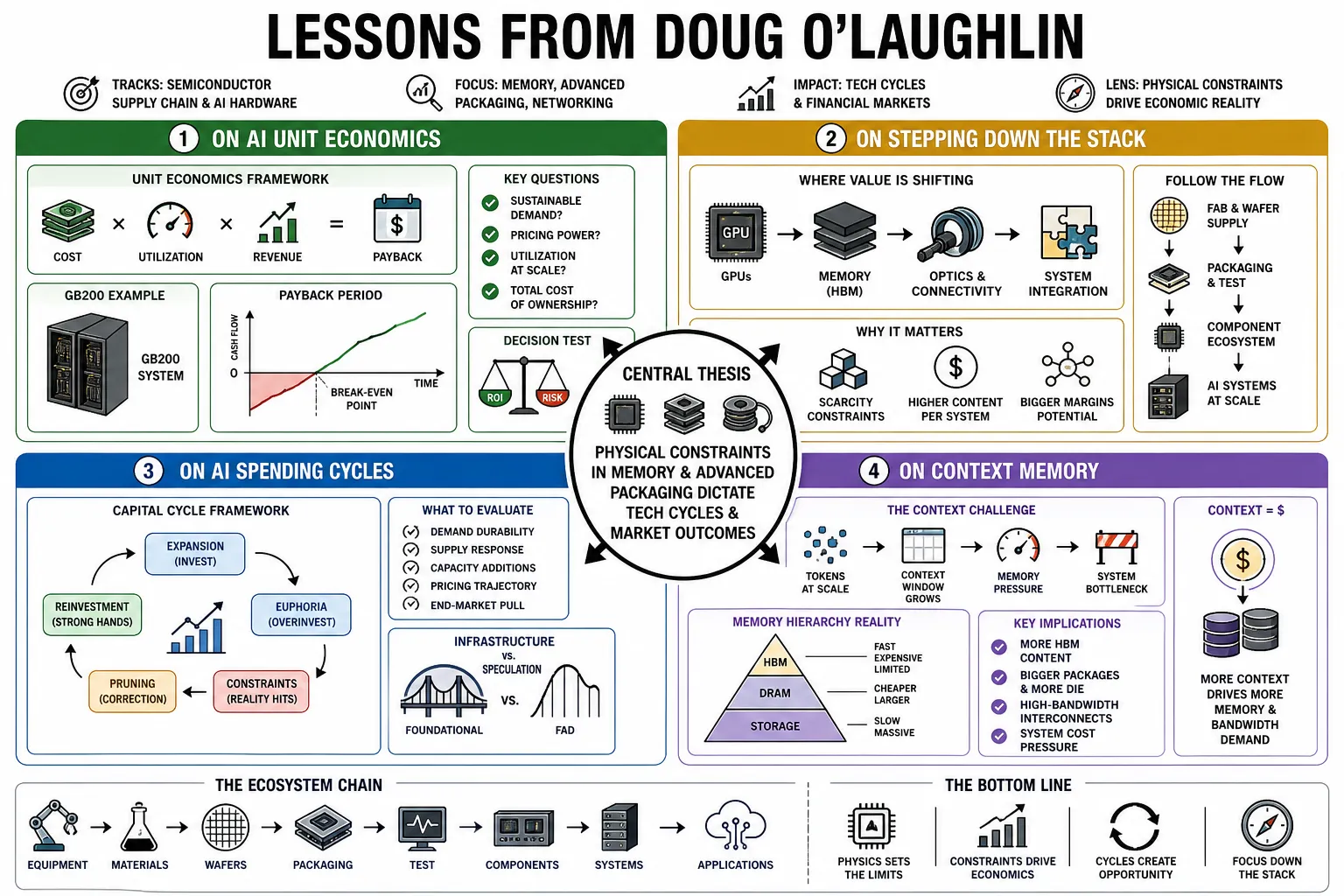
Lessons from Doug O'Laughlin
Doug O’Laughlin is president of SemiAnalysis, where he works on semiconductor strategy, market intelligence and competitive analysis. — SemiAnalysis — Doug O’Laughlin.
Part 1: The AI Infrastructure Boom
- Test the Economics of AI Scaling: O’Laughlin argues that technical progress alone is not enough to justify ever-larger AI systems: the marginal improvement must warrant the training and serving cost. — Fabricated Knowledge — Scaling Laws Meet Economics.
- Look Beyond the GPU: O’Laughlin analyzes Nvidia’s AI systems through memory and interconnect as well as the accelerator itself; he expects system design to shape performance and economics. — Fabricated Knowledge — Jensen’s World.
- Separate Durable Demand from Overbuilding: In his 2024 outlook, O’Laughlin viewed AI demand as a potentially durable market while warning that suppliers of capital goods could still overbuild capacity. — Fabricated Knowledge — Semiconductor Outlook 2024.
- Track the Memory Tiers Behind Context: In a 2025 conversation with Weka’s Val Bercovici, O’Laughlin highlighted disaggregated inference as an important trend and explored how KV-cache demands could change the role of HBM, DRAM and NVMe storage. — Fabricated Knowledge — Disaggregated Prefill/Decode Conversation.
- Let Hardware Shape Model Design: O’Laughlin argues that memory capacity and coherent serving space constrain which model sizes, context windows and inference strategies can be economical. — Fabricated Knowledge — Scaling Laws Meet Economics.
- Read Foundry CapEx as a Supply-Chain Signal: O’Laughlin treated TSMC’s raised 2021 capital-spending guidance as a signal for wafer-fab-equipment demand, while noting that other chipmakers would not necessarily match its spending pace. — Fabricated Knowledge — TSMC Earnings.
- Evaluate the Whole AI System: O’Laughlin argues that Nvidia’s advantage in 2024 came from integrating GPU silicon with memory, interconnect and rack-scale software and networking, rather than from an isolated chip benchmark. — Fabricated Knowledge — Jensen’s World.
- Watch the Memory Constraint: In his 2024 outlook, O’Laughlin identified high-bandwidth memory availability and bandwidth as potential constraints on AI accelerator supply and usefulness. — Fabricated Knowledge — Semiconductor Outlook 2024.
- Design for Power, Cooling and Data Movement: O’Laughlin describes AI rack design as a joint problem of moving data efficiently, connecting accelerators and cooling increasingly dense systems. — Fabricated Knowledge — The Data Center Is the New Compute Unit.
- Do Not Confuse Demand with Orders: O’Laughlin warned in 2024 that even a fast-growing AI end market could experience excess capital-goods supply; semiconductor investment cycles still matter. — Fabricated Knowledge — Semiconductor Outlook 2024.
Part 2: Nvidia's Moat and Ecosystem
- Nvidia Expanded from GPUs to Systems: O’Laughlin traces Nvidia’s move from graphics processors toward integrated AI systems combining accelerators, memory and networking. — Fabricated Knowledge — Jensen’s World.
- CUDA Was an Early Layer of Nvidia’s Advantage: O’Laughlin connects Nvidia’s earlier CUDA and parallel-computing investments with its later ability to scale AI systems; software is part of the story alongside silicon and networking. — Fabricated Knowledge — Jensen’s World.
- Treat the Rack as a Compute Unit: O’Laughlin argues that Nvidia’s rack-scale design can yield gains beyond chip-level scaling by placing memory, logic and interconnect closer together. — Fabricated Knowledge — The Data Center Is the New Compute Unit.
- See CoreWeave as a Strategic Cloud Partner: In a 2023 essay, O’Laughlin treated Nvidia’s investment and partnership with CoreWeave as a way to expand specialized GPU cloud supply without Nvidia operating the lower-margin service itself. — Fabricated Knowledge — Taiwan AI Conference and Nvidia.
- See the Long Software-to-System Arc: O’Laughlin describes Nvidia’s earlier CUDA and parallel-computing work as steps toward larger AI systems; its 2024 system strategy had roots well before the GB200 launch. — Fabricated Knowledge — Jensen’s World.
- Treat Nvidia’s Margins as a System Question: In an August 2023 earnings analysis, O’Laughlin distinguished Nvidia’s off-the-shelf DGX systems, which included software, from accelerator components supplied to hyperscalers when considering potential margin drivers. — Fabricated Knowledge — Nvidia: Better than Dreamed.
- Inference Changes the Hardware Trade-Off: O’Laughlin expects inference strategies to depend on the available memory pool, batch size and the cost of serving different model configurations. — Fabricated Knowledge — Scaling Laws Meet Economics.
- A Challenger Must Match More Than a Chip: O’Laughlin argued in 2023 that a rival to Nvidia would need to compete with its combined hardware, software, installed base and distribution ecosystem, not only an accelerator benchmark. — Fabricated Knowledge — Nvidia: Better than Dreamed.
- Watch Hyperscalers Design Their Own Chips: O’Laughlin argued in 2020 that large technology platforms were moving down the stack into custom processors, including Google’s TPU and Amazon’s Graviton, to control compute cost and product differentiation. — Fabricated Knowledge — The Tech Monopolies Go Vertical.
Part 3: TSMC and the Foundry Bottleneck
- Learn What CoWoS Actually Does: O’Laughlin describes TSMC’s CoWoS as a 2.5D packaging process that puts logic dies on a silicon interposer and connects them to a package substrate. — Fabricated Knowledge — Packaging History and Primer.
- Understand the Difficulty of New-Node Ramps: In a 2023 TSMC earnings analysis, O’Laughlin argued that greater process complexity made the 3-nanometer ramp harder and temporarily diluted foundry margins. — Fabricated Knowledge — TSMC and EUV’s Quandary.
- Trace Foundry Margins to Technology and Capacity: In a 2021 TSMC earnings analysis, O’Laughlin highlighted management’s view that increasingly complex leading nodes and scarce capacity supported higher pricing and a long-run gross-margin goal. — Fabricated Knowledge — TSMC Earnings.
- Match CapEx to Future Demand: O’Laughlin described TSMC’s capital spending as investment ahead of anticipated growth, but noted in 2023 that weaker demand and fab delays had pushed its guidance toward the low end of the range. — Fabricated Knowledge — TSMC and EUV’s Quandary.
- Leading-Edge Foundry Ramps Shape Chip Options: O’Laughlin argues that the shrinking number of viable leading-edge foundries makes TSMC’s process ramp strategically important to fabless chip designers. — Fabricated Knowledge — Fabs Are in Favor.
- Fabless Firms Depend on Foundry Capacity: O’Laughlin notes that many large fabless chip firms were effectively single-sourced to TSMC during the 2022 cycle, prompting greater attention to supply agreements and capacity assurance. — Fabricated Knowledge — Fabs Are in Favor.
- Yield Matters Alongside Node Size: O’Laughlin emphasizes that leading-edge manufacturing economics depend on process complexity, useful die yield and the margins achieved while a new node ramps. — Fabricated Knowledge — TSMC and EUV’s Quandary.
- Secure Capacity Before a Tight Cycle: In his 2022 analysis, O’Laughlin described how capacity shortages pushed some foundries and fabless customers toward long-term and non-cancelable supply agreements. — Fabricated Knowledge — Fabs Are in Favor.
Part 4: Intel's Stumbles and Governance
- Demand Semiconductor Expertise in Governance: In a December 2024 critique, O’Laughlin argued that Intel’s board lacked enough semiconductor operating experience to oversee its difficult foundry and product decisions. — Fabricated Knowledge — The Death of Intel.
- Foundry and Product Incentives Can Conflict: O’Laughlin saw Intel’s foundry ambition as a long-term strategic project exposed to tension with its existing product business and shorter-term shareholder pressures. — Fabricated Knowledge — The Death of Intel.
- Watch Intel’s CPU Competition: O’Laughlin argued in 2025 that Intel’s legacy CPU franchise faced pressure from AMD’s designs and the possibility of hyperscaler-owned Arm-based processors, even as its foundry assets had strategic value. — Fabricated Knowledge — Intel’s One True Stakeholder.
- Separate Short-Term Asset Value from Long-Term Strategy: O’Laughlin wrote in late 2024 that selling Intel assets might improve near-term sum-of-the-parts value while damaging its longer-term foundry and industrial strategy. — Fabricated Knowledge — The Death of Intel.
- Treat Government Support as a Proposed Stakeholder: In August 2025, O’Laughlin advocated considering a US government stake in Intel to preserve a domestic leading-edge foundry, while acknowledging the foundry’s execution problems. — Fabricated Knowledge — Intel’s One True Stakeholder.
- Read Incentive Grants as Investment Clues: In a 2023 AppLovin discussion, O’Laughlin said an unusually aggressive performance-stock grant prompted him to investigate what the board expected of management; he treated it as a clue, not proof of future returns. — Yet Another Value Podcast #166.
- Treat Intel as an Execution Problem: O’Laughlin argued in late 2024 that Intel’s foundry strategy needed experienced governance and sustained execution, not merely a short-term sale of assets. — Fabricated Knowledge — The Death of Intel.
- Consider Policy-Backed Foundry Scenarios: O’Laughlin argued in 2025 that large customer commitments and a possible US government stake could create a path for Intel Foundry, but that the company would still have to execute. — Fabricated Knowledge — Intel’s One True Stakeholder.
Part 5: Memory (HBM) and Hardware Constraints
- HBM Became a Key AI Constraint: O’Laughlin identified high-bandwidth memory as a crucial 2024 constraint for training and inference accelerators, with both demand and production economics affecting supply. — Fabricated Knowledge — Semiconductor Outlook 2024.
- Memory Supply Cannot Move Instantly: O’Laughlin wrote in 2024 that memory producers emerging from a deep downturn faced constrained capital budgets even as demand for HBM rose, limiting how quickly they could add capacity. — Fabricated Knowledge — Why HBM Is the Hottest Thing in Memory.
- Distinguish the Memory Suppliers: In early 2024, O’Laughlin favored SK Hynix as the clearest HBM exposure while expecting Micron to benefit and viewing Samsung as a less pure-play memory investment. — Fabricated Knowledge — Why HBM Is the Hottest Thing in Memory.
- Keep Memory Close to Compute: O’Laughlin argues that placing memory nearer the accelerator can improve bandwidth and power efficiency, making memory locality a core system-design choice. — Fabricated Knowledge — The Data Center Is the New Compute Unit.
- Separate Prefill from Decode: O’Laughlin highlighted in 2025 that prefill is largely compute-bound while decode is more memory-bound, making their separation an important inference-system design question. — Fabricated Knowledge — Disaggregated Prefill/Decode Conversation.
- HBM Raises the Capital Requirement: O’Laughlin argued in 2024 that HBM’s larger die area made meaningful volume growth capital-intensive for memory producers and could redirect investment away from conventional memory. — Fabricated Knowledge — Why HBM Is the Hottest Thing in Memory.
- Cooling Enables Denser Racks: O’Laughlin sees liquid cooling as a key enabler for higher-power AI racks and for packing more silicon into a small physical footprint. — Fabricated Knowledge — The Data Center Is the New Compute Unit.
- Remember Memory’s Cycles: O’Laughlin argues that memory remains capital-intensive and cyclical even when a new demand source such as HBM appears; capacity decisions can still create oversupply. — Fabricated Knowledge — Why HBM Is the Hottest Thing in Memory.
- HBM Redirects Capacity Spending: O’Laughlin expected memory producers emerging from a downturn to direct constrained capital budgets toward HBM, potentially limiting conventional DRAM and NAND supply growth. — Fabricated Knowledge — Why HBM Is the Hottest Thing in Memory.
- Memory Can Bound Accelerator Performance: O’Laughlin argues that HBM bandwidth and capacity can matter more to an AI accelerator than its headline compute figure alone. — Fabricated Knowledge — Semiconductor Outlook 2024.
Part 6: Advanced Packaging as the New Scaling
- Scale Beyond the Transistor: As shrinking chips grows costlier, O’Laughlin sees advanced packaging and rack-scale system design as additional routes to computing gains. — Fabricated Knowledge — The Data Center Is the New Compute Unit.
- CoWoS Connects Logic and Memory: O’Laughlin explains CoWoS as one of TSMC’s ways to join multiple logic dies and memory through an interposer, extending performance beyond a single monolithic die. — Fabricated Knowledge — Packaging History and Primer.
- Look at Packaging Equipment Suppliers: O’Laughlin treats advanced packaging as an emerging semiconductor-equipment segment as assembly steps move closer to wafer fabrication. — Fabricated Knowledge — Semiconductor Capital Equipment Series.
- Add Packaging to the CapEx Map: O’Laughlin argues that advanced packaging is becoming a more important equipment-spending category as wafer-level packaging begins to resemble front-end fabrication. — Fabricated Knowledge — Semiconductor Capital Equipment Series.
- Use Packaging to Combine Different Dies: O’Laughlin places chiplets and heterogeneous computing in a longer shift from single chips toward integrated packages and larger systems. — Fabricated Knowledge — The Data Center Is the New Compute Unit.
- See Packaging as a System Boundary: O’Laughlin describes advanced packages that bring logic and memory closer together, then extend the same proximity principle into the AI rack. — Fabricated Knowledge — The Data Center Is the New Compute Unit.
- Packaging Became Strategic Engineering: O’Laughlin argues that packaging moved from a relatively neglected back-end step to a strategically important area as chip geometry became harder to scale. — Fabricated Knowledge — Packaging History and Primer.
- Package Specialized Dies Together: O’Laughlin describes advanced packaging as an enabler of heterogeneous computing, bringing specialized logic and memory pieces together in one working system. — Fabricated Knowledge — Packaging History and Primer.
- Expect Constraints to Move: O’Laughlin argues that gains at the chip level expose new limits in packaging, interconnect, power and cooling, so system-level engineering becomes increasingly important. — Fabricated Knowledge — The Data Center Is the New Compute Unit.
Part 7: Semiconductor Investing Strategies
- Understand the Technology Before the Stock: O’Laughlin says semiconductor investing benefits from understanding how manufacturing roadmaps and physical constraints create future demand for equipment and materials. — Yet Another Value Podcast #112.
- Follow Foundry Capital Intensity: O’Laughlin’s TSMC analysis links rising process complexity to higher foundry capital spending and to subsequent demand for wafer-fab equipment. — Fabricated Knowledge — TSMC Earnings.
- Study Specialized Equipment Niches: O’Laughlin sees semiconductor equipment as an attractive area for investors to study because specialized process steps, concentrated suppliers and new packaging needs create differentiated businesses. — Fabricated Knowledge — Semiconductor Capital Equipment Series.
- Use Cycles Alongside Secular Trends: O’Laughlin separates the long-run emergence of AI computing from shorter semiconductor capacity and inventory cycles when assessing investment opportunities. — Fabricated Knowledge — Semiconductor Outlook 2024.
- Use Governance Signals Alongside Technical Research: The producer’s 2025 episode description says O’Laughlin discusses off-cycle performance-stock grants and reflexive incentives as potential investment signals alongside AI and power analysis. — Yet Another Value Podcast #348.
- Do Not Overlook the Mid-End: O’Laughlin called wafer-level advanced packaging an emerging, underappreciated equipment opportunity as back-end processes began to move closer to the front end. — Fabricated Knowledge — Semiconductor Capital Equipment Series.
- Power and Cooling Shape AI Infrastructure: O’Laughlin argues that the economics of scaling AI racks depend on moving data efficiently while supplying and removing increasing amounts of power and heat. — Fabricated Knowledge — The Data Center Is the New Compute Unit.
- Translate Chip Complexity for Investors: O’Laughlin describes Fabricated Knowledge as a way to explain semiconductor companies in plain English for an investment audience, using primers, history and company analysis. — Yet Another Value Podcast #112.
- Map Equipment to Process Transitions: O’Laughlin’s equipment primer argues that investors need to understand each manufacturing step and its specialist suppliers to assess technology transitions such as advanced packaging. — Fabricated Knowledge — Semiconductor Capital Equipment Series.
Part 8: Geopolitics and Global Supply Chains
- Recognize the Taiwan Foundry Dependence: O’Laughlin argues that reliance on Taiwanese leading-edge foundry capacity creates a strategic vulnerability for the United States, motivating interest in a domestic alternative. — Fabricated Knowledge — Intel’s One True Stakeholder.
- Foundry Concentration Creates Geographic Risk: O’Laughlin warned that leading-edge chip production had become highly concentrated in Taiwan, making diversification difficult because a manufacturing ecosystem cannot be rebuilt with capital alone. — Fabricated Knowledge — Fabs Are in Favor.
- Model the Effects of Export Controls: In an October 2022 analysis, O’Laughlin examined how US semiconductor export rules could affect Chinese producers and the revenue of equipment suppliers. — Fabricated Knowledge — US Export Restrictions.
- Chips Become an Industrial-Policy Concern: O’Laughlin frames US–China chip restrictions and efforts to secure domestic manufacturing as strategic choices about who controls future computing capacity. — Fabricated Knowledge — Semiconductor Outlook 2024.
- Recognize ASML’s EUV Position: O’Laughlin describes ASML’s ability to deliver extreme-ultraviolet lithography as the result of unusually difficult optical and manufacturing engineering. — Fabricated Knowledge — Lithography and ASML.
- Assess a Domestic Foundry Alternative: O’Laughlin argued in 2025 that US chip designers needed to consider whether Intel could become a viable domestic leading-edge foundry, while acknowledging its serious product and customer-experience problems. — Fabricated Knowledge — Intel’s One True Stakeholder.
- Track China’s Mature-Node Response: In a 2023 essay, O’Laughlin argued that restrictions on advanced chips had encouraged Chinese companies to expand older-node capacity, raising the possibility of future oversupply in some automotive components. — Fabricated Knowledge — Chinese EVs and the Lagging-Edge Price War.
- Examine Subsidized Fab Economics: O’Laughlin warned in 2023 that CHIPS Act incentives were encouraging Western chipmakers to add capacity while Chinese competitors were also expanding mature-node output, risking poor returns in some segments. — Fabricated Knowledge — Chinese EVs and the Lagging-Edge Price War.
- Recognize the Cost of Resilience: O’Laughlin argues that preserving a US leading-edge foundry could justify public support even if it is expensive, because reliance on one overseas center carries strategic risk. — Fabricated Knowledge — Intel’s One True Stakeholder.
- Geopolitics Changes Supply Planning: O’Laughlin argued that Taiwan concentration and US–China technology restrictions were pushing firms and governments to consider new foundry capacity and supply assurance, despite the difficulty of rebuilding manufacturing ecosystems. — Fabricated Knowledge — Fabs Are in Favor.