Lessons from Douglas Hanna
Douglas Hanna has led operations and revenue at companies like Grafana Labs, Zendesk, and Kustomer. He is best known for figuring out how to commercialize open-source software without alienating developers. This profile compiles his practical rules for pricing technical products, building sales teams, and operating as an executive.
Part 1: Open-Source Commercialization
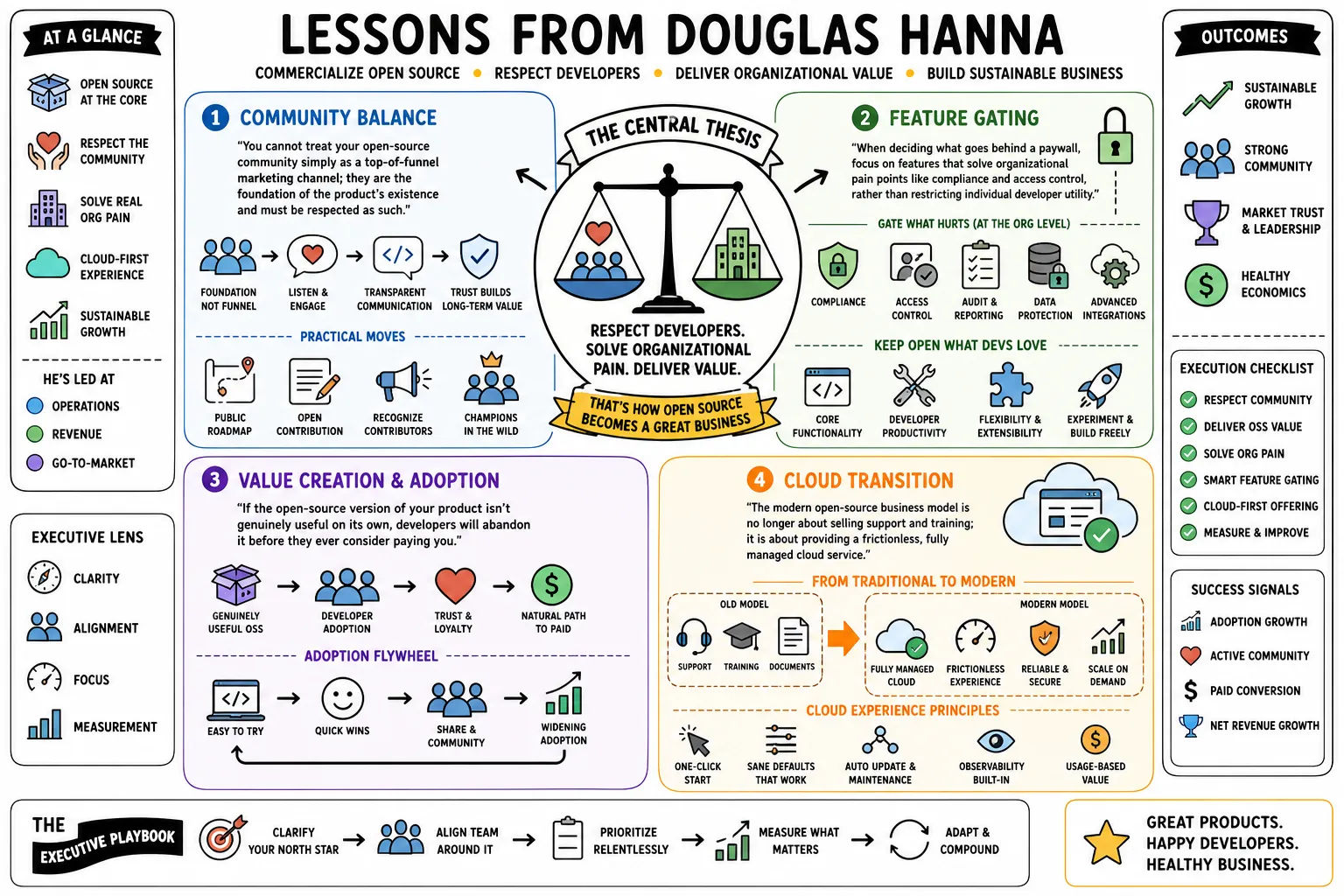
- On Community Balance: "You cannot treat your open-source community simply as a top-of-funnel marketing channel; they are the foundation of the product's existence and must be respected as such." — Source: [First Round Review]
- On Feature Gating: "When deciding what goes behind a paywall, focus on features that solve organizational pain points like compliance and access control, rather than restricting individual developer utility." — Source: [First Round Review]
- On the Cloud Transition: "The modern open-source business model is no longer about selling support and training; it is about providing a frictionless, fully managed cloud service." — Source: [First Round Review]
- On Value Creation: "If the open-source version of your product isn't genuinely useful on its own, developers will abandon it before they ever consider paying you." — Source: [SaaStr Podcast]
- On Adoption Metrics: "Track open-source downloads and active instances, but recognize that only a fraction of those users have the specific enterprise needs that justify a commercial contract." — Source: [First Round Review]
- On Commercial Tension: "It is normal for there to be internal friction between product teams wanting to give things away and sales teams wanting to monetize them; the executive's job is to manage that tension constructively." — Source: [First Round Review]
- On the Support Model: "Selling open-source support as a primary revenue driver is a decaying model because it incentivizes you to make the software hard to use." — Source: [SaaStr Podcast]
- On Open Core: "An open-core model works best when the commercial features act as administrative multipliers for the open-source foundation." — Source: [First Round Review]
- On Community Contributions: "Accepting and integrating community pull requests requires dedicated internal resources; if you don't staff for it, the community will lose faith in your stewardship." — Source: [Grafana Labs Blog]
- On Product Roadmaps: "Your commercial roadmap should never cannibalize the core promises you made to your open-source users." — Source: [First Round Review]
Part 2: Selling to Developers
- On Sales Approach: "Selling to developers requires a fundamentally different posture; high-pressure tactics will backfire immediately and permanently." — Source: [First Round Review]
- On Developer Marketing: "Developers have a highly tuned radar for obnoxious marketing and corporate jargon; they respond to technical accuracy and clear documentation." — Source: [First Round Review]
- On the First Interaction: "When a developer engages with your sales team, they usually just want to talk to an engineer who can help them solve a specific technical roadblock." — Source: [First Round Review]
- On Building Trust: "Trust with a technical audience is built over months of them using your free tools and is lost in seconds with a single aggressive cold call." — Source: [Can I Get That Software In Blue?]
- On Solutions Engineering: "Sales engineers are the bridge in developer-led sales; they must be credible practitioners rather than quota-carriers who learned a script." — Source: [First Round Review]
- On Self-Serve: "Your self-serve onboarding flow is your most important sales rep for the developer demographic." — Source: [SaaStr Podcast]
- On Objections: "A developer's objection is rarely about budget; it is almost always about architectural fit, vendor lock-in, or performance overhead." — Source: [First Round Review]
- On Enterprise Buyers: "The developer usually champions the product, but you still have to navigate procurement and security to actually close the deal." — Source: [Can I Get That Software In Blue?]
- On Proof of Concepts: "A successful proof of concept should be scoped to a single, measurable business problem rather than an open-ended exploration of the tool." — Source: [First Round Review]
- On Feedback Loops: "When a developer tells you why they aren't buying, treat that feedback as product research rather than a lost deal." — Source: [SaaStr Podcast]
Part 3: Go-to-Market Architecture
- On GTM Alignment: "Marketing, sales, and customer success cannot operate as silos; they must function as a single contiguous revenue engine." — Source: [Second in Command]
- On Funnel Metrics: "If your marketing team celebrates lead volume while your sales team complains about lead quality, your funnel architecture is broken." — Source: [SaaStr Podcast]
- On Sales Capacity: "Hiring more account executives will not fix a fundamental gap in your product-market fit or lead generation machine." — Source: [First Round Review]
- On Territory Design: "Design sales territories based on account potential and existing open-source footprints, rather than arbitrary geographic boundaries." — Source: [First Round Review]
- On Compensation: "Sales compensation plans should be aggressively simple; if a rep needs a spreadsheet to calculate their commission, the plan is too complex." — Source: [Can I Get That Software In Blue?]
- On Channel Strategy: "Partner and channel strategies are highly effective, but they only work after you have successfully figured out how to sell the product yourself." — Source: [SaaStr Podcast]
- On Renewals: "The go-to-market motion does not end at the initial sale; the renewal process should begin the day the customer signs the contract." — Source: [Second in Command]
- On Expansion: "Land and expand requires the initial landing to be incredibly successful; you cannot expand an account that is struggling with implementation." — Source: [First Round Review]
- On Sales Leadership: "The best frontline sales managers spend the majority of their time coaching reps on specific deals, rather than staring at dashboard forecasts." — Source: [Can I Get That Software In Blue?]
Part 4: Operations & Scalability
- On Systems: "Operational debt is as real as technical debt; if you patch a process with manual spreadsheets early on, it will break when you scale." — Source: [Second in Command]
- On Data Truth: "A company can only move fast if executives agree on a single source of truth for core metrics like ARR, churn, and acquisition cost." — Source: [SaaStr Podcast]
- On Process Design: "Good process is about creating predictable pathways so smart people don't have to reinvent the wheel." — Source: [Second in Command]
- On Tooling: "Do not buy enterprise software to fix a broken internal process; fix the process first, then automate it with software." — Source: [SaaStr Podcast]
- On Scaling Support: "Customer support should scale linearly or sub-linearly with revenue; if support headcount grows faster than sales, your product needs fixing." — Source: [Zendesk Engineering Blog]
- On Cross-functional Projects: "Every cross-functional initiative needs a single, named owner. Shared ownership usually results in no ownership." — Source: [Second in Command]
- On Visibility: "Operations teams exist to provide visibility and friction-reduction, rather than to act as internal police." — Source: [Second in Command]
- On Forecasting: "Accurate forecasting requires a culture of intellectual honesty, where reps aren't penalized for adjusting a close date when new information arises." — Source: [Can I Get That Software In Blue?]
- On Agility: "As you scale, the goal is to remain agile enough to change course quickly without creating whiplash for the teams executing the work." — Source: [SaaStr Podcast]
Part 5: Leadership & The COO Role
- On the COO Mandate: "The role of the COO is highly contextual; it is about filling the operational gaps around the CEO so they can focus on their most important work." — Source: [Second in Command]
- On CEO Alignment: "A COO cannot be effective without absolute, lockstep alignment with the CEO on the company's strategic priorities." — Source: [Second in Command]
- On Decision Making: "Most organizational bottlenecks are caused by a lack of clarity on who actually has the authority to make a specific decision." — Source: [Second in Command]
- On Transitioning Roles: "When moving from a founder/CEO role to a COO role, you have to unlearn the instinct to be the final word on everything." — Source: [Second in Command]
- On Managing Managers: "You have to evaluate leaders on their direct output, but equally on the capacity and health of the teams they build." — Source: [SaaStr Podcast]
- On Communication: "In a growing company, you have to repeat the core strategy until you are sick of hearing yourself say it." — Source: [Second in Command]
- On Talent Density: "You cannot compromise on hiring standards just because you have aggressive headcount targets; bad hires are vastly more expensive than empty seats." — Source: [Second in Command]
- On Prioritization: "Strategy is as much about deciding what the company will deliberately ignore as it is about what it will pursue." — Source: [SaaStr Podcast]
- On Accountability: "Accountability is holding people to the commitments they made, but doing so with the intent to solve the underlying problem rather than to assign blame." — Source: [Second in Command]
- On Ego: "The best executives view their organizations as machines they are tuning, completely detached from their personal ego." — Source: [Second in Command]
Part 6: Building Customer Trust
- On the Customer View: "Customers do not care about your internal org chart; they expect a seamless experience whether they are talking to support, billing, or sales." — Source: [Grafana Labs Blog]
- On Outages: "When something breaks, transparency is your best defense. Engineers respect vendors who admit fault and explain the technical root cause." — Source: [First Round Review]
- On Support Quality: "Treat customer support as an engineering function rather than a call center. Technical users need answers from people who understand the stack." — Source: [Zendesk Engineering Blog]
- On Vendor Lock-in: "Earning developer trust often requires proving to them that they can easily export their data and leave if they choose to." — Source: [First Round Review]
- On Customer Success: "Customer success should not be a glorified renewal team; their primary job is to ensure the customer is actually deriving value from the deployment." — Source: [Grafana Labs Blog]
- On Onboarding: "The first thirty days of a customer's journey dictate the likelihood of their renewal a year later." — Source: [SaaStr Podcast]
- On Product Feedback: "Closing the loop with a customer after they submit a feature request builds immense loyalty, even if the answer is no." — Source: [Zendesk Engineering Blog]
- On Security: "For infrastructure products, your security posture is a core feature, rather than a compliance checklist." — Source: [First Round Review]
- On Enterprise Readiness: "Enterprise readiness means having the dull, unglamorous features like role-based access control and audit logs flawlessly executed." — Source: [First Round Review]
Part 7: Pricing and Packaging
- On Value Alignment: "Pricing should roughly align with the value the customer is extracting; if they feel penalized for using the product more, the model is flawed." — Source: [First Round Review]
- On Simplicity: "If a buyer cannot independently estimate their monthly bill based on your pricing page, you are losing deals to friction." — Source: [First Round Review]
- On Freemium: "A generous free tier is an acquisition cost; it allows developers to experiment and validate without needing budget approval." — Source: [First Round Review]
- On Seat vs. Usage Pricing: "Usage-based pricing aligns better with infrastructure products, whereas seat-based pricing works for workflow tools; mixing them requires careful consideration." — Source: [First Round Review]
- On Pricing Changes: "When you raise prices, you must over-communicate the rationale to existing customers and usually grandfather them in to preserve trust." — Source: [SaaStr Podcast]
- On Discounting: "Sales teams should trade discounts for structural value, like multi-year commitments or case studies, rather than lowering the price to win a deal." — Source: [Can I Get That Software In Blue?]
- On Tiered Packaging: "The jump from a pro tier to an enterprise tier should reflect a shift in the buyer profile, rather than arbitrary feature limits." — Source: [First Round Review]
- On Open-Source Cannibalization: "Do not cripple the open-source product to force upgrades; build separate, enterprise-grade capabilities that justify the commercial price tag." — Source: [First Round Review]
- On Pilot Pricing: "Paid proofs of concept can filter out non-serious buyers, but they also slow down the sales cycle; use them selectively." — Source: [Can I Get That Software In Blue?]
Part 8: Culture and Internal Alignment
- On Shared Goals: "When we say 'we are all on sales,' it means every department understands how their specific work impacts revenue generation." — Source: [Grafana Labs Blog]
- On Customer Centricity: "Saying 'we are all on customer success' requires engineering to care about support tickets and marketing to care about user retention." — Source: [Grafana Labs Blog]
- On Remote Work: "Building culture in a distributed company requires writing things down meticulously and being highly intentional about how people gather." — Source: [Second in Command]
- On Cross-Team Friction: "Friction between product and sales is healthy if it centers on customer needs, but toxic if it becomes territorial." — Source: [Second in Command]
- On Transparency: "Internal transparency builds organizational trust; employees can handle bad news, but they cannot handle feeling out of the loop." — Source: [Second in Command]
- On Meritocracy: "A high-performance culture rewards the best ideas, regardless of whether they came from the executive team or a junior engineer." — Source: [SaaStr Podcast]
- On Adapting: "The culture that gets you to ten million in revenue will not automatically scale to one hundred million without deliberate adjustments." — Source: [Second in Command]
- On Onboarding Employees: "How you treat a new hire in their first two weeks sets the trajectory for their entire tenure at the company." — Source: [Second in Command]
- On Long-term Thinking: "You have to build the operational foundation for the company you want to be in three years, rather than the company you are today." — Source: [SaaStr Podcast]