Dr. Anders Ericsson was a Swedish psychologist and a globally recognized researcher in the psychological nature of expertise and human performance. His groundbreaking work on "deliberate practice" fundamentally changed our understanding of how people become experts. His research is the foundation upon which Malcolm Gladwell's "10,000-hour rule" was built, though Ericsson's own findings are far more nuanced.
The Core of Deliberate Practice
- The book actually frames the new world this way: it no longer makes sense to think of people as born with fixed reserves of potential; instead, potential is an expandable vessel, shaped by the various things we do throughout our lives, and learning isn't a way of reaching one's potential but rather a way of developing it. [3]
- "Deliberate practice is purposeful practice that knows where it is going and how to get there." [1]
- "The most effective practice is that which is designed and supervised by a teacher or coach who is familiar with the abilities of expert performers."
- Source: "The Role of Deliberate Practice in the Acquisition of Expert Performance" (1993 paper)
- Link: Academic Paper
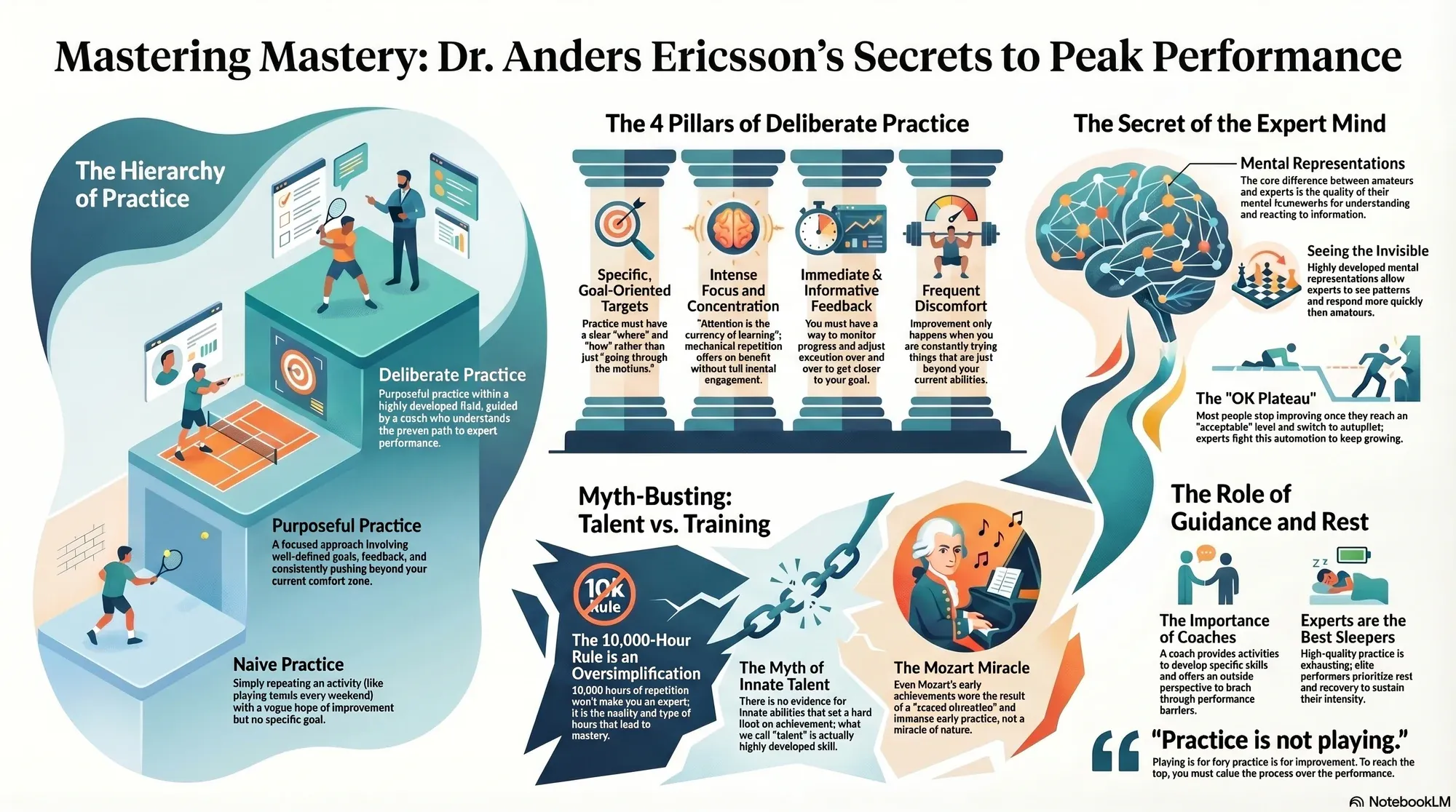
- Learning: The Four Essential Components of Deliberate Practice. It must have: 1) A specific goal, 2) Intense focus and concentration, 3) Immediate and informative feedback, and 4) Frequent stepping outside of one's comfort zone.
- Source: Peak: Secrets from the New Science of Expertise
- "You don't get benefits from mechanical repetition, but by adjusting your execution over and over to get closer to your goal."
- Source: Interview with Business Insider
- Link: Business Insider
- "Deliberate practice takes place outside one’s comfort zone and requires a student to constantly try things that are just beyond his or her current abilities."
- Source: Peak: Secrets from the New Science of Expertise
- As Tes Magazine reported it, Ericsson draws this line in less aphoristic terms than a playing-versus-practice slogan: deliberate practice is highly structured, designed to improve performance through immediate feedback, demands a lot of concentration, and is not supposed to be fun -- he explicitly distinguishes it from both play and from ordinary work, which offers external rewards. [7]
- "The right sort of practice carried out over a sufficient period of time leads to improvement. Nothing else."
- Source: Peak: Secrets from the New Science of Expertise
- Learning: This is a direct challenge to the idea that expertise is primarily based on innate talent.
Debunking the Myth of Innate Talent
- "The belief that a person’s abilities are limited by some innate talent is a major obstacle to improvement."
- Source: Peak: Secrets from the New Science of Expertise
- Learning: A fixed mindset is the enemy of expertise. Believing you can improve is a prerequisite for doing so.
- The book puts it this way: people do not stop learning and improving because they have reached some innate limits on their performance; they stop learning and improving because, for whatever reasons, they stopped practicing, or never started. [2]
- "The story of Mozart’s early achievements is a story of a child’s crazed obsession with music, not of a miracle."
- Source: An example used to show that even prodigies engaged in immense amounts of early, focused practice.
- In the same interview, Ericsson challenged the idea of innate gift-finding directly: he pushed back on the common view that your job, at least through school, is to go around looking for opportunities to discover your gifts, saying he has found no evidence that this is actually how people become good at things. [6]
The 10,000-Hour Rule (and His Clarification)
- "The 10,000-hour rule is an oversimplification. It’s not just the number of hours, but the quality of those hours that matters."
- Source: Numerous interviews clarifying his work after Gladwell's Outliers.
- Link: Freakonomics Radio Interview
- "Ten thousand hours of simply repeating the same thing will not make you an expert. Ten thousand hours of deliberate practice might."
- Source: His consistent clarification.
- Learning: 10,000 Hours is an Average. The number came from an average time it took elite violinists to reach the top. Some took more, some less. It was an observation, not a prescription.
- Source: Peak: Secrets from the New Science of Expertise
- In a Tes Magazine interview, Ericsson pushed back on the fixation with a round number: it may not take exactly ten thousand hours, but it will take a great deal of deliberate practice, and the real determining factor in success is simply not giving up on trying to improve. [4]
The Power of Mental Representations
- "The single most important difference between amateurs and experts is the quality and quantity of their mental representations."
- Source: Peak: Secrets from the New Science of Expertise
- Learning: This is a cornerstone of his theory. Experts don't just have better skills; they have better mental frameworks for understanding and reacting to situations in their field.
- "A mental representation is a pre-existing pattern of information—facts, images, rules, relationships, and so on—that is held in long-term memory and that can be used to respond quickly and effectively in certain types of situations."
- Source: Peak: Secrets from the New Science of Expertise
- Learning: Mental representations allow experts to: see patterns amateurs miss, respond more quickly, have a better understanding of their field, and know what to focus on during practice.
- Source: Peak: Secrets from the New Science of Expertise
- "Deliberate practice is the method for developing ever more effective mental representations."
- Source: Peak: Secrets from the New Science of Expertise
The Role of Coaches and Feedback
- "The best way to get past any barrier is to come at it from a different direction, which is one reason it is useful to have a coach or teacher."
- Source: Peak: Secrets from the New Science of Expertise
- "Without feedback—either from yourself or from an outside observer—you cannot figure out what you need to improve on."
- Source: Peak: Secrets from the New Science of Expertise
- "A good teacher can provide activities aimed at developing specific skills."
- Source: "The Role of Deliberate Practice in the Acquisition of Expert Performance" (1993 paper)
- "One of the best pieces of feedback is simply a report on what you did and how it compares to what you were trying to do."
- Source: Peak: Secrets from the New Science of Expertise
Purposeful Practice vs. Naive Practice
- Learning: Naive Practice. This is simply repeating an activity with the vague hope of improvement (e.g., playing tennis every weekend without a specific goal).
- Source: Peak: Secrets from the New Science of Expertise
- Learning: Purposeful Practice. This is more effective than naive practice. It has well-defined, specific goals; it's focused; it involves feedback; and it requires getting out of your comfort zone.
- Source: Peak: Secrets from the New Science of Expertise
- "Purposeful practice is the bedrock of deliberate practice, but it's not the same thing."
- Source: Peak: Secrets from the New Science of Expertise
- Learning: Deliberate practice is purposeful practice within a highly developed field, often guided by an expert coach, where the path to expertise is already well-understood.
- "Get outside your comfort zone but do it in a focused way, with clear goals, a plan for reaching those goals, and a way to monitor your progress."
- Source: Peak: Secrets from the New Science of Expertise
Additional Key Learnings and Quotes
- "Expertise is not a destination. It is a process of continuous improvement."
- "The brain is adaptable, and training can create skills that did not exist before." (The principle of neuroplasticity is central to his work).
- "To be a true expert, you must be able to reproduce your performance consistently."
- Learning: Plateaus are not a sign of reaching your limit. They are a sign that you need to change your practice methods, get more specific feedback, and push yourself in new ways.
- Source: Peak: Secrets from the New Science of Expertise
- "Break it down. Any complex skill can be broken down into smaller, manageable components to be practiced individually."
- "Motivation is a key factor. Deliberate practice is hard work, and without a strong reason to do it, you won't."
- "The effects of practice are cumulative. Every hour of high-quality practice builds on the last."
- "Once you have reached a satisfactory level of performance, your skills will automate. This is good for efficiency, but bad for improvement."
- Learning: To keep improving, you must fight against automaticity by consciously focusing on specific aspects of your performance.
- "Attention is the currency of learning."
- "How expert performers change the world is by doing things that nobody else thought was possible."
- "It's not about working harder, it's about working smarter."
- Learning: The "OK Plateau." In a Tes Magazine interview, Ericsson described this default trap directly: for a lot of people, the assumption is that you learn the rules, keep engaging and training, and then automate and basically reach your peak performance -- but he argues the opposite is true, and that real progress requires continually probing your weaknesses rather than switching to autopilot. [5]
- "The best performers are also the best sleepers." (He emphasized the role of rest and recovery in sustaining high-quality practice).
- "To practice deliberately, you must know what 'good' looks like." (Hence the importance of studying expert models).
- "Learning isn’t a way of reaching one’s potential but rather a way of developing it."
- "There are no shortcuts."
- "The human body and brain are not static; they change in response to training."
- "Age is not the barrier we think it is. The principles of deliberate practice apply at any age."
- "Identify the expert performers, figure out what they do that makes them so good, and then come up with training techniques that allow you to do it, too."
- "The most important gift from your parents is their support of your chosen passion."
- "You can't just want to be good. You have to want to do the work to be good."
- "Ultimately, the thing that sets experts apart is their dedication to the process of improvement itself."
Learn more:
- Peak: Secrets from the New Science of Expertise -- Book Summary (durmonski.com)
- Peak: Secrets from the New Science of Expertise -- Book Summary (durmonski.com)
- Peak: Secrets from the New Science of Expertise -- Book Summary (durmonski.com)
- Anders Ericsson, interviewed in Tes Magazine, "Why the 10,000 hour rule is a myth and practice doesn't make perfect"
- Anders Ericsson, interviewed in Tes Magazine, "Why the 10,000 hour rule is a myth and practice doesn't make perfect"
- Anders Ericsson, interviewed in Tes Magazine, "Why the 10,000 hour rule is a myth and practice doesn't make perfect"
- Anders Ericsson, interviewed in Tes Magazine, "Why the 10,000 hour rule is a myth and practice doesn't make perfect"