Dr. Rhonda Patrick is a biomedical scientist and the founder of FoundMyFitness, where she interviews researchers and explains evidence on nutrition, exercise and aging for a broad audience. — FoundMyFitness: About Dr. Rhonda Patrick.
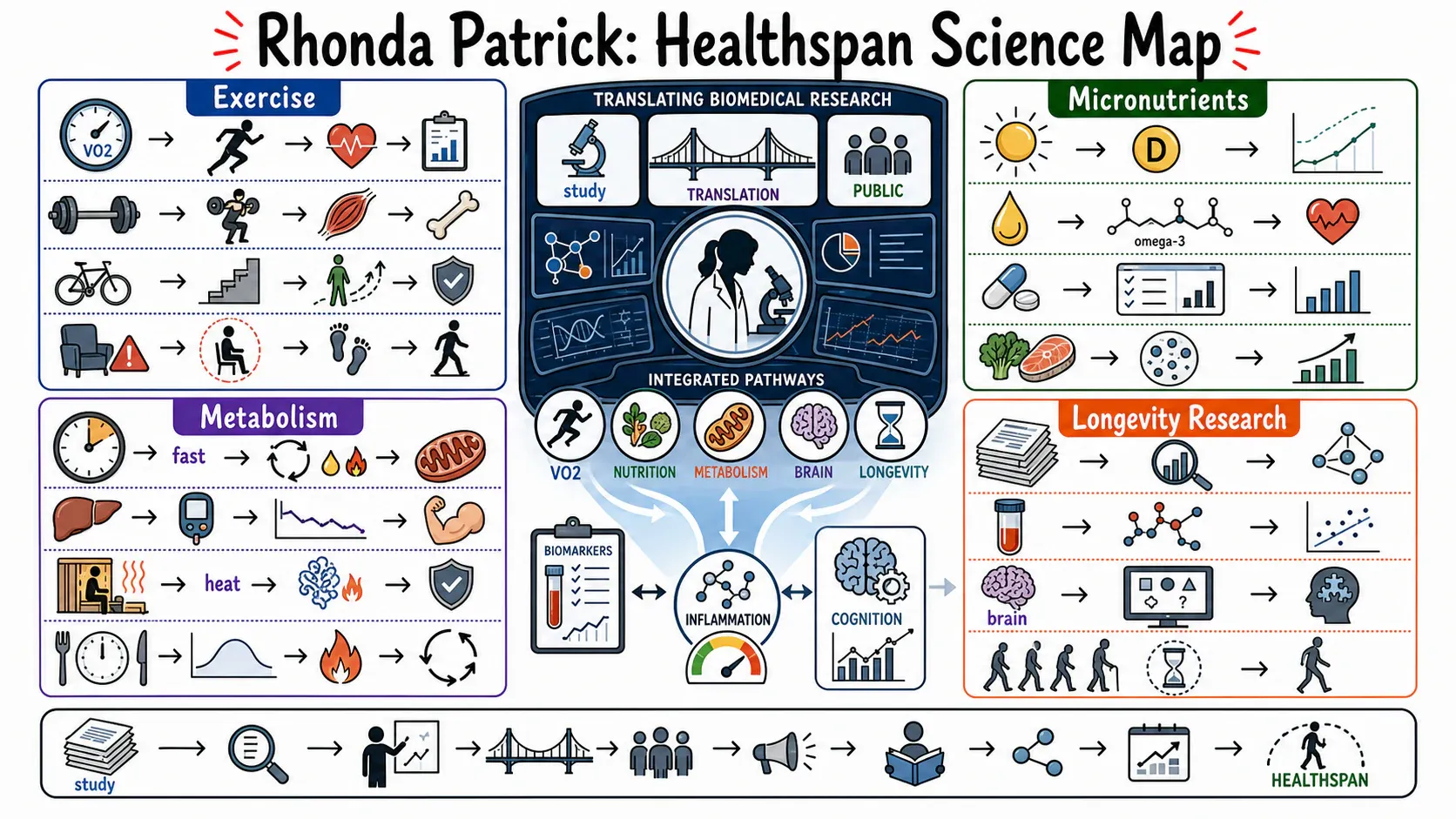
Selected Statements
- On exercise and healthspan: Patrick calls vigorous exercise one of the most powerful available healthspan practices; that is her assessment, not proof of a drug-equivalent effect. — FoundMyFitness: Why VO2 Max Is a Powerful Longevity Marker.
- On cardiorespiratory fitness: Patrick described a roughly five-year life-expectancy difference between high- and low-fitness groups in observational studies; the estimate is not an individual outcome guaranteed by training. — Tim Ferriss Show: Rhonda Patrick #819 Transcript.
- On avoiding low fitness: Patrick called sedentary living a “disease” rhetorically while arguing that cardiorespiratory fitness deserves deliberate training; this is not a clinical diagnosis. — Tim Ferriss Show: Rhonda Patrick #819 Transcript.
- On the COSMOS multivitamin trial: Patrick described trial-level cognitive-test differences in older adults as equivalent to about two years of global cognitive aging; the study did not literally reverse anyone's age. — Tim Ferriss Show: Rhonda Patrick #819 Transcript.
- On aging and vitamin D: Patrick said older skin makes substantially less vitamin D from sunlight than younger skin, citing a roughly fourfold difference between ages 70 and 20; this is not a universal dosing rule. — Tim Ferriss Show: Rhonda Patrick #819 Transcript.
- On omega-3s and inflammation: Patrick called marine omega-3s a useful dietary input for inflammatory processes; the mortality comparisons she discussed were observational. — Huberman Lab: Rhonda Patrick on Micronutrients and Longevity.
- On fasting and calories: Patrick said some free-living time-restricted-eating studies found participants ate about 200 fewer calories daily; she also distinguishes this incidental restriction from her own practice without meal skipping. — Tim Ferriss Show: Rhonda Patrick #819 Transcript.
- On exercise and blood pressure: Patrick cited studies in which regular vigorous exercise improved blood pressure. Exercise is not a substitute for prescribed antihypertensive treatment. — Rich Roll: The Fitness Doctor with Rhonda Patrick.
- On folate and DNA: Patrick compared DNA breaks from folate deficiency with ionizing radiation in a laboratory cell experiment; the comparison does not equate ordinary dietary insufficiency with a person's radiation exposure. — The Knowledge Project: Rhonda Patrick on Diet Essentials.
Learnings
Diet and Nutrition
- Prioritize micronutrient-rich foods: Patrick organizes food choices around obtaining essential nutrients and points to vegetables and fatty fish as examples, without claiming that one smoothie prevents disease. — The Knowledge Project: Rhonda Patrick on Diet Essentials.
- Separate meal timing from meal skipping: Patrick reports eating in a restricted window while maintaining her calorie and protein intake; her practice does not establish a universal metabolic or endurance benefit. — FoundMyFitness Q&A #35: Time-Restricted Eating and Muscle Loss.
- Individualize refined-grain choices: Patrick limits some grains because of her own glucose responses but explicitly says she does not eliminate all whole grains and acknowledges evidence in their favor. — FoundMyFitness Q&A #16: Why Patrick Limits Whole Grains.
- Include adequate protein: Patrick's own meals include eggs, fish and meat, and she stresses maintaining protein intake when compressing eating times, especially to protect muscle. — FoundMyFitness Q&A #35: Time-Restricted Eating and Muscle Loss.
- Understand sulforaphane as a research lead: Patrick discusses broccoli-sprout sulforaphane and early human glutathione findings; a cellular mechanism is not proof of broad disease prevention. — FoundMyFitness: New Omega-3 and Sulforaphane Research.
- Interpret the omega-3 index cautiously: In the Framingham cohort, higher red-cell omega-3 status was associated with lower adjusted mortality and cardiovascular-event rates; the study did not test whether supplements cause extra years of life. — Framingham Heart Study: Omega-3 Index and Mortality.
- Use nutrient-dense foods as examples: Patrick has described eating salmon, kale, avocado and blueberries in her own routine; these are examples from her diet, not a required daily four-food prescription. — FoundMyFitness Q&A #6: Fasting, Omega-3s and CGM.
- Get magnesium from food: Patrick discusses magnesium's role in DNA synthesis and repair and identifies leafy greens as a source; this mechanism does not establish that supplementation prevents cancer. — FoundMyFitness: Vitamin D, Omega-3s and Exercise.
- Treat vitamin D as a hormone, not a universal target: Patrick explains vitamin D's gene-regulating role and favors assessing status; the captured 40–60 ng/mL range should not be presented as a universal clinical target. — Huberman Lab: Rhonda Patrick on Micronutrients and Longevity.
- Use genetics as one input to nutrition: Patrick's nutrigenomics presentation examines variants that affect nutrient metabolism, including folate pathways; it does not establish that her own genotype requires extra folate. — FoundMyFitness: Personalize Nutrition Based on Genetics.
- Protect protein intake at breakfast: Patrick describes protein-containing breakfasts and cautions that time-restricted eating need not mean dropping meals or protein. — FoundMyFitness Q&A #35: Time-Restricted Eating and Muscle Loss.
- Consider the timing of meals: Patrick discusses circadian variation in glucose responses and earlier eating; these study-specific observations do not prove that timing is as important as diet quality for everyone. — FoundMyFitness Q&A #35: Time-Restricted Eating and Muscle Loss.
- Distinguish forms of DHA: Patrick discusses phospholipid DHA transport to the brain as a mechanistic question; superior long-term human outcomes from salmon roe are not established. — FoundMyFitness: New Omega-3 and Sulforaphane Research.
Exercise
- Combine aerobic and strength work: Patrick describes adding demanding resistance training to her long-standing endurance practice; her routine changes over time and is not a fixed universal prescription. — Rich Roll: The Fitness Doctor with Rhonda Patrick.
- Train cardiorespiratory fitness: Patrick advocates appropriately scaled vigorous intervals to improve VO2 max; links between measured fitness and lifespan are observational. — FoundMyFitness: Why VO2 Max Is a Powerful Longevity Marker.
- Use the 4x4 protocol as one option: Patrick describes four four-minute efforts separated by three-minute recoveries; a randomized study in 40 moderately trained men found VO2 max gains after eight weeks. — Helgerud et al.: Aerobic 4x4 Interval Trial.
- Strength train with a sustainable routine: Patrick describes squats and deadlifts in a more recent routine; the original fixed 2–3-times-weekly detail is not established across time. — Rich Roll: The Fitness Doctor with Rhonda Patrick.
- Separate brain-health signals from literal rejuvenation: Patrick reviews randomized exercise studies using MRI-derived brain-age models; within one group, greater leg-strength gains tracked with modelled brain-age changes, not demonstrated new neurons or brain-volume growth. — FoundMyFitness: Strength, Endurance and Brain Aging.
- Use short vigorous movement when feasible: In a UK Biobank cohort of nonexercisers, brief vigorous daily activity was associated with lower subsequent cancer incidence; the analysis does not prove the bursts prevent cancer or reduce mortality. — JAMA Oncology: Vigorous Intermittent Activity and Cancer.
- Lactate can fuel the brain: Patrick discusses lactate produced during vigorous exercise as a substrate available to the brain; this biochemical mechanism alone does not prove better cognition. — FoundMyFitness: Vitamin D, Omega-3s and Exercise.
Sauna Use (Hyperthermic Conditioning)
- Understand sauna as complementary heat stress: Patrick describes sauna-induced heart-rate, blood-flow and heat responses that overlap with aspects of moderate exercise, not a replacement for exercise. — FoundMyFitness: Ultimate Guide to Saunas and Heat Exposure.
- Keep sauna frequency associations in context: A Finnish cohort of middle-aged men associated four-to-seven weekly sauna visits with lower dementia incidence than one weekly visit; the design cannot establish a best preventive dose. — Age and Ageing: Sauna Bathing and Dementia in Finnish Men.
- Distinguish sauna association from mechanism: Frequent sauna use was associated with lower dementia incidence in one male cohort; heat-shock proteins are a proposed mechanism, not proof that sauna prevents Alzheimer's disease. — Age and Ageing: Sauna Bathing and Dementia in Finnish Men.
- Separate mood experience from depression treatment: Patrick reports that sauna helps her mood; a small sham-controlled study involved specialized whole-body hyperthermia rather than ordinary sauna bathing. — FoundMyFitness: Sauna, Depression and Mood.
- Interpret sauna immunity claims cautiously: Patrick describes observational links with fewer respiratory infections and explicitly says there was no direct evidence for COVID-19 effects in that discussion. — FoundMyFitness: Sauna and Respiratory Infections.
- Describe studied sauna settings, not an optimum: Patrick notes Finnish studies around 174°F for roughly 20 minutes and personally uses about 175–180°F; safe tolerances vary by person and health status. — FoundMyFitness: Ultimate Guide to Saunas and Heat Exposure.
- Sauna reproduces some exercise responses: Patrick describes elevated heart rate and circulation during sauna bathing, while noting that heat exposure is not the same intervention as aerobic exercise. — FoundMyFitness: Ultimate Guide to Saunas and Heat Exposure.
Longevity and Aging
- Use hormesis as a framework: Patrick describes intermittent exercise, heat and other stressors as triggering adaptive pathways; the framework is not direct proof of longer human lifespan. — FoundMyFitness: Vitamin D, Omega-3s and Exercise.
- Explore cellular senescence with its actual expert: Patrick interviews Judith Campisi about senescence and aging; Campisi provides the mechanistic research explanation, and human anti-aging treatment is not established. — FoundMyFitness: Judith Campisi on Cellular Senescence.
- Study nutrient insufficiency without overclaiming prevention: Patrick's research and communication focus includes how micronutrient insufficiency relates to metabolism and aging; broad disease-prevention effects remain separate questions. — Buck Institute: Training to Age Better.
- Treat inflammation as one biological lens: Patrick discusses inflammation in aging and the roles of diet, exercise and heat; this does not show that a combined routine prevents age-related diseases. — Buck Institute: Training to Age Better.
General Wellness and Mindset
- Start with what the diet needs to supply: Patrick's nutrition framework emphasizes adding sources of essential micronutrients rather than only compiling forbidden foods. — The Knowledge Project: Rhonda Patrick on Diet Essentials.
- Make sleep a consistent priority: Patrick reported aiming for eight to nine hours of sleep and adjusting evening light in a first-person Q&A; this describes her practice. — FoundMyFitness Q&A #6: Fasting, Omega-3s and CGM.
- Use CGM observations as self-experiment data: Patrick reports wearing a CGM and observing individual food responses; that personal experiment does not make CGM necessary for healthy people. — FoundMyFitness Q&A #6: Fasting, Omega-3s and CGM.
- Communicate science accessibly: Patrick recounts moving from laboratory research to articles, videos and interviews so non-specialists could engage with the evidence. — Buck Institute: Training to Age Better.
- Choose activity you can sustain: Patrick advises starting with a form of physical activity one can repeat regularly before optimizing a specific training zone or protocol. — FoundMyFitness: Vitamin D, Omega-3s and Exercise.
Learn more:
- FoundMyFitness: Why VO2 Max Is a Powerful Longevity Marker
- Tim Ferriss Show: Rhonda Patrick #819 Transcript
- Huberman Lab: Rhonda Patrick on Micronutrients and Longevity
- Rich Roll: The Fitness Doctor with Rhonda Patrick
- The Knowledge Project: Rhonda Patrick on Diet Essentials
- FoundMyFitness: About Dr. Rhonda Patrick
- Buck Institute: Training to Age Better
- FoundMyFitness: Vitamin D, Omega-3s and Exercise
- FoundMyFitness Q&A #35: Time-Restricted Eating and Muscle Loss
- FoundMyFitness Q&A #6: Fasting, Omega-3s and CGM
- FoundMyFitness Q&A #16: Why Patrick Limits Whole Grains
- FoundMyFitness: New Omega-3 and Sulforaphane Research
- FoundMyFitness: Judith Campisi on Cellular Senescence
- FoundMyFitness: Ultimate Guide to Saunas and Heat Exposure
- FoundMyFitness: Sauna and Respiratory Infections
- FoundMyFitness: Sauna, Depression and Mood
- FoundMyFitness: Personalize Nutrition Based on Genetics
- AJCN: COSMOS Multivitamin Cognitive Trial
- Framingham Heart Study: Omega-3 Index and Mortality
- Age and Ageing: Sauna Bathing and Dementia in Finnish Men
- JAMA Oncology: Vigorous Intermittent Activity and Cancer
- Helgerud et al.: Aerobic 4x4 Interval Trial
- FoundMyFitness: Strength, Endurance and Brain Aging