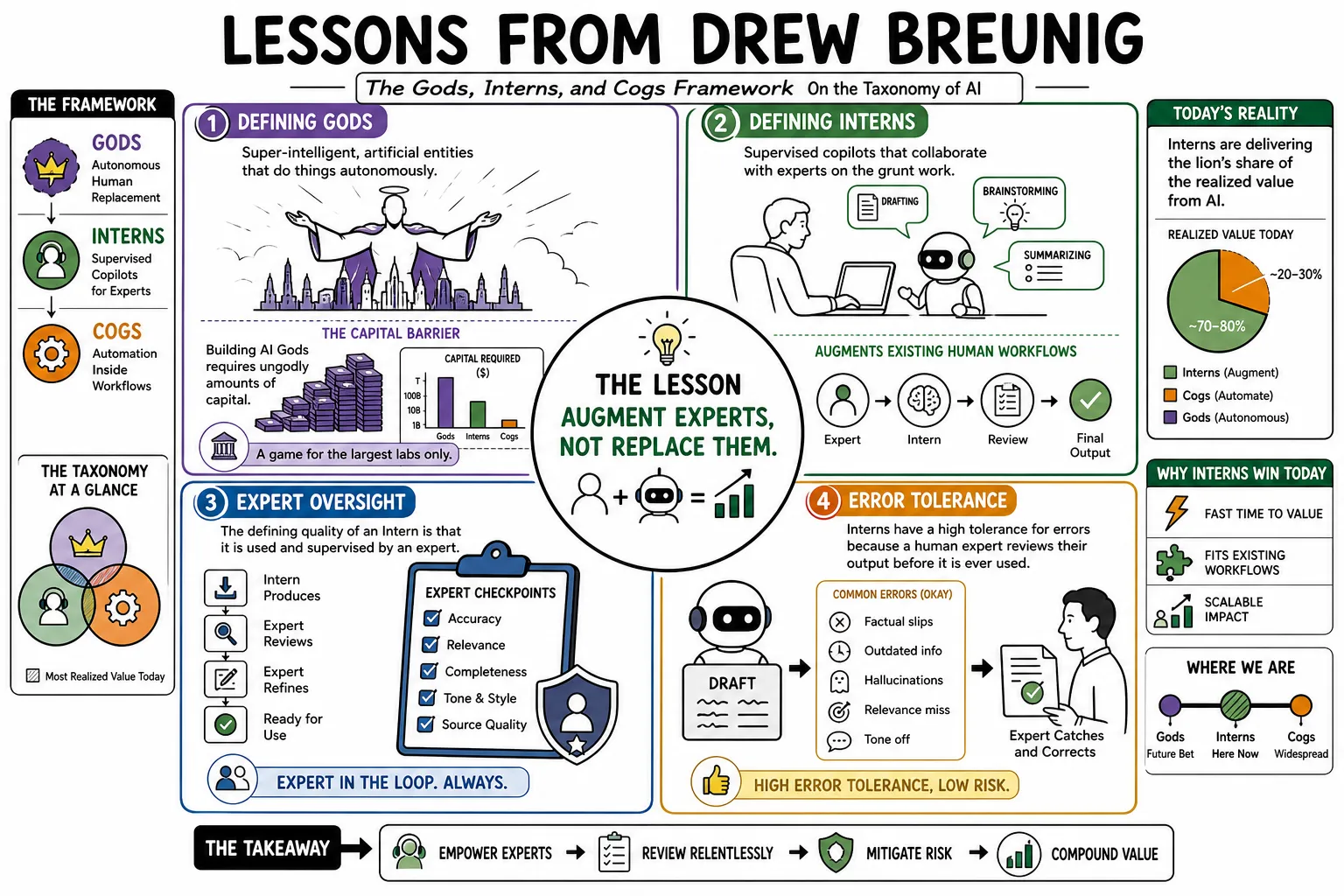
Part 1: The Gods, Interns, and Cogs Framework
- On the Taxonomy of AI: "AI use cases can be simplified into three distinct buckets: Gods, Interns, and Cogs." — Source: dbreunig.com
- On Defining Gods: "Gods are super-intelligent, artificial entities that do things autonomously and represent the human replacement use case." — Source: dbreunig.com
- On the Capital Barrier: "Building AI Gods requires ungodly amounts of capital—billions or trillions of dollars—making it a game only for the largest labs." — Source: dbreunig.com
- On Defining Interns: "Interns are supervised copilots that collaborate with experts, focusing on the grunt work of drafting, brainstorming, and summarizing." — Source: dbreunig.com
- On Expert Oversight: "The defining quality of an Intern is that it is used and supervised by an expert who can catch its inevitable mistakes." — Source: dbreunig.com
- On Error Tolerance: "Interns have a high tolerance for errors because a human expert reviews their output before it is ever used in a final product." — Source: dbreunig.com
- On Realized Value: "Today, Interns are delivering the lion's share of the realized value from AI because they augment existing human workflows." — Source: dbreunig.com
- On Defining Cogs: "Cogs are functions optimized to perform a single task extremely well, usually as part of a larger, automated software pipeline." — Source: dbreunig.com
- On Low Error Tolerance: "Cogs have a low tolerance for errors because they run unsupervised; if a Cog fails, the entire pipeline often fails with it." — Source: dbreunig.com
- On Sorting for Bottlenecks: "Sorting AI into these buckets helps identify the specific technical and capital bottlenecks holding back each category of application." — Source: dbreunig.com
Part 2: Context Engineering Fundamentals
- On the Core Definition: "Context Engineering is the systematic discipline of designing, organizing, and optimizing the complete informational payload provided to an LLM at inference time." — Source: dbreunig.com
- On the RAM Metaphor: "If the LLM is the CPU, the context window is the RAM—the model’s limited, high-speed working memory that must be managed." — Source: dbreunig.com
- On Architecture vs. Text: "Context is no longer just a string of text; it is a compilation pipeline that assembles data, tools, and state." — Source: dbreunig.com
- On the 80/20 Rule: "In production AI, the prompt is 20% of the work; the other 80% is the engineering of the environment and context around it." — Source: dbreunig.com
- On Context as a Product: "Your knowledge base and context assembly logic should be treated as a living product, not a static asset." — Source: dbreunig.com
- On the Iceberg Insight: "Prompt engineering focuses on the tip, the instruction; context engineering focuses on the massive submerged portion, the data environment." — Source: dbreunig.com
- On Pure Functionality: "LLMs are essentially pure functions; the quality of the output depends entirely on the structure and relevance of the input context." — Source: dbreunig.com
- On Situational Awareness: "Context engineering gives AI the situational awareness needed to act with relevance and precision in a specific business domain." — Source: dbreunig.com
- On Stateless to Stateful: "Prompting is for stateless tasks; context engineering is for stateful, multi-turn agentic workflows that require memory." — Source: dbreunig.com
- On the Karpathy Effect: "The term 'Context Engineering' identified a common technical experience that had been felt but not yet named by the community." — Source: dbreunig.com
Part 3: The Mechanics of Context Rot
- On Context Poisoning: "Context poisoning occurs when a hallucination enters the context window and the model repeatedly references it as truth in future turns." — Source: dbreunig.com
- On Context Distraction: "When the context grows too large, the model may over-focus on provided text and neglect the logic of its underlying training." — Source: dbreunig.com
- On Context Confusion: "Superfluous or irrelevant information in the window causes context confusion, leading the model to generate low-quality, noisy responses." — Source: dbreunig.com
- On Context Clash: "Context clash happens when new tool outputs or user inputs conflict with earlier instructions or established conversation facts." — Source: dbreunig.com
- On Lost in the Middle: "Accuracy drops significantly when the decisive fact is buried in the middle of a long context window rather than the ends." — Source: dbreunig.com
- On Context Rot: "Context rot is the systematic degradation of AI performance as a session grows longer and the signal-to-noise ratio drops." — Source: dbreunig.com
- On Token Pressure: "As the window fills, models start cutting corners, leading to shorter, less nuanced, or logically incomplete reasoning." — Source: dbreunig.com
- On Instruction Drift: "Models tend to stop honoring initial system constraints as the volume of conversation history accumulates in the window." — Source: dbreunig.com
- On the U-Shaped Curve: "Retrieval performance follows a U-shaped curve; models remember the beginning and the end but fail at the center." — Source: dbreunig.com
- On the Attention Tax: "If you put something in the context, the model has to pay attention to it, whether it is relevant or not." — Source: dbreunig.com
Part 4: AI Product Strategy and Subsumption
- On the Subsumption Window: "The subsumption window is the time between a product's launch and when a future foundation model replicates its core functionality." — Source: dbreunig.com
- On What to Build Today: "The haunting question for every AI product team is: what can you build today that won't be subsumed by tomorrow's model?" — Source: dbreunig.com
- On Resistance to Subsumption: "Features resistant to subsumption include unique user interfaces, proprietary data access, and complex multi-step workflow integration." — Source: dbreunig.com
- On Spec-Driven Development: "In spec-driven development, the specification is the actual product, and the code is merely a generated artifact." — Source: GitHub
- On the Spec-Tests-Code Triangle: "Reliable AI systems require a Spec-Tests-Code triangle where the model's output is constantly validated against rigid specifications." — Source: GitHub
- On AI as a Commodity: "The model itself is becoming a commodity; the value lies in the specialized context and the workflow it enables." — Source: dbreunig.com
- On Unique UI as Defense: "A specialized UI that solves a specific user problem remains a defensive moat even when the underlying model gets smarter." — Source: dbreunig.com
- On Proprietary Data as Defense: "Proprietary data that the model hasn't seen during training is the most robust defense against being subsumed." — Source: dbreunig.com
- On the Year of Context: "2026 will be the year where context engineering officially replaces prompt engineering as the dominant technical discipline." — Source: dbreunig.com
- On the Communication Tax: "Emergent fields pay a communication tax; we must agree on the meaning of words before we can do productive work." — Source: dbreunig.com
Part 5: Location Intelligence and Geospatial Standards
- On Making Place as Easy as Time: "The goal of modern geospatial engineering is to make place as easy to work with as time is in software." — Source: dbreunig.com
- On Standardizing the Built Environment: "Standardizing the human-made world—stores, offices, and infrastructure—is far more complex than mapping natural geography." — Source: dbreunig.com
- On the Join Problem: "The hardest part of geospatial data is the 'join'—trying to combine disparate datasets that refer to the same physical location." — Source: dbreunig.com
- On Placekey Utility: "Placekey provides a universal identifier for physical places, solving the joining problem without sharing sensitive latitude/longitude data." — Source: Placekey Blog
- On Overture Maps and GERS: "The Global Entity Reference System (GERS) is the industry's attempt to create a common ID for every building on Earth." — Source: Overture Maps Foundation
- On Location-Aware Insights: "Location intelligence is really about understanding journeys and brand affinities, not just seeing pings on a map." — Source: dbreunig.com
- On Mapping the Human-Made World: "We spend 90% of our lives inside the human-made world, yet our maps are still largely focused on the natural one." — Source: dbreunig.com
- On Data Interoperability: "Geospatial data interoperability is the prerequisite for building truly intelligent local service agents." — Source: Overture Maps Foundation
- On the GERS Importance: "GERS isn't just a database; it's a shared language that allows different organizations to speak about the same physical entities." — Source: Overture Maps Foundation
Part 6: Data Integrity and Information Environments
- On Information Environment vs. Model: "The model is not the bottleneck; the information environment you construct around the model determines its reliability." — Source: dbreunig.com
- On Data Integrity as Strategy: "Data integrity is a strategic positioning problem; if you can't trust the data, you can't build a product around it." — Source: Precisely Blog
- On Reliability over Optimization: "In the current era of LLMs, reliability is a much bigger bottleneck for adoption than speed or cost optimization." — Source: dbreunig.com
- On Context as Infrastructure: "Enterprise context is shifting from a per-call variable to a governed, unified infrastructure layer shared by many agents." — Source: dbreunig.com
- On Context Caching: "Context caching is the primary technical lever for making large, static background information affordable at scale." — Source: dbreunig.com
- On Stable Prefixes: "Keep prompt prefixes stable and predictable to maximize cache reuse and significantly lower overall system latency." — Source: dbreunig.com
- On Deterministic Serialization: "Serialize your context, actions, and observations in a predictable, repeatable order to ensure model consistency." — Source: dbreunig.com
- On Noise Filtering: "The science of context engineering is often more about what you systematically exclude than what you choose to include." — Source: dbreunig.com
- On the Wiki Sweet Spot: "For many corporate agents, a curated wiki of 1,000 high-signal documents is more valuable than an unmanaged lake of 1,000,000." — Source: dbreunig.com
Part 7: Engineering Reliability and Tool Harnesses
- On Compound AI Systems: "Modern AI systems are compound architectures built from multiple models, specialized tools, and state management logic." — Source: dbreunig.com
- On the Agent Harness: "The agent harness is the software wrapper that manages the flow of context, memory, and tool-calling in and out of the model." — Source: dbreunig.com
- On Software Engineering Best Practices: "Software engineering remains the discipline of managing complexity and reliability, even when models do the coding." — Source: dbreunig.com
- On Evals as Backbone: "Rigorous, automated evaluations are the backbone of any successful context engineering project." — Source: dbreunig.com
- On the Reliability Bottleneck: "Employees won't use AI if it's wrong even 10% of the time, because then it becomes more work to supervise than to do manually." — Source: dbreunig.com
- On Tool Loadout: "Actively selecting only the subset of tools relevant to a specific task phase prevents the model from becoming confused by tool sprawl." — Source: dbreunig.com
- On Context Quarantine: "Isolate specific sub-tasks into their own dedicated threads to prevent early errors from poisoning the entire project context." — Source: dbreunig.com
- On Agentic RAG: "We are moving from fixed RAG pipelines to reasoning loops where the agent proactively decides what information it needs to retrieve." — Source: dbreunig.com
- On Black Box Memory Warning: "Avoid black box memory systems; agents need transparent, auditable, and steerable memory to be safe for production." — Source: dbreunig.com
Part 8: The Cultural and Linguistic Shift of AI
- On Language Defining Reality: "Language does not just describe reality; it defines reality and puts hard limits on the conversations we can have." — Source: dbreunig.com
- On Knighting Buzzwords: "The term 'context engineering' gained traction because it was knighted by industry leaders, crystallizing a shared technical experience." — Source: dbreunig.com
- On AI Fluency as Leadership: "AI fluency is no longer a technical nice-to-have; it is a mandatory leadership skill for anyone managing a modern workforce." — Source: dbreunig.com
- On Transforming Thought: "AI isn't just transforming the work we produce; it is transforming how we think through problems together in teams." — Source: dbreunig.com
- On AI Security as Proof of Work: "Cybersecurity increasingly looks like proof of work; you don't win by being clever, you win by out-spending the attacker in tokens." — Source: dbreunig.com
- On Tokens as Proof of Stake: "Tokens are the new units of digital verification; the cost of compute is becoming the ultimate barrier to entry for malicious actors." — Source: dbreunig.com
- On the Cathedral and the Bazaar: "The future of AI is a battle between the Cathedral of closed labs and the Bazaar of open-source context engineers." — Source: dbreunig.com
- On the Winchester Mystery House Warning: "Avoid building AI systems that grow haphazardly like the Winchester Mystery House; they need a central, intentional architecture." — Source: dbreunig.com