Dylan Field cofounded Figma with Evan Wallace and serves as its CEO. The company's long-running aim is to help more people move ideas from imagination into shareable, collaborative designs. — Figma Founder Letter.
On Design and Creativity
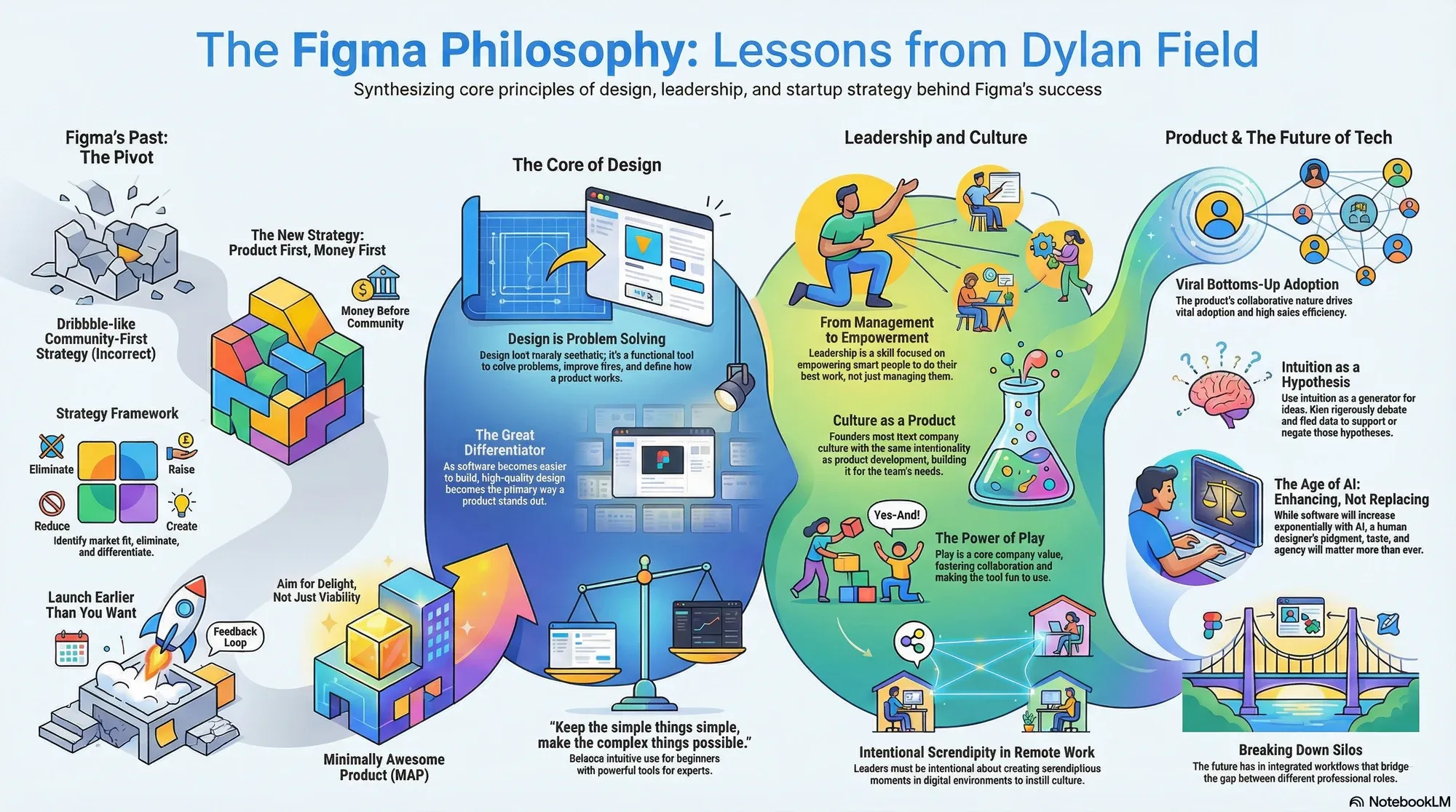
- Design as Problem-Solving: Field describes design as applying art to problem-solving; designers must bring user needs, context, and the wider product experience into their work. — Figma Conversation with Garry Tan.
- How Things Work: For Field, design extends beyond a product's appearance to how people interact with it and whether it works well for them. — Stratechery Interview.
- Subjective Design: Field says taste, culture, aesthetics, and user experience resist simple verification; these judgment-heavy aspects of design remain difficult for AI models to reproduce at high craft. — Stratechery Interview.
- Defining Taste: Field describes taste as having clear preferences among possibilities and being able to explain the direction one is trying to achieve. — Behind the Craft Interview.
- Having a Point of View: Field distinguishes point of view from taste: a design should express a distinctive insight, not just a position everyone already agrees with. — Behind the Craft Interview.
- Creative Risk: Field argues that when AI produces average-looking work, a distinct creative voice and a willingness to take risks can make writing or design stand out. — Hard Fork Live Interview.
- Speed and Visual Exploration: Field argues that AI can speed scaffolding, but creators still need to explore and iterate visually instead of simply following the first generated direction. — Stratechery Interview.
- Balancing Simplicity and Power: Figma tries to remain approachable for new users while retaining power for experienced users; Field sees making simple work easy without blocking complex work as an ongoing design challenge. — Figma Conversation with Garry Tan.
- Collaborative Play: Field connects Figma's collaboration to the improv spirit of building on another person's idea, enabling people to create together in a shared space. — Sequoia Capital Interview.
- Simple and Complex: Field endorses making simple tasks simple while keeping complex tasks possible, but explicitly says the familiar phrase is not his own quotation. — Config 2024 Video Interview.
- Design as Differentiation: Field says that as software becomes easier to build, design becomes more important as a way for products to stand apart. — Figma Conversation with Garry Tan.
- Accessible Design: Field's aim is to lower the barriers to creative tools and bring more people into the design process, beyond specialist designers. — Brown Daily Herald Interview.
On Entrepreneurship and Startups
- Launching Earlier: Looking back on Figma's long stealth period, Field advises founders to launch earlier than feels comfortable so they can get feedback and build interest. — South Park Commons Fireside Chat.
- Monetizing Before Community: Field says Figma first envisioned a design community, then chose to establish a business tool before building the community around it. — TechCrunch Early Stage Interview.
- Differentiation Frameworks: Field says the team used the Eliminate, Raise, Reduce, Create framework to clarify how Figma could differ from existing design tools. — South Park Commons Fireside Chat.
- Design-Led Economies: Field observed that more economic activity was becoming digital and argued that design was increasingly important to competitive outcomes. — Distributed Podcast Transcript.
- Making Creativity Accessible: Field's early ambition was to make creative tools simpler and available in the browser so more people could express their ideas. — Brown Daily Herald Interview.
- Choosing Ideas That Matter: Field advises founders to choose a problem they genuinely care about: building takes years, and personal commitment helps sustain the work even if one idea fails. — Elad Gil Fireside Transcript.
- Product and Design as a Career Compass: Field says his interest in technology was driven more by imagining future products and design than by mastering technology for control. — Stratechery Interview.
On Leadership and Management
- Empowering Smart People: Field recalls that he initially failed to give talented colleagues enough room to do their best work and had to learn to empower them. — Sequoia Capital Interview.
- Building the Company as a Product: Field says founders build a company and culture for their team as deliberately as they build a product for users. — Sequoia Capital Interview.
- Learning Leadership: Field entered Figma with little management experience and had to develop those skills with feedback and help from more experienced colleagues. — Sequoia Capital Interview.
- Continuous Improvement: Field argues that a founder can become so reactive that they never improve the organization; delegating recurring work creates room to build the next layer of the team. — Figma Conversation with Garry Tan.
- Empowerment Over Home Runs: Field recalls pushing for big wins while giving the team too little autonomy; difficult feedback led him to change how he managed. — Sequoia Capital Interview.
- Sustaining Urgency: Field says teams sustain pace by choosing well-motivated problems, moving on when work will not converge, and examining assumptions behind long timelines. — 2025 Dylan Field Video Interview.
On Company Culture
- Culture and Execution: Field recognized that Figma's early silent office was not enjoyable and deliberately made fun a part of the company culture. — Index Ventures Interview.
- Remote Culture: Field says distributed teams cannot rely on an office's physical context to convey values, so important cultural signals need to be made explicit digitally. — Distributed Podcast Transcript.
- Creating Serendipity: Field urges remote teams to intentionally create serendipitous collaborative moments rather than expect them to happen on their own. — Distributed Podcast Transcript.
- Play as a Company Value: Field says play is a Figma value in both team culture and product experience, and the company aims to make creative work enjoyable. — Figma Conversation with Garry Tan.
On Product and Users
- Listening to Dissatisfied Users: Field reads feedback and support channels, including complaints, and asks what underlying problem a user is trying to solve. — Config 2024 Video Interview.
- Product-Led Distribution: Figma's official prospectus says browser-based collaboration and URL sharing helped the product spread within teams; its bottoms-up adoption is supplemented by direct sales and marketing. — Figma IPO Prospectus.
- Intuition as Hypothesis: Field treats intuition as a hypothesis generator: teams should debate ideas and test them with evidence rather than accept instinct as the final word. — Config 2024 Video Interview.
- The Minimally Awesome Product: Field says launch scope requires tradeoffs among quality, features, and deadline; a new product needs sufficient quality even when its feature set is narrow. — Config 2024 Video Interview.
- Delivering Outcomes: For Field, strong product managers focus on problems and outcomes, align colleagues around a shared goal, and keep the team together through milestones. — Config 2024 Video Interview.
- Expanding from Strength to Strength: Field cautions against choosing the next product solely by apparent market size; he favors extending Figma's strengths and observed user needs. — 2025 Dylan Field Video Interview.
- Removing Activation Blockers: Field says Figma assigned a team to remove activation blockers one by one and saw retention and activation improve, while balancing this with exciting new features. — 2025 Dylan Field Video Interview.
On the Future and Technology
- Accessible Collaborative Design: Field envisions tools that let more people participate in design and help teams move together from ideas through prototypes toward shipped work. — Figma Conversation with Garry Tan.
- AI Specialization: In a 2024 interview, Field expected AI-model companies to specialize further over time, while noting that model capabilities and prices were changing rapidly. — CNBC Interview.
- Integrated Design Workflows: Field expects designers, engineers, and product teams to work together in new ways, moving ideas across brainstorming, design, prototyping, and development. — Figma Conversation with Garry Tan.
- Judgment, Taste, and Agency: Field argues that AI can accelerate work, but people still need to provide judgment, taste, and agency to make design distinct rather than average. — Stratechery Interview.
- Software Growth in the AI Era: Field expects AI to accelerate software creation and argues that design will become a more important differentiator as a result. — Figma Conversation with Garry Tan.
- Non-Obvious Decisions: In his founder letter, Field says Figma may make investments that look irrational in the short term to pursue long-term compounding, while acknowledging that some calls will be wrong. — Figma Founder Letter.
Learn more:
- Figma IPO Founder Letter
- The Future Of Design With Figma's Dylan Field : YC Startup Library | Y Combinator
- How Figma's Dylan Field Won Over the Haters | Sequoia Capital
- Figma, Inc. Registration Statement (Form S-1)
- TechCrunch Early Stage: Dylan Field on Fundraising, Hiring, and Marketing in Stealth
- Figma CEO Dylan Field on Collaboration and Design in the Workplace | Greymatter
- Elad Gil Fireside with Dylan Field — Transcript and Video
- Brown Daily Herald: CS Undergrad Wins Tech Fellowship
- Episode 29: Dylan Field, Figma Co-founder, Talks Design, Digital Economy, and Remote Culture with Host Connie Yang - Distributed.blog
- Dylan Field: Leadership is a Journey | Index Ventures
- Figma: In Conversation with Dylan Field and Garry Tan
- Championing Low-Ego Leadership at Figma | Interview - Lattice
- South Park Commons: Accessible Design for a Remote World
- Dylan Field live at Config: Intuition, simplicity, and the future of design - Lenny's Newsletter
- Figma CEO on failed Adobe deal, startup landscape, big redesign with AI - YouTube
- Peter Yang: Dylan Field on Taste, Craft, and Point of View
- Dylan Field on Design, Craft, and Quality — Video Interview
- An Interview with Figma CEO Dylan Field About Design and AI — Stratechery
- Hard Fork Live, Part 2: Dylan Field on Standing Out in the AI Era
- Figma CEO on How Anyone Can Get Good at Design in AI — Creator Economy