Lessons from Ed Boyden
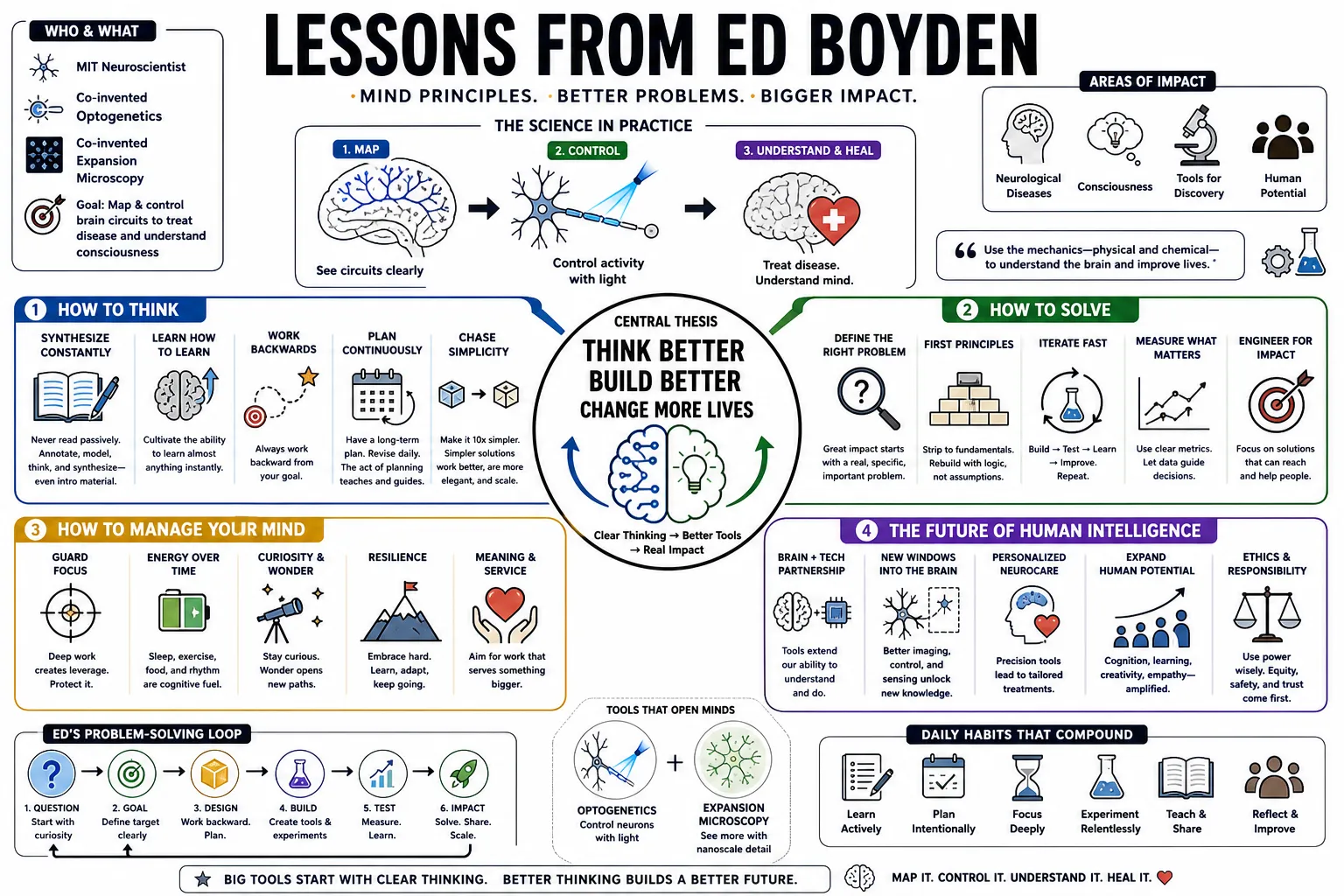
Ed Boyden is an MIT neuroscientist who co-invented optogenetics and expansion microscopy, tools that let researchers map and control brain circuits. He studies the brain's physical and chemical mechanics to treat neurological diseases and understand consciousness. This profile collects his principles on problem-solving, managing the mind, and the future of human intelligence.
Part 1: How to Think
- On synthesizing constantly: "Never read passively. Annotate, model, think, and synthesize information even when reading introductory material." — Source: [MIT Technology Review]
- On learning how to learn: "Cultivate the ability to learn almost anything instantly—a critical talent for managing brain resources in an age of complexity." — Source: [MIT Technology Review]
- On working backwards: "Always work backward from your goal. If you only work forward, you may not arrive at a meaningful destination." — Source: [MIT Technology Review]
- On continuous planning: "Always have a long-term plan. Even if you change or revise it daily, the act of planning helps you learn and provides direction." — Source: [MIT Technology Review]
- On simplicity: "If a solution looks hard to engineer, try to find a way to make it 10 times simpler. Simpler solutions usually work better, are more reliable, and have a greater impact." — Source: [MIT Technology Review]
- On efficiency: "Six months in the lab can save an afternoon in the library. Balance research with existing knowledge to avoid reinventing the wheel." — Source: [MIT Technology Review]
- On knowing your brain: "Understand your own cognitive patterns, like when you need a power nap or caffeine, to manage your energy and output effectively." — Source: [MIT Technology Review]
- On logarithmic time: "Use logarithmic time planning. Schedule events close at hand with finer resolution than those further in the future." — Source: [MIT Technology Review]
- On active reading: "To be creative, you have to understand subjects at a resolution fine enough that you can put the pieces together in a new way." — Source: [MIT Technology Review]
Part 2: Engineering the Brain
- On the brain's complexity: "I think something that people don’t appreciate is how little we know about the brain. Basically none of these [brain diseases] can be cured." — Source: [Conversations with Tyler]
- On ignorance: "I sometimes half-jokingly say we should write a book about the brain called Ignorance: What We Don’t Know about the Brain." — Source: [Conversations with Tyler]
- On the goal of his work: "My goal is to understand the brain at a level of abstraction that enables the engineering of its function." — Source: [Addgene]
- On mapping and controlling: "Most of the technologies we build are oriented around two classes of approach... can we make detailed maps of the wiring... and can you watch and control the high-speed dynamics of the brain." — Source: [Conversations with Tyler]
- On speaking the brain's language: "You can heal the brain by speaking the natural language of the brain, which is electrical pulses." — Source: [Conversations with Tyler]
- On the brain as a computer: "Let's take an iPhone—there are millions around the world, they all have the same map, but at this moment they are all doing different computations... You need more than just a map to understand a brain." — Source: [The Guardian]
- On electrical circuits: "Neurons are electrical devices and we have to think about circuits and networks. Building tools that allow us to regard the brain as a big electrical circuit appealed to me." — Source: [The Guardian]
- On missing tools: "For the last century of neuroscience, lots of people have tried to control neurons using all sorts of different technologies... we needed something precise." — Source: [AZ Quotes]
- On the missing catalog: "It's not even known how many kinds of cells there are in the brain. If you were looking for a periodic table of the brain, there is no such thing." — Source: [The Guardian]
Part 3: Solving Hard Problems
- On opposite thinking: "We often start by trying to think, 'Can we do the opposite of what other people have done?' So we started thinking, what if, instead of zooming in... let's blow it up." — Source: [Conversations with Tyler]
- On cross-disciplinary solutions: "We survey multiple disciplines—physics, chemistry, computer science—to design the optimal path to a solution." — Source: [BioTechniques]
- On the black box: "The brain has always been a black box... understanding how firing patterns relate to behavioral events is a hard problem." — Source: [Breakthrough Prize]
- On taking risks: "Tackle extremely hard problems where failing—even if it happens—is part of a larger, successful journey of discovery." — Source: [Joanne Peng]
- On eclecticism: "I hire eclectic talent because you need different perspectives to solve the universe's hardest problems." — Source: [Conversations with Tyler]
- On contingency mapping: "Map out all the dependencies of your project. If part A fails, you need a backup plan B already defined." — Source: [Alejandro Aleman]
- On building tools: "Sometimes to solve a problem, you have to stop trying to solve it directly and build a tool that makes it solvable." — Source: [Conversations with Tyler]
- On finding inspiration: "I try to learn from every interaction and take inspiration from diverse figures—such as scientists Seymour Benzer and Max Delbrück." — Source: [Bitesize Bio]
- On rapid prototyping: "Don't just theorize; build and test. The faster you prototype, the faster you find out if you're asking the right questions." — Source: [Prasenjit Manna]
Part 4: Constructive Failure
- On defining constructive failure: "A constructive failure is an experiment designed such that, even if it does not produce the desired result, it still yields valuable information." — Source: [MIT News]
- On planned failure: "If a project is probably going to fail, it should be structured to reveal exactly what steps to take next." — Source: [MIT News]
- On trustworthy failure: "A failure is only useful if it occurs despite one's best efforts and skills. Carelessness is not constructive." — Source: [Substack]
- On the secrets of the universe: "Truly constructive failures happen when a researcher encounters a fundamental difficulty or 'secret of the universe' that provides a path forward." — Source: [Substack]
- On failing up: "Embrace experiments that inform future work regardless of the immediate outcome. This is how you 'fail up' on complex problems." — Source: [MIT News]
- On intellectual courage: "You need intellectual courage to run experiments that might disprove your favorite hypothesis." — Source: [Joanne Peng]
- On intermediate steps: "Constructive failing is an intermediate step where one tests hypotheses to notice phenomena that were previously unseen." — Source: [BioTechniques]
- On creating your own luck: "Luck in science is something you can engineer by repeatedly placing yourself in situations where constructive failures lead to new insights." — Source: [Bitesize Bio]
- On avoiding incompetence: "If a failure stems from a lack of effort or basic incompetence, it is not considered constructive. It’s just a failure." — Source: [Substack]
Part 5: Managing the Mind
- On internal family systems: "I meditate every day... where you treat the parts of your mind like members of a family, and show compassion for them, and they relax and become more of your ally." — Source: [Conversations with Tyler]
- On anxiety and despair: "The parts of your mind that might be driving you anxious or causing despair—you realize what they’re trying to do for you." — Source: [Conversations with Tyler]
- On defining consciousness: "Since we don’t know what consciousness is, you don’t even know for sure if I’m conscious. There is no consciousness meter." — Source: [Conversations with Tyler]
- On testing for consciousness: "Alan Turing proposed the Turing test... but with Siri and Alexa... I think everybody would agree that’s probably not enough. You need to know something about the internal state." — Source: [Conversations with Tyler]
- On unconscious processes: "What we are consciously aware of is being generated by some unconscious processes that happen right beforehand." — Source: [Conversations with Tyler]
- On reductionism: "If you say, can we understand the brain in terms of chemical underpinnings, I would say yes. But for consciousness, the jury is still out." — Source: [Conversations with Tyler]
- On side effects of focus: "When you intervene with the brain, even with brain stimulation, you can cause unpredictable side effects. Do attention drugs sacrifice wandering and creativity?" — Source: [Conversations with Tyler]
- On brain states: "Suppose that, at a certain moment, I am conscious... presumably that brain state was caused by a previous brain state, and during that previous brain state we were not conscious." — Source: [Conversations with Tyler]
- On multiple agents: "Your brain is a bunch of independent agents that can work together. You actually do explicitly try to consider parts of your mind as having their own drives." — Source: [Conversations with Tyler]
Part 6: Optogenetics and Expansion Microscopy
- On borrowing from nature: "To speak the natural language of the brain... we borrow from the natural world, effectively, tiny solar panels that exist in bacteria and plants." — Source: [Conversations with Tyler]
- On light control: "We transplant them into brain cells, and then we can control the electrical pulses of brain cells with light." — Source: [Conversations with Tyler]
- On gene therapy: "These solar panels are actually proteins, and proteins are encoded by DNA. You can use tricks from gene therapy to deliver the gene into the brain." — Source: [Conversations with Tyler]
- On mapping circuits: "We want to make a map of the brain which literally would tell you where the wires are and how they’re connected... and which biomolecules are on those wires." — Source: [Conversations with Tyler]
- On optical limitations: "You can’t see things much smaller than the size or wavelength of light... biomolecules are a hundred times smaller than the limit of a microscope." — Source: [Conversations with Tyler]
- On expansion microscopy mechanics: "We infuse the specimens with the same kind of chemical that you find in baby diapers, a swellable polymer. Add water, and the brain will become bigger." — Source: [Conversations with Tyler]
- On preservation of structure: "The expansion process is very even, and it preserves the information of how the molecules are organized. It’s just bigger." — Source: [Conversations with Tyler]
- On understanding violence: "Using optogenetics, researchers activated a cluster of cells and mice became violent. We can start to ask questions about why the brain does what it does." — Source: [Conversations with Tyler]
- On treating Alzheimer's: "We used optogenetic tools to discover a pattern of brain activity that made mice with Alzheimer’s better, leading to human trials using movies." — Source: [Conversations with Tyler]
- On noninvasive therapies: "If you use the information obtained in mice... and then try to build noninvasive ways of controlling the brain... that could translate to humans quite rapidly." — Source: [Conversations with Tyler]
Part 7: The Ecology of the Body
- On extended intelligence: "I’m not just me... when I hang out with friends, maybe certain parts of my personality are expressed. We’re part of an ecosystem of people as well." — Source: [Conversations with Tyler]
- On the body as a system: "The brain is almost like part of an ecosystem that you could call the body, and the whole body is computing together." — Source: [Conversations with Tyler]
- On gut microbes: "There might be microbes in the gut that secrete molecules that can actually get into the brain and modulate complex functions, like social behavior." — Source: [Conversations with Tyler]
- On biological resourcefulness: "If a biological system could use some biological resource to get something done, it will." — Source: [Conversations with Tyler]
- On gene expression in synapses: "Brain cells have one nucleus with a genome inside but thousands of synaptic connections. It makes sense to turn genes on or off at the synapse level." — Source: [Conversations with Tyler]
- On RNA and memory: "Using expansion microscopy, we map out which expressed genes are located at which synapses... to understand if biomolecular types are involved with plasticity." — Source: [Conversations with Tyler]
- On viral mechanisms in the brain: "When a brain cell is active, it manufactures virus-like particles that can bring genetic material from one brain cell to another." — Source: [Conversations with Tyler]
- On memory formation: "When you’re forming a memory, is your brain manufacturing HIV-like things, and you’re exchanging genetic material? It shows how little we know." — Source: [Conversations with Tyler]
- On emulating the brain: "If you want to integrate all the changes that are due to the rest of the body to encompass long-term emotions... you might have to think about the body as an ecosystem." — Source: [Conversations with Tyler]
- On whole-brain emulation constraints: "We’re going to need to be able to simulate as much of the biology as possible, and then there might be a point where things become unpredictable." — Source: [Conversations with Tyler]
Part 8: The Future of Intelligence and Empathy
- On human suffering: "The thing that got me interested in confronting philosophical questions through science as a kid was about human suffering." — Source: [Conversations with Tyler]
- On the barrier of language: "Right now, it’s very hard to know what somebody’s feeling in their mind. We use language to try to convey that, but it doesn’t quite seal the deal." — Source: [Conversations with Tyler]
- On direct empathy: "What if I could read out what happens in my mind, and somebody else could experience that literal state, and vice versa?" — Source: [Conversations with Tyler]
- On the roots of conflict: "That’s one of the reasons, some people think, why there’s so much conflict: that you can’t understand the internal state of somebody else at a true level." — Source: [Conversations with Tyler]
- On in-silico simulations: "If we could make a map of the brain so detailed that we could simulate decisions or emotions in software, I would be very excited." — Source: [Conversations with Tyler]
- On detecting conscious decisions: "Researchers can actually detect changes in the brain up to 10 seconds before people feel like they’re making the decision to move their hand." — Source: [Conversations with Tyler]
- On accessing empathy: "Maybe when we are trying to experience empathy, there are other processes in the brain that occurred beforehand. If we could access those processes, we could have a greater kind of empathy." — Source: [Conversations with Tyler]
- On scientific limits: "Science can fail. There are certain things that science can’t yet answer, like what happened before the Big Bang. But we have to give it our best shot." — Source: [Conversations with Tyler]
- On hallucinogens and psychiatry: "Ketamine will help within tens of minutes to hours. That’s an example where a hallucinogenic drug can actually have a rapid-acting effect on a psychiatric illness." — Source: [Conversations with Tyler]
- On mind reading tech: "Groups for many years have been using functional MRI to read out what people are seeing. You can show somebody a movie, scan their brain, and guess what they are seeing." — Source: [Conversations with Tyler]