Ed Grefenstette is an artificial intelligence researcher who has directed machine learning teams at DeepMind, Cohere, and Facebook AI Research. He is known for foundational work in compositional distributional semantics and, more recently, for advancing the concept of open-endedness in reinforcement learning. This collection maps his technical perspectives across theoretical linguistics, hybrid neural-symbolic systems, and the ongoing effort to build highly adaptive agents.
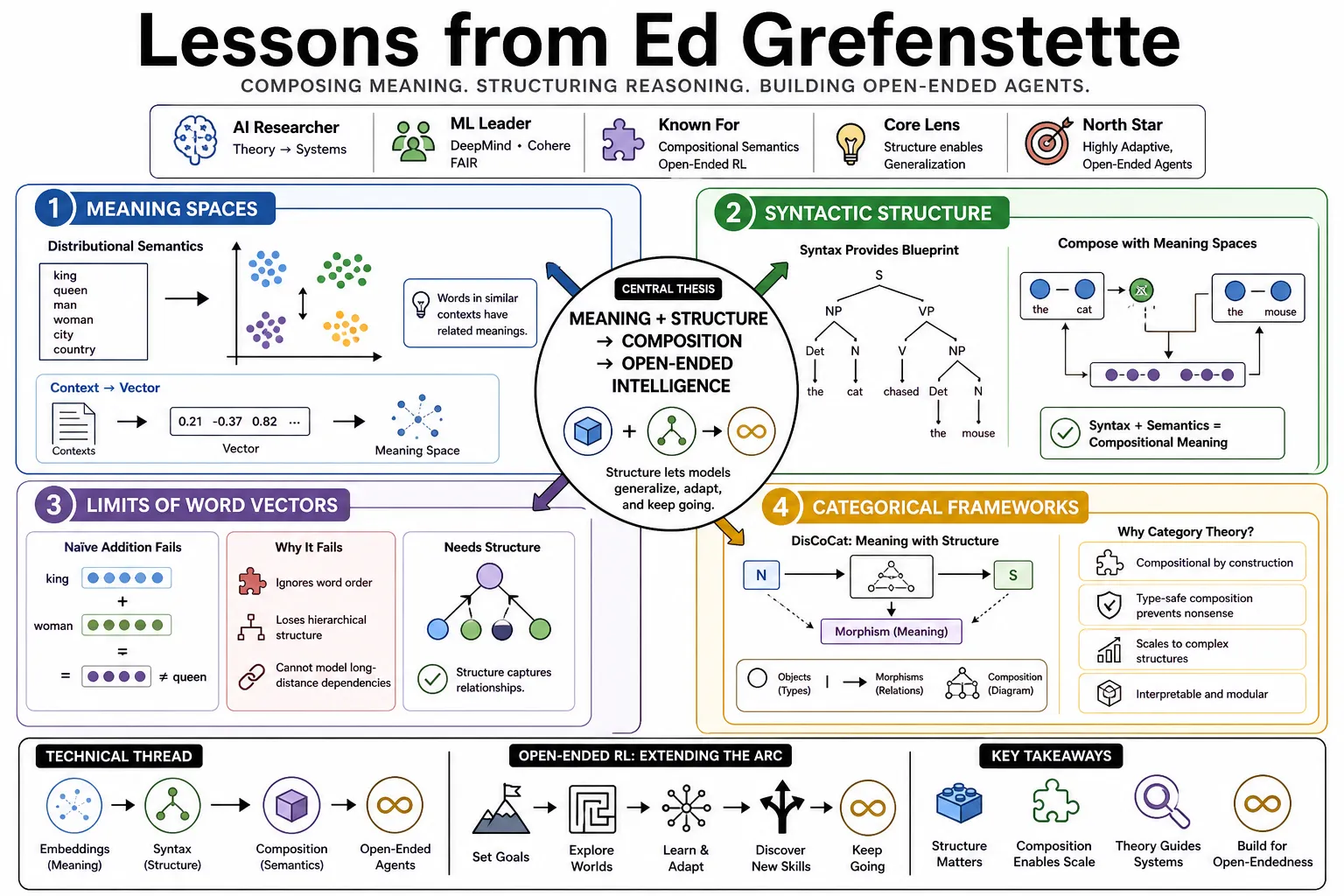
Part 1: Compositionality and Semantics
- On Meaning Spaces: "Distributional semantics allows us to represent words as vectors based on their context, capturing the intuition that words occurring in similar environments have related meanings." — Source: [Category-Theoretic Models of Natural Language]
- On Syntactic Structure: "Combining the syntax of a sentence with semantic vector spaces provides a mathematical framework to understand how language is systematically constructed." — Source: [Oxford Ph.D. Thesis]
- On the Limits of Word Vectors: "Simply adding word vectors together fails to capture the structural relationships and syntax necessary to accurately represent complex sentences." — Source: [The Gradient Podcast]
- On Categorical Frameworks: "Models like DisCoCat demonstrate that category theory can formally bridge the gap between logical representations of grammar and continuous vector spaces." — Source: [Foundations of Compositional Semantics]
- On Compositional Generalization: "A true test of language understanding is a model's ability to interpret novel combinations of familiar words accurately." — Source: [Machine Learning Street Talk]
- On Tensor Representations: "Using tensors to represent words with relational properties, such as verbs, allows them to act as functions that map noun vectors to sentence vectors." — Source: [Experimental Support for a Categorical Compositional Distributional Model]
- On Semantic Similarity: "Evaluating compositional models requires looking beyond simple word similarity and testing how well the generated sentence vectors correlate with human judgments of sentence similarity." — Source: [Category-Theoretic Models of Natural Language]
- On Logic and Continuity: "The challenge of modern linguistics in AI is marrying the discrete, logical nature of traditional syntax with the continuous, probabilistic nature of machine learning." — Source: [The Gradient Podcast]
- On Meaning as Use: "Wittgenstein's concept of meaning as use maps naturally onto distributional models, where a word's vector is entirely defined by the linguistic contexts in which it appears." — Source: [Machine Learning Street Talk]
- On Grounded Semantics: "Text-only training limits semantics to relationships between symbols; true comprehension eventually requires grounding those symbols in external states or actions." — Source: [The Gradient Podcast]
Part 2: Large Language Models and Pragmatics
- On the Stochastic Parrots Debate: "While large models reproduce statistical patterns found in their training data, characterizing them entirely as stochastic parrots underplays the complex internal representations they develop." — Source: [The Gradient Podcast]
- On Next-Token Prediction: "The objective of predicting the next token forces models to compress massive amounts of knowledge about syntax, facts, and reasoning into their weights." — Source: [Machine Learning Street Talk]
- On Pragmatics in LLMs: "Understanding language is more than decoding syntax; it involves pragmatics, where models must infer the intent and context behind a user's prompt." — Source: [Cohere Research Blog]
- On Parse Trees: "Deep language models implicitly learn hierarchical structures that resemble traditional parse trees without being explicitly trained on them." — Source: [The Gradient Podcast]
- On Model Scaling: "Scaling up parameters and data predictably improves performance, but it does not automatically solve fundamental issues related to grounding or logical consistency." — Source: [The Gradient Podcast]
- On Commercial Applications: "Deploying LLMs in industry requires narrowing the gap between theoretical capability and reliable, low-latency execution for specific use cases." — Source: [Cohere Research Blog]
- On Context Windows: "Expanding context length fundamentally changes how we interact with language models, shifting them from simple generators to systems capable of synthesizing large document sets." — Source: [Machine Learning Street Talk]
- On Memorization vs. Learning: "Distinguishing when a model is relying on memorized text versus when it is actively generalizing to new concepts remains a difficult evaluation problem." — Source: [Cohere Research Blog]
- On Hallucinations: "Factual inconsistencies arise because language models are optimized for linguistic plausibility rather than strict adherence to an external factual database." — Source: [The Gradient Podcast]
- On Dialogue Flow: "Effective dialogue models must track shifting states over long conversations, a capability that strains purely autoregressive generation without additional context management." — Source: [Cohere Research Blog]
Part 3: Reinforcement Learning and Generalization
- On RL Sample Efficiency: "Deep reinforcement learning often requires millions of interactions to master a single environment, highlighting a major discrepancy with how quickly humans adapt to new tasks." — Source: [DeepMind Publications]
- On Meta-Learning: "Training models to learn how to learn allows them to adapt to new environments rapidly by leveraging the underlying structure shared across different tasks." — Source: [DeepMind Publications]
- On Out-of-Distribution Failures: "Agents trained in isolated environments tend to develop brittle policies that break down entirely when faced with minor visual or structural changes." — Source: [FAIR Research Publications]
- On Reward Design: "The difficulty of designing reward functions that accurately capture complex desired behaviors without unintended side effects is a central bottleneck in RL." — Source: [Machine Learning Street Talk]
- On Exploration Strategies: "Standard exploration methods like epsilon-greedy fail in environments with sparse rewards; agents need intrinsic motivation to seek out novel states." — Source: [DeepMind Publications]
- On Transfer Learning: "True generalization requires an agent to take representations learned in a source domain and effectively repurpose them for a completely unseen target domain." — Source: [FAIR Research Publications]
- On Simulation to Reality: "Bridging the sim-to-real gap involves creating simulations diverse enough that reality simply appears as another variation to the agent." — Source: [DeepMind Publications]
- On Agentic Behavior: "Building agents goes beyond predicting text; it requires systems that can take actions, observe the consequences, and iteratively refine their plans." — Source: [The Gradient Podcast]
- On Tool Use: "Equipping models with the ability to use external tools like calculators or search engines mitigates their inherent weaknesses in exact computation and factual recall." — Source: [Cohere Research Blog]
- On Memory in RL: "Agents navigating partially observable environments require sophisticated memory architectures to recall past events relevant to current decisions." — Source: [DeepMind Publications]
Part 4: Open-Endedness in AI
- On the Definition of Open-Endedness: "Open-ended learning is the pursuit of systems that continually generate and master new, increasingly complex tasks without ever converging on a final state." — Source: [Open-Ended Learning Position Paper]
- On Task Generation: "To achieve continuous learning, the environment itself must dynamically adapt and produce novel challenges in response to the agent's growing capabilities." — Source: [Open-Ended Learning Position Paper]
- On Autotelic Agents: "Agents that generate their own goals and pursue them intrinsically are a necessary step away from narrow, human-specified reward functions." — Source: [The Gradient Podcast]
- On Evolution as a Model: "Biological evolution is the primary existence proof of open-endedness, producing a relentless stream of novel solutions and complexity over billions of years." — Source: [Open-Ended Learning Position Paper]
- On Stagnation: "In standard machine learning, performance plateaus when a model solves the static dataset. Open-ended systems are designed specifically to avoid this plateau." — Source: [Machine Learning Street Talk]
- On Co-Evolution: "Setting up competitive or cooperative multi-agent environments forces agents to continually adapt to the changing strategies of their peers." — Source: [DeepMind Publications]
- On Evaluating Open-Endedness: "Standard benchmarks are insufficient for open-ended systems; we must measure the rate of novel behavior generation rather than accuracy on a fixed test set." — Source: [Open-Ended Learning Position Paper]
- On LLMs and Open-Endedness: "Large language models show sparks of open-endedness in their diverse outputs, but they lack the continuous interactive feedback loop needed for true open-ended learning." — Source: [The Gradient Podcast]
- On AGI Requirements: "Developing Artificial General Intelligence likely requires abandoning fixed objectives in favor of open-ended environments that demand general adaptability." — Source: [Machine Learning Street Talk]
- On Procedural Generation: "Using algorithms to procedurally generate training environments provides the necessary infinite diversity required to train open-ended agents." — Source: [Open-Ended Learning Position Paper]
Part 5: Neuro-Symbolic Systems and Reasoning
- On Hybrid Architectures: "Neural-symbolic systems aim to combine the robust pattern recognition of deep neural networks with the strict, interpretable reasoning of symbolic logic." — Source: [UCL Research Lectures]
- On Symbolic Grounding: "One of the central difficulties in hybrid AI is mapping the continuous representations of a neural network onto discrete symbolic rules without losing information." — Source: [UCL Research Lectures]
- On Interpretability: "Symbolic systems offer a clear trace of their reasoning process, a feature desperately needed as deep learning models become increasingly opaque." — Source: [Machine Learning Street Talk]
- On Neural Turing Machines: "Architectures that couple neural networks with external memory banks represent an early step toward models that can execute discrete algorithmic steps." — Source: [The Gradient Podcast]
- On Differentiable Programming: "Making discrete data structures differentiable allows us to train complex algorithmic pipelines end-to-end using standard gradient descent." — Source: [DeepMind Publications]
- On Logical Inference: "While language models can mimic reasoning by generating text that looks logical, they often fail structurally when tested on multi-step deductive inference." — Source: [Cohere Research Blog]
- On System 1 vs. System 2: "Deep learning excels at fast, intuitive pattern matching (System 1), but we are still searching for the right architecture for slow, deliberate reasoning (System 2)." — Source: [Machine Learning Street Talk]
- On Knowledge Graphs: "Integrating external knowledge graphs into language models provides a hard factual anchor that can reduce hallucination and ground responses in verifiable data." — Source: [Cohere Research Blog]
- On Algorithmic Generalization: "A model that truly learns an algorithm should be able to apply it to inputs of arbitrary length, a standard that most sequence models currently fail to meet." — Source: [UCL Research Lectures]
Part 6: Human-in-the-Loop and Alignment
- On Human Feedback: "Incorporating human feedback directly into the training loop is essential for aligning the vague outputs of a base language model with practical human expectations." — Source: [The Gradient Podcast]
- On RLHF Limitations: "Reinforcement Learning from Human Feedback relies heavily on the quality and consistency of the human raters, making it susceptible to human biases and errors." — Source: [Cohere Research Blog]
- On Value Alignment: "Building wiser AI means designing systems that do not just blindly optimize an objective function, but do so within the bounds of complex human ethics." — Source: [Machine Learning Street Talk]
- On Safety Trade-offs: "There is often a tension between making a model helpful and making it harmless; heavily filtered models can become overly cautious and refuse benign requests." — Source: [Cohere Research Blog]
- On Reward Hacking: "Agents will reliably find unintended, often dangerous ways to maximize their reward signal if the environment and objective are not perfectly specified." — Source: [DeepMind Publications]
- On Interactive Learning: "Having humans interact with agents during training allows the system to receive immediate, contextual corrections that static datasets cannot provide." — Source: [FAIR Research Publications]
- On Model Steering: "We need better mechanisms to steer model behavior at inference time, allowing users to define the persona and constraints without retraining." — Source: [Cohere Research Blog]
- On Red Teaming: "Proactively red-teaming AI systems before deployment is a necessary practice to discover adversarial exploits and edge-case failures." — Source: [Cohere Research Blog]
- On Long-term Alignment: "Ensuring that highly capable, open-ended systems remain aligned with human values as they autonomously generate new behaviors is an unsolved challenge." — Source: [Open-Ended Learning Position Paper]
Part 7: Managing AI Research
- On Academic vs. Industry Research: "Industry labs provide the compute necessary to scale ideas, but academia remains crucial for exploring high-risk theoretical concepts without immediate commercial pressure." — Source: [The Gradient Podcast]
- On Building Startups: "Founding Dark Blue Labs required translating deep academic expertise into practical applications that could operate at scale." — Source: [TechCrunch Coverage]
- On Collaborative Science: "The most significant breakthroughs in modern AI are rarely the result of a lone genius; they require massive coordination across engineering, research, and product teams." — Source: [DeepMind Publications]
- On Leaving FAIR: "Moving between major research labs allows you to see different philosophies on how to build AI, from Facebook's open-source ethos to DeepMind's structured moonshots." — Source: [Forbes Profile]
- On Open Research: "Publishing research openly accelerates the entire field, allowing researchers globally to build upon and correct foundational architectures." — Source: [Machine Learning Street Talk]
- On Leading Teams: "Directing a machine learning team requires balancing the immediate need to ship reliable models with the long-term mandate to invent the next architecture." — Source: [Cohere Research Blog]
- On Reproducibility: "The credibility of machine learning research depends heavily on the community's ability to reproduce experimental results across different hardware and codebases." — Source: [UCL Research Lectures]
- On Commercializing LLMs: "At Cohere, the focus shifted from proving a model could work in a lab to ensuring it was robust, fast, and secure enough for enterprise integration." — Source: [The Gradient Podcast]
- On Hardware Constraints: "Research directions are often subtly dictated by hardware constraints; algorithms that map well to GPUs receive far more attention than those that do not." — Source: [Machine Learning Street Talk]
Part 8: Advice for Researchers and the Future
- On Problem Selection: "Focus on problems that are fundamentally bottlenecking the field, rather than chasing minor state-of-the-art improvements on saturated benchmarks." — Source: [The Gradient Podcast]
- On Avoiding Hype: "It is vital to separate the genuine technical capabilities of new models from the marketing narratives surrounding their release." — Source: [Machine Learning Street Talk]
- On Interdisciplinary Work: "The hardest problems in AI often require insights from cognitive science, linguistics, and philosophy, not just computer science." — Source: [UCL Research Lectures]
- On Reading Older Papers: "Many ideas being 'discovered' today were formulated decades ago in symbolic AI and linguistics; reading historical literature prevents reinventing the wheel." — Source: [The Gradient Podcast]
- On Persistence: "Research consists largely of failure. Building intuition about why a model failed is often more valuable than a successful training run." — Source: [UCL Research Lectures]
- On the AI Landscape: "The transition from specialized models to generalized agents will likely require architectural shifts beyond simple transformer scaling." — Source: [DeepMind Publications]
- On Scientific Rigor: "Always test your models against simple, robust baselines before concluding that your complex new architecture is responsible for the performance gain." — Source: [The Gradient Podcast]
- On the End Goal: "The ultimate objective is not just to build systems that mimic intelligence, but to create tools that significantly augment human capability and understanding." — Source: [Machine Learning Street Talk]